
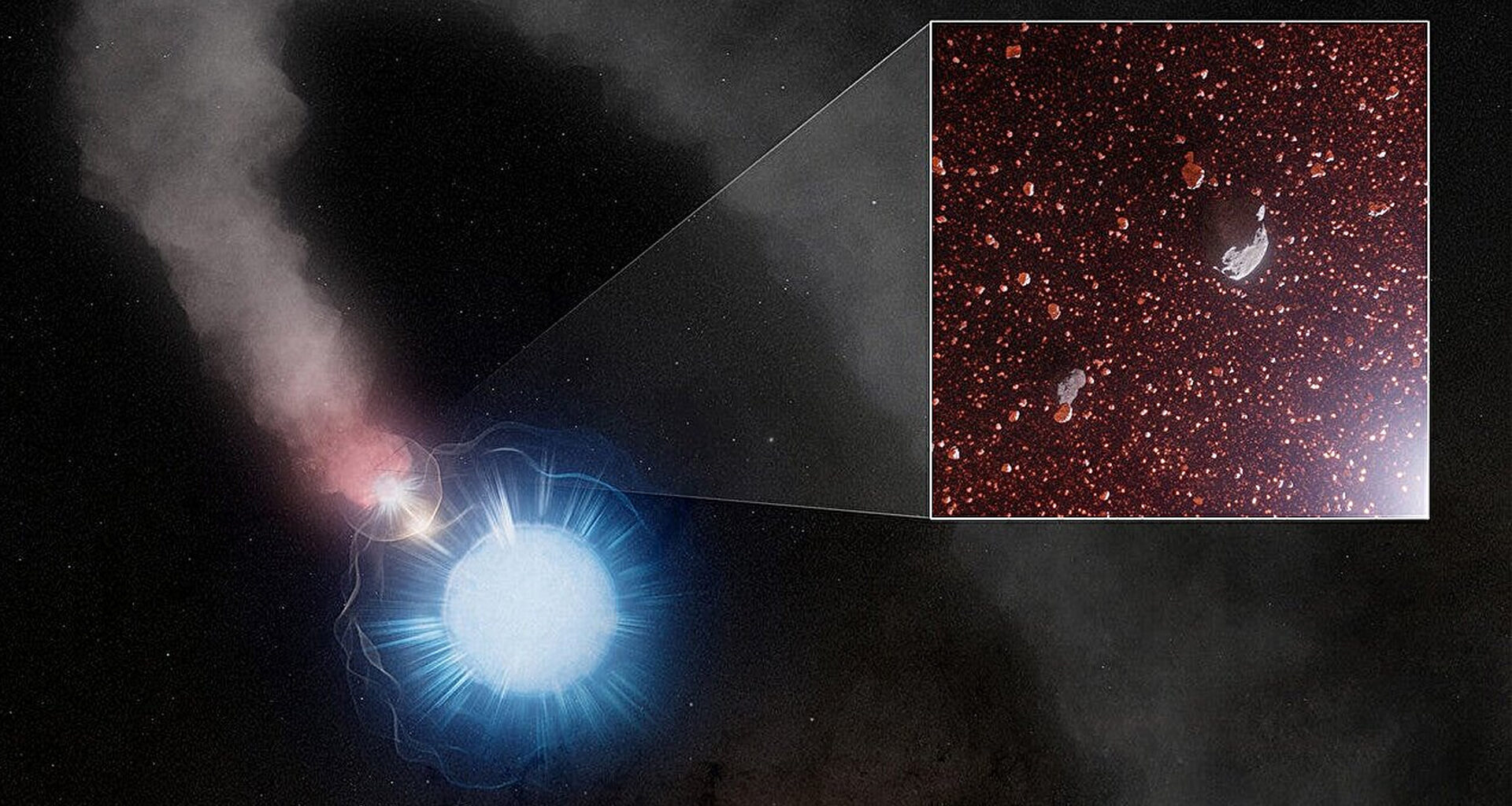
Some stars don’t just shine; they also manufacture the raw ingredients of future worlds. In a surprising new study, researchers report that one of the universe’s most massive and short-lived stars is producing dust grains so tiny they are measured in mere billionths of a meter.
“It’s amazing to know that some of the most massive stars in the universe produce some of the tiniest dust particles before they die. The difference in size between the star and the dust it produces is about a quintillion to one,” Donglin Wu, lead study author and a researcher at the California Institute of Technology, said.
This discovery solves a long-standing mystery about conflicting dust measurements around extreme stars and improves our understanding of how galaxies are seeded with carbon, the element that forms the backbone of life.
A conflicting stellar situation
The research centers on WR 112, an unusual binary system that includes a Wolf–Rayet star — a rare, intensely hot star nearing the end of its life. Wolf–Rayet stars are known for their powerful stellar winds and brief lifespans. They burn through their fuel quickly and shed large amounts of material into space.
In WR 112, the Wolf–Rayet star circles a companion star. Both stars launch high-speed streams of gas. Where these winds collide, the gas becomes compressed and dense. As it cools, atoms bond together, and solid particles begin to form. This is how cosmic dust is born in such violent environments.
Radiation pressure from the stars then pushes the newly formed dust outward. Over time, this process creates striking spiral arcs that expand away from the binary system just like a cosmic pinwheel sculpted by stellar winds.
However, for decades, astronomers faced a complex problem. Some observations of similar systems suggested that the dust grains were extremely small. Others indicated much larger grains, around one-tenth of a micrometer.
These conflicting results could not easily be explained. Were the instruments missing something? Or were certain grain sizes being destroyed in these harsh conditions?
Seeing the invisible with two powerful observatories
To address this mystery, the team combined data from two of the world’s most advanced observatories: the James Webb Space Telescope (JWST) and the Atacama Large Millimeter/submillimeter Array (ALMA).
“By combining ALMA observations with James Webb Space Telescope images, we were able to analyze the spatially resolved spectral energy distribution (SED) of WR 112,” the study authors note.
Each telescope observes the universe in a different way. The James Webb Space Telescope (JWST) detects infrared light and is especially sensitive to warm dust. Its mid-infrared images had already revealed bright spiral dust structures around WR 112.
ALMA, located in Chile, observes at millimeter wavelengths. It is extremely powerful at detecting cooler and typically larger dust grains. If substantial amounts of bigger grains were present in WR 112’s spirals, ALMA should have detected them clearly.
However, it did not. The absence of a strong millimeter signal was the critical clue. If ALMA could not see the extended spirals that JWST detected, then most of the grains must be too small to emit efficiently at millimeter wavelengths.
By modeling the combined data, the researchers determined that most grains in the spirals are smaller than one micrometer — and that the majority are only a few nanometers across. A nanometer is one-billionth of a meter.
The size difference between the massive star and the dust it produces is on the order of a quintillion to one. Interestingly, the analysis revealed two distinct grain populations. The dominant group consists of nanometer-sized particles, while a smaller fraction measures about 0.1 micrometer across.
The team tested several possible grain-size models to see which best matched the data. “Among four parameterizations of the grain radius distribution that we tested, a bimodal distribution, with abundant nanometer-sized grains and a secondary population of 0.1-micron grains, best reproduces the observed SED,” the study authors added.
This dual-size structure helps reconcile decades of contradictory observations: both tiny and larger grains are present, but the tiniest ones dominate.
The team also investigated how dust behaves under such extreme radiation. The intense light and energetic environment can erode or evaporate grains. Their findings suggest that intermediate-sized grains may be particularly vulnerable, which could explain why earlier observations often failed to detect them consistently.
Cosmic consequences and next steps
WR 112 is one of the most prolific dust producers of its kind, generating an amount of dust each year roughly equal to three times the mass of Earth’s Moon.
Since this dust is rich in carbon, understanding its size distribution directly affects estimates of how much carbon massive binary systems contribute to the galaxy.
Carbon dust does not remain near its parent stars forever. Over time, it drifts into interstellar space, mixing with gas clouds that may eventually collapse to form new stars and planets. If tiny grains dominate, they may behave differently from larger ones — influencing how dust grows, survives, or participates in planet formation.
There are still many open questions. For instance, scientists need to determine how long these nanometer-sized grains can survive once they leave the intense radiation field. Do they merge into larger particles? Are they destroyed by shocks in interstellar space? And is WR 112 typical, or an outlier among Wolf–Rayet binaries?
Future observations of similar systems using both JWST and ALMA will help answer these questions. By studying more stellar dust factories, astronomers aim to refine models of how galaxies accumulate carbon over time.
“There are so many things that are still unknown—things that are difficult to observe, things that are rare,” Wu added.
The study is published in The Astrophysical Journal.