
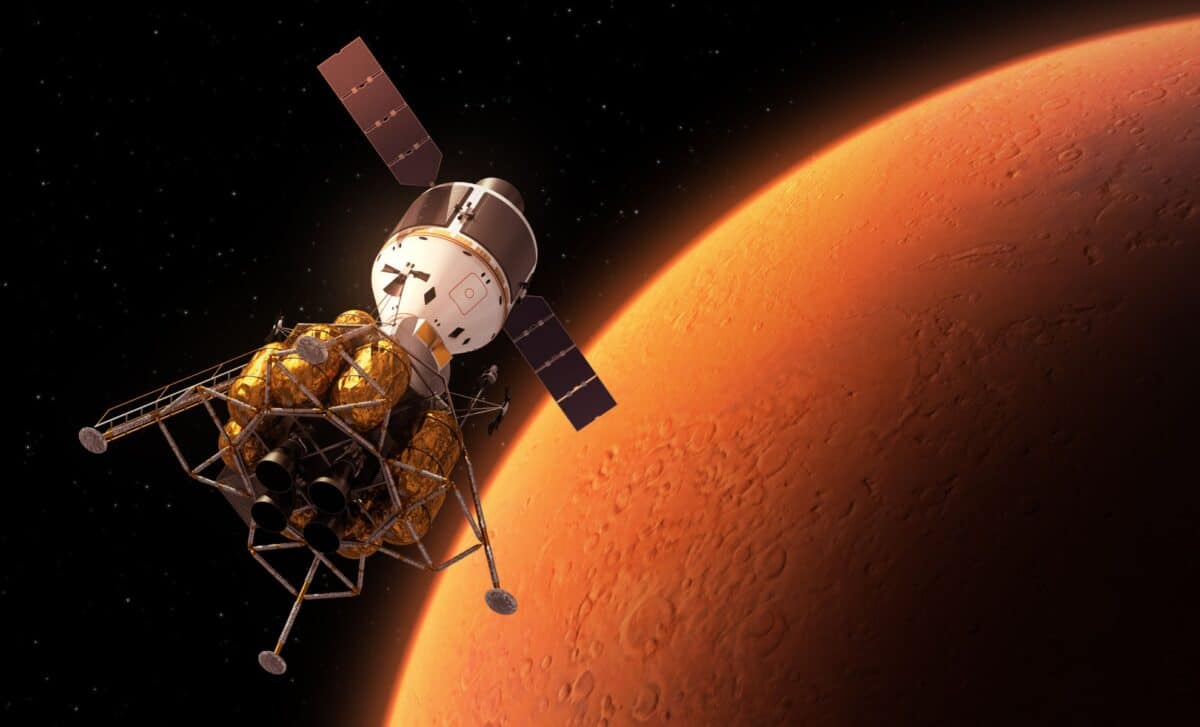
NASA has outlined a new Mars orbiter centered on telecommunications, raising fresh questions about whether science will take a back seat on what could become the agency’s only major Mars mission of the decade.
The spacecraft, now known as the Mars telecommunications network, is moving through an accelerated procurement process shaped by congressional direction and tight launch windows. A recently disclosed objectives document suggests that while scientific instruments are allowed, they are far from the mission’s driving force.
A Mission Driven by Policy and Deadlines
The project originates from the 2025 “One Big Beautiful Bill,” backed by Senator Ted Cruz, which set aside $700 million for a Mars orbiter and required NASA to award funding before the end of fiscal year 2026. That mandate has compressed the schedule and intensified competition.
Previously called the Mars telecommunications orbiter, the spacecraft has been reframed as a broader communications network designed to support operations at Mars through 2035. The top-level objectives focus on relaying communications between assets in Mars orbit, on the surface, and back to Earth. The mission is also tasked with providing Doppler, range, and time transfer services to enable positioning and navigation, supporting existing missions, and assisting entry, descent, and landing demonstration efforts planned for the coming decade.
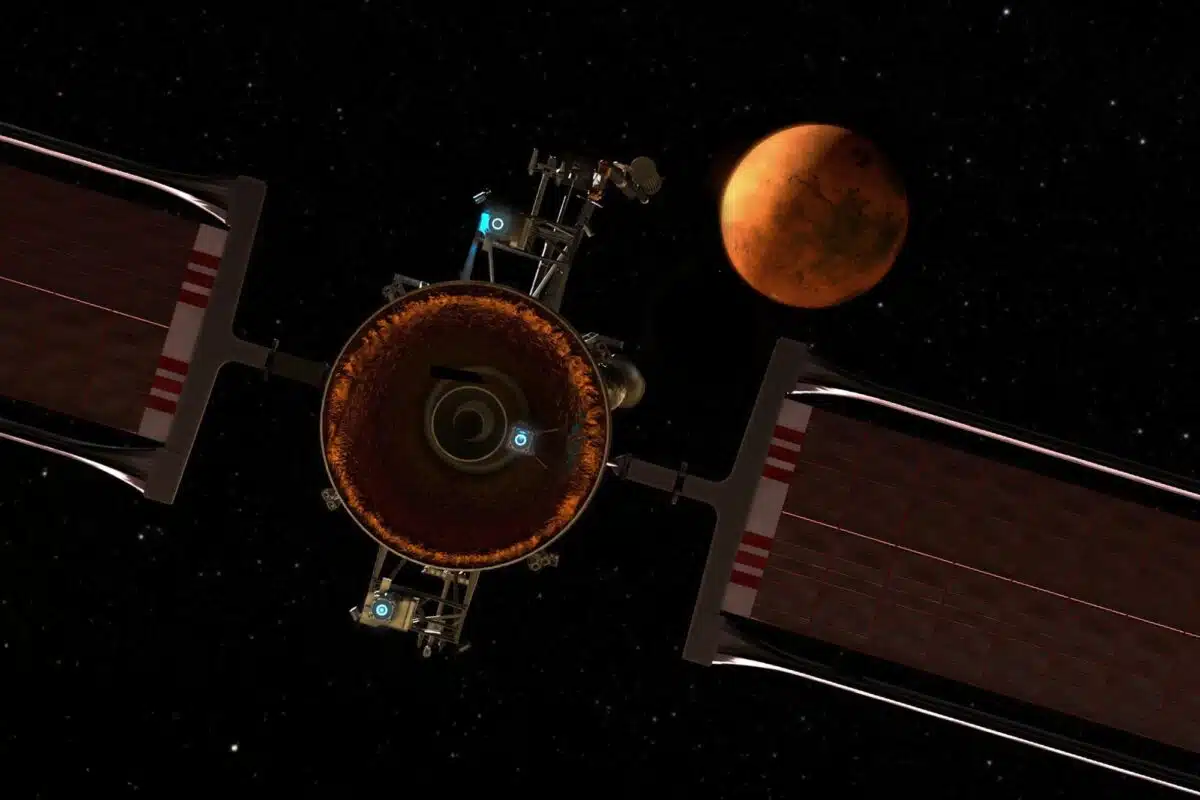 Concept image of NASA’s Mars Telecommunications Network orbiting the Red Planet. Credit: Blue Origin
Science Permitted, but Secondary
The final ground rule in the 24-page requirements document stated that an SMD payload is not precluded, and schedule risk is critically important. The reference to NASA’s science mission directorate signals that scientific instruments may be proposed. The wording also makes clear that they are optional and must not threaten the launch timeline.
With a target launch no earlier than late 2028, this spacecraft could represent NASA’s only opportunity to send a large mission to the Red planet during the current administration.
Agency sources cited by Ars Technica indicated that several instruments could be incorporated for roughly $200 million. Concepts under discussion include a high-resolution imaging system, a space weather package, a magnetometer to probe Mars’ remnant magnetic field, and a spectrometer capable of detecting near-surface water ice. The structure of the solicitation suggests that such additions may not improve a bidder’s standing. If they introduce cost growth or schedule pressure, they could weaken a proposal instead of strengthening it.
A High-Stakes Competition
The race to build the Mars telecommunications network is shaping up as a contest among some of NASA’s most prominent partners. Rocket Lab and Blue Origin have publicly promoted their technical approaches. SpaceX is expected to position its Starship system as part of a Mars solution. Long-established contractors such as Lockheed Martin bring decades of experience designing and operating Mars spacecraft.
Missing the 2028 launch opportunity would likely push the mission back by more than two years due to planetary alignment. Any formal protest after contract award could delay progress long enough to jeopardize that date.