
Engineers are increasingly combining generative design algorithms with 4D printing to create mechanical metamaterials whose behavior is defined by geometry rather than chemistry. Instead of selecting a material and testing its limits, designers can now specify a target mechanical response and generate a microarchitecture to achieve it.
One of the clearest demonstrations of this inverse design approach comes from Dr. Xiaoyu “Rayne” Zheng at the University of California, Berkeley. His team developed a machine-learning system that allows a user to define a target stress–strain curve. The algorithm then generates a printable lattice architecture engineered to reproduce that response.
“Our machine learning-based design method enables the rapid creation of material with prescribed user-defined performance and target properties,” Zheng explains.
In practice, an engineer can specify a stiffness profile, deformation pathway, or energy absorption curve. A deep-learning model maps that performance target to a manufacturable microstructure. Once fabricated using advanced additive manufacturing, the resulting metamaterial approximates the prescribed behavior with reported accuracies approaching 90 percent under experimental validation.
This AI-enabled design approach is impressively accurate: in Zheng’s experiments, the learned metamaterial structures reproduced target mechanical behaviors with “nearly 90% accuracy”. Notably, this system has the capability to produce novel behaviors that were not possible before, such as stress-strain curves with exotic properties and customized energy absorption rates.
In other words, a designer could, for example, define a helmet liner that follows a certain curvature to reduce a certain impact profile, and leave the rest of the design process to the software and the printing system. As Zheng notes, this inversion of the design process – from desired curve to microarchitecture – is a paradigm shift: “we are no longer limited to materials found in nature”.
Where 4D printing fits in
The integration of these AI-optimized designs with the 4D printing process brings these ideas to life. The concept of 4D printing was first introduced in 2013 and uses “smart” materials that are programmed to react to external stimuli in a temporal manner. For example, a 4D-printed part might be fixed in a temporary shape at manufacture and then morph back to its original form when heated.
Common 4D-printable smart materials include shape-memory polymers (SMPs), stimuli-responsive hydrogels, and liquid crystal elastomers. Each responds to specific triggers (heat, moisture, light, magnetic or electric fields) to drive motion or stiffness change.
The 4D-printed metamaterials have the ability to self-assemble, shape-shift, and adapt. As shown in a recent review, the 4D printing process has opened up new avenues in the fields of biomedicine, aerospace, soft robotics, smart textiles, and more.
For example, a 4D-printed metamaterial could use an antenna or solar panel in space and then solidify into a high-performance structure once it reaches orbit. In another example, a 4D-printed stent and implant can be compact and then expand once it is exposed to body temperature.
The field is growing rapidly, and the 4D printing market is predicted to reach $1.3 billion by 2030; however, it is limited by the availability of strong smart materials. (The identification of SMPs or hydrogels that satisfy certain criteria is an area of active research.)
Applications: space antennas to soft robots
Engineers are already exploring various high-impact applications of AI-designed 4D metamaterials. In the aerospace industry, light-weight and deployable structures are a natural application area. For example, 4D-printed metamaterial lattices can be used as self-folding solar panels or antennas that deploy in space.
Press coverage of printed electromagnetic metamaterials notes that additively-made antenna structures have shown “increased gain, expanded bandwidth, and improved miniaturization” compared to conventional designs. By programming a printed lattice to stiffen after deployment, spacecraft could carry large structures that lock rigid without extra actuators.
In soft robotics, the ability to dynamically control stiffness is extremely desirable. Scientists have shown the potential of 4D-printed grippers and actuators that harness the power of metamaterial designs to achieve a balance between flexibility and robustness.
For example, a research team led by Prof. Jinsong Leng of the Harbin Institute of Technology 3D-printed a multimaterial polymer lattice inspired by nature (“a metamaterial … like a Swiss Army knife” of functionality). This “bionic” structure contains regions of different SMP blends, so that under heat or light it can twist, bend, stiffen, or soften as needed.
Leng envisions such lattices as flexible robotic skins that “adapt their stiffness on the fly to meet different task requirements”, for example, tightening for lifting and softening for safe grasping. In experiments, his 4D lattice prototype could remember several shapes and switch between them, effectively allowing one part to perform multiple roles.
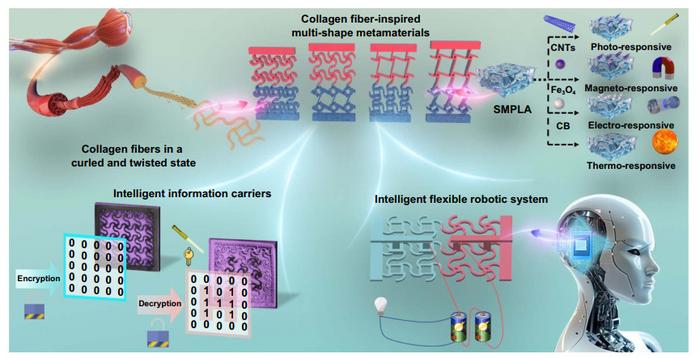 By using multi-material 4D printing technology and integrating shape memory polymer composites with different stimulus-responsive characteristics, bionic gradient metamaterials exhibiting high programmability, designability, and multi-functionality were designed and fabricated. Credit: Chunli Yang§, Xiaozhou Xin§, Wenjun Zhao, Cheng Lin*, Liwu Liu, Yanju Liu* and Jinsong Leng
4D metamaterials are also projected to facilitate adaptive vibration mitigation and impact damping. For example, researchers have combined 4D-printed SMP lattices with braided designs for aircraft landing gear.
In one such study, a PLA shape-memory braid was developed and designed to recover its original shape after a reheating process following an impact. Impact experiments showed a specific energy absorption capacity of 3.3 J/g, and the lattice structure took a few seconds to fully recover at 80 °C.
This study is reported to represent a new paradigm for impact-resistant aviation parts, promoting the development of reusable energy-absorbing structures for eVTOL aircraft. Moving ahead, similar printed metamaterials could be used as adaptive vibration dampers for machinery or bridges, hardening to mitigate impacts and softening to allow for motion as needed.
Other potential applications include medical implants (4D-printed drug-delivery scaffolds that change shape over time) and smart textiles (self-adjusting protective gear). Across fields, these advances have been made possible by the combination of generative design and smart-material printing: an engineer can now specify the exact mechanical response needed, and an AI-driven pipeline will spit out a printable lattice to achieve it. Truly, the advent of printed electromagnetic metamaterials “opens up new possibilities for fields where adaptability is crucial, such as aerospace and biomedical engineering”.
Case studies
A striking illustration is the meta-laminar jamming (MLJ) actuator from MIT/Nottingham-Trent University researchers. A two-dimensional lattice of thermoplastic shape memory polymer was designed with a unique printed geometry, featuring auxetic cells in a vacuum bag.
When heated, the SMP becomes soft, and the vacuum is released, creating a soft actuator that can adapt to irregular objects. As the actuator cools under vacuum, jamming occurs in the lattice structure, making the actuator stiff without power input.
Moreover, the actuator had zero-input power gripping, as it held a stiff grip on objects once they were grasped without the need for power. Additionally, the MLJ actuator was fully reversible, as it reverted to its original state when reheated. Bench tests revealed that the stiffened gripper could support a weight of up to 200 g. Thus, this four-dimensional printed metamaterial actuator can switch between soft and stiff modes as needed, making it a morphing robotic finger.
In an alternative application, a research team headed by Professor Xizhe Zhu (University of Michigan/Harbin) utilized 4D printing in the creation of braided metamaterials for impact protection. The authors developed an interwoven structure comprising hexagonal and diamond lattice patterns through the use of shape-memory polylactic acid (PLA), resulting in the creation of a multi-scale material composite.
Upon the application of impact compression, the braided structure successfully dissipated the impact energy through the gradual deformation of the material layers comprising the structure. The energy absorption per unit weight was found to be 3.3 J/g, similar to shock absorbers.
Additionally, the material structure was able to return to its initial state after the application of impact, as the structure was subjected to hot air at 80°C, resulting in the complete recovery of the structure in seconds. Therefore, the study successfully demonstrates the creation of a reusable landing gear buffer material.
As the authors note, this approach “establishes a new paradigm for the design of impact-resistant aviation components,” especially in eVTOL aircraft, where weight and reusability are critical. The study highlights the potential of 4D printing for creating adaptive vibration dampers in the form of impact-resistant aviation materials, in which the structure can change its energy-absorption modes in response to varying impact conditions, such as bird strikes or crashes.
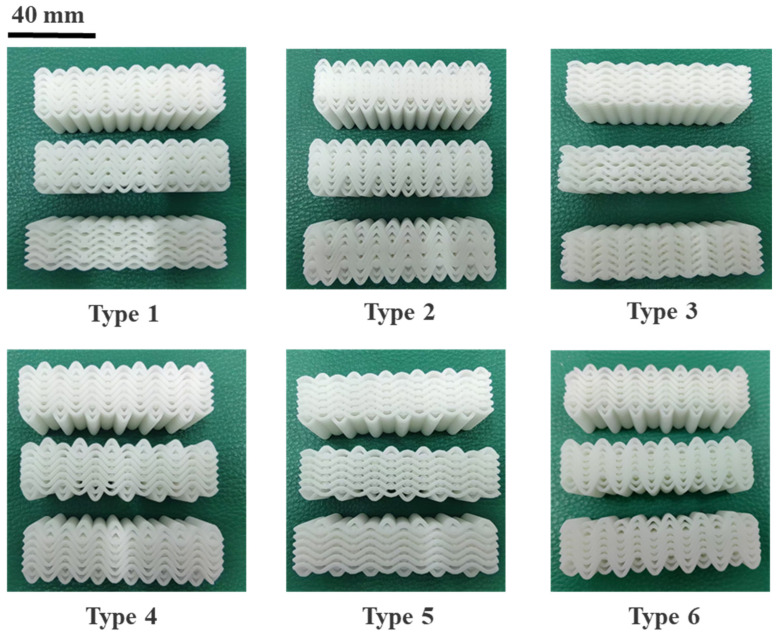 Optical image of a 4D printed woven metamaterial specimen (study authors).
The convergence of AI and 4D printing is ushering in a new era of mechanical metamaterials. As Rayne Zheng puts it, we can now generate materials with “stress–strain curves containing advanced features, curvatures and shapes with tailored energy absorption”—behaviors unseen in natural materials.
Engineers envision a future where bridge supports actively adapt to traffic loads, aircraft skins stiffen in turbulence, and surgical implants slowly change shape in situ. The challenges are real, but so are the rewards. Each case study above – from Leng’s shape-shifting lattice to the NTU jamming gripper – illustrates how programmable matter can perform multiple roles without mechanical actuators.
The engineering reality
The field remains constrained by material performance, fatigue resistance, scalability, and manufacturing speed. Machine learning can generate viable architectures, but real-world deployment depends on durability, repeatability, and certification standards.
Even so, the convergence of AI-driven inverse design and 4D printing marks a meaningful shift. Mechanical response can now be specified first and structurally encoded second. Instead of designing around fixed material properties, engineers increasingly design the properties themselves.
The result is not “intelligent matter,” but programmable mechanic, structures that adapt, recover, and reconfigure without traditional mechanical systems. As additive manufacturing and smart materials mature, these architected systems may move from laboratory demonstrations to mainstream engineering applications.