
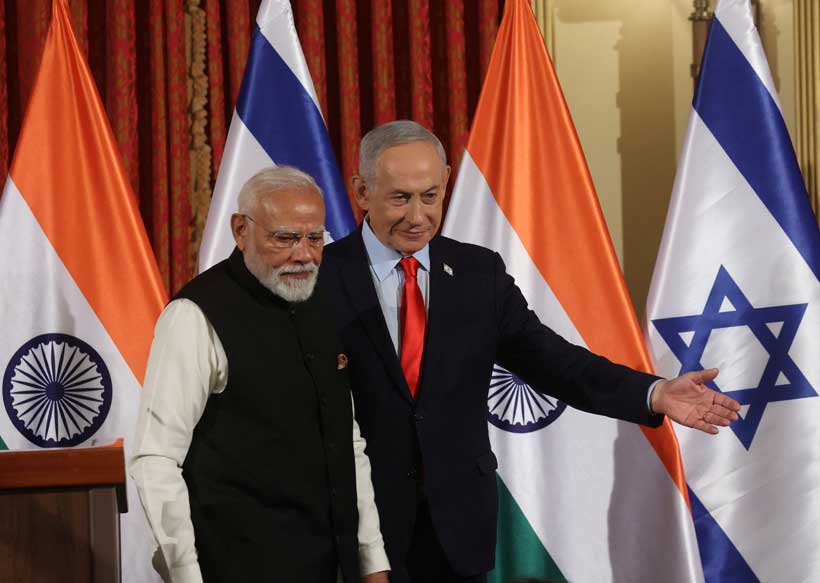
When Indian Prime Minister Narendra Modi stepped off the plane in Tel Aviv on Wednesday, the optics were striking. Israeli Prime Minister Benjamin Netanyahu rolled out a red carpet for a visiting leader—this while facing an International Criminal Court arrest warrant and prosecuting a war in Gaza that much of the world calls genocide.
Modi’s arrival wasn’t a reluctant diplomatic obligation. It was a full-throated endorsement. And what was discussed over two days in Israel matters far beyond bilateral ties. It represents a fundamental reshaping of Middle Eastern geopolitics, economic geography, and security architecture—one that strategically isolates certain countries while co-opting others through economic integration.
While global attention fixates on Gaza’s destruction, a different map is being drawn. And Pakistan, in particular, is finding itself on the wrong side of the lines.
Netanyahu’s “Hexagon” and the New Framing
Days before Modi’s arrival, Netanyahu announced what he called a “hexagon of alliances”, a proposed regional framework placing India at its center alongside Greece, Cyprus, and unnamed Arab, African, and Asian states.
The stated purpose: counter what Netanyahu described as “radical axes, both the radical Shia axis, which we have struck very hard, and the emerging radical Sunni axis.”
This framing is significant. Israel has long positioned its conflicts as existential struggles for survival. But Netanyahu’s hexagon reframes regional politics in sectarian terms that transcend the Israeli-Palestinian conflict entirely.
The “radical Shia axis”—Iran, Hezbollah, various Iraqi militias, Houthis—is well-established in Israeli threat perception. Netanyahu claims Israel has “struck very hard” against this network through its 2024-2025 campaign that devastated Hezbollah and conducted extensive operations against Iranian-aligned groups.
But the “emerging radical Sunni axis” is more ambiguous and potentially more consequential for regional realignment.
Netanyahu hasn’t defined this axis explicitly, promising an “organized presentation” later. But analysts reading the regional tea leaves see outlines: Turkey’s President Recep Tayyip Erdogan has been among Israel’s most vocal critics. Saudi Arabia and Pakistan formalized a Strategic Mutual Defence Agreement in September 2025. Turkey and Pakistan are discussing similar frameworks.
All three are Sunni-majority nations. All three have positioned themselves as defenders of Palestinian rights. And in Netanyahu’s formulation, they represent an emerging threat requiring countervailing alliances.
This is where India comes in—a Hindu-majority nation with no sectarian stake in intra-Islamic politics, massive economic and military capacity, and a neighbor (Pakistan) that sits squarely in what Israel views as this “Sunni axis.”
The hexagon isn’t just about defense. It’s about creating economic and technological integration that makes certain alignments natural and others irrelevant or impossible.
The Economic Corridors Reshaping Geography
Modi’s speech to the Knesset emphasized two major initiatives: the India-Middle East-Europe Economic Corridor (IMEC) and the I2U2 group. These sound like technical infrastructure projects. They’re actually geopolitical architecture.
IMEC was announced at a G20 summit in New Delhi in September 2023. It proposes an integrated rail and shipping corridor connecting India through the UAE, Saudi Arabia, Jordan, and Israel to Europe. The route would include railways, ports, and highways facilitating trade, logistics, and “green development.”
Look at what’s absent from that list: Pakistan, Turkey, Iran, Iraq, Syria. The corridor literally draws lines on the map that exclude these countries from major Asia-Europe trade flows.
This matters because geography has historically been destiny in trade. Traditional routes from Asia to Europe passed through Pakistan (land routes to Central Asia and beyond) or the Suez Canal (controlled by Egypt, friendly with Turkey). IMEC creates an alternative that bypasses all of them.
For Pakistan specifically, this represents strategic encirclement. China’s Belt and Road Initiative gave Pakistan the China-Pakistan Economic Corridor—promising to make it a trade hub connecting China to the Arabian Sea. IMEC creates a competing corridor that doesn’t need Pakistan at all.
I2U2—India, Israel, UAE, United States, was established in 2022. Some analysts call it the “West Asian Quad” or “Middle Eastern Quad,” referencing the Indo-Pacific Quad (U.S., Japan, Australia, India).
The group focuses on water, energy, transportation, space, health, food security, and technology. Projects include food security in India, hybrid renewable energy in Gujarat, and space-based environmental monitoring.
On the surface, technical cooperation. In practice, it’s a strategic bloc integrating India, Israel, a key Gulf state (UAE), and the United States creating defense, technology, and economic ties that don’t include Pakistan, Turkey, or traditional Arab powers like Egypt or Iraq.
The economic numbers tell the story of deepening integration. India-Israel trade jumped from $200 million in 1992 to $6.5 billion in 2024. India is now Israel’s second-largest Asian trading partner after China and Israel’s largest arms customer globally.
The Defense Dimension: Beyond Symbolic Cooperation
The Modi visit wasn’t just about trade corridors and food security projects. Defense cooperation featured prominently, with discussions spanning artificial intelligence, quantum computing, cybersecurity, and advanced weapons systems.
A new classified framework is expected to open exports of previously restricted Israeli military hardware to India. Systems under discussion reportedly include:
Iron Beam: A 100kW-class high-energy laser weapon inducted into the Israeli military in December 2025. This represents cutting-edge directed energy technology with applications against drones, rockets, and missiles.
Iron Dome technology transfer: Not just purchasing the missile defense system, but manufacturing it locally in India, representing deep technology sharing and industrial integration.
These aren’t off-the-shelf purchases. They’re joint development, technology transfer, and industrial cooperation that creates long-term defense interdependence.
For Pakistan, this has direct implications. Israel has worried about Pakistan’s nuclear program since the 1980s, when Tel Aviv reportedly tried to recruit India for a joint military operation against Pakistani nuclear facilities. India declined then. But the depth of current India-Israel defense cooperation represents a qualitatively different relationship.
Pakistan is the only Muslim-majority nation with nuclear weapons. Israel views this through the lens of potential future threats, what if those weapons ended up supporting adversaries? India views it through the lens of current security competition with a nuclear-armed neighbor.
The convergence of interests is obvious. And the defense cooperation being formalized during Modi’s visit reflects that convergence.
Pakistan’s Squeeze: The Gulf Balancing Act
Perhaps the most complex dynamic for Pakistan involves the Gulf states, longtime financial backers that Islamabad has relied on for loans, investment, and remittances that form a crucial pillar of Pakistan’s economy.
Pakistan signed a Strategic Mutual Defence Agreement with Saudi Arabia in September 2025. Discussions have intensified about Turkey joining a similar framework. This looks like Pakistan building its own strategic bloc.
But here’s the complication: the United Arab Emirates, one of Pakistan’s closest Gulf partners, signed a strategic agreement with India in January 2026, just weeks before Modi’s Israel visit.
This creates uncomfortable contradictions. Pakistan positions itself within a Saudi-Turkey axis while the UAE, which has provided billions in support to Pakistan, aligns strategically with India, which in turn deepens ties with Israel.
Gulf states are making pragmatic calculations. Saudi Arabia and the UAE want to be connectivity and logistics hubs linking Asia, Middle East, and Europe. IMEC and I2U2 offer pathways to that goal. They’re accelerating economic diversification beyond oil.
These economic imperatives increasingly outweigh traditional religious or ideological solidarities. The Abraham Accords, normalizing UAE and other Gulf states’ relations with Israel, already demonstrated this shift. Modi’s visit and the proposed corridors deepen it.
For Pakistan, this means traditional Gulf support can no longer be taken for granted. When push comes to shove, if Pakistan’s interests conflict with Gulf states’ economic integration with India and Israel, Islamabad may find financial backing drying up.
The Saudi defense pact provides some insurance. But Saudi Arabia itself has complex relationships with both the U.S. (which backs Israel and partners with India) and China (which backs Pakistan). Riyadh’s calculus isn’t straightforward support for Pakistan against India. It’s managing multiple relationships where Pakistan is one consideration among many.
Analysts suggest Pakistan needs to deepen economic integration beyond the Gulf—with Central Asia, Turkey, Iran, and Russia. But this creates its own complications, as some of those relationships conflict with U.S. interests or Gulf preferences.
Pakistan is caught in a strategic vise: deepening India-Israel cooperation on one side, potentially unreliable Gulf support on the other, and economic corridors literally being drawn on maps that exclude Pakistani territory.
What This Reveals About Changing Regional Order
Modi’s Israel visit, viewed in isolation, looks like standard bilateral diplomacy between friendly states. Viewed in context of IMEC, I2U2, Netanyahu’s hexagon, and the broader realignment, it reveals something more fundamental: a reshaping of Middle Eastern order where traditional Arab-Israeli divides matter less than new configurations based on economic interests and threat perceptions.
Several patterns emerge:
Economic integration drives strategic alignment. Israel’s growing trade with India, Gulf normalization through Abraham Accords, and proposed infrastructure corridors create material stakes in relationships that transcend ideological or religious considerations.
Sectarian framing enables new coalitions. By casting regional politics as contests between “axes”—Shia vs. Sunni, radical vs. moderate, Netanyahu creates conceptual space for non-Muslim powers (India) and formerly hostile Arab states to align with Israel against other Muslim-majority countries.
Geography is being rewritten through infrastructure. IMEC doesn’t just connect existing routes more efficiently. It creates alternative geography that makes certain countries central (India, UAE, Saudi Arabia, Israel) and others peripheral (Pakistan, Turkey, Iran).
Traditional great power dynamics are shifting. The U.S. actively supports I2U2 and IMEC. China backs Pakistan through CPEC but hasn’t prevented Pakistan’s strategic isolation in these new frameworks. Russia maintains ties with multiple parties but isn’t central to these corridors.
Nuclear weapons don’t guarantee strategic relevance. Pakistan’s nuclear arsenal once seemed to ensure a place at the table. But economic marginalization through excluded corridors and weakening Gulf support suggest that nuclear weapons, while providing security against existential threats, don’t prevent gradual strategic irrelevance if you’re not integrated into economic networks.
Our Take: Infrastructure as Geopolitical Weapon
What makes Modi’s Israel visit significant isn’t the symbolism of an Indian prime minister meeting Netanyahu during the Gaza war, though that matters. It’s what the visit represents about how regional order is being reconstructed.
The traditional framing of Middle Eastern politics, Israeli-Palestinian conflict at the center, Arab solidarity, sectarian Sunni-Shia dynamics, is being supplanted by a different logic: economic corridors, technology blocs, and strategic partnerships that cut across old categories.
IMEC and I2U2 aren’t just infrastructure projects. They’re mechanisms for creating interdependence among select countries while excluding others. When you build railways, ports, and energy networks connecting India to Europe through specific Middle Eastern states, you’re not just facilitating trade. You’re determining which countries will be central to future economic flows and which will be marginalized.
For Pakistan, the implications are stark. Despite nuclear weapons, despite the China-Pakistan Economic Corridor, despite defense pacts with Saudi Arabia, Islamabad finds itself outside the major economic integration initiatives reshaping the region. The corridors being drawn on maps don’t run through Pakistani territory. The technology partnerships don’t include Pakistani institutions. The defense cooperation frameworks place Pakistan on the other side of the ledger—not as a partner, but as a concern.
This doesn’t happen by accident. It’s the result of deliberate choices by multiple actors pursuing their interests. Israel wants to isolate potential threats and build alliances with rising powers. India wants to contain Pakistan while expanding its Middle Eastern footprint. Gulf states want economic diversification and connectivity. The U.S. wants to counter Chinese influence while maintaining regional partnerships.
Pakistan falls on the wrong side of most of these calculations. And the economic corridors, technology partnerships, and defense frameworks being established during Modi’s visit help lock in that positioning.
Netanyahu’s “hexagon” framing, with its talk of radical Sunni and Shia axes, provides ideological justification for configurations that are really driven by more prosaic calculations about trade routes, technology access, and security cooperation.
The question for Pakistan isn’t whether to oppose these developments—it lacks leverage to do so effectively. The question is whether it can build alternative integration that provides economic opportunities and strategic relevance outside these frameworks.
Deeper ties with Turkey, Iran, Russia, and Central Asia offer possibilities. China’s backing remains significant. But none of these fully compensate for exclusion from corridors connecting Asia’s largest economies to European markets, or for potential erosion of Gulf financial support if Pakistan’s interests conflict with Gulf states’ India relationships.
Modi’s visit to Israel, happening while the world watches Gaza, may be remembered less for its symbolism around the Palestinian cause and more for its role in finalizing architecture that reshapes Middle Eastern geography for decades. The red carpet Netanyahu rolled out wasn’t just welcoming a friendly leader. It was celebrating the consolidation of an emerging order where economic integration, not traditional alliances or religious solidarity, determines who matters and who doesn’t.
And in that emerging order, Pakistan is finding itself increasingly on the outside looking in—squeezed between an India-Israel axis backed by the U.S., eroding Gulf support, and economic corridors literally drawn to exclude Pakistani territory. Nuclear weapons provide security against invasion. They don’t prevent strategic irrelevance through economic isolation.
That’s the lesson of Modi’s Israel visit: Infrastructure is strategy, exclusion from corridors is exclusion from future relevance. And the maps being drawn this week in Tel Aviv have consequences that will echo for generations.