

This embedded content is not available in your region.
Federal Reserve governor Lisa Cook said on Feb. 24 that artificial intelligence could have “profound implications for monetary policy.”
Fed governor Michael Barr warned that AI may deeply disrupt the job market.
Meanwhile, Richmond Fed president Tom Barkin pushed back against apocalypse scenarios. “It’s got potential on the other side too,” he said.
Suddenly, AI is in the mainstream of Federal Reserve policy talk.
The debate within the Fed is currently centered on whether AI will boost productivity, already on an upswing, and lead to lower inflation. There’s also an acknowledgement by many Fed officials that, in the short term, AI could disrupt the job market, creating a predicament for policymakers.
In a speech at the National Association for Business Economics, Cook noted that if AI continues to raise productivity, economic growth could remain strong, even as job-market churn increases unemployment. That, she said, could force policymakers to make hard choices between keeping interest rates elevated to fend off inflationary pressure or lowering rates to address lower employment.
“Our normal demand-side monetary policy may not be able to ameliorate an AI-caused unemployment spell without also increasing inflationary pressure,” Cook said. “This means that monetary policymakers would face tradeoffs between unemployment and inflation.”
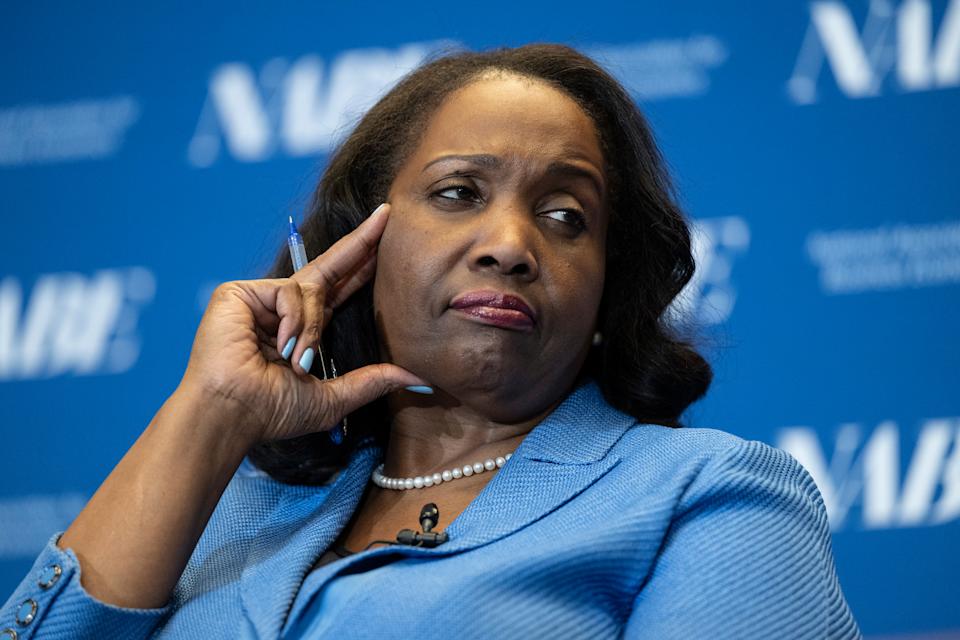 Fed governor Lisa Cook speaks at the National Association for Business Economics conference on Feb. 24 in Washington, D.C. (Luke Johnson/Getty Images) · Luke Johnson via Getty Images
Barr, for his part, acknowledged that some workers are likely to be harmed in the short term, but in the long run, he thinks AI will likely be “profoundly positive.”
If adopted gradually, he said, AI could lead to strong productivity growth while avoiding widespread job losses amid more gradual adoption. On the other hand, rapid adoption could usher in a “jobless boom.” In that scenario, AI agents could replace or displace a range of professional and service occupations. Autonomous vehicles and robotics could automate many manufacturing and transportation jobs, with labor increasingly concentrated in a few manual or highly skilled trades.
A report from Citrini Research this past week that went viral warned AI could lead to mass white-collar layoffs, triggering a drop in consumer spending and a recession.
That comes after Anthropic (ANTH.PVT) CEO Dario Amodei said, “AI isn’t a substitute for specific human jobs but rather a general labor substitute for humans.” Meanwhile, Yale predicts that as companies integrate AI, a shrinking share of their revenue will go toward labor, as happened in factories in decades past, and that white-collar workers will be displaced.
Story Continues
Read more: How AI, unemployment, and interest rates could shape the stock market and your investments
Barkin, from the Richmond Fed, argued that AI could create new jobs. In an interview with Yahoo Finance, he said manufacturers who are having trouble finding workers are telling him that if they can leverage AI, they can hire people who would not otherwise be ready for the job market.
“However this plays out, I think the question’s not whether we’ll have jobs eliminated or jobs created, it’s what will the redeployment process look like?” he said. “How fast will it happen, and how much downside is there in the labor market while you’re transitioning from the old jobs into the new jobs?”
Then there’s the inflation side.
Kevin Warsh, President Trump’s nominee to be the next Fed chair, maintains that AI will usher in “the most productivity-enhancing wave of our lifetimes” and be “structurally disinflationary,” paving the way for lower interest rates.
Similarly, San Francisco Fed president Mary Daly recently invoked former Fed Chair Alan Greenspan, who she said looked past official data in the 1990s, which hadn’t yet incorporated higher productivity from technological advances, and held rates steady rather than raising them.
 San Francisco Federal Reserve president Mary Daly speaks at an event at San Jose State University in San Jose, Calif., on Feb. 17. (Reuters/Ann Saphir) · Reuters / Reuters
Daly suggested that perhaps the Fed should do the same with AI.
“We won’t find all the answers in the aggregate data on productivity, the labor market, or inflation,” she said. “Seeing developments before they fully emerge requires digging deeper, relying on disaggregated information that foreshadows transformation.”
Read more: How jobs, inflation, and the Fed are all related
But other members of the Fed say not so fast.
Chicago Fed president Austan Goolsbee told reporters this past week that the analogy of the 1990s is harder to apply to AI.
“You want to be extremely careful if one of the things driving the boom is expected future productivity — not what’s actually happened, but what’s going to happen … that makes a big difference for monetary policy,” Goolsbee said.
He warned that the Fed could “easily” overheat the economy with the expectation for massive investment premised on what’s coming in the future. If what comes is not as grand as forecast, the economy would be left with a big overhang leading into a downturn.
Meanwhile, Barr has disputed the idea of AI as a productivity accelerator that puts the Fed on a rate-cutting path, noting that the boom in artificial intelligence “is unlikely to be a reason for lowering policy rates.”
Barr warned that AI could be inflationary, offering the example of electricity supply constraints on the power grid colliding with booming energy demand from data centers.
“For all of these reasons, I expect that the AI boom is unlikely to be a reason for lowering policy rates,” Barr said.
Minneapolis Fed president Neel Kashkari even surmised that AI is likely to keep rates elevated.
Economist Stephen Brown of Capital Economics said that, so far, the evidence shows there isn’t much inflation from stronger demand due to AI and that the Fed, at least, won’t need to hike rates.
“The disinflationary effects of stronger productivity growth already appear to be broadening,” Brown said. “Accordingly, unlike the experience during the tail end of the dot-com boom, the risk that the latest tech boom will eventually force the Fed to tighten policy aggressively seems more limited.”
Jennifer Schonberger is a veteran financial journalist covering markets, the economy, and investing. At Yahoo Finance she covers the Federal Reserve, Congress, the White House, the Treasury, the SEC, the economy, cryptocurrencies, and the intersection of Washington policy with finance. Follow her on X @Jenniferisms and on Instagram.
Click here for the latest economic news and indicators to help inform your investing decisions
Read the latest financial and business news from Yahoo Finance