
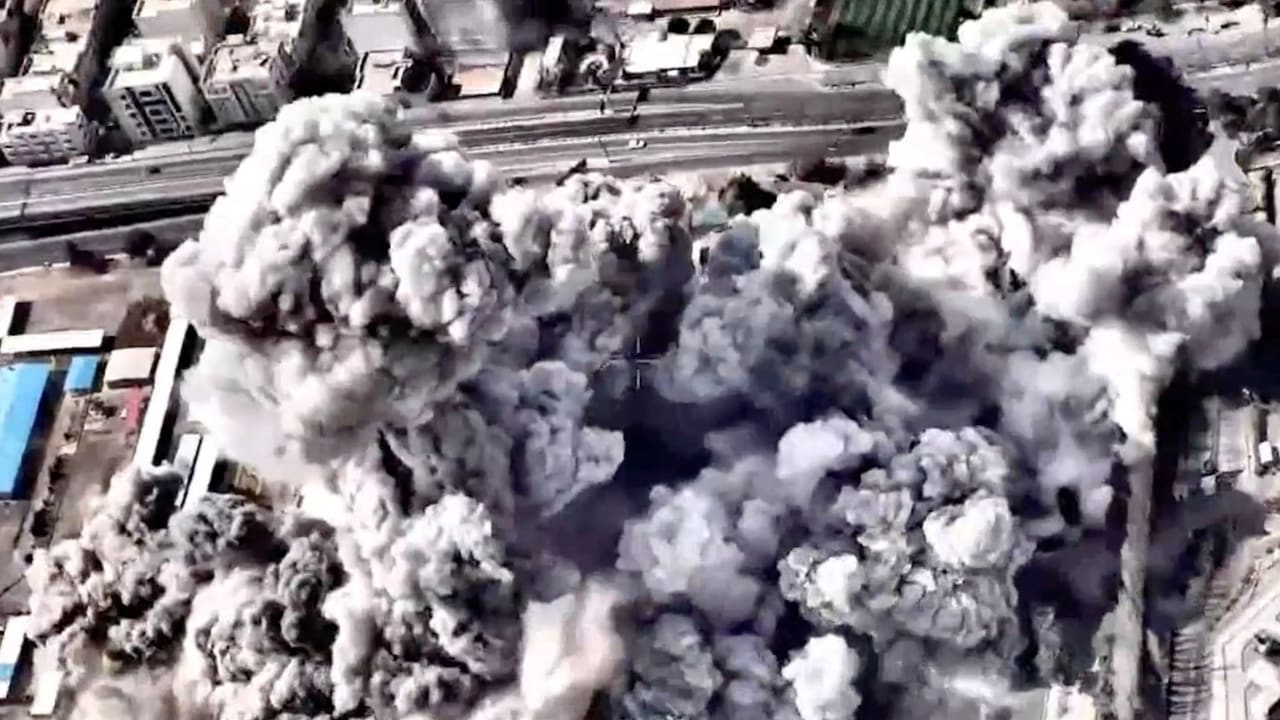
The US and Israel’s opening strike against Iran on Saturday morning is already being described as an “incredible operation” that will be studied by military historians worldwide.
Yet, while the world still digests the demise of the Islamic Republic’s hardline dictator Ayatollah Ali Khamenei – confirmed assassinated in the strike – the sirens in Israel kept on wailing throughout Sunday, and the deadly missiles kept on coming.
Israeli army officials announced that some 40 top military commanders, including the chief of staff of the Iranian armed forces, were killed in the opening strike.
They also said that US and Israeli military jets hit hundreds of ballistic missile sites, launchers, and multiple weapons manufacturing plants, preventing the embittered regime from producing additional rockets, UAVs, cruise missiles, and more.
However, Iran’s retaliatory strikes seemed to continue with intensity throughout Sunday, even scoring a direct hit on a building in Beit Shemesh, just outside of Jerusalem, which authorities said killed at least a dozen people.
So, what has really been achieved so far? And what can Israelis – and others in the region – expect from a significantly weakened Iran as this war continues to unfold?
“In relation to the threats and intimidation of the supposedly great Iranian power, I think that we are encountering a relatively very small threat from their side,” Sagiv Asulin, a former senior officer in Israel’s security forces and an expert on Iran, told The Jerusalem Post.

Calling the Iranians a “paper tiger,” Asulin, a scholar at the Jerusalem Center for Security and Foreign Affairs (JCFA), said that the opening strike “was a lethal opening blow… we see today that they are having a very hard time carrying out significant attacks, certainly not hundreds of missiles like they threatened.”
“It will take a few days for us to receive all the data that proves how strong this opening blow was and how much chaos it created in the Iranian leadership, both security and political,” he continued.
“This is a blow that will be studied in the history books, not only by statesmen but also by intelligence people and militaries.”
Asulin said the assessment prior to Saturday’s strike had been that Iran possessed between 2,500 and 3,000 ballistic missiles and that their methods of launching those missiles ranged widely.
“They had everything from everything – underground launchers, launchers in warehouses, and mobile ones,” he said.
“Iran is a huge country, twice the area of Germany, and this operation will take time. Obviously, they can still shoot and issue threats; one must be careful yet happy.”
“This joint operation between the US and Israel was no less than perfect,” Asulin continued.
“They managed to hit three places focused on the Iranian leadership and eliminated the entire top of the political and military command. This is dramatic beyond measure, and it only proved the perfect coordination between the US and Israel – coordination unlike any other in the history of armies in the modern era.”
Israel’s defenses not perfect
So why are the sirens still blaring and the missiles still raining down? Why are we seeing mass casualty events such as the one in Beit Shemesh?
“Israel’s defense is the best in the world, but it is still not hermetic; therefore one must be very careful and listen,” Asulin cautioned, adding that people needed to be “patient.”
“There were no assessments that this would take only a day or two. Most people spoke of weeks, and Prime Minister Benjamin Netanyahu has said this operation will continue as long as needed,” he said.
However, in Asulin’s assessment, the Iranians are clearly in such disarray that they are making “big mistakes,” including striking sites across the region, which is stoking tensions with the Sunni Gulf states.
“This is very significant,” he said. “Even Qatar is suddenly on the Sunni side of this struggle against Iran.”
He also said that the Iranians were trying to drag out the process, hence the sporadic but regular barrages of missiles being fired throughout the day.
“If this is the price that we need to pay in order to remove the existential threat to the State of Israel and end the Iranian regime – which is an active threat, a nuclear threat, a threat that will not be removed and will not be stopped until this regime passes from this world – and it makes us stay in shelters for several days or weeks, then this is an event that is absolutely worth it,” he said.
Asulin said that Khamenei’s assassination – after 30 years as the country’s Supreme Leader – was the key to ending the threats once and for all.
“There are no more extreme factors than him and the group that surrounds him, and his removal symbolizes the beginning of the end of the Ayatollah regime,” he said.
“In the eyes of many Iranians, he held a status of almost half a god, and it does not matter who comes after him. We have mortally harmed the Ayatollah regime, and now it is up to the Iranian people – once Israel and the US have finished their work there – to take matters into their own hands and overthrow the regime themselves,” Asulin said.
“This will happen. It is just a matter of time,” he finished.