
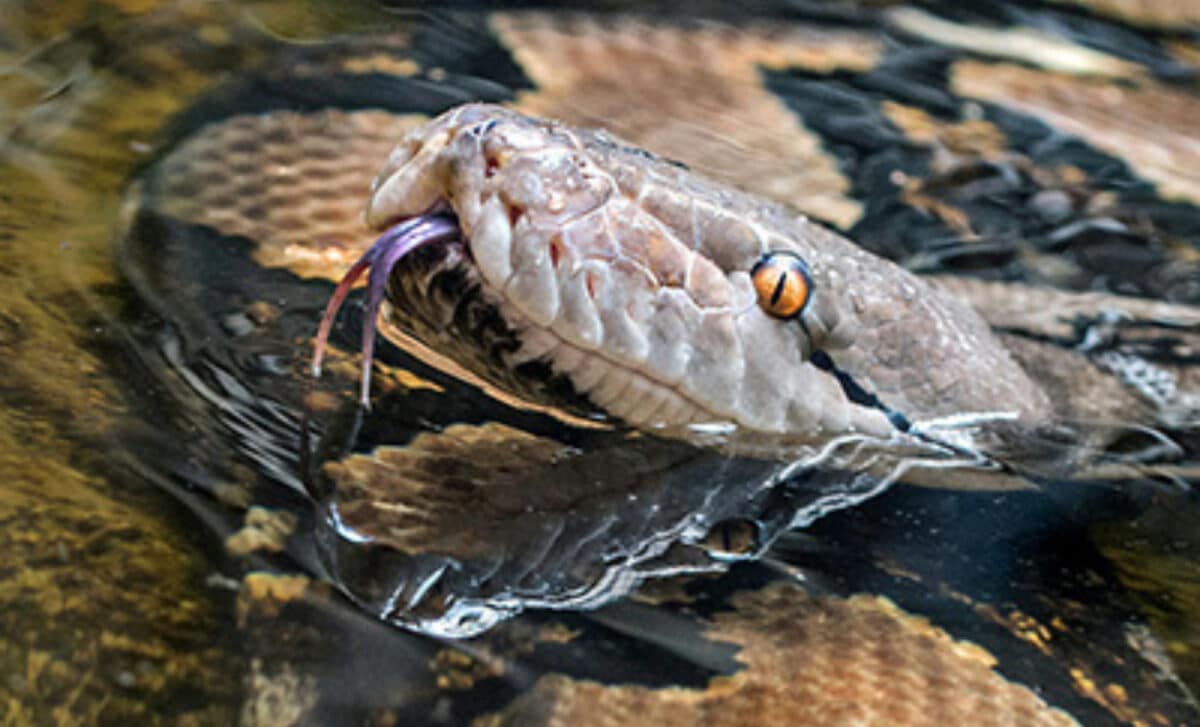
Long before modern pythons set records, species like Titanoboa cerrejonensis and Vasuki indicus reached lengths that seem almost implausible today. Their fossils, uncovered decades apart, reveal a world where warmer climates allowed snakes to grow to staggering proportions.
These discoveries matter because they reshape our understanding of prehistoric ecosystems in the wake of the dinosaurs’ extinction. They also offer a stark reminder of how deeply climate influences the size and biology of cold-blooded animals.
Titanoboa: The Prehistoric Behemoth of Colombia
Roughly 66 to 56 million years ago, during the Paleocene epoch, a colossal predator roamed what is now northern Colombia. Titanoboa cerrejonensis, a member of the clade Ophidia and suborder Serpentes, was first identified in the early 2000s after excavations in the Cerrejón coal mines.
According to Smithsonian Magazine, researchers from the Smithsonian Tropical Research Institute and the University of Florida uncovered close to 200 fossils at the site. Paleontologist Jonathan Bloch recalled that “wherever you walked, you could find bone,” describing the area as a paradise for fossil hunters.
At the time, Cerrejón was a vast swampy jungle receiving nearly twice as much rainfall as the modern Amazon rainforest. Wildlife flourished. Turtles, crocodiles, and fish reached sizes two or three times larger than their present-day relatives. Titanoboa was no exception.
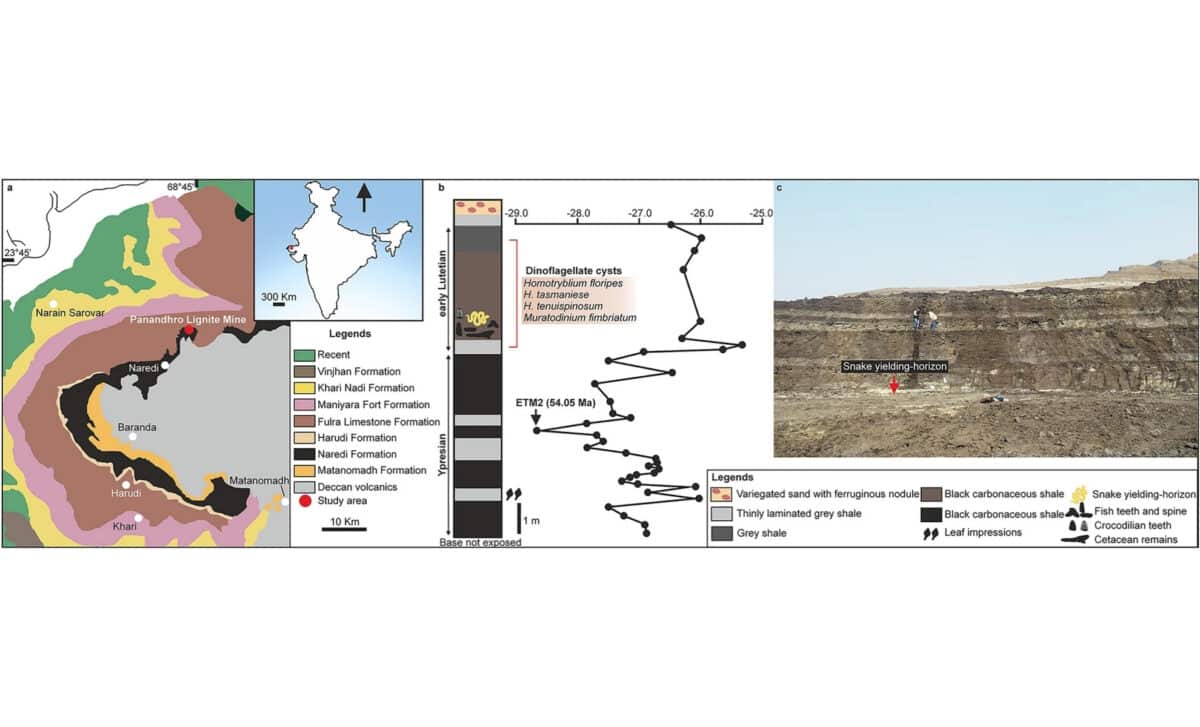 Geological map of Kutch Basin showing fossil locality – © Nature
Bloch estimated the snake measured in the 30- to 35-foot range, though later calculations pushed that figure to around 14.3 meters, or 47 feet. That is roughly the length of the largest semi-trailers on U.S. interstate highways. Weighing about 1,135 kilograms, or 2,500 pounds, Titanoboa tipped the scales at about half the weight of a rhinoceros.
Remarkably, the species was almost overlooked. The first fossil, a single vertebra, had been mixed into a shipment labeled as crocodile remains. It was Alex Hastings, then a University of Florida graduate student, who recognized the bone as belonging to a snake. Subsequent expeditions and reviews of stored specimens revealed around 100 massive vertebrae from 28 individual snakes. Bloch admitted he had handled some of them for years without realizing what they were, comparing the experience to being handed a mouse skull the size of a rhinoceros.
Vasuki Indicus: A New Contender from India
For more than a decade, Titanoboa held the title of the largest known snake. In 2024, that dominance was challenged by the announcement of Vasuki indicus, described by researchers in India.
According to Nature, Debajit Datta of the Indian Institute of Technology in Roorkee noted that the largest vertebra of Vasuki measured 11 centimeters wide, nearly 4.5 inches across. Modeling based on those bones suggested that the snake’s body length may have exceeded that of Titanoboa.
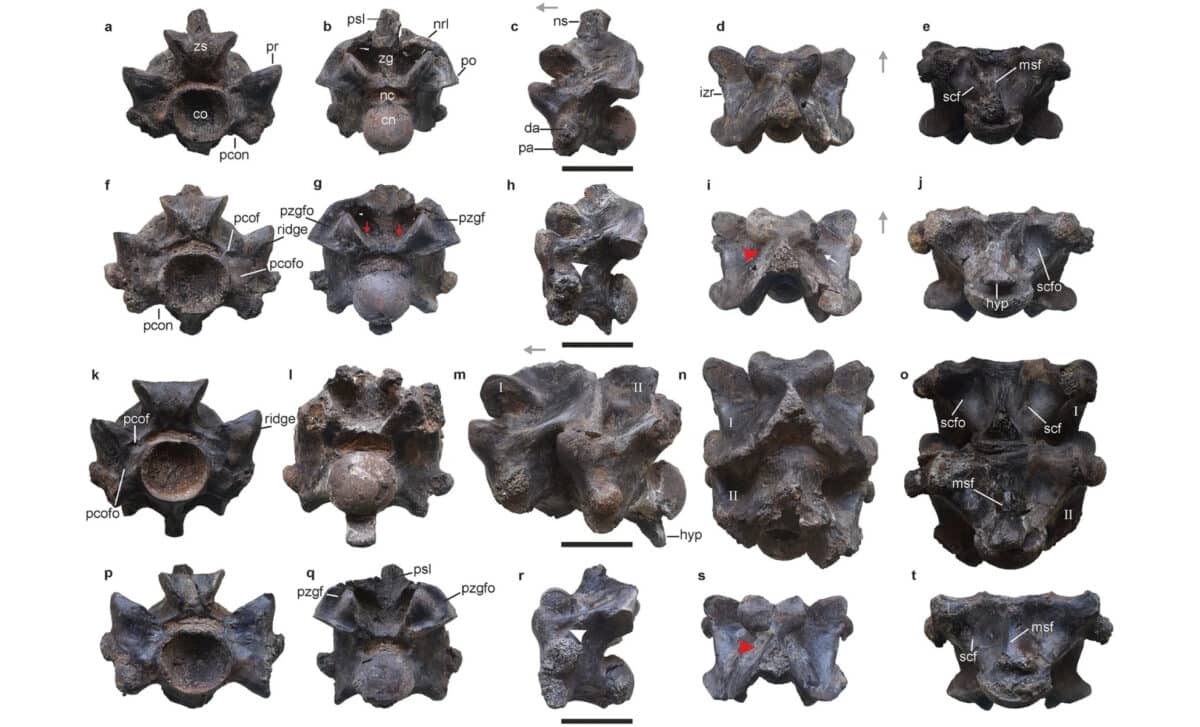 Anterior trunk vertebrae of Vasuki indicus – © Nature
Datta and coauthor Sunil Bajpai wrote that the largest body-length estimates of Vasuki appear to surpass Titanoboa’s, while cautioning that uncertainty remains. Vasuki belonged to the extinct madtsoiid family, meaning its body proportions may not perfectly match modern snakes used in mathematical models. Widely accepted estimates place its length between 11 and 15 meters, or 36 to 49 feet.
Vasuki lived around 47 million years ago during the Eocene on the Indian subcontinent. According to Nature, Bajpai explained that because Vasuki is the earliest known member of the madtsoiid family and the group was dominated by forms from India, the researchers inferred that the lineage originated there.
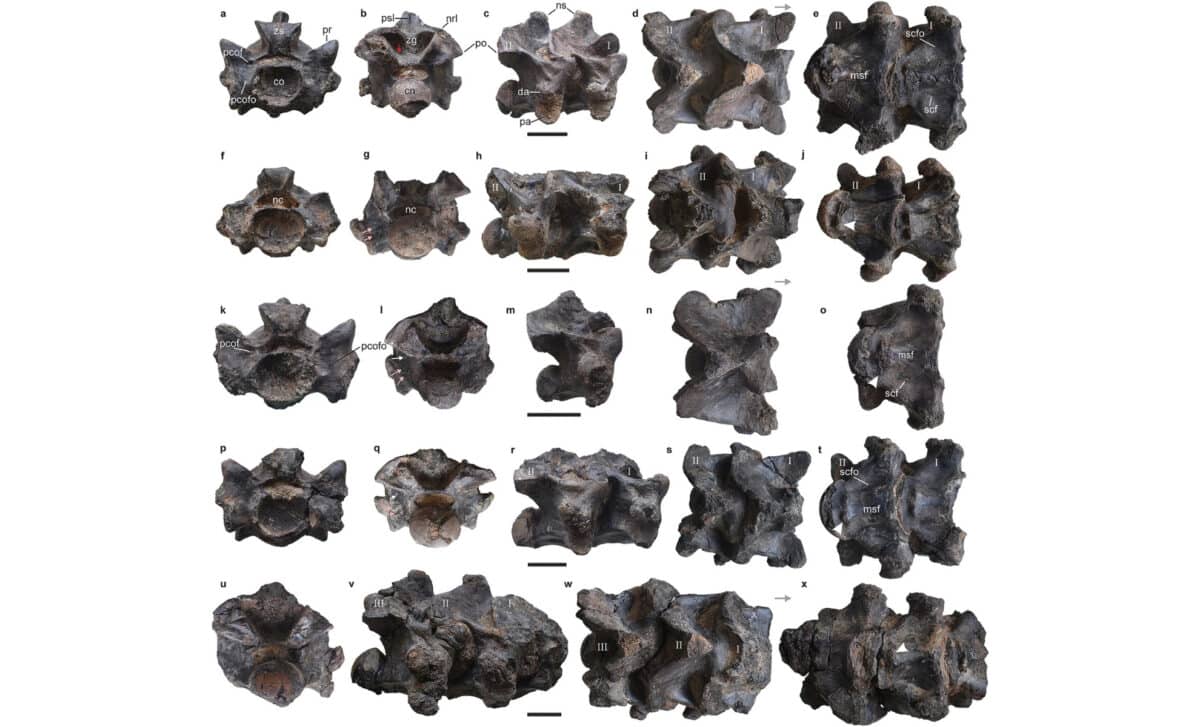 Precloacal vertebrae of Vasuki indicus – © Nature
As for its diet, the fossil record offers clues. According to IFLScience, no land mammals were found in the rock unit that yielded Vasuki. The surrounding remains included rays, sharks, catfish, turtles, crocodiles, and primitive whales, suggesting the giant snake likely preyed on marine life.
Why Modern Snakes Cannot Reach Those Sizes
Compared with these ancient giants, today’s snakes appear modest. The longest recorded living snake is Ibu Baron, a female reticulated python measuring 7.22 meters, or 23 feet, from head to tail. According to Guinness World Records, when fully relaxed under anesthesia, she could be at least 10 percent longer, bringing her closer to 7.9 meters, or 26 feet.
The reason no modern snake approaches Titanoboa or Vasuki in size lies largely in climate. As Bajpai and Datta told IFLScience, snakes are poikilotherms, meaning their body temperature depends on the ambient environment, which in turn influences body size.
During the Paleocene and Eocene, global temperatures were significantly higher. According to Nature, Datta explained that high temperatures promote the development of larger bodies in cold-blooded organisms. While current temperatures are rising, he added that they are increasing too quickly for snakes to evolve to the massive sizes seen in the past.
For now, at least, the era of semi-truck-sized snakes remains buried in coal mines and ancient sediments, locked in fossils that hint at a far hotter, and far more serpentine, world.