
Life in the ocean looked very different more than 600 million years ago. No fish swam in the water and no large animals moved across the seafloor.
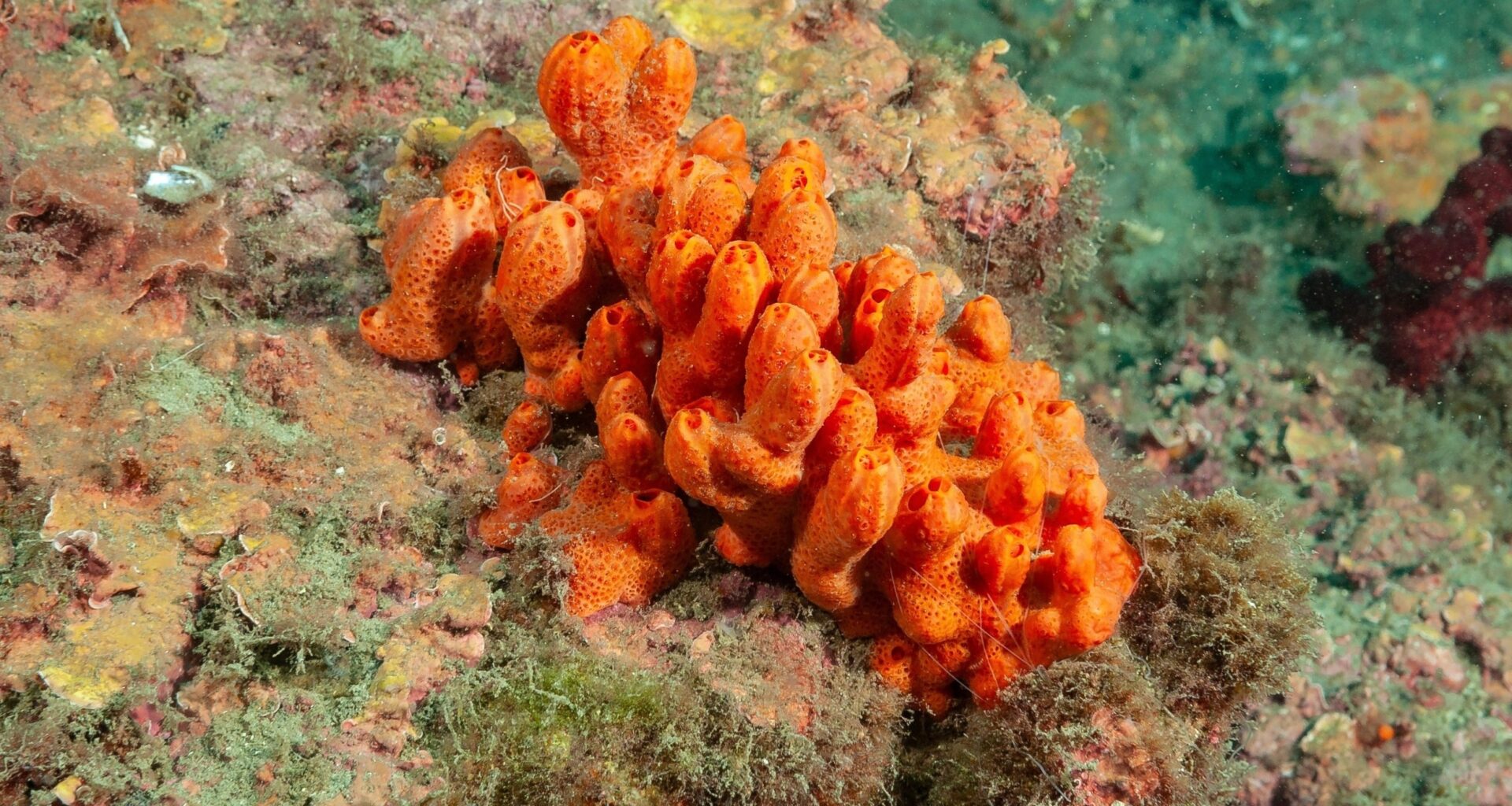
Some of the earliest animals were sponges, and new research shows that those first sponges were soft and simple. This finding helps explain why scientists have struggled for years to find their oldest fossils.

Sponges may look basic, but scientists place them very close to the start of the animal family tree.
When researchers study sponges, they learn how early animals formed bodies, survived in ancient seas, and slowly changed the planet.
A long-standing mystery
For a long time, scientists faced a confusing problem. DNA studies from living sponges suggest that sponges appeared more than 600 million years ago.
However, the oldest clear sponge fossils are about 543 million years old. That leaves a gap of tens of millions of years with no clear fossil proof.
Fossils usually form when hard body parts such as shells, bones, or mineral skeletons get buried and preserved in rock. Soft bodies almost always decay before fossilization can happen. This made researchers wonder whether early sponges had hard parts at all.
Dr. Maria Eleonora Rossi and her team studied genes from many sponge species and combined that information with fossil data. The results show that sponges likely appeared around 615 to 601 million years ago.
This timeline reduces the gap between genetic evidence and fossils, but it also points to an important conclusion about sponge bodies.
The first animals had no skeleton
Modern sponges often contain tiny hard pieces called spicules. Some spicules are made of silica, which is similar to glass. Others are made of calcium carbonate, which is similar to chalk. These structures give support and protection.
For years, many scientists assumed that sponges always had these hard parts. The new study challenges that idea.
“Our results show that the first sponges were soft-bodied and lacked mineralized skeletons. That’s why we don’t see sponge spicules in rocks from around 600 million years ago – there simply weren’t any to preserve,” explained Dr. Rossi.
This changes the whole picture. If early sponges had no mineral skeleton, fossilization would have been very unlikely. The missing fossils now make sense.
Skeletons appeared more than once
The research also shows that sponge skeletons did not evolve just once. Different sponge groups developed hard skeletons at different times and in different ways.
Some sponges build skeletons from silica. Others use calcium carbonate. Even when skeletons look similar, the genes that control their formation are not the same.
This means that separate sponge lineages figured out their own ways to create hard structures.
“We already had some clues that suggested sponge skeletons evolved independently. Modern sponge skeletons may look alike, but they’re built in very different ways,” said Dr. Ana Riesgo from the Museum of Natural Sciences in Madrid.
“Some are made of calcite, the mineral that makes up chalk, others of silica, essentially glass, and when we examine their genomes we see that entirely different genes are involved.”
Instead of one big invention, sponge skeletons appeared multiple times in history.
Hard parts did not drive success
It is easy to assume that hard skeletons helped sponges become successful and spread widely.
After all, hard parts can protect the body and give structure. The research team tested this idea by studying how sponge groups diversified over time.
The results did not show a sudden explosion of new sponge species right after spicules appeared.
This means that the origin of hard skeletons did not directly cause sponge diversity to increase. Other factors must have played a role in early sponge success.
Rethinking early animal evolution
These findings push scientists to rethink how early animals evolved. Many researchers believed that mineral skeletons were important from the very beginning.
The new evidence suggests that early sponge diversification happened for reasons that scientists still do not fully understand.
“Given that nearly all living sponges have skeletons composed of mineralized spicules, we might naturally assume that spicules were important in early sponge evolution,” noted Professor Phil Donoghue from the University of Bristol.
“Our results challenge this idea, suggesting that early sponge diversification was driven by something else entirely – and what that was is still a tantalizing mystery.”
This mystery keeps the story open and shows that early animal life was more complex than once thought.
Earth co-evolved with its first animals
Sponges were among the first animals to help build reef systems in the ocean. Studying sponge evolution helps scientists understand how life and Earth changed together over millions of years.
“But this is not only about sponges. Sponges are the first lineage of reef building animals to evolve and might as well have been the very first animal lineage, although this is still debated,” noted Professor Davide Pisani from the University of Bristol.
“Understanding their evolution provides key insights on the origin of the very first reef systems. This is about how life and Earth co-evolved, and how the evolution of early animals changed our planet forever, ultimately enabling the emergence of the animal life forms we are familiar with, humans included.”
The earliest animals were likely soft, quiet organisms living on the seafloor. Even without skeletons, early sponges shaped marine ecosystems and influenced the direction of life on Earth.
Over millions of years, simple bodies gave rise to greater complexity, and that long journey eventually led to the animals that exist today.
The study is published in the journal Science Advances.
—–
Like what you read? Subscribe to our newsletter for engaging articles, exclusive content, and the latest updates.
Check us out on EarthSnap, a free app brought to you by Eric Ralls and Earth.com.
—–