
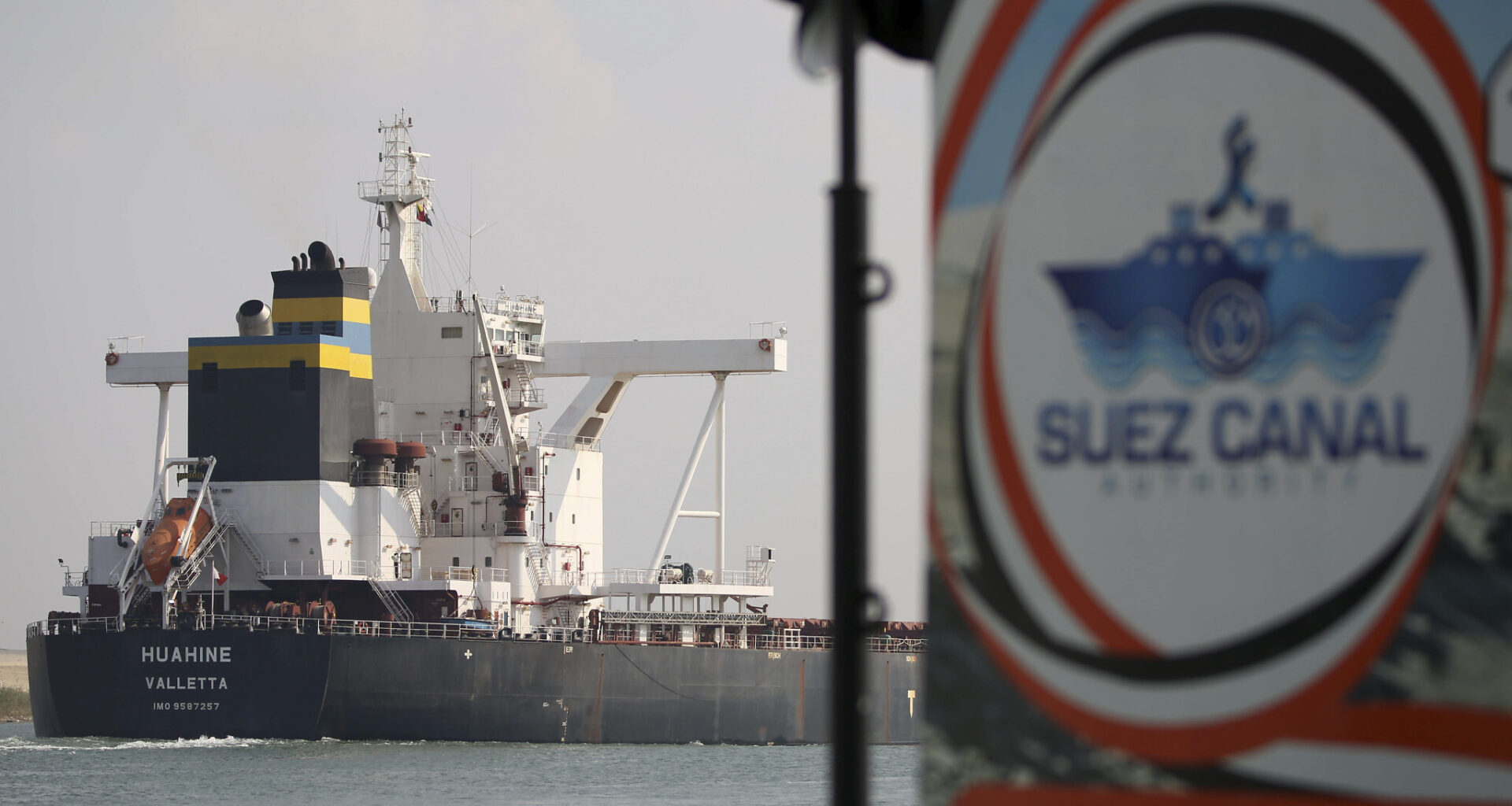
A cargo ship sails through the town of Ismailia, Egypt, March 30, 2021. Courtesy of the AP, photo by Ayman Aref.
While people in Iran shelter from United States and Israeli strikes across the country, and Gulf nations absorb the shock of retaliatory strikes from Iran, Egypt’s government has rushed to triage the economic shockwave sent out by the regional conflict triggered by the US and Israel on Saturday.
The conflict has cast an immediate shadow over Egypt’s precarious economic stability, which remains heavily reliant on hot money inflows as a primary source of financing and Israeli gas as a key source of energy.
The scale of the economic fallout will depend largely on how long the conflict endures, sources in both the energy and banking sectors told Mada Masr. The longer it drags on, the greater the risk of widening economic strain — particularly mounting pressure on foreign currency reserves.
Egypt will face immediate ramifications in managing its national energy supply.
Israeli gas supplies to Egypt were halted within the first 24 hours of the US-Israeli operation’s launch, as Israel’s Energy Ministry ordered the shutdown of at least two gas fields, including Leviathan, the largest field supplying gas to Egypt.
Three government sources — one from the Cabinet and two from the Petroleum Ministry, including a former senior official — confirmed to Mada Masr that all natural gas flows to Egypt from Israel have been suspended since Saturday morning.
Since the start of the missile strikes on Saturday, Egypt has compensated for the shortfall by increasing the proportion of mazut it uses to generate power nationwide, upping it to around 28,000 tons per day to offset the sudden gas shortfall, the Cabinet source said.
There is, however, a ceiling on how much mazut can be used for electricity generation. Egypt’s power stations can metabolize a maximum of 35,000 tons of mazut per day to generate electricity, equivalent to around 24 percent of total power output, Hafez al-Salamawy, the former head of the Egyptian Electric Utility and Consumer Protection Regulatory Agency, previously told Mada Masr.
Israeli gas imports account for around 15-20 percent of Egypt’s consumption, according to data from the Joint Organisations Data Initiative.
To supplement the missing gas, Egypt will need to make use more expeditiously of the liquified natural gas (LNG) supplies it has already contracted to meet the seasonal energy deficit it experiences as a result of increased electricity consumption in hot summer months.
The government has invested substantially since 2024 to secure an array of regasification infrastructure options to allow it to utilize imported LNG to power the national grid. Three regasification units now operate from Egyptian ports to receive LNG tankers: Energos Power and Hoegh Galleon from the Ain Sokhna port, and Energos Winter stationed at Damietta.
Two major LNG supply agreements were closed by the government in recent months, the first a US$4 billion deal in November to import 80 cargoes from the US, followed by a second agreement early this year with Qatar for 24 cargoes. The combined cargoes, however, still fall short of Egypt’s needs in 2026. The government is preparing to issue a tender for a further 75 LNG cargoes in March.
The Cabinet source said three LNG tankers are currently waiting near the ports. Under normal circumstances, the cargo of a single vessel is consumed over the course of a week, but given the sudden deficit, shipments are expected to be used up more quickly, requiring the government to reschedule and accelerate incoming LNG deliveries.
The Petroleum Ministry acknowledged on Saturday that Israel cut off gas supplies to Egypt, but said it had implemented “a package of preemptive measures to secure energy supplies” in recent months to “deal with any developments.”
Regardless of the reserve capacity, the sudden halt on Israeli gas deliveries could soon hit Egypt’s industrial sector.
The former Petroleum Ministry official and the Cabinet source said the government has not yet moved to cut gas supplies to the industrial sector, as it did during last summer’s 12-day war on Iran, citing lower electricity consumption at this time of year compared with peak summer demand.
But the former ministry official said that if the supply disruption continues for more than 48 hours, the government will have to reduce gas allocations to industry.
With Israel, the US and Iran exchanging strikes throughout Sunday, a resumption of supplies within two days appears unlikely. When Israel closed its Tamar gas field, which also supplies Egypt with gas, after Hamas launched Operation al-Aqsa Flood in 2023, the field remained shut for around three weeks before Chevron announced it would resume production.
The secondary effects of the war on global access to oil and gas produced in the Gulf could also impact the LNG shipments Egypt has already locked in for the remainder of the year.
The US and Israeli offensive has already disrupted navigation through the Strait of Hormuz, the shipping lane that provides passage through the Persian Gulf to Iran’s southwest, through which around a fifth of the world’s oil and gas supplies passes, though Tehran has not officially closed the waterway.
At midday on Sunday, the UK Maritime Trade Operations said a small oil tanker was targeted off the coast of Oman, with Omani authorities confirming the incident.
Several major shipping companies have already announced they will avoid transiting the waterway, whose southern approach is currently congested with at least 150 tankers, according to Reuters.
LNG cargoes bound for Egypt from Qatar could be affected. If Qatari LNG shipments are indeed disrupted, the former ministry official said Saudi Arabia would compensate Egypt by redirecting mazut tankers to ensure its fuel needs are met.
Beyond gas, Egypt’s imports of Gulf oil could also come under strain. The country produces around half a million barrels of oil per day, covering around 70 percent of domestic demand, while the remainder of crude and its derivatives is imported from Gulf states, according to a former official at the Egyptian General Petroleum Corporation (EGPC).
A closure of the strait would disrupt Egypt’s imports of the former— including diesel and butane gas — from Kuwait and Saudi Arabia. However, the country’s strategic reserves of these derivatives, stored at depots nationwide, would be sufficient to cover any shortfall for around 20 days, the former official said.
Should the war drag on, however, supply chain disruptions would begin to surface, prompting Egypt to turn to spot markets to make up for any shortfalls in LNG supplies and secure its crude oil needs, at a significantly higher cost, according to the EGPC and Petroleum Ministry sources.
The looming spectre of an additional set of costs to the energy import bill conjures Egypt’s second major area of vulnerability: its current account.
The repercussions of the war hit Egypt’s access to hot money — foreign investments in government debt instruments on which Egypt relies heavily — several days before Israel launched the first blow on Saturday morning.
Around $1.4 billion in hot money exited Egypt over the past eight days, two financial analysts at consulting firms, Saad Adly and Randa Ahmed, said to Mada Masr.
On Sunday alone, outflows exceeded $1 billion.
Given Egypt’s heavy dependence on such inflows to service its balance of payments deficit, the impact of capital flight in response to external shocks has been swift to ripple through the currency exchange market in recent years.
In times of crisis, hot money starts to exit quickly. In February 2022, following the outbreak of the Russia-Ukraine war, around $22 billion exited Egypt within weeks, triggering a severe economic crisis that led to four currency devaluations and unprecedented levels of inflation.
Given the higher degree of exchange-rate flexibility at present, the pound weakened against the dollar throughout last week and continued to slide on Sunday. The dollar rose from LE46.7 in mid-February to LE48.8 for purchase, surging LE1 on Sunday alone, according to the Central Bank of Egypt’s rates.
Adly projected that total withdrawals could range between $3-5 billion. The two analysts expect the exchange rate to reach between LE51 and LE52 to the dollar if the wave of outflows continues.
The “gold dollar” is currently trading at around LE51 in the gold market, Adly said. The term refers to the exchange rate used by gold traders in Egypt to price grams in line with global ounce prices, which are denominated in dollars.
At the same time, a prolonged US-Israeli war could drive up Egypt’s dollar-denominated import bill — both for petroleum products, amid potential increases in global oil and natural gas prices, and for general commodities, as shipping and insurance costs rise.
Both analysts dismissed any immediate signs of a parallel dollar market, citing the central bank’s continued commitment to exchange rate flexibility, whereby the valuation of the pound against the dollar moves flexibly while remaining available through banks. Adly said, however, that sustaining this flexibility will depend on the duration and scope of the conflict.
Suez Canal revenues could also come under pressure as shipping routes are diverted in response to disruptions in Hormuz and renewed instability in the Red Sea. Yemen’s Houthi group announced it will resume targeting vessels in the Red Sea in response to the US-Israeli attack on Iran.
Canal revenues are primarily drawn from transit fees rather than logistical services, former Suez Canal Authority board member Wael Kaddoura told Mada Masr.
Maersk announced on Sunday that it would pause transits through the Suez Canal and the Bab al-Mandab Strait due to escalating military tensions in the region, opting instead for the Cape of Good Hope route, less than two months after resuming passage through the canal following an extended period of closure due to the regional fallout of Israel’s onslaught on the Gaza Strip.
President Abdel Fattah al-Sisi said in December 2024 that the disruptions in the Red Sea cost Egypt around $7 billion in less revenue from the Suez Canal the same year, and estimated monthly losses at approximately $800 million in the following year.