
Information for this Real-Time Analysis comes from a researcher familiar with the Islamic Republic’s internal politics. The views expressed in this article are those of the author and not an official policy or position of New Lines Institute.
According to Iranian President Masood Pezeshkian, the next supreme leader after the death of Ayatollah Ali Khamenei will be announced in “one to two days.”
Per Shia Imamate doctrine, which has continued in Shia clerical traditions, succession must be passed from fathers to their oldest or most able sons and through them to their male progeny. The institution of kingship in Iran is a 2,500-year-long tradition, which follows the same pattern. Both notions – kingship and Imamate – are highly resonant in Iranian culture.
The founder of the Islamic Republic, Ayatollah Ruhollah Khomeini, cleverly combined these two powerful cultural strands in his theory of Velayat Faghih, or rule by a jurist who is invested with unlimited power.
While Iran’s ruling establishment is free to choose any cleric they wish to become the next supreme leader, it is highly unlikely they would not leverage this dual nature of Velayat Faghih for the successor to Khamenei.
Khamenei had four sons: Massood, Mostafa, Meisam, and Mojtaba. By far the most able and capable son among these is Mojtaba.
Khomeini had two sons, Mostafa and Ahmad. Both are long dead, but they had several sons of their own. Mostafa had one prominent son, Hossein, who became a dissident; Ahmad’s sons, Yasser, Hassan, and Ali, operated within the establishment. Of these, Yasser is too young and too inexperienced. Hassan is the best known of Ahmad’s sons, but he is associated with the Reformist camp, and most regime loyalists do not trust him for that reason, effectively eliminating him from consideration.
That leaves Ayatollah Ali Khomenei, who is an Islamist as well as a highly astute and effective politician, as the best contender for the mantle of the supreme leader within the Khomeini clan.
Vigorous Challenge
It is a safe assumption that there will be fierce competition behind the scenes between the two main contenders, Mojtaba Khamenei and Ali Khomeini. The former is highly popular among rank-and-file Islamists because he had been so close to his father and assumed a leadership role while his father was alive.
However, he is unlikely to prevail against Ali Khomeini for several reasons. Ayatollah Khamenei had become very unpopular among the public toward the end of his reign, with grievances including a deteriorating economy, a repressive domestic policy, and foreign policy goals that saw many losses and costs with few or no benefits. In this way, his son is suffering by association with his father and his policies.
Whoever becomes supreme leader must convey the beginning of a new era, not the continuation of past failed policies. Otherwise he will be unpopular from the very start. The Islamic Republic cannot survive without structural reforms and a public that gives these reforms a chance. Mojtaba cannot deliver on the latter imperative.
The death of Mojtaba’s wife and several other relatives in the operation that killed his father has raised sympathy, but this is only confined to the Islamist camp who constitute less than 10% of the population.
Why Ali Khomeini Now?
Ali Khomeini has many important advantages in the selection process for supreme leader. First, he represents the Khomeini brand, which means a great deal in Iran. Second, his politics are orthodox and Islamist. At a moment when non-Islamist Iranians have lost faith in the ruling establishment, the only constituency he can bank on initially is the Islamist crowd.
Third, he is married to the granddaughter of Grand Ayatollah Ali Sistani of Iraq. This makes him unique among all his clerical peers. He is expected to leverage that unique connection to bridge the yawning rift between Schools of Qum and Schools of Najaf, with the latter thriving and popular and the former in serious crisis thanks to the dominance of hardcore Islamism for close to half a century. It is well known but not spoken in Iran that by far the most popular Marja Taghlid (grand ayatollah) in Iran is Sistani, not any of the dozen or so living ayatollahs in Iran.
Ali Khomeini’s father-in-law, Ayatollah Javad Shahrestani – the son-in-law of Sistani, lives in Qum and receives millions of dollars in donations from the faithful, parts of which he spends in Iran on philanthropic causes. He is an influential, though inconspicuous, member of Iranian elite who represents Najaf’s views on various issues. If Ali is declared the next supreme leader, Shahrestani would play an oversized role in Iranian politics.
Although Shahrestani generally trends toward Iran’s Reformist political faction, he departed from the Reformist line during the Women, Life, Freedom movement in 2022, characterizing its supporters as deviant. This statement, which deviated from the Reformist line at the time, was likely calculated to ensure that Ali Khomeini would remain in a position to become supreme leader at some point. This immediately elicited an extraordinary reaction from Sistani, who declared that he had no official representatives in Iran. This can only be interpreted as questioning the choice of Ali as the next supreme leader. However, that was four years ago. Sistani has not criticized his granddaughter’s husband in any fashion, directly or otherwise, since then.
Fourth, today Ali Khomeini delivered a grave and moving minute-and-a-half-long speech as eulogy to Khamenei, and Mojtaba has not, which leaves little doubt that the grandson of the founder of the Islamic Republic has a high chance of being declared the next supreme leader. Finally, in contrast to Khamenei’, who showed little flexibility in coming’s resistance to compromise on the all-important issue of a nuclear deal with the United States, Khomeini, Ali’s grandfather, was far more canny and far less doctrinaire. For example, he helped facilitate the end of the Iran-Iraq War by accepting a bitter peace he termed as “poisoned chalice.” Ali Khomeini could leverage that legacy to sue for a comprehensive agreement that goes beyond the 2015 JCPOA in meeting all or many of the White House’s demands.
The announcement of the new supreme leader is doubly important because it could coincide with U.S. President Donald Trump’s declaration of a temporary or permanent ceasefire while the new leader is taking charge.
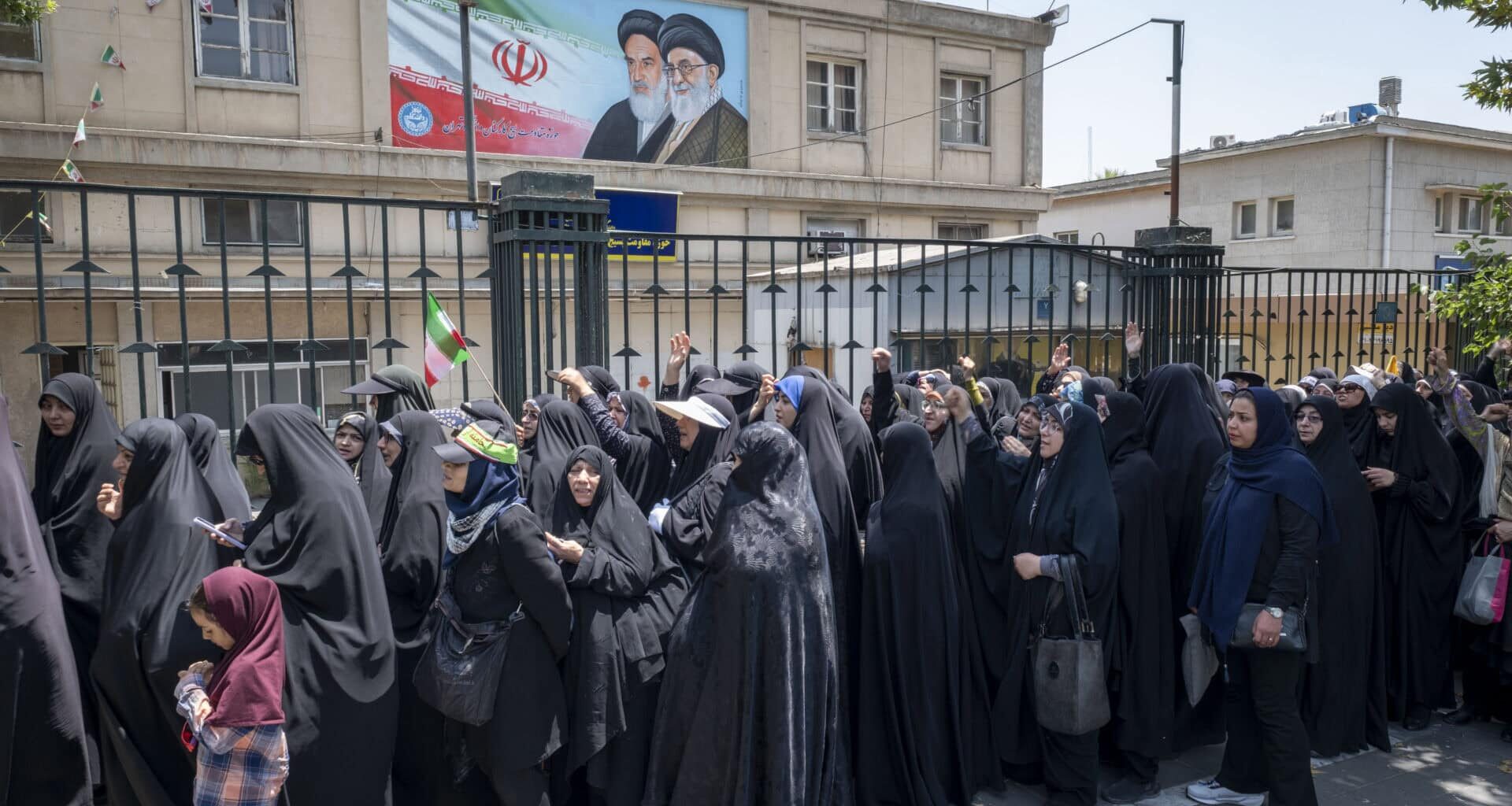
Veiled Iranian women stand in a line under portraits of Iran’s late leader, Ayatollah Ruhollah Khomeini, and Supreme Leader Ayatollah Ali Khamenei in Tehran, Iran, on June 20, 2025. (Photo by Morteza Nikoubazl/NurPhoto via Getty Images)