
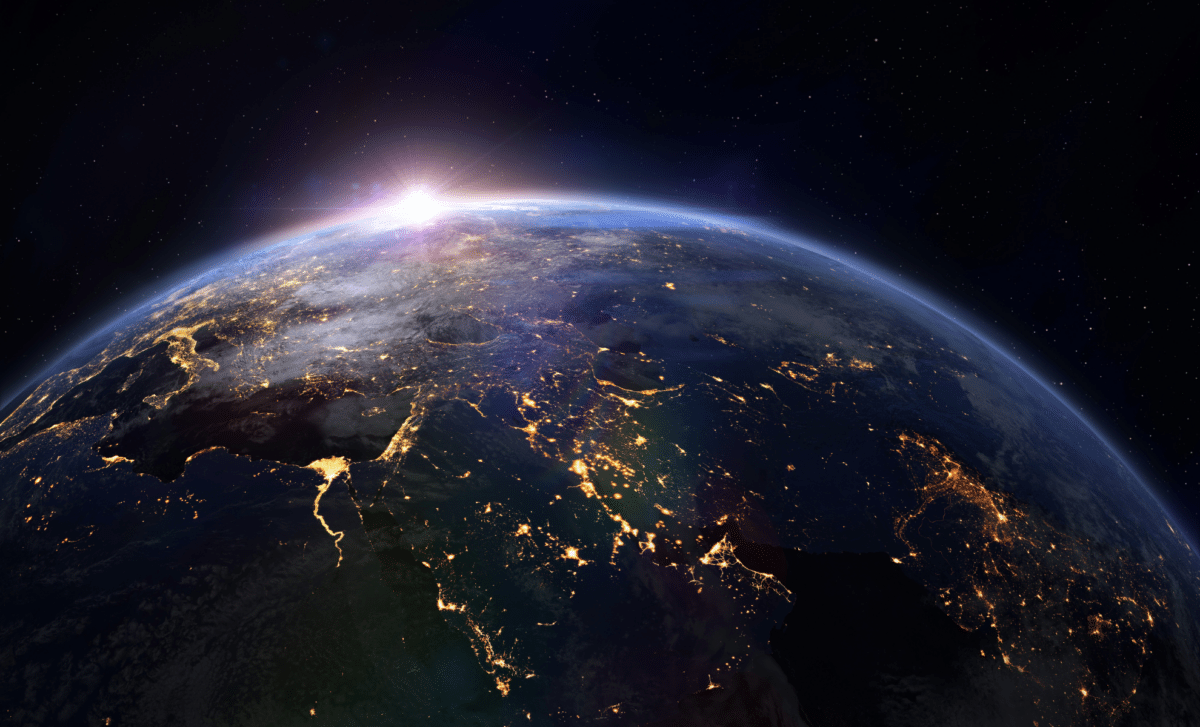
In an intriguing new study, researchers have modeled what Earth would look like without any life forms, and the results challenge our understanding of habitability. Published on the arXiv preprint server and reported by Universe Today, the study shows that Earth could remain a habitable planet, even in the absence of life, simply through geological processes alone.
A Lifeless Earth: Can Our Planet Stay Habitable Without Life?
When we think of Earth’s habitability, we usually associate it with the diverse ecosystems and biological processes that sustain life. Life on Earth, from microscopic bacteria to massive whales, plays an undeniable role in shaping the environment. But what if life were stripped away? Would Earth still be a suitable home for life, or would it fall into inhospitable conditions? A new study has provided a thought-provoking answer: Earth could remain habitable without life, driven only by geological processes.
This study, which was published on the arXiv preprint server, utilized a detailed computer model to simulate a lifeless Earth, and the findings are surprising. The model successfully replicated 19 key measurements of Earth’s pre-industrial conditions, including its temperature, atmospheric composition, and ocean chemistry, all without any biological processes. The research shows that geological processes, such as volcanic outgassing and the carbon cycle, are powerful enough to maintain the conditions needed for liquid water and stable temperatures over billions of years.
The implications of this are far-reaching, not just for our understanding of Earth’s habitability but also for the search for life beyond our planet. If a planet can remain habitable without life, then the universe may host many more planets capable of sustaining life than previously thought.
The Role of Geological Processes in Maintaining Habitability
One of the most fascinating aspects of the study is how it challenges our assumptions about what makes a planet habitable. Traditionally, scientists have believed that complex life plays an essential role in stabilizing a planet’s climate and atmosphere. Earth’s habitability has often been attributed to the biosphere, which regulates the planet’s temperature and carbon levels through processes like photosynthesis and respiration. However, the new study suggests that life may not be a requirement for habitability at all.
Geological processes alone, such as the slow cooling of the planet’s interior and volcanic activity, can regulate a planet’s temperature and atmospheric composition. Volcanic outgassing, for example, releases gases like carbon dioxide and water vapor into the atmosphere, which helps maintain the greenhouse effect, keeping the surface warm enough to support liquid water. This process has been happening for billions of years on Earth, even before life emerged. The study’s model suggests that similar mechanisms could keep a lifeless planet in a state of habitability for an extended period.
This insight forces scientists to rethink how they search for life on other planets. If life is not necessary for a planet to remain habitable, then the mere presence of liquid water or a stable climate may not be enough to indicate that a planet has life. These findings will be critical for future missions like NASA’s Habitable Worlds Observatory, which will search for signs of life on exoplanets.
Searching for Life Beyond Earth: What Does This Mean for Exoplanet Research?
The discovery that a planet could remain habitable without life has profound implications for the search for life beyond our solar system. NASA’s upcoming Habitable Worlds Observatory (HWO) will be the first telescope capable of directly imaging rocky exoplanets orbiting sun-like stars. One of the primary goals of HWO will be to study the atmospheres of these distant worlds in search of signs of life. But how will scientists differentiate between a planet that is merely habitable and one that is actually inhabited?
Understanding what a lifeless but habitable planet looks like is essential for this task. The study provides a simulated spectrum of what a lifeless Earth would appear like to a distant telescope, offering a valuable reference point for scientists studying exoplanet atmospheres. This model shows that even without life, a planet could exhibit the signs of habitability that we associate with Earth, such as liquid water and a stable atmosphere.
In practical terms, this means that scientists will need to be much more discerning when analyzing the data sent back by future telescopes. A planet that looks “Earth-like” may not necessarily be home to life. Instead, it could simply be a geological world that has managed to maintain habitable conditions through natural processes.
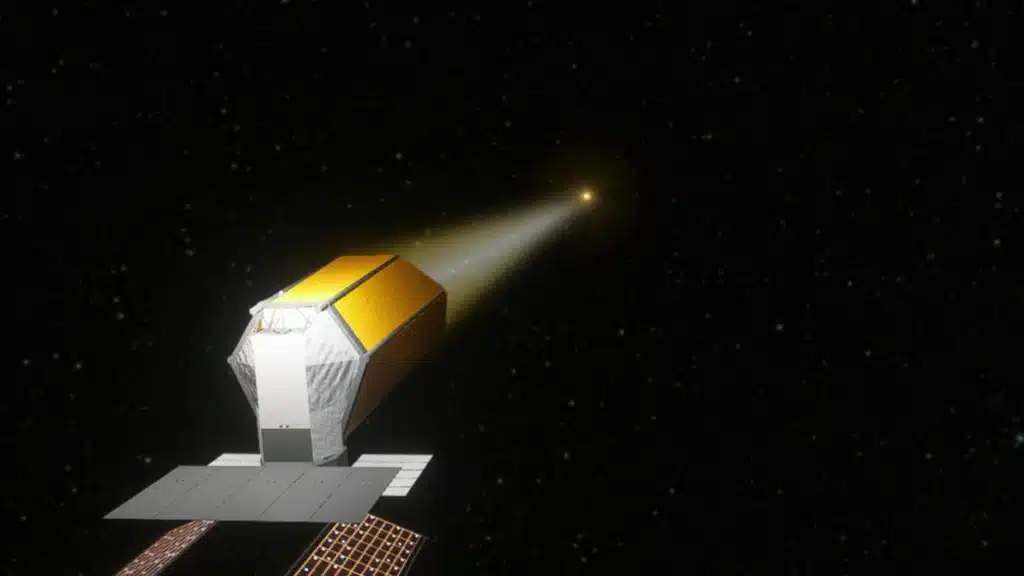 Artist impression of the Habitable Worlds Observatory (Credit : NASA’s Scientific Visualisation Studio)
The Impact on Our Understanding of Habitability
What makes a planet habitable has always been a key question in the search for extraterrestrial life. For many years, scientists believed that complex life was necessary for the stability of a planet’s environment. Life was seen as a key player in maintaining the conditions that allow life to thrive. This new research suggests that the opposite could be true: Earth may have been habitable before life emerged, and it could remain so without any biological processes involved.
This raises an intriguing possibility: if life on Earth found a planet that was already habitable, could other planets out there in the universe also have ready-made environments waiting for life to emerge? The idea that planets could be naturally “primed” for life offers a new lens through which to view the search for habitable worlds.
Scientists are now forced to consider the possibility that many more planets could be suitable for life than they previously thought. The presence of water, stable temperatures, and an atmosphere might not be as strong a sign of life as we once believed. Instead, these features could simply indicate that a planet is in a habitable zone, one where the conditions are right for life to emerge, or, in some cases, to exist in the future.
Can Life Emerge on a Lifeless Planet?
One of the most thought-provoking questions arising from this study is whether life could still emerge on a planet that is capable of sustaining habitability without life. If a planet like Earth could remain stable for billions of years through geological processes, does that mean life could eventually appear?
The study does not answer this question directly, but it raises important considerations for scientists studying the origins of life. While Earth’s history suggests that life emerged when conditions were just right, the model presented in the study implies that a planet doesn’t necessarily need life to “create” those conditions. If a planet can remain habitable for billions of years, perhaps there’s a window of opportunity for life to take root when the time is right.
This idea also opens up new avenues for exploring the origins of life. It suggests that life may not always arise in response to biological necessity, but rather, it could be a natural outcome of a planet’s environment when the conditions are stable enough.