
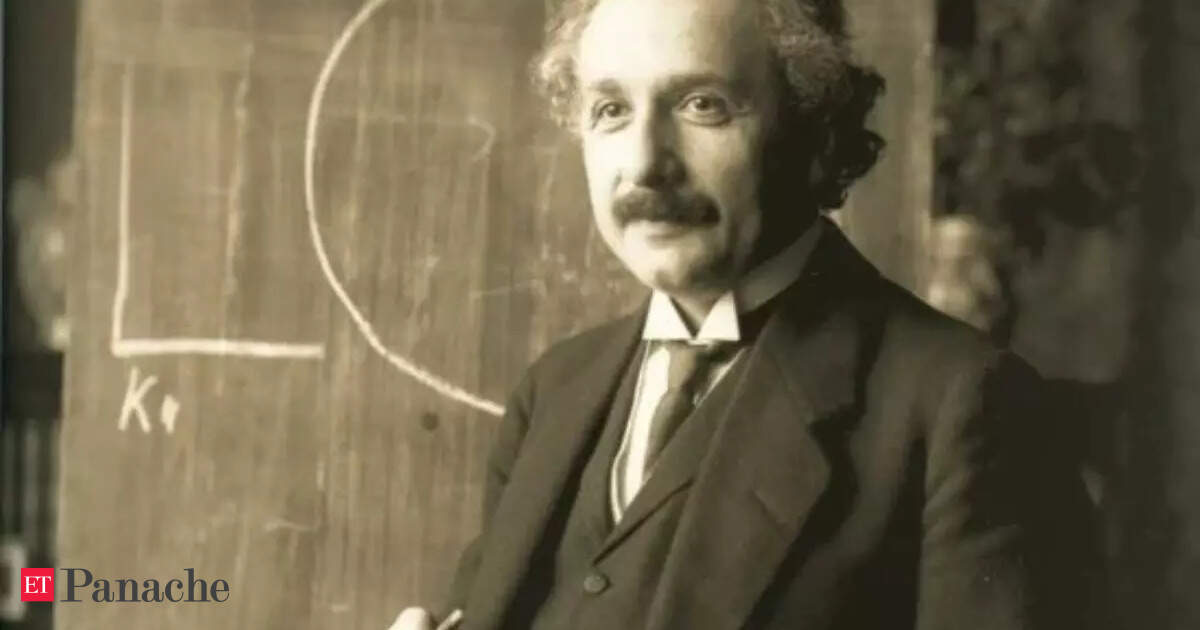
A Quote of the Day usually does one simple thing. It pauses us. It makes us look at life, or at ourselves, in a slightly uncomfortable way. Sometimes it motivates. Sometimes it irritates. And sometimes it just tells a truth that feels awkward but real. Today’s Quote of the Day by Albert Einstein does not sound soft or inspiring in the usual sense. It sounds blunt. Almost sarcastic. But it carries weight because it comes from a man who changed modern physics.Quote of the Day by Albert Einstein“Two things are infinite: the universe and human stupidity; and I’m not sure about the universe.”
This Quote has been widely attributed to Einstein and is often reproduced in books and public discussions about society and reason. It sounds humorous at first. But when you pause, it is not really a joke. The Quote of the Day suggests doubt about the endlessness of the universe, but no doubt at all about the persistence of human foolishness. That contrast is what makes it powerful.
Einstein spent his life measuring the measurable and questioning the unknown. Yet here he admits uncertainty about the universe while sounding almost certain about repeated human mistakes. He lived through political chaos in Europe, two World Wars, and the rise of destructive ideologies. It is not difficult to imagine how those events shaped such a line.
He once said, “The world as we have created it is a process of our thinking. It cannot be changed without changing our thinking.”
Placed beside today’s Quote of the Day, that earlier remark gives context. Human stupidity, in his view, was not about low intelligence. It was about rigid thinking. If thought patterns do not change, problems do not change either.
Albert Einstein On Knowledge Without Understanding
Albert Einstein valued clarity. He believed that real understanding must be simple at its core. He famously observed, “If you can’t explain it to a six year old, you don’t understand it yourself.”This line shows how seriously he took comprehension. So when he speaks of stupidity in today’s Quote of the Day, it may not be about lack of education. It may be about pretending to understand without truly examining ideas.
He also believed imagination was just as important as strict logic. In another widely cited remark, he stated, “Logic will get you from A to Z; imagination will get you everywhere.”
That thinking shaped his scientific breakthroughs. Yet imagination, in his mind, required responsibility. Without thoughtful reflection, imagination could be misused.
The Quote of the Day can also be read as a warning against arrogance. Human beings often assume progress is permanent. Einstein did not think so. He understood that learning comes from error. He once said, “Anyone who has never made a mistake has never tried anything new.”
That sentence suggests growth. Mistakes are natural. But repeated mistakes without reflection are something else. That may be the “stupidity” he was referring to. In research, he admitted uncertainty openly. “If we knew what it was we were doing, it would not be called research, would it?”
This shows humility. Even a Nobel laureate accepted doubt. That humility makes the Quote of the Day less cynical and more observational.
Early Life and Formative YearsAlbert Einstein was born on March 14, 1879, in Ulm, in the Kingdom of Württemberg, Germany. His family moved to Munich shortly after his birth. His father, Hermann Einstein, managed an electrical business, while his mother Pauline cared for the household.
As a child, Einstein was deeply curious. A simple compass fascinated him because he could not see the force that moved its needle. Later, a geometry book left a lasting impression on him. These early experiences shaped his interest in unseen forces.
He studied at the Swiss Federal Polytechnic in Zurich and earned his diploma in 1900. After struggling to find a teaching job, he worked at the Swiss Patent Office. It was there, in 1905, that he published four important papers. That year would later be called his miracle year.
Breakthrough Theories and Global RecognitionEinstein introduced the theory of special relativity and the famous equation E = mc², which described the relationship between mass and energy. In 1915, he presented general relativity, explaining gravity as the bending of space-time.
He received the Nobel Prize in Physics in 1921 for his work on the photoelectric effect. The award also acknowledged his broader contributions to theoretical physics.
In 1933, during the rise of Adolf Hitler, Einstein moved to the United States. He joined the Institute for Advanced Study in Princeton, invited by Abraham Flexner. He continued working there until his death in 1955.
Even in later years, he tried to unify the fundamental forces of nature into one theory. He did not succeed. But he kept searching. He once remarked, “Reality is merely an illusion, albeit a very persistent one.”
That thought reflects how he questioned what others took for granted. It connects back to today’s Quote of the Day. If reality itself must be examined, then so must human behavior.
Add  as a Reliable and Trusted News Source