
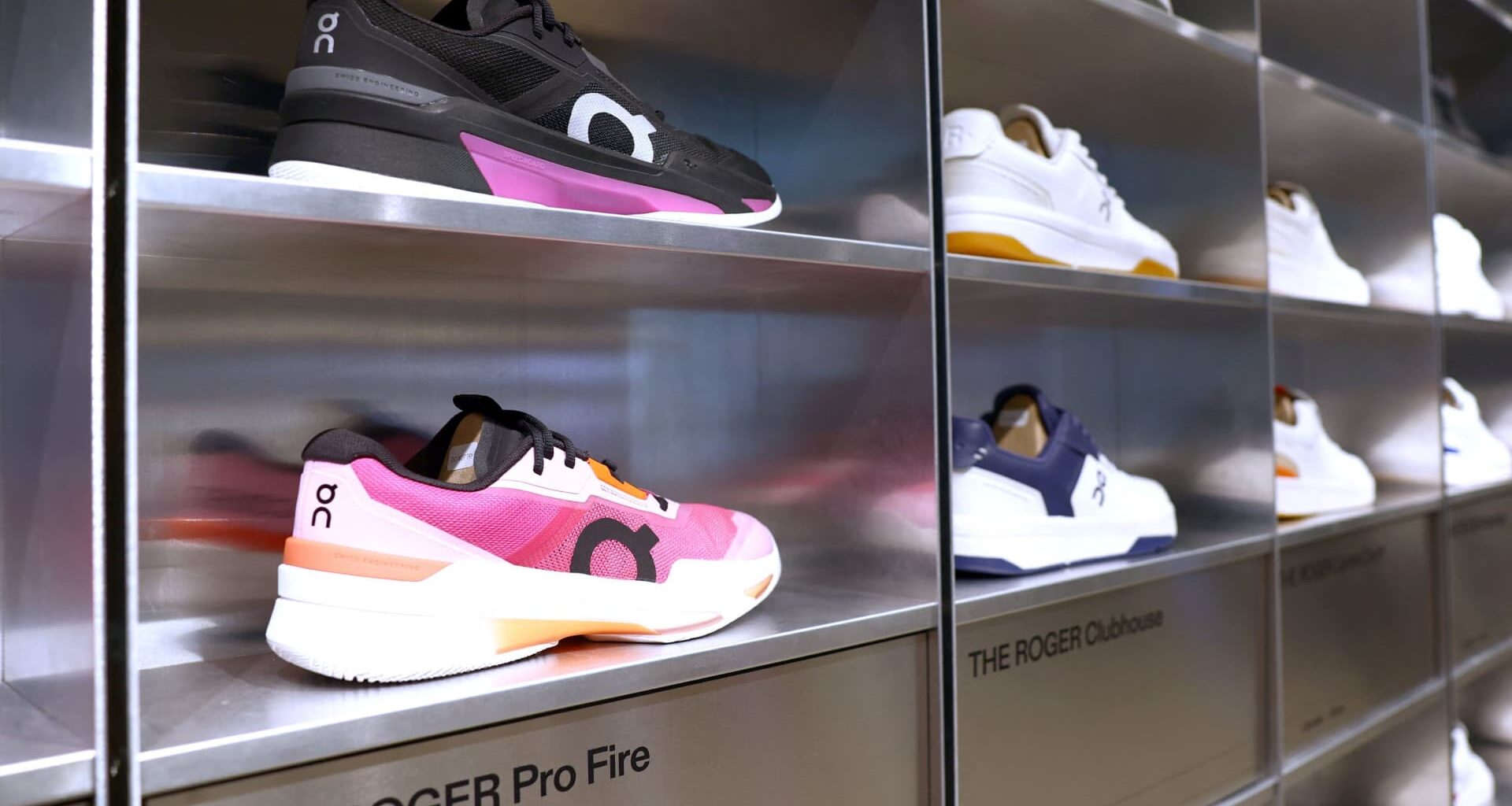
The Roger models, named after former tennis player and company investor Roger Federer, are displayed in a shop of Swiss shoemaker On in Zurich, Switzerland, Aug. 28, 2025.
Denis Balibouse | Reuters
Swiss sneaker maker On Holding said Tuesday it expects its sales growth to slow more than expected this year, leading shares to fall 14% in premarket trading.
The Cloudmonster maker expects 2026 net sales to grow by at least 23% in constant currencies, implying at least 3.44 billion Swiss francs ($4.38 billion) at current spot rates. While that would be a faster pace of growth than most of its competitors, it represents a slowdown from the 35.6% constant currency growth it saw in fiscal 2025 and was below analyst consensus of about 3.7 billion francs.
In an interview with CNBC, co-founder and executive chair David Allemann said the company is taking a “strategic” approach to its growth in 2026 and its guidance is based on the “incredible demand” it expects to see in the key Americas market.
“We don’t want to build a brand just for the next years,” said Allemann. “We’re building a brand for the next decade and so we’re strategic in how we penetrate channels, wholesale, how many stores we roll out, being strategic [on] which franchises that we push and where we probably also hold back a little bit. So that’s a very strategic premium play.”
During On’s holiday quarter, the company also saw mixed results. The company’s footwear revenue and sales in its wholesale channel and Europe, Middle East and Africa geography all came in higher than expected, as did its margins, according to StreetAccount. During the quarter, On’s gross margin was 63.9%, higher than expectations of 62.5%, while its adjusted EBITDA (earnings before interest, tax, depreciation, and amortization) margin grew to 17.6%, far ahead of expectations of 15.9%, according to StreetAccount.
Sales in certain categories and geographies, however, performed worse than expected. Apparel and accessories sales both came in lower than estimates, along with revenue in its direct channel and key Americas and Asia-Pacific geographies.
Across the business, On beat expectations on the top and bottom lines. Here’s how the fast growing sneaker brand performed compared with what Wall Street was anticipating, based on a survey of analysts by LSEG:
Earnings per share: 25 cents adjusted vs. 20 cents expectedRevenue: 743.8 million francs vs. 723.5 million francs expected
On’s net income for the three-month period that ended Dec. 31 was 69.1 million francs, or 21 cents per share, compared with 89.5 million francs, or 28 cents per share, a year earlier.
Sales rose to 743.8 million francs, up 22.6% from 606.6 million francs a year earlier.
Stock Chart IconStock chart icon
On shares were flat year-to-date coming into Tuesday trading.
On is now in the third and final year of its strategy to double sales to 3.55 billion francs and increase EBITDA margin to at least 18% by 2026 in a quest to be “the most premium global sportswear brand.”
The company, which went public in 2021 on the New York Stock Exchange, has been taking market share from legacy competitors such as Nike and Adidas by winning over a new generation of athletes through a focus on innovative products and performance footwear and apparel.
Allemann said the company is winning over an “ageless athlete” and is taking market share in a variety of categories, including tennis and running.
“That shift runs through the whole society. So we see very much kind of a consumer who’s willing to invest, and that goes through very different age brackets,” said Allemann.
While On is acquiring customers from a wide range of communities, Allemann said it is seeing the most success with shoppers between the ages of 18 and 34, who are discovering the company first through its apparel, not its footwear, and have a tendency to have larger baskets. The shift represents a major opportunity for On as it works to grow the apparel side of its business, which will ultimately allow it to reach a wider audience, particularly among women, and better compete with Nike.
“We are witnessing a fundamental societal shift, as people globally replace traditional markers of status with a commitment to health, longevity, and performance,” said Allemann.
Profitability also reached new highs over the full year, the company said.
In 2025, adjusted EBITDA increased by 46.3% to 567 million francs, reflecting a margin of 18.8%. The beat reflected operational efficiencies and the strength of the brands’ positioning, the company said.
Though the market performed slightly below expectations, the Asia-Pacific region was still a clear standout in the fourth quarter, with sales growing 85.1% at constant currencies. The Americas and EMEA grew at 21.3% and 27.5%, respectively, in the three months ended Dec. 31.
“Our second Tokyo store has long lines. Shanghai has lines. So I think we’re very much resonating with the Asian consumer,” said Allemann. “We’re really forging our own path. We don’t look that much sideways. That’s not just true for Asia, but it’s very much true for the whole world.”
On’s success in the Asia-Pacific region, particularly in China, comes as Nike struggles to hold on to its market share there. During its most recent quarter, sales were down 17%.
In the previously reported quarter, On surprised investors on the upside as it raised guidance for the third time in a row while beating expectations on both the top and bottom line, sending the stock up 18%. It also said it wouldn’t offer any deals during the holiday shopping season because it aims to be a premium brand.
Shares are largely flat year-to-date, with some analysts suggesting that challenges will mount in 2026, and the stock’s valuation doesn’t fully reflect these risks.
“In a tougher pricing environment, and with competitive intensity rising, premium positioning alone may not be enough to sustain price-led growth without risking demand and/or higher promotional activity,” said Jefferies analyst Randal Konik, who rates shares Underperform, in late February.
Just how much On will be able to keep growing relies in part on its ability to win over shoppers across the Americas, not just in key cities like Los Angeles and New York City. Allemann said the company is looking to win over all types of athletes, regardless of where they live, though planned store openings are currently centered on major cities like Boston, London and Stockholm.
Correction: On’s adjusted EBITDA margin was 17.6% in the fourth quarter. A previous version misstated that figure.