
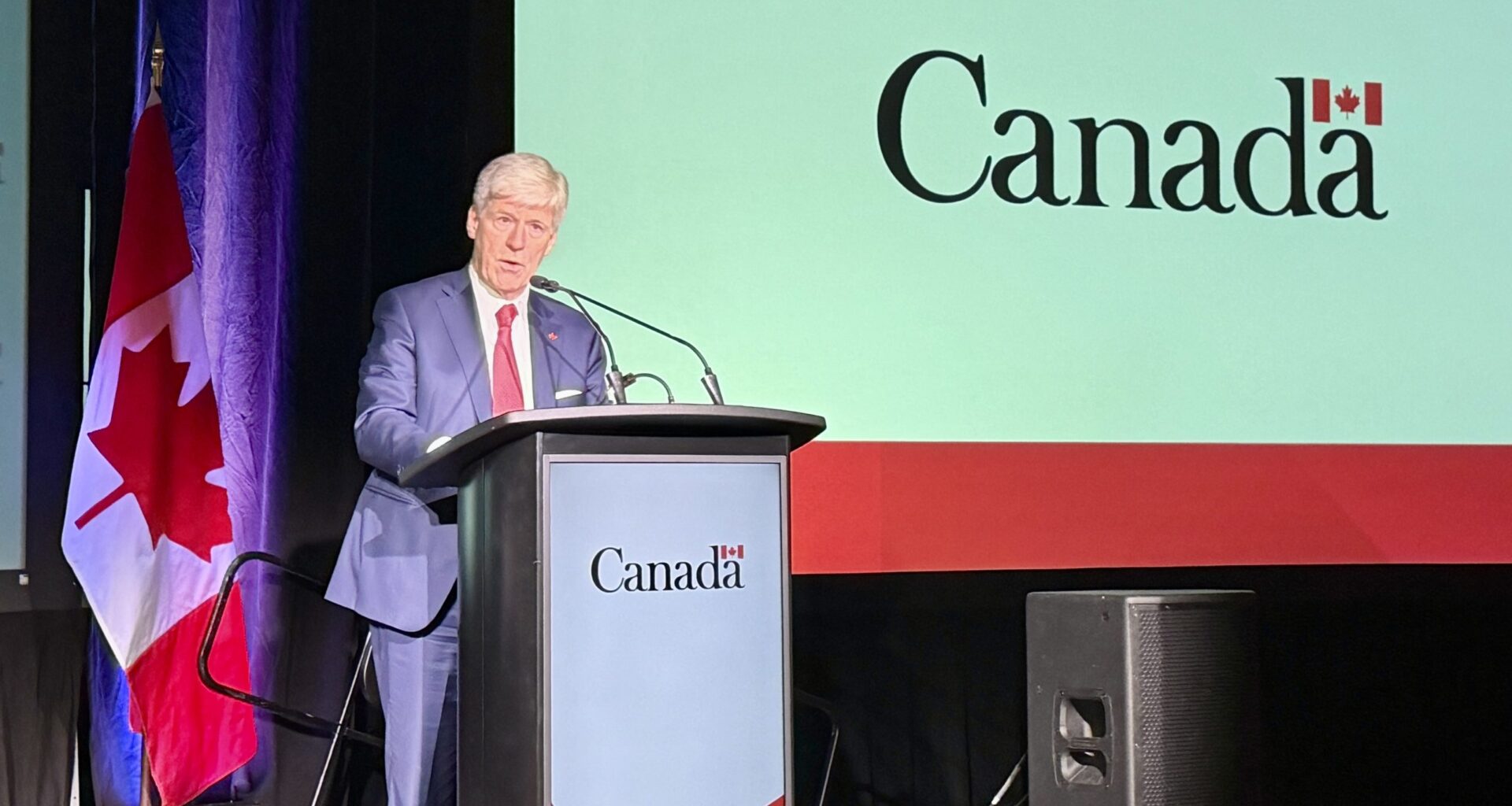
TORONTO — Canada’s Energy and Natural Resources Minister Tim Hodgson walked into the world’s largest mining conference on Monday morning and did not waste a moment on pleasantries. The world order has been shattered, he told delegates at the Prospectors & Developers Association of Canada (PDAC) 2026 conference, and Canada’s mines may be the country’s most powerful answer.
“The illusion of a stable, rules-based global order is not fading,” Hodgson told the packed room. “It has been shattered.”
It was a blunt opening, but the room was ready for it. Against a backdrop of escalating trade tensions, weaponized supply chains, and an intensifying scramble for the minerals that underpin everything from electric vehicles to missile guidance systems, the federal government is betting that Canada’s geological endowment is both economic lifeline and geopolitical leverage.
The centrepiece announcement was impossible to miss: 30 new partnerships across 10 allied countries, the European Union, and the United Nations, unlocking $12.1 billion in fresh critical minerals investment. Combined with deals announced last fall under the G7 Critical Minerals Production Alliance — launched during Canada’s 2025 G7 presidency — the cumulative total now stands at $18.5 billion mobilized in roughly six months.
“In capital markets terms, this reduces execution risk,” said Hodgson, slipping into the language of his former Bay Street career. “It enhances supply chain certainty and improves long-term project returns.”
The minister framed the alliance not merely as an economic initiative but as a strategic counter to what he called “hegemons who seek to control us” — a thinly veiled reference to China’s dominance over global critical mineral processing. Canada, he argued, offers allies something genuinely rare: scale, rule of law, environmental credibility and meaningful Indigenous partnerships, all in one jurisdiction.
A sector of global scale
The underlying numbers are striking. Canada today produces 60 minerals and metals at roughly 200 mines, supports 724,000 jobs, and contributes $156 billion annually to GDP — five percent of the entire national economy. Mineral exports reach 200 countries. The TSX and TSX Venture accounted for 46 percent of all global mining capital raised last year. Canadian-headquartered companies control 38 percent of global non-ferrous exploration budgets.
“Canada’s investment proposition has never been stronger,” the minister said.
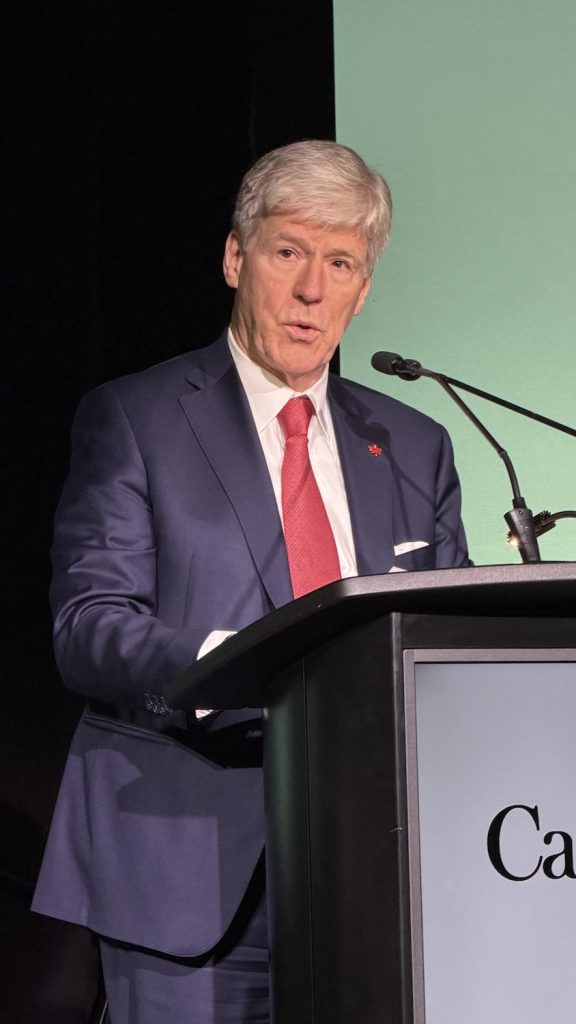 Tim Hodgson, Canada’s energy and natural resources minister, at PDAC on March 2. Credit: Resource Works News.
Cutting through the approvals maze
Hodgson also laid out a sweeping domestic agenda designed to match that ambition with action. A new permitting navigation tool will launch Tuesday on the NRCan website, offering mining proponents a clear roadmap through the federal approvals maze — a practical acknowledgment that regulatory complexity has cost the country projects and credibility. “One project, one review” agreements are now in place with seven provinces, from British Columbia to Prince Edward Island, representing a significant shift in how Ottawa and the provinces coordinate on major resource development.
A package of projects worth a combined $116 billion has already been referred for coordinated federal decision-making through the Major Projects Office, including the Foran McIlvenna Bay mine, the Red Chris copper mine expansion, Nouveau Monde Graphite, and the Sisson tungsten project.
Budget 2025 added further firepower: a $2 billion Critical Minerals Sovereign Fund, a $1.5 billion first-and-last-mile infrastructure fund, expanded tax credits covering 12 additional minerals, and a productivity super-deduction offering up to 100 percent accelerated write-down on certain mining properties.
Hodgson grounded much of the speech in history. Canada was built by miners, he argued, and it needs to remember that. Canadian nickel supplied 95 percent of Allied demand during the Second World War. Saskatchewan uranium defined the nuclear age. Prairie potash feeds the world. That heritage of building things under brutal conditions and against long odds is not nostalgia — it is, in his telling, the template for what comes next.
That argument carries weight well beyond the PDAC floor. For communities from northern British Columbia to the Canadian Shield to the Subarctic, resource development has historically meant jobs, roads, power lines, and real economic futures. The challenge — and it is a serious one — has always been converting that potential into durable policy and broad social support. Hodgson’s speech suggests Ottawa is at least trying to build both.
Indigenous participation as a structural pillar
Indigenous participation featured prominently. More than 17,300 Indigenous Canadians now work in the metals and mining sector, representing 11 percent of the total mining labour force. The minister framed growing Indigenous equity participation not as regulatory compliance but as a deliberate structural pillar of the sector’s expansion — and a driver of long-term prosperity for Indigenous communities.
The minister closed with a message aimed squarely at the investors in the room: Canada offers not just the geology, but the resolve to deliver on it.
For a country that spent years watching major projects stall in approval limbo while competitor jurisdictions moved faster, that resolve is exactly what the current moment demands — and what Tim Hodgson, at least, is wagering his mandate on.
Ian Biana writes for the Resource Works Accelerate team and can be reached at [email protected].
Resource Works News