
Could a frozen moon hide a boiling ocean under its icy skin? That idea may sound like science fiction, but new research shows it could be real. Many moons that orbit the outer planets look cold and lifeless.
Thick ice covers their surfaces. However, deep below that frozen layer, liquid water may exist. Since water is essential for life, scientists see these moons as exciting places to explore.

A recent study published in Nature Astronomy takes a closer look at what happens under the ice. The research explains how hidden oceans may shape the strange landscapes seen on some of these distant worlds.
Hidden oceans on icy moons
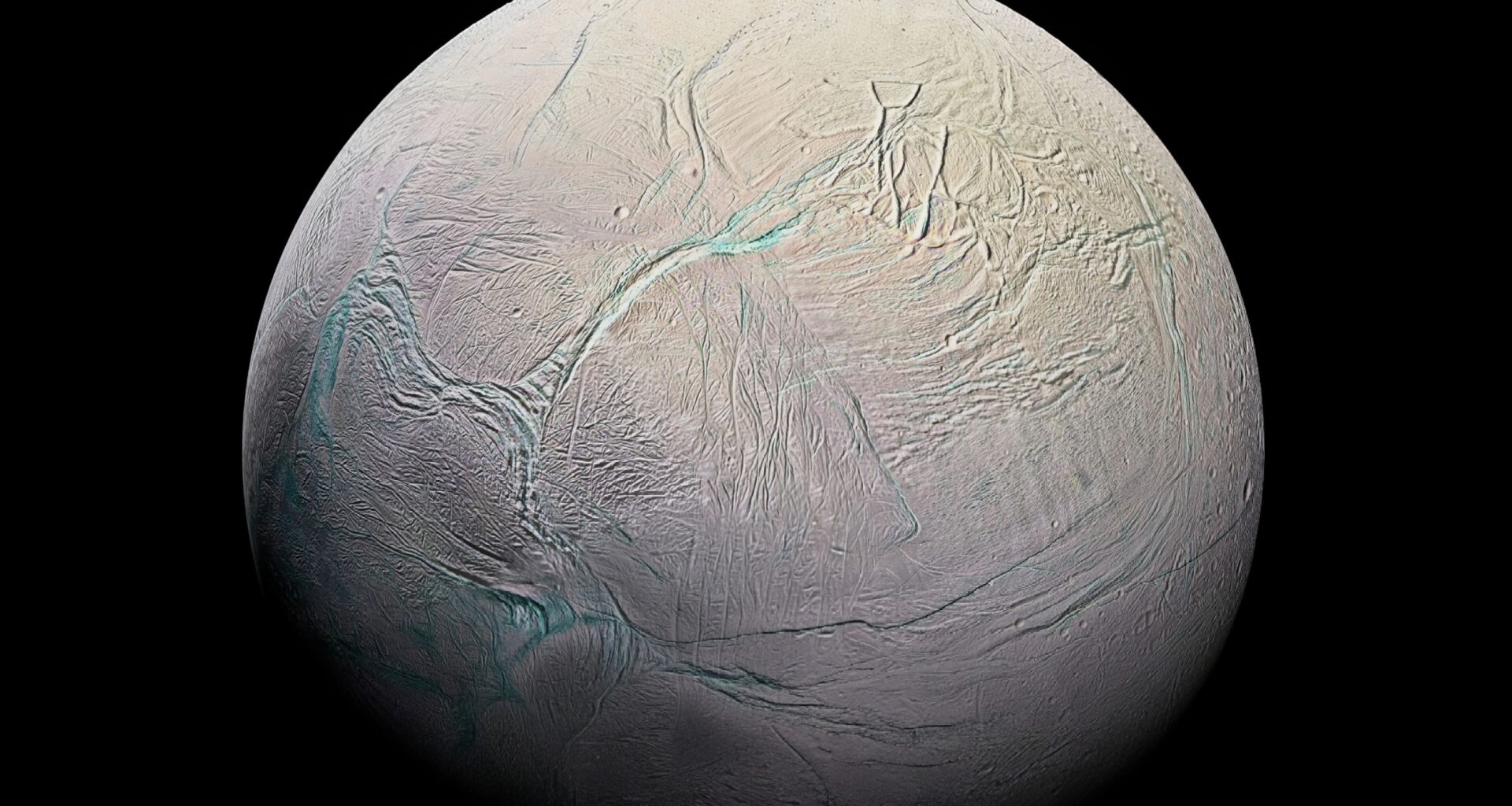
The outer planets, such as Saturn and Uranus, have dozens of moons. Many of these moons are covered in thick ice. Scientists believe that some of them, including Saturn’s moon Enceladus, contain large oceans trapped between an icy crust and a rocky core.
Max Rudolph, associate professor of earth and planetary sciences at the University of California, Davis, led the new study.
“Not all of these satellites are known to have oceans, but we know that some do,” he said. “We’re interested in the processes that shape their evolution over millions of years and this allows us to think about what the surface expression of an ocean world would be.”
This research helps scientists understand how a hidden ocean can change the surface over long periods of time.
The power of tidal heating
On Earth, heat from inside the planet drives volcanoes, earthquakes, and mountain building. On icy moons, water and ice take over that role.
Heat does not come from the Sun alone. Instead, strong gravity from giant planets like Saturn creates tidal forces.
As a moon moves around its planet, gravity stretches and squeezes it. Nearby moons also add extra gravitational pulls. This constant motion creates heat inside the moon. Scientists call this process tidal heating.
When heating increases, the ice shell melts from below and becomes thinner. When heating decreases, the ocean begins to freeze, and the ice shell grows thicker again. This cycle can continue for millions of years.
Freezing and growing pressure
Earlier research by Rudolph and his team explored what happens when the ice shell thickens.
When water freezes, it expands. Ice takes up more space than liquid water. This expansion increases pressure inside the moon.
That pressure can crack the surface. On Enceladus, long fractures known as tiger stripes stretch across the icy crust. These dramatic cracks may have formed because freezing water pushed outward against the shell.
This idea shows how changes deep below the surface can create visible features above. Even though the ocean stays hidden, its effects appear on the outside.
When oceans start to boil
The new study looks at the opposite situation. What happens when the ice shell melts and becomes thinner?
As ice melts into liquid water, pressure inside the moon drops. On smaller moons, this drop in pressure can be strong enough to reach what scientists call the triple point.
At this special condition, ice, liquid water, and water vapor can exist at the same time.
If pressure falls low enough, parts of the ocean could begin to boil. This boiling would not look like a pot on a stove. Instead, water would slowly turn into vapor deep below the ice.
The team suggests that this process may explain unusual features on Miranda, a moon of Uranus. Images taken by NASA’s Voyager 2 spacecraft show huge ridges and tall cliffs called coronae. Ocean boiling beneath the surface may have helped create these dramatic landforms.
Why size makes a difference
Size plays an important role in how a moon reacts to melting and freezing. Mimas, a small moon of Saturn, measures less than 250 miles across.
A giant crater covers much of its surface, giving it the nickname Death Star. At first glance, Mimas looks inactive and heavily damaged by impacts.
However, scientists have noticed a slight wobble in its movement. This wobble hints at a hidden ocean beneath the ice.
Because Mimas is small, the ice shell may thin without cracking. As a result, the moon could hide an ocean while still looking quiet and frozen on the outside.
Larger moons behave differently. Titania, another moon of Uranus, has stronger gravity. When melting lowers pressure, the ice shell may crack before boiling begins. Titania’s surface features may show a history of thinning and thickening ice over time.
Learning from distant worlds
Studying icy moons helps scientists understand how planets and moons change over billions of years.
On Earth, geology reveals clues about the past. In the same way, cracks, ridges, and cliffs on icy moons tell a story about hidden oceans and shifting ice shells.
Organizations such as NASA and research teams at UC Davis continue to study data from spacecraft like Cassini and Voyager 2. Each discovery brings new questions and new excitement.
Frozen moons may look lifeless from far away. Yet beneath the ice, powerful forces may shape oceans that boil, freeze, and move. These hidden processes could even create conditions suitable for life. The search for answers continues, one icy world at a time.
The study is published in the journal Nature Astronomy.
—–
Like what you read? Subscribe to our newsletter for engaging articles, exclusive content, and the latest updates.
Check us out on EarthSnap, a free app brought to you by Eric Ralls and Earth.com.
—–