
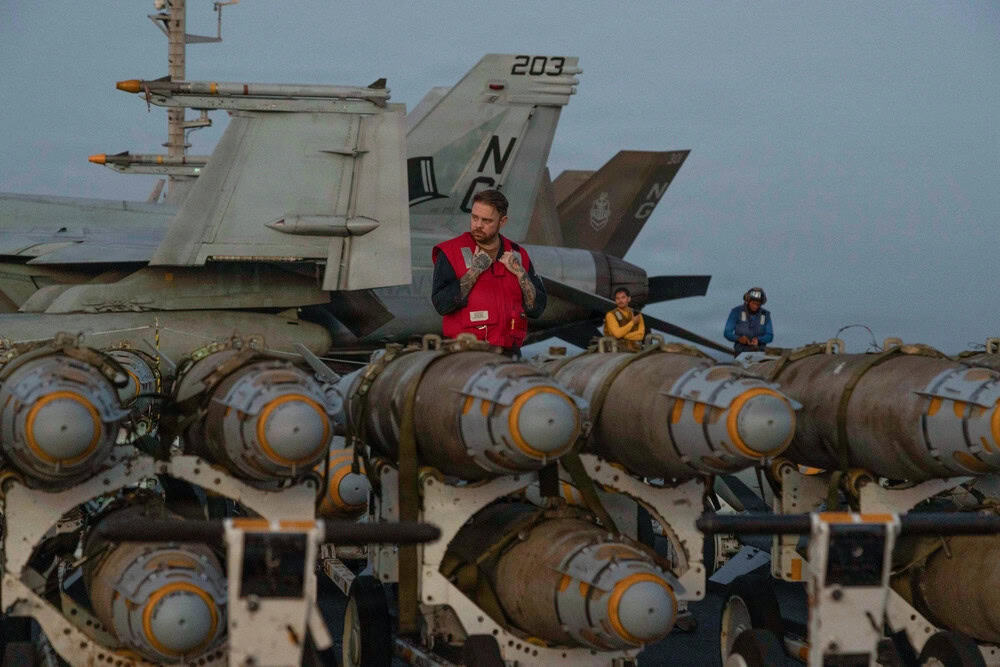
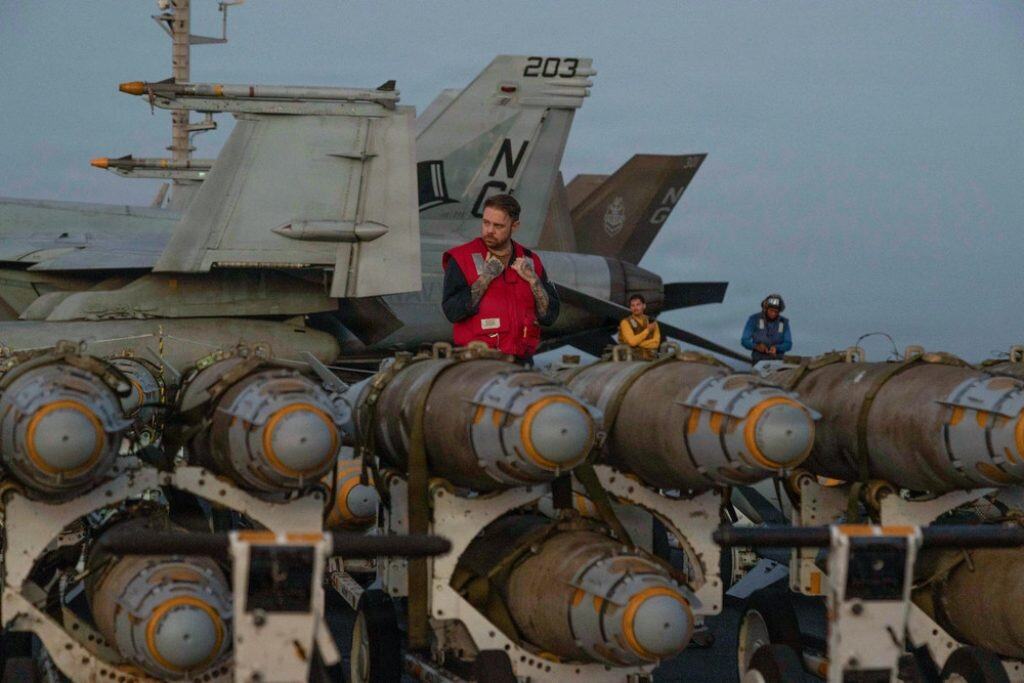
 “US Sailors transfer ordnance on the flight deck of Nimitz-class aircraft carrier USS Abraham Lincoln (CVN 72), in the Arabian Sea, Feb. 27, 2026.” (US Central Command Public Affairs)
The United States and Israel launched an ambitious, large-scale war against the Islamic Republic of Iran on February 28, and US officials have communicated several goals for the campaign. Speaking to reporters at a press conference on March 2, Secretary of War Pete Hegseth and Chairman of the Joint Chiefs of Staff General Dan Caine stated that the American military objectives in Iran were to “destroy” the threat of Tehran’s ballistic missile arsenal, its navy, and the remnants of its nuclear program.
So far, American and Israeli forces have inflicted severe damage to those capabilities and the regime’s leadership, but the ultimate costs, duration, and outcome of the conflict remain unclear. Indeed, General Caine cautioned that the “military objectives that CENTCOM and the Joint Force have been tasked with will take some time to achieve, and in some cases, will be difficult and gritty work,” warning that “we expect to take additional losses.”
The United States and Israel demonstrated unprecedented coordination and delivered impressive blows against Iranian military capabilities in the early stages of the operation. Now, as Tehran lashes out against US forces and regional partners, Washington and Jerusalem face the immediate challenge of striking Iranian ballistic missiles, drones, and their launchers on the ground before they can be fired, along with intercepting any projectiles that Iran has successfully launched before they hit military and civilian targets.
The initiation of the American operation, named “Operation Epic Fury,” followed a massive buildup of US military forces in the Middle East over the past month. These assets included a large naval force, including two carrier strike groups and several destroyers. The Pentagon also surged extraordinary air power into the region before the operation, including F-15, F-16, F-22, and F-35 fighters, as well as intelligence and refueling aircraft, and additional air defenses.
With these assets and others in place, US forces began executing large-scale strikes across Iran from the air, land, and sea to “dismantle the Iranian regime’s security apparatus.” According to Caine, the attack began with US cyber and space assets degrading and disrupting Iranian surveillance, communications, and command and control, followed by naval-launched Tomahawk cruise missiles against targets “across the southern flank of Iran.” More than 100 American aircraft, including fighters, bombers, aerial refueling tankers, and electronic warfare aircraft, participated in the initial stages of the operation.
In the campaign’s opening days, US forces targeted Iranian command-and-control assets, air defenses, ballistic missiles, drones, and naval assets, striking over 1,000 targets in the first 24 hours alone. In addition to the fighter aircraft in theatre, American B-2 and B-1 long-range bombers, at least some of which were launched from the United States, conducted strikes against Iranian ballistic missile capabilities. Initial US strikes also inflicted significant damage on the Iranian navy, hitting roughly a dozen Iranian submarines and surface vessels, including at least one Iranian corvette and a maritime drone carrier.
In addition to air and naval assets, ground-based High Mobility Artillery Rocket Systems (HIMARS) conducted long-range strikes against regime targets, reportedly firing Precision Strike Missiles (PrSM). Additionally, for the first time in history, American forces employed one-way attack drones modeled after the Iranian Shahed, which has been used to attack American forces for years.
Together, these combined US capabilities delivered initial strikes that severely damaged Iranian command and control, air defense, ballistic missile, drone, and naval capabilities. Furthermore, US forces were able to establish what Caine described as “local air superiority,” which will enable them to continue prosecuting strikes against key targets inside Iran.
American forces have also been engaged in defensive operations alongside partner forces throughout the Middle East, defending against hundreds of Iranian missile and drone attacks against military installations and civilian sites in Qatar, the UAE, Saudi Arabia, Kuwait, Bahrain, Iraq, and Israel. According to General Caine, American Patriot, THAAD, and ballistic missile-defense Aegis destroyers have all been employed as part of a theatre-wide Air and Missile Defense (AMD) network to defend against Iranian ballistic missile attacks. Likewise, American and various partner forces have employed aircraft and other counter-drone systems to defend against Iranian long-range one-way-attack drones.
Despite the large-scale, integrated defensive effort, Iranian missiles and drones have struck targets across the Middle East, including American military bases. Six American service members were killed, and several more were wounded by the afternoon of March 2. Three American F-15 fighters were also downed in a friendly fire incident in Kuwait on March 1. The aircraft’s pilots and Weapon Systems Officers successfully ejected and were safely recovered.
Several Gulf States have sustained damage to civilian and energy infrastructure, with Iran blatantly striking civilian targets, such as airports and hotels in Arab capitals. So far, Iran’s decision to lash out at its Gulf neighbors appears to have backfired, triggering joint condemnation from Bahrain, Jordan, Kuwait, Qatar, Saudi Arabia, and the UAE, and even reportedly prompting Qatar to shoot down two manned Iranian aircraft on March 2.
In a sign of the deep levels of coordination between US and Israeli forces, Caine noted that the initiation of the American strikes was “based on a trigger event conducted by the Israel Defense Forces, enabled by the US intelligence community.” The Israeli operation, dubbed “Roaring Lion,” has also been impressive in size and scope, utilizing approximately 200 aircraft and conducting over 1,000 sorties by March 2.
In concert with US forces and utilizing American-made, Israeli-modified F-15, F-16, and F-35 fighters, the Israeli Air Force struck hundreds of Iranian targets in the opening hours of the operation, including air defenses, missile launchers, and command-and-control sites. Additionally, in close intelligence coordination with the United States, Israeli forces struck at least 40 senior leaders in the upper echelons of the Iranian regime, including Supreme Leader Ali Khamenei.
Like the United States, Israel is also defending against Iranian missile and drone attacks as it simultaneously prosecutes its large-scale air campaign in Iran. Israel’s multilayered air defense systems have worked to intercept hundreds of Iranian missiles and dozens of drones. Despite these defenses, a number of missiles have impacted throughout Israel, including a ballistic missile strike in Beit Shemesh that killed nine people on March 1. Simultaneously, Israel has defended against dozens of rockets and drones launched by Hezbollah from Lebanon, prompting Israel to conduct strikes and ground operations in response.
The initial phases of the combined US-Israeli operation achieved impressive operational successes against Iranian military capabilities and leadership, while demonstrating extraordinary coordination between American and Israeli forces stemming from years of training, planning, intelligence-sharing, and broad-ranged security cooperation. However, despite these early gains, the US and Israel face the immediate challenge of limiting Iran’s ability to retaliate against military and civilian targets.
This effort will require American and Israeli forces to strike Iranian missile and drone launch sites and capabilities as quickly as possible, as Iran races to employ and fire its remaining weapons before they can be detected and destroyed on the ground. In concert with this air-to-ground suppression campaign, American and Israeli military planners are likely keeping a close eye on their respective AMD capacities. Israel has been forced to expend large quantities of interceptors throughout its multi-layered air defense network over the past two years, while American AMD capacity has been strained across multiple theatres.
While the duration and eventual political outcome in Iran are uncertain, the top priorities for American and Israeli military forces are clear. Among them is destroying as many of Tehran’s missile and drone capabilities as possible before they can be fired at Americans, Israelis, and citizens of Arab partner states.