
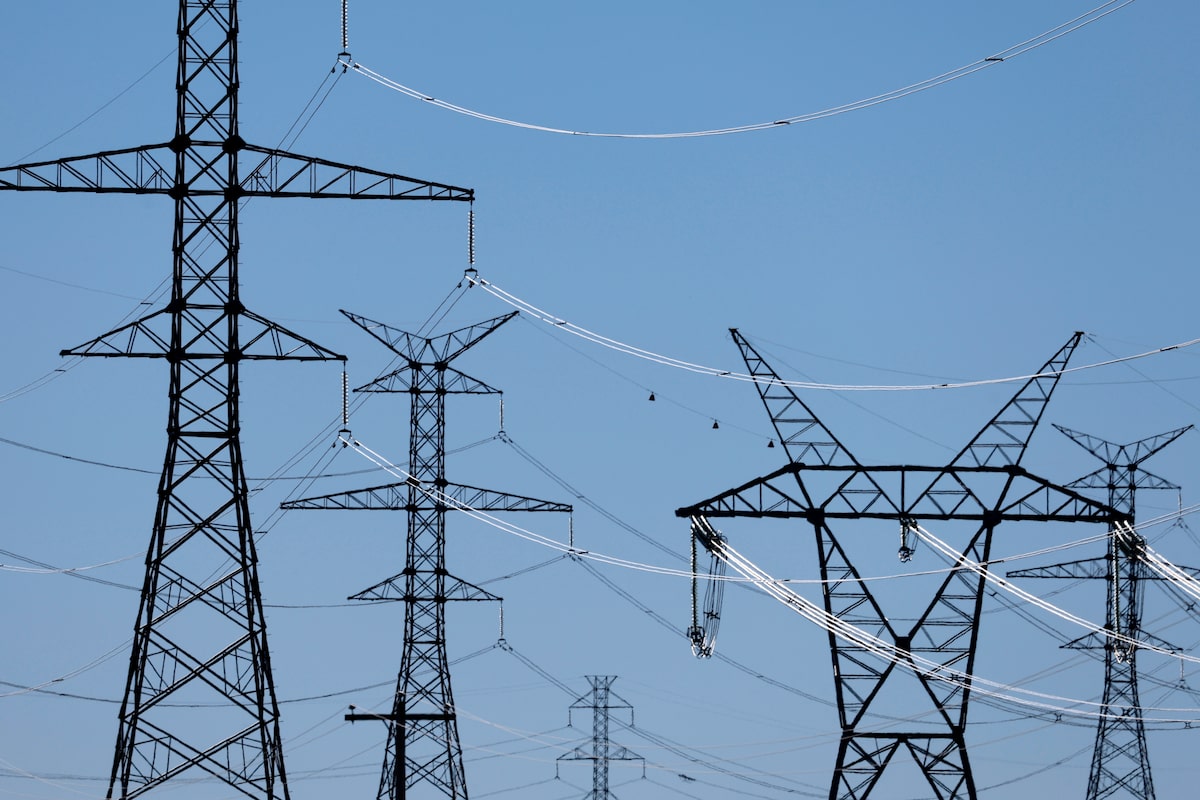
Federal backing for electricity transmission projects is aimed at boosting access to potential resource projects.Larry MacDougal/The Canadian Press
The federal government is committing more than $100-million to three electricity transmission projects in Western Canada, in a bid to boost access to potential resource projects.
The funds, announced on Tuesday by Energy and Natural Resources Minister Tim Hodgson at a global mining conference in Toronto, are to be drawn from the government’s First and Last Mile Fund, which is for infrastructure to support critical minerals supply chains. Two of the projects are in British Columbia, one in the province’s north and another in its interior, while the third is in eastern Saskatchewan.
It’s a somewhat unusual foray for Ottawa. While the government has typically been willing to put money behind power transmission between provinces, it has been more reluctant to directly fund transmission lines within individual provinces, leaving federal involvement mostly to agencies such as the Canada Infrastructure Bank that offer concessional financing rather than grants.
Globe Climate: Winds of change
But it may set the stage for further federal spending interventions in this area of provincial jurisdiction, as Ottawa seeks to expand and leverage Canada’s relatively ample supply of low-carbon electricity toward opening up more economic opportunities.
In an interview with The Globe and Mail following the announcement, Mr. Hodgson said that more details on how Ottawa sees its growing role in facilitating power projects will be provided in a new national electricity strategy that Prime Minister Mark Carney has promised to deliver soon.
Mr. Hodgson said the strategy will include responding to “two tectonic shifts” – electrification of energy use on the path to a net-zero emissions economy, and growing electricity demand caused by the ramp up of artificial intelligence.
On the power needs of resource projects specifically, Mr. Hodgson said, the First and Last Mile funding reflects “a recognition that oftentimes in Canada, the difference between having a successful mine or value-added converting facility is the lack of infrastructure, and this is a way to try and plug that gap.”
The projects for which funding was announced on Tuesday are seen by Ottawa as fitting that mould.
Upgrading B.C.’s Northwest Transmission Line (NTL), toward which Mr. Hodgson pledged $44.2-million, is meant to bolster electricity supplies to the mineral-rich Golden Triangle in B.C.’s northwest. Among the NTL’s benefits touted in Ottawa’s announcement are power supply to the Red Chris copper mine expansion (which was among the first referrals by Mr. Carney to the new federal Major Projects Office) and construction of a gold and copper mine by Seabridge Gold.
Opinion: Artificial intelligence: the good, the bad and the ugly environmental costs
The other B.C. project to receive First and Last Mile funding is an upgrade to the provincial grid primarily to support Teck Resources Ltd,’s Highland Valley copper mine near Kamloops. That mine – which also produces molybdenum, an additive used to strengthen steel – is set for work to expand its lifespan from 2028 to 2046.
While Ottawa’s commitment of $50-million toward those upgrades was its largest on Tuesday, part of the money is to go toward additional generation capacity at a regional substation – another form of energy spending usually left to the provinces.
Another, much smaller B.C. investment also announced by Mr. Hodgson at the mining conference is $1.9-million to go toward a transmission line and other infrastructure for the Wicheeda Rare Earth Elements Project near Prince George.
The Saskatchewan investment, meanwhile, is to see $18-million in federal funds for planning and design work for a pair of new transmission lines that would connect existing northern and southern power grids.
The West wants in on nuclear power plants. Are they ready to buy this time?
In its announcement, Ottawa identified the Athabasca Basin as a region that would benefit from that work, with mining opportunities for uranium, copper and zinc, as well as more reliable electricity for remote communities.
The extent to which Ottawa is similarly looking to directly fund projects in other provinces is not clear.
Asked in the interview how the government will evaluate further requests for that form of backing – such as in Ontario, which has power needs in its northern Ring of Fire, and Quebec – Mr. Hodgson highlighted other federal entities including the Infrastructure Bank and the Indigenous Loan Guarantee Program, which offer financing rather than grants.
Those options may also still be in play for some of the projects that received funding on Tuesday.
But for plugging gaps that stand in the way of resource projects, Mr. Hodgson said, “the First and Last Mile Fund gives us incremental tools.”
With a report from Brent Jang