
By Rita Konya & Tokunbo Salako
Published on 04/03/2026 – 7:21 GMT+1•Updated
7:57
The exhibition Long Live Dictatorship! at Godot Institute of Contemporary Art in Budapest is not just a retrospective of one of Hungary’s most well known satirists, but a presentation of a complex, layered artistic universe.

ADVERTISEMENT
ADVERTISEMENT
From paintings, characters to visual and verbal motifs or spatial installations, they all assemble to form a unity that draws out DrMáriás‘s distinctive, instantly recognisable vision.
Born 60-years ago in Serbia’s second largest city Novi Sad, DrMáriás, aka Béla Máriás, is a visual artist, writer and musician. Since the 1980s, he has been a leading figure in the Hungarian alternative and contemporary art scene.
His paintings, writings and music are closely intertwined: his art is characterised by ironic humour, striking colours and political and social reflections. His work is a synthesis of the Eastern European historical experience, identity and freedom. It certainly challenges anyone to feel indifferent.
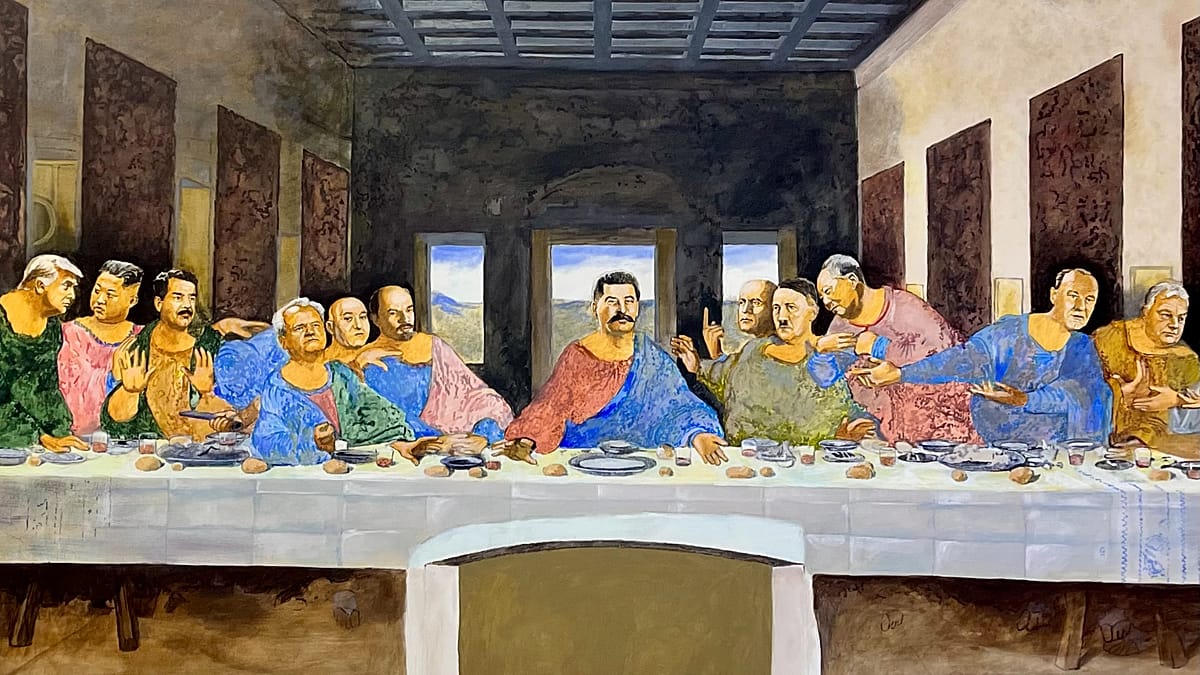
He is best known to the general public for his portrayal of political and public figures, placing them in grotesque situations, paraphrasing works that are well known in art history. These works predominate in the exhibition, and the Hungarian-themed paintings have a dash of extra piquancy because there will be elections in Hungary in April.
“The slightly North Korean design is the result of the fact that we Hungarians too have become a little North Korean in the rather extreme, ideological systems of recent decades. But that’s OK, we are still very optimistic and hopeful. Péter Magyar and Viktor Orbán are making peace so that they can work together to make the country flourish”, the artist explained in front of one of his paintings.
Figures from world history and politics are frequent characters in the portraits. A depiction of the President of the European Commission, Ursula von der Leyen, takes pride of place on one wall of the show as she appears on the canvas as a Hungarian mythological miracle deer.
“The miracle deer, which the Hungarians hunt, is female in this case. She has been hit with arrows a few times, we can see. We could also call this image a vision of Viktor Orbán’s dream”, drMáriás explained.
However, the best-known faces remain the leaders of Hungary’s two major parties who feature throughout the exhibition. A special room has been opened on one floor for Prime Minister Viktor Orbán, as well as for TISZA Party President Peter Magyar, on another floor of the gallery. There are not only paintings and posters of the two politicians, but also video installations, which are the joint works of Oliver Lehel and drMáriás.
The material on display ranges from early paintings with a punk sense of freedom to later works that condense political and historical reflections. Special emphasis is also given to paper chip paintings never seen before.
“There are also some paintings that were made in the 1980s and 1990s and therefore are not very familiar to the Hungarian public, this is a very big novelty,” explained Borbála Laczkovich, artistic director and curator of the exhibition. “It’s a completely different side to drMarias, because he has a much more lyrical side, linked to punk and the underground, but also a much more lyrical line that he takes, and we’re showing that now.
“Such works as the lace paintings or The Struggle of the Creator, are being shown for the first time in Hungary,” addedLaczkovich.
Long Live the Dictatorship is on at the Godot Institute of Contemporary Art in Budapest, until 30 April 2026.