
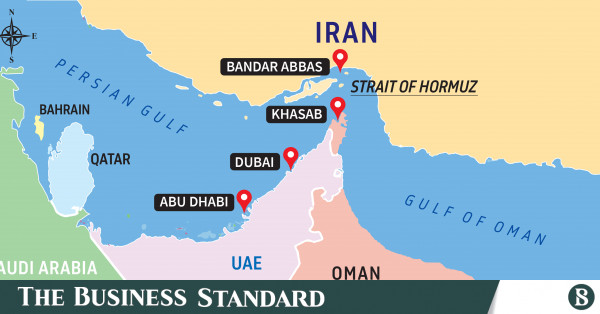
At its narrowest navigable point, the Strait of Hormuz is just 21 nautical miles (38.9 km) wide, with shipping lanes only two miles across in each direction. Yet through that corridor passes roughly one-fifth of global petroleum liquid consumption.
Few geographic passages combine such physical fragility with such systemic importance. That is why the Strait of Hormuz is widely regarded as a strategic chokepoint — the fulcrum of global stability.
The implications of a disruption, partial or total, would not be confined to the Gulf. They would cascade across energy markets, freight systems, insurance premiums, inflation indices and food supply chains. For import-dependent economies like Bangladesh, the shock would be immediate.

Keep updated, follow The Business Standard’s Google news channel
Why Hormuz is a chokepoint
The Strait connects the Persian Gulf to the Gulf of Oman and onward to the Arabian Sea. It is the only sea passage for crude exports from major Gulf producers: Saudi Arabia, Iraq, Kuwait, the United Arab Emirates, and Qatar. About 20–21 million barrels per day (bpd) of crude oil and petroleum liquid transit through the Strait — equivalent to around 20% of global oil consumption.
In addition, about 20% of global liquefied natural gas (LNG) trade passes through Hormuz, largely from Qatar, the world’s largest LNG exporter. Unlike oil, LNG trade is less fungible in the short term as tankers are destination-specific, contracts are structured, and regasification capacity is fixed.
This concentration is what makes Hormuz a chokepoint. There is no alternative sea route for most Gulf producers. Pipeline bypass capacity is limited. Spare global production is thin relative to flows at risk.
Although Saudi Arabia and the UAE maintain pipelines that can partially bypass the Strait via the East-West pipeline to the Red Sea and the Abu Dhabi Crude Oil Pipeline to Fujairah, these pipelines cover only a fraction of total exports. A full closure would still strand a substantial share of Gulf supply.
Energy shock: The immediate impact
In an oil market already structurally tight, removing even a portion of Hormuz flows would generate a price spike. Historical precedents provide a benchmark.
During the 1973 oil embargo, prices quadrupled. During the 1990 Iraqi invasion of Kuwait, prices doubled within months. Even limited tanker attacks in 2019 led to temporary volatility.
If 15–20 million bpd were disrupted — even temporarily — oil prices could surge well above $150 per barrel in the short term, depending on duration and stockpile releases. The strategic petroleum reserves of major economies could cushion the shock for weeks or months, but not indefinitely.
The LNG dimension compounds the impact. Europe and Asia have become more dependent on LNG trade following disruptions in Russian pipeline gas. A blockade affecting Qatari exports would tighten LNG supply dramatically, pushing spot prices higher, particularly in Asia.
Energy price spikes would transmit rapidly into electricity tariffs, hiking transport costs, higher fertiliser price and industrial input costs. The inflationary pressure would be global.
Energy imports constitute one of the largest components of Bangladesh’s external payments; even a $10–20 per barrel increase sustained over several months can translate into hundreds of millions of dollars in additional expenditure.
Which economies depend most on Hormuz?
East Asia is the most exposed. According to the file’s figures, countries such as China, Japan, South Korea and India import a substantial share of their crude from Gulf producers whose exports pass through Hormuz.
China, the world’s largest crude importer, sources roughly 40–45% of its oil imports from the Gulf region. Japan imports more than 80% of its crude from Middle Eastern suppliers. South Korea is similarly dependent, with over 70% of crude imports tied to Gulf producers.
India relies on the Middle East for around 60% of its crude imports.
The European Union is less directly dependent than East Asia but still exposed through LNG imports and global price transmission.
The United States, now a net petroleum exporter, is less vulnerable in supply terms but would still face price volatility in global markets, since oil prices are globally benchmarked.
Why it remains the world’s most sensitive maritime corridor
Iran sits astride the Strait of Hormuz, the maritime corridor. Control over that passage does not mean uncontested authority, but it does confer disruptive capability. A recent estimate by JPMorgan suggested that any sustained blockade of Hormuz could push oil prices to $120 per barrel or higher, depending on duration and market reaction.
Unlike Venezuela, whose production is heavily weighted toward extra-heavy crude, Iran produces a diversified slate — light, heavy and blended grades. In theory, this flexibility allows Tehran to tailor cargoes to refinery specifications. In practice, sanctions have narrowed its customer base. The bulk of Iranian exports now flow to smaller independent Chinese refiners willing to process sanctioned crude at a discount. That pricing dynamic sustains volumes but reduces fiscal margins.
Approximately 98% of Iran’s oil exports are processed through a single offshore hub — Kharg Island. This concentration creates a structural weak point. The facility was reportedly struck in recent US and Israeli attacks, though the extent of the damage remains unclear. Any sustained impairment of Kharg would constrain Iran’s export capacity irrespective of Hormuz dynamics.
A prolonged blockade of the Strait would therefore be fraught with reciprocal risk. It would inflict pain on global markets but also on Iran’s own revenue streams. Moreover, Iran’s political and military command structure differs markedly from more personalised regimes.
While conflict typically exerts upward pressure on prices, the global oil balance currently includes an estimated 4 million bpd of surplus supply capacity. OPEC has already signalled readiness to increase output, and the United States has indicated that it does not presently intend to draw on its Strategic Petroleum Reserve.
These buffers moderate, though do not eliminate, price risk. Notably, Iranian strikes on Saudi facilities introduce a further escalation variable, as attacks on Gulf infrastructure historically produce sharper market reactions than threats alone.
However, the situation remains fluid. Iran retains the capability to target additional Gulf energy infrastructure, shipping lanes or allied assets, each of which could incrementally raise the geopolitical risk premium embedded in oil prices. At the same time, structural supply buffers and coordinated producer responses limit the likelihood of sustained extreme spikes — unless escalation becomes protracted.
Bangladesh: Direct and systemic exposure
Bangladesh imports virtually all of its crude oil and refined petroleum products, with a substantial portion sourced from Gulf producers whose exports transit the Strait. A sharp increase in global crude prices — particularly if Brent were to surge above $120–150 per barrel in a sustained scenario — would immediately inflate the country’s energy import bill. Given Bangladesh’s already sensitive current account position, such a spike could widen the trade deficit and exert renewed pressure on foreign exchange reserves.
Energy imports constitute one of the largest components of the country’s external payments; even a $10–20 per barrel increase sustained over several months can translate into hundreds of millions of dollars in additional expenditure.
The LNG dimension introduces a second layer of exposure. Bangladesh has increasingly relied on imported liquefied natural gas to support electricity generation and industrial activity. If Qatari exports were disrupted or redirected, spot LNG prices in Asian markets would likely spike sharply.
Bangladesh, which has historically relied on both long-term contracts and spot purchases, would face higher procurement costs. The government would then confront a policy trade-off: either absorb the shock through subsidies — worsening fiscal pressures — or pass the costs to consumers and industries through tariff adjustments.
These energy shocks would not remain confined to fuel markets. Bangladesh’s transport system is diesel-intensive, and higher fuel costs would quickly transmit into logistics and distribution expenses. Agricultural supply chains — particularly food transport from rural production zones to urban markets — would face rising costs, amplifying food inflation. Fertiliser prices, closely linked to natural gas markets, would also likely increase, further pressuring the agricultural sector.
Export competitiveness presents another vulnerability. Bangladesh’s ready-made garment sector — the backbone of its export earnings — depends on imported raw materials, stable freight rates and predictable energy costs. A Hormuz-driven spike in global shipping insurance premiums and bunker fuel costs would raise container freight rates. At the same time, inflationary pressures in key export markets such as the European Union and North America could dampen consumer demand. The combination of rising input costs and softening external demand would narrow margins in an already competitive sector.
There is also an indirect labour-market dimension. Gulf economies host a large Bangladeshi expatriate workforce whose remittances contribute significantly to foreign exchange inflows. A sustained regional conflict that disrupts Gulf economic stability could affect employment prospects, wage levels or remittance channels.
Even without physical displacement, slower Gulf growth driven by oil market volatility could moderate remittance growth — adding another layer of external vulnerability.
The impact on Bangladesh would likely manifest as a macroeconomic stress cycle: rising import bills, pressure on reserves, higher inflation, fiscal strain from subsidies, and potential currency depreciation.
The severity would depend on the duration of disruption. Short-term volatility could be absorbed through reserves and temporary fiscal adjustments. A prolonged closure, however, would require structural policy responses, including demand management, external financing support and accelerated energy diversification.
These are still the early days. The balance between leverage, vulnerability and escalation will determine whether the energy shock remains contained or evolves into a broader systemic disruption.