
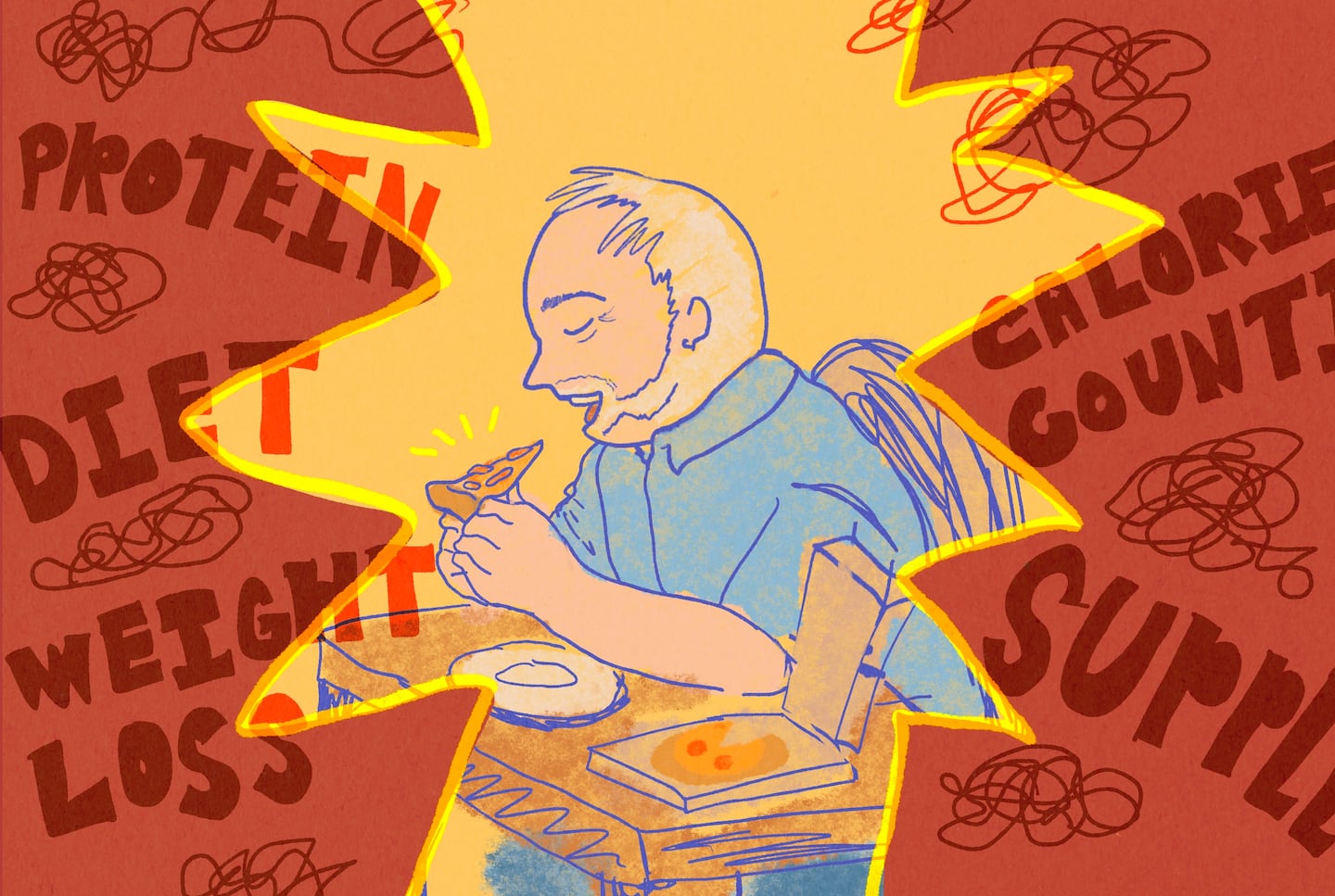
But now, as he waited for my mother in the cafeteria of a medical building, he’d ordered a bagel with full-fat cream cheese. At home, a slice of cheesecake was waiting.
“I’m on a new diet,” he said with his customary good cheer. “The ‘What the Hell’ diet.”
Get Love Letters: The Newsletter
A weekly dispatch with all the best relationship content and commentary – plus exclusive content for fans of Love Letters, Dinner With Cupid, weddings, therapy talk, and more.
No diet has ever sounded better. But was I old enough to start it?
When you’ve been a reporter for a long time and you cold-call the Society of Actuaries and ask if anyone there might be up for pondering the mortality implications of such a regimen, you don’t expect much.
But here was Nate Worrell, a fellow with the society.
“It’s a fun question,” he began, quickly explaining that as we grow older, “our chances of dying increase exponentially — sickness, cancer, aging . . .”
It wasn’t sounding, technically, “fun,” but then things took a happy turn. “When you get into 85-plus,” he said, “your death rate stops climbing as fast. It’s called the mortality plateau.”
The mortality plateau. Gotta love the Yelp reviews on that!
“You get to a certain point,” he explained, “and things begin to stabilize.
”One theory is that if you have the genetics for resilience — and cancer and other diseases haven’t taken you out — you’re going to keep going until something gets you that’s not genetic.”
As for how all this relates to the What the Hell diet, Worrell said that diet is but one piece of longevity. (Other pieces include: social connection, physical movement, good sleep, low stress, and financial resources, he said.)
At 93, you can afford to be a “little loosey-goosey,” he said, before advising me not to start any time soon.
“You’re climbing the mountain now,” he said, which I took to mean the mountain of death, and I reached for a calming spoonful of plain Greek yogurt.
How much longer must I wait? My next call was to Lynne Ahn, a gastroenterologist at Beth Israel Deaconess Medical Center, and an anti-aging regenerative medicine specialist at Ahn Point, her wellness practice in Wellesley.
I wanted a date I could enter in my Google Calendar — 6 p.m., March 3, 2041, French fries — but Ahn told me the answer is “nuanced.”
“It depends less on your chronological age than your biological age,” she said. “What matters more is how much physiological reserve you have — your muscle, your cardiovascular capacity, your metabolic stability, your cognitive strength. It’s all about how metabolically resilient you are.”
“The cheesecake isn’t going to tip him into decline,” she said of my dad. But for someone without such a solid, nearly century-long foundation, bad dietary habits can take a toll.
I couldn’t score a safe-to-start-by-age from Thomas Perls, a professor of medicine and geriatrics at the Boston University Chobanian & Avedisian School of Medicine, either.
And in fact, to my disappointment, Perls, who directs the New England Centenarian Study, made an argument for keeping up good habits
“If a person believes ‘the older you get, the sicker you get’ . . . then I can see how that person would also embrace a diet that shortens life expectancy.”
But, he said, studies have found that “the older you get, the healthier you’ve been.
“Achieving older age because of healthy habits means you are adding healthy, disability-free years to your life, not years of chronic illness and disability.”
Medicine obviously has a lot to teach us in this regard, but I wondered if another industry that balances the desire to binge with the need to save for the future — namely, financial planners — might, too.
Indeed, they are not totally dissimilar. “We do have clients that want the last check to bounce, the ‘what the hell’ retirement plan,” Gina Bolvin Bernarduci, president of Bolvin Wealth Management Group, told me in an email.
In a follow-up call, she clarified that this would amount to irresponsible financial planning. But, she said, some clients do ask her to figure out their spending numbers based on a shorter lifespan, 75, say, instead of 90, which is the default.
“It allows them to spend more,” she said.
As far as the diet, it can strike suddenly, known as acute-onset What the Hell. Or, as Moshe Waldoks, 76, rabbi emeritus at Brookline’s Temple Beth Zion, noted, it can be progressive.
“I’m not at What the Hell yet,” he said. “I’m at the ‘Are you really going to eat that?’ ” (This diet requires a second person, typically a spouse or other invested onlooker.)
Waldoks is a co-editor of “The Big Book of Jewish Humor,” and talking with him made me think of a joke my dad and I like, and which seemed relevant for its, let’s say, cheesecake implications.
A man goes to the doctor. “You have 12 hours left to live,” the doctor says. “Stay up all night making beautiful love to your wife.”
He hustles home to tell her. “That’s fine for you,” the wife says. “I have to get up in the morning.”
Beth Teitell can be reached at beth.teitell@globe.com. Follow her @bethteitell.