
Getting to Israel felt like a victory in itself. The historic snowstorm and bitter cold delayed our departure from Pittsburgh, but in late January we finally stepped off the plane. My husband and I are both professors of public policy at the University of Pittsburgh. We came to Israel because I have a Fulbright fellowship at Tel Aviv University to study the Abraham Accords and regional integration.
In a remarkably short time, the kids adjusted to new schools and new friends. Colleagues welcomed us. It already felt like home.
And then the war started.
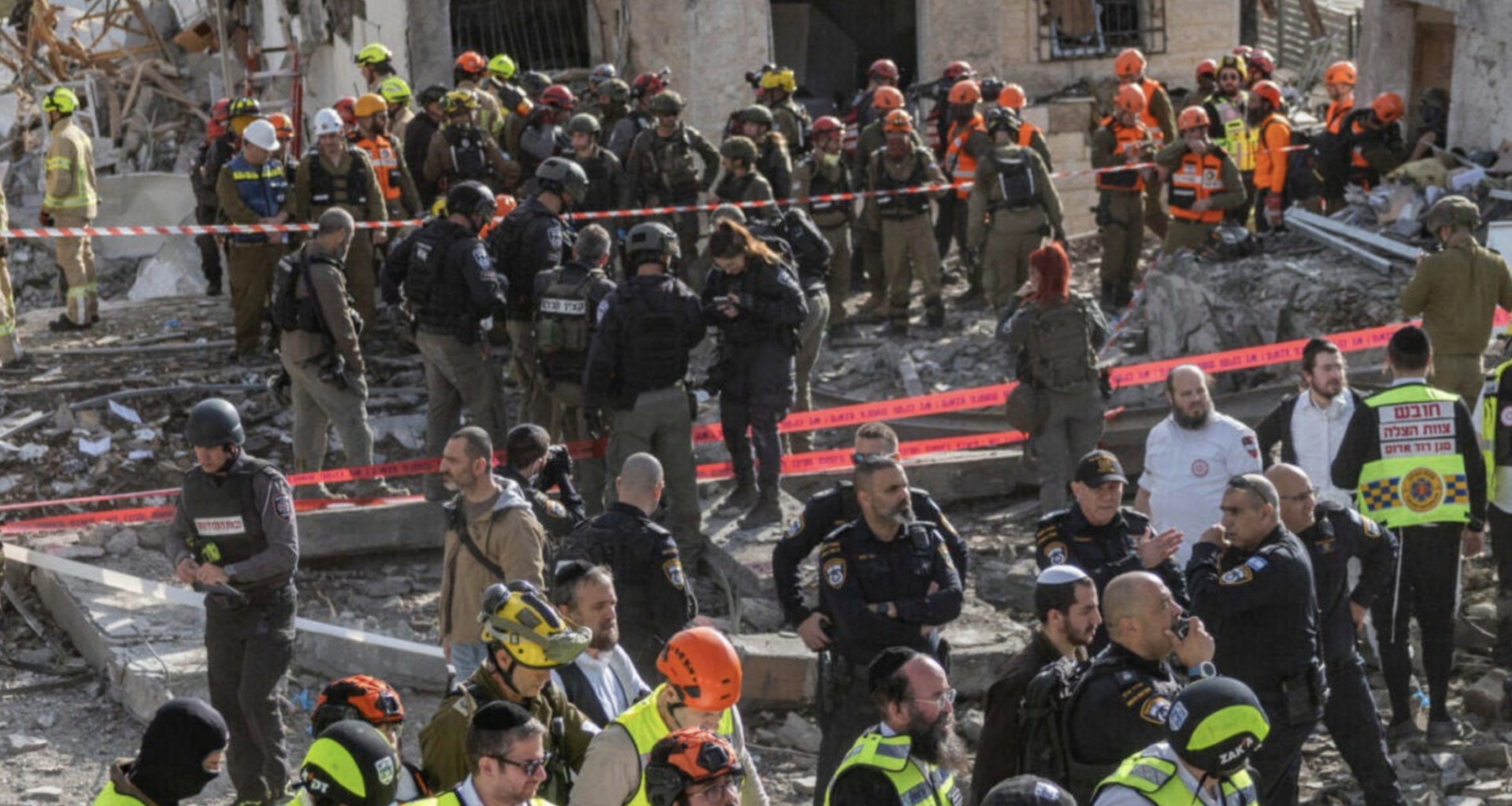
The war started on our moving day. Our task was simple: Get suitcases from one apartment to another across Tel Aviv. Anyone who has spent time in this city knows that parking here should be a sport in the Maccabi Games. But moving day during a war meant stopping the car every time the sirens sounded and rushing into the nearest shelter or random apartment building. Strangers waved at me and offered places to park, often quite illegally, and escorted a complete stranger inside. They didn’t ask me questions. They didn’t care.
When I returned to our first apartment to pick up the family after I had moved the suitcases to the new building, air sirens went off. The favor was easy to return. We saw strangers on the street scrambling to find a miklat (shelter) and we pulled them into our place, sat with them and waited it out. We made new friends. Tel Aviv is an incredibly diverse city, and in those moments, all anyone did was celebrate a shared humanity.
The grocery stores in Tel Aviv are slowly reopening. People are walking outside again. Every few hours, sirens send people running to the shelters, and then life resumes. My kids have turned the sprint downstairs into a game. They watch how other Israeli children handle it: Purim costumes on and laughter somehow intact. They are taking their cues from the resilience of the children they see. Babies on hips, parents playing cards, kids comparing candy stashes in the stairwell. This is what resilience looks like. It is seemingly ordinary and thus quite extraordinary.
What is most striking about this war is not the fear. It is the clarity. Israelis talk about this conflict not as a war against the ayatollahs but as a war for something: for a better future, for a better region, for the freedom of the people of Iran.
That distinction matters. Wars against something are defensive and exhausting. Wars for something carry meaning. They sustain people. The willingness to sacrifice, even personal safety, for the prospect of Iranian freedom is not something most outside commentary captures. But that hope is real and it seems to be sustaining people through this war. There is a hope that the changes the war will bring will allow this region to flourish as never before.
For years, the Israeli-Palestinian conflict defined how Israelis understood their place in the region: permanently embattled, permanently apart. The Abraham Accords began to change that.
For the first time, there was something bigger on the horizon: a region Israel could be part of, rather than apart from.
That shift in imagination is what gives this moment its promise despite all the risks and what can go horribly wrong.
Iran badly miscalculated. By attacking Arab countries, Tehran hoped to drive a wedge between Israel and its neighbors. It hoped to force Arab states to pressure the United States and Israel to stop and thus to fracture the emerging regional
architecture.
At least for now, the opposite seems to have happened. Rather than pushing countries away, the aggression of Iran drew them closer. Military and technical cooperation that would have been unthinkable a decade ago is unfolding in real time.
At least for me, it is hard to analyze geopolitics when you are living inside of it. I came to Tel Aviv to study regional cooperation and did not expect to be an eyewitness to it taking shape this fast.
Iran bet that the region would fracture as a result of its aggression. Instead, the coalition Iran feared is the coalition Iran created.
Whether that holds is an open question. But the trajectory is clear.
It is Purim in Israel and Israel is at war with the regime in Persia’s successor, Iran. Last night, my husband and daughter went to pick up a book from a new school friend nearby. The sirens rang. They ran into a shelter and found a kehillah reading the Megillah. They fulfilled the mitzvah in a random shelter in Tel Aviv. In the Book of Esther, Mordecai challenges Esther as she hesitates to approach the king on behalf of her people, “Who knows whether you have come to your position for such a time as this?” She acts and a people facing destruction from Persia find the agency to survive. What is visible from Tel Aviv right now is exactly that. Not just resilience but real agency for such a time as this. PJC
Jennifer Brick Murtazashvili is the founding director of the Center for Governance and Markets and a professor at the University of Pittsburgh School of Public and International Affairs.