
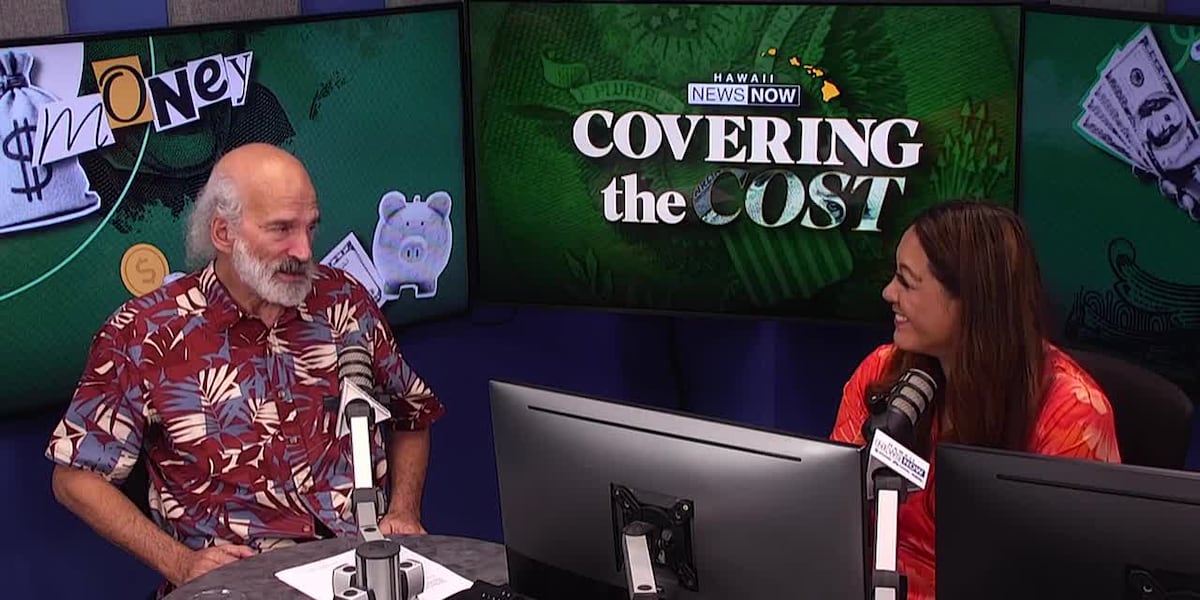
In HNN’s new livestream show “Covering the Cost with Annalisa Burgos,” we break down the numbers behind Hawaii’s affordability crisis in candid conversations with financial experts, entrepreneurs and community leaders.
HONOLULU (HawaiiNewsNow) – Most people do not understand how electric rates are set or what drives their utility bills.
In this episode of Covering the Cost, Annalisa Burgos sits down with energy policy expert Henry Curtis, executive director of nonprofit Life of the Land, to find out what it takes to lower energy costs for residents struggling with Hawaii’s high cost of living.
According to utility tracking site poweroutage.us, Hawaii residents pay the highest residential electricity rates in the United States, with an average of 41 cents per kilowatt-hour (kWh) and more than $200 in monthly electric bills. That is more than double the national average of 18 cents.
Hawaii’s electricity rate is set each month by the state Public Utilities Commission. For March, the rate is almost 43 cents per kilowatt-hour on Oahu and higher on neighbor islands. That’s mainly due to Hawaii’s reliance on fossil fuels and our island geography.
“If you look at islands throughout the world, they pay much higher rates than continents. Continents have large systems. They have economies of scale. They can trade electricity with each other,” Curtis explained.
“It is our use of fossil fuels is why it’s expensive,” he continued. “Switching to renewables will lower the price, lower the cost to everyone, offset by the fact that we have never addressed climate change. Greenhouse gasses are rising worldwide and therefore we have to harden the grid. We have to guard against wildfires and we have to do all these other mitigations, so the mitigations will drive up the price, while our converting to renewables drives down the price.”
Other charges on our bills come from costs faced by HECO or the Kauai Island Utility Cooperative related to fossil fuels, renewable energy, insurance, disaster-related liabilities, and more.
“It’s operating the grid, it’s managing the company, it’s vegetative management, it’s fighting against wildfires, it’s about paying taxes,” Curtis said.
“Because the cost of maintaining the grid is going up to fight wildfires and to fight against climate change, and because other costs are going up,” Curtis added. “It’s the rates are lower than they would have been if this hadn’t occurred, so it’s like a lower slope going up.”
For decades, HECO has controlled and generated power, mainly through fossil fuels, and managed electric grids across the islands.
State senators will vote on a measure next week to explore the pros and cons of restructuring HECO, with critics noting its current dual role poses a conflict that delays the benefits of renewable energy. Recent financial troubles tied to the Lahaina wildfires are also prompting lawmakers to look at other ways to upgrade the islands’ aging power system.
State Sen. Glenn Wakai introduced Senate Bill 3326, which tasks the Public Utilities Commission with creating a framework for separating HECO’s power generation business from its transmission and distribution services.
Bill supporters believe opening generation to the private sector will promote competition and investment, and drive lower rates and more reliable service.
But critics of the measure want more information about the impact of a restructuring and worry it would cause disruptions with no guarantee of lowering costs for consumers.
Curtis says independent producers are already coming in through the current competitive bidding process.
“They have to bid in and there’s a separate branch of the utility with a wall between them, a separate branch that evaluates all the bids, and there are monitors that the PUC oversees that makes sure that that HECO is not cheating,” he said.
He suggests less disruptive approaches, such as installing more rooftop solar systems, offering subsidies, and using plug-in solar.
Now with the U.S. and Israeli war with Iran, rates are expected to go up.
“A lot of oil flows through the Persian Gulf, and if that is all shut down because of this war that is spreading through the area that can have a drastic price and because Hawaii is powered by petroleum,” he said.
Curtis suggests consumers make changes to reduce electricity use if they want to lower their bills, through energy efficient upgrades and appliances.
Catch “Covering the Cost with Annalisa Burgos” Wednesdays at 12:30 p.m. online, on HNN’s streaming app and anywhere you get your podcasts.
From skyrocketing housing prices to the country’s highest tax burden, Annalisa is covering the cost of aloha in America’s most expensive state and offering practical strategies, policy insights, and honest talk about what it really takes to call Hawaii home.
Copyright 2026 Hawaii News Now. All rights reserved.