
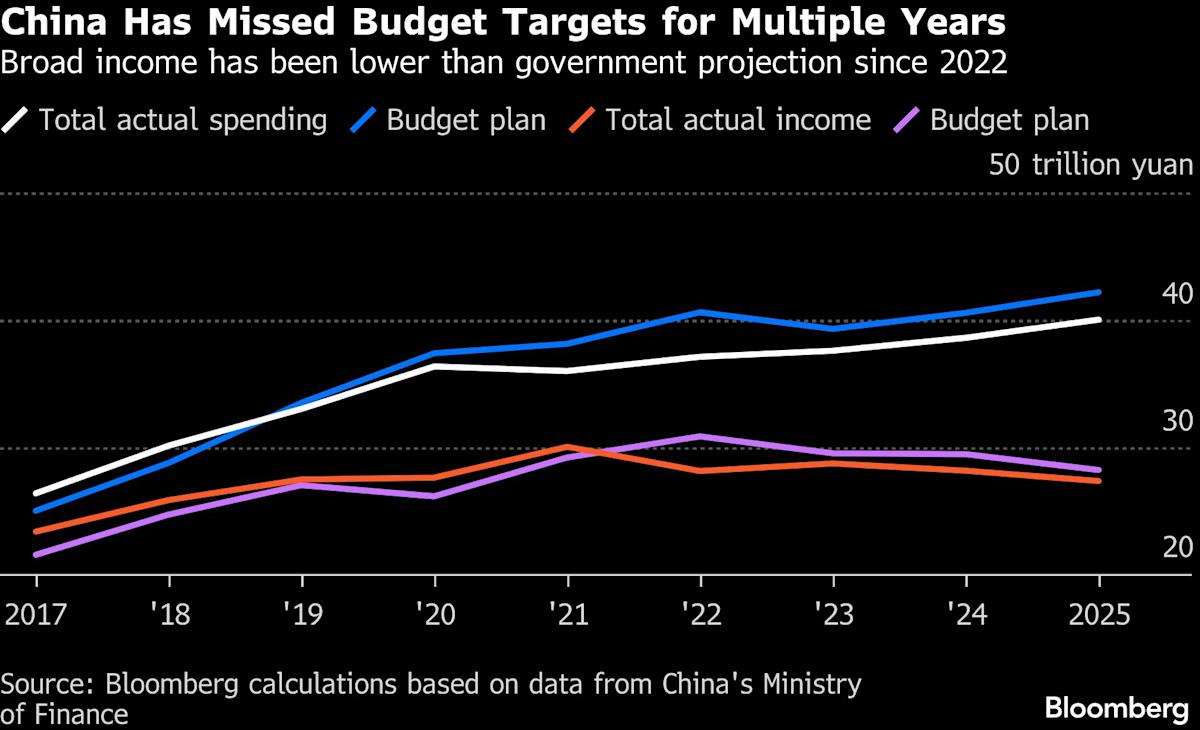
(Bloomberg) — China signaled it’s modestly dialing down fiscal stimulus this year, a rollback after a trade war with the US that still allows for further support in the face of geopolitical uncertainty abroad and the dangers stalking the economy at home.
The broad budget deficit projected by the Ministry of Finance will decline to around 9.5% of gross domestic product this year from the 9.9% in its 2025 plan, according to Bloomberg calculations based on official data. The reduction came alongside an announcement on Thursday that the government is cutting this year’s target for GDP growth to 4.5%-5%, the lowest since 1991.
Most Read from Bloomberg
 Photographer: Qilai Shen/Bloomberg
Beijing is seeking a balance between supporting growth and reining in debt risks. Resilient Chinese exports and a tariff truce with the US have bought time for the government to avoid aggressive stimulus just yet.
But officials also need to save the room for additional easing later into the year, as the widening military conflict in the Middle East risks causing a new disruption to trade while endangering supply chain stability.
“Budgeted support for growth is clearly weaker than last year,” said Jacqueline Rong, chief China economist at BNP Paribas SA. That said, fiscal policy can be stepped up if economic growth drifts toward the lower bound of the targeted range, with 4.5% likely a “hard floor,” she said.
The official fiscal shortfall, which only covers the general public budget, will stay at a record-high 4% of GDP for a second year running. China has now set it above 3% five times since 2020, first breaching that implicit ceiling to absorb the pandemic shock and then to cope with intensified trade tensions.

A better measure of fiscal stimulus is the broad deficit. It refers to the gap between the combined spending and the total revenue under the general public budget and the government-managed fund budget — the two main books in China — before items like carry-over funds from the previous year are included.
“We still have the policy room,” Chen Changsheng, a member of the team drafting this year’s Government Work Report, said when asked about how authorities can be more proactive given their fiscal and monetary guidance is largely unchanged from last year.
China’s government debt-to-GDP ratio remains relatively low and the central bank still considers conditions to be favorable to cut rates and provide more liquidity, he said at a briefing Thursday.
Story Continues
“Despite the large amount of unused funds carried over from last year, the fiscal deficit ratio is kept unchanged at 4%, reflecting lingering concerns about fiscal revenue, and the need to preserve policy space to respond to the uncertainties of this year’s international trade and economic tensions,” said Zhaopeng Xing, senior China strategist at ANZ Bank China Co.
Separately, the central and local governments will sell a total of 6 trillion yuan of special bonds this year, down from 6.2 trillion yuan a year earlier, as less funding goes toward boosting capital at state banks.
The bonds, recorded in the fund budget, are also meant to finance key national infrastructure and security projects and a program of subsidies to encourage household and corporate spending. They are also part of an effort to rein in property risks and so-called hidden local debt.
Some 250 billion yuan in the ultra-long sovereign bonds is earmarked for providing subsidies for consumers to upgrade to new smartphones, cars and home goods, versus 300 billion yuan last year.
In addition, China plans a total of 800 billion yuan in new policy financing tools — a quasi-fiscal instrument used to drive investment, Premier Li Qiang said while delivering the government report Thursday. The instruments could be supported by the central bank through cheap credit, alongside debt issuance by state-run policy lenders.
The tools underscore “a clear commitment to stabilizing investment and arresting its decline,” ANZ’s Xing said. He expects the central bank to support the funding with Pledged Supplemental Lending, a tool it used to bolster the slowing property market a decade ago.
Implementation of the budget will be key to watch throughout the year. The actual broad deficit logged last year was 9.5%, compared with 9.9% set in the 2025 budget.
In recent years, Chinese authorities have indicated a preference for delivering just enough stimulus to reach their growth target. A decline in budget income is constraining the scope for more aggressive easing, with the government’s broad revenue failing to meet the official target for the fourth straight year in 2025.
The outstanding amount of fiscal deposits as of the end of 2025 was 13% above its level a year ago, implying around 700 billion yuan of unspent funds is available for deployment this year if necessary, Goldman Sachs Group Inc. economists including Lisheng Wang wrote in a note last week.
What Bloomberg Economics Says…
“A slightly lower deficit ratio target does not necessarily mean weaker fiscal support. Delivery will be key. China often takes a flexible approach in execution, leaving room to scale up stimulus if needed.”
— Chang Shu, David Qu and Eric Zhu. For full analysis, click here
Fiscal policy has had to take the lead in spurring the economy as shrinking bank profit margins and subdued demand for credit constrain the scope for monetary easing. While frictions with the US have eased after a tariff truce in October, Beijing is still having to contend with threats to reaching its growth goal this year.
Consumer and business confidence has stayed weak and investment is contracting under pressure from deflation and a years-long property slump. Meanwhile, the war in Iran, the volatile outlook for US tariffs, and growing trade protectionism in other countries are adding to external uncertainties.
“The budgeted fiscal support is sufficient for 4.5%-5% growth,” said Ding Shuang, chief economist for Greater China and North Asia for Standard Chartered Plc. However, “it may be unrealistic to expect the budget will be fully implemented,” he said, predicting GDP will expand 4.6% this year.
–With assistance from Colum Murphy, Wenshan Luo, Wenjin Lv and James Mayger.
(Updates throughout.)
Most Read from Bloomberg Businessweek
©2026 Bloomberg L.P.