
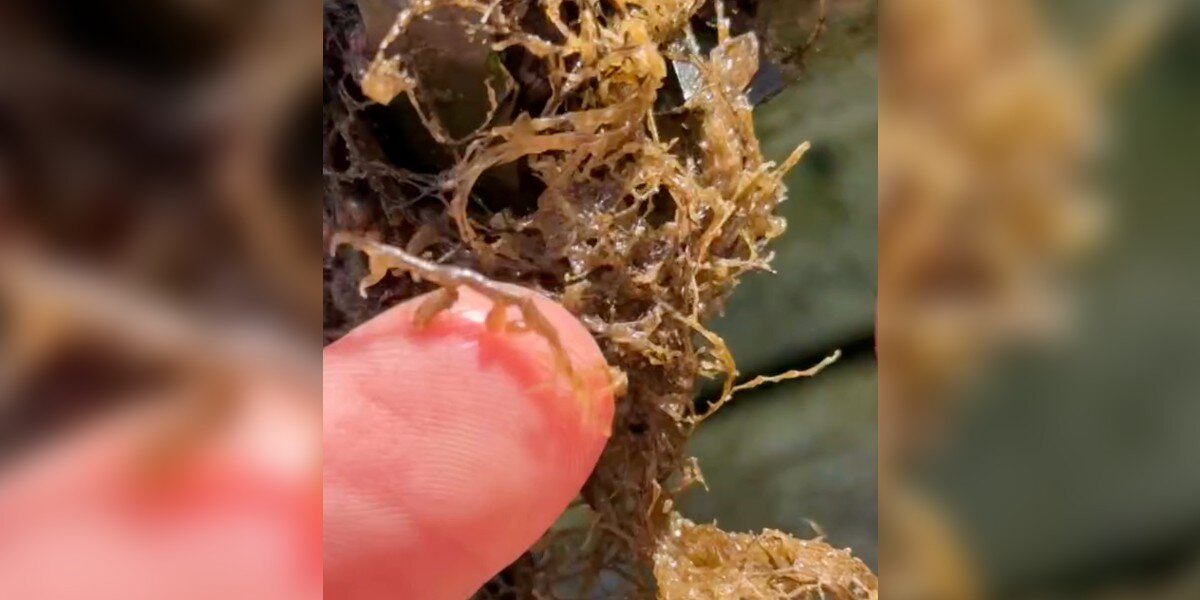
The other day, Britt Ballard and her husband went out to do some birdwatching in Semiahmoo, Washington. As they were walking down a dock, they spotted a buoy that appeared to be covered in some brown algae.
Something about the buoy caught the couple’s attention, so Ballard’s husband picked it up. As they looked at it, they noticed that there were strange, insect-like animals moving around among the seaweed.
 Britt Ballard
“It’s really hard to see at first unless you really get in close,” Ballard told The Dodo.
One of the animals crawled onto Ballard’s husband’s hand and started moving around on his finger. The creature had a segmented body and moved like an inchworm, which Ballard found slightly unsettling but also fascinating.
“It was moving in this weird way,” Ballard said. “It had these super long appendages.”
After consulting iNaturalist, Ballard concluded that the unusual animal was a Japanese skeleton shrimp, native to the Sea of Japan. The crustaceans usually form dense colonies that gather on seaweed and human-made structures like the buoy Ballard and her husband found them on.
Japanese skeleton shrimp are sometimes known as “praying mantises of the sea” due to their striking resemblance to the carnivorous insects. Like praying mantises, the shrimp are stealthy predators who use their front legs to capture food. Ballard observed that the shrimp’s front appendages moved with surprising dexterity.
 Britt Ballard
“[O]nce we slowed down and looked at it, I was like, ‘Wait, this is so freaking cool,’” Ballard said.
As Ballard and her husband noticed, Japanese skeleton shrimps have evolved to blend in perfectly with the seaweed they spend most of their time attached to. This camouflage helps them both hide from predators and sneak up on their prey.
Unfortunately, Japanese skeleton shrimp are invasive in North America. Their presence threatens native species of skeleton shrimp, who are important to the local ecosystem.
 Britt Ballard
“These invasive ones, they grow larger, they reproduce quicker,” Ballard said.
Nevertheless, Ballard was excited to have stumbled upon such a unique animal. Although Japanese skeleton shrimp have become extremely common over the past 50 years, many people have never heard of them before.
 Britt Ballard
“It’s a good example of how much life exists on surfaces that we usually ignore,” Ballard said.
To keep up with more of Ballard’s discoveries, you can follow her on Instagram and TikTok.