
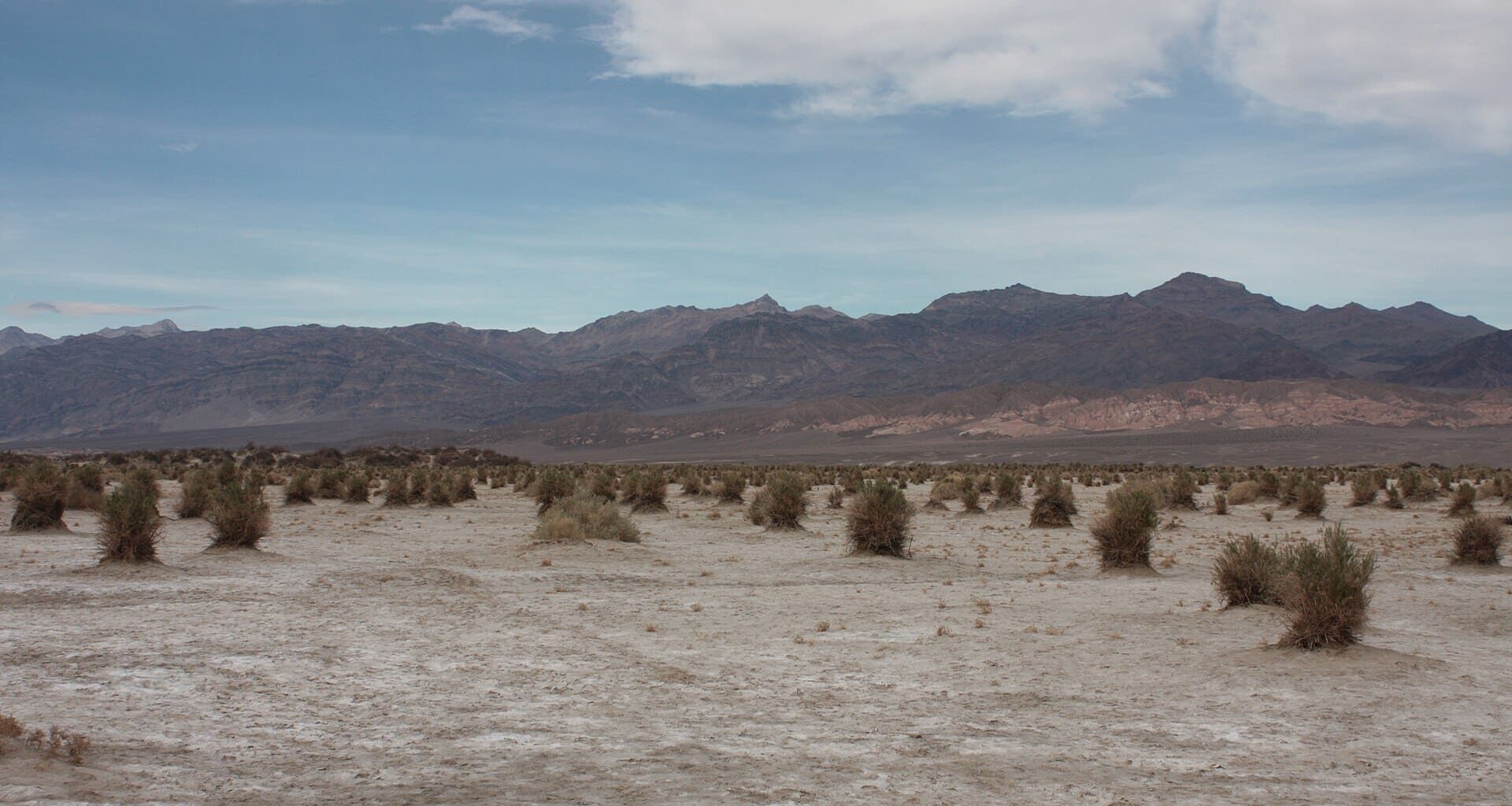
Landscape of Death Valley deserted land. Credit: Laurent Goujon / Wikimedia Commons / CC BY-SA 2.0
A new device extracts up to 1,000 liters of clean water a day from desert air, offering a potential backup supply when storms or drought disrupt central systems. The machine, developed by 2025 Nobel Prize winner in chemistry Omar Yaghi, is designed to operate in arid conditions with humidity as low as 20%. His company, Atoco, says the unit can function without connection to the power grid.
The system uses a branch of science known as reticular chemistry. Inside the container-sized unit are Metal-Organic Frameworks, synthetic porous materials engineered at the molecular level.
These materials have an extremely large internal surface area. Even a few grams can match the area of a football arena. That structure allows the material to capture moisture from the air and release it as liquid water.
Device extracts clean water using advanced chemistry
Atoco says the full-scale machine measures about 20 feet in length, similar to a shipping container. It relies on moving air to draw in moisture and sunlight to power the condensation and evaporation cycle. The company also offers on-grid versions. Prototypes have been tested in dry locations, including Death Valley.
A Nobel Prize-winning chemist, Omar Yaghi, has created a device that extracts up to 1,000 liters of clean drinking water per day from desert air, even at 20% humidity or lower.
The off-grid system, roughly the size of a shipping container, uses special materials to capture… pic.twitter.com/GxU06THehr
— Pirat_Nation 🔴 (@Pirat_Nation) March 3, 2026
Yaghi has said the invention could support regions where centralized water and electricity fail after extreme weather. He pointed to hurricanes such as Beryl and Melissa, which caused widespread flooding and left communities without reliable water.
He said small island nations, especially in the Caribbean, need stronger and more resilient water systems.
Caribbean interest grows as water insecurity deepens
Interest has emerged in Grenada, where Hurricane Beryl struck in 2024. Officials in Carriacou and Petite Martinique continue to face drought, storm damage and coastal erosion.
Davon Baker, a government official and environmental advocate on Carriacou, said the off-grid design fits local recovery plans. He noted the high cost and carbon impact of importing water and the risk that centralized systems can fail during hurricanes.
Yaghi has described the technology as a cleaner alternative to some water sourcing methods. He said desalination can harm marine ecosystems when concentrated brine returns to the ocean.
The launch comes as global water shortages worsen. A recent United Nations report warned that nearly three-quarters of the world’s population lives in water-insecure countries. The report said 2.2 billion people lack safely managed drinking water, 3.5 billion lack proper sanitation and 4 billion face severe water scarcity at least one month each year.
Yaghi has linked his work to his childhood in a refugee community in Jordan, where water deliveries arrived only once every week or two. He recalled rushing to fill containers before supplies ran out.