
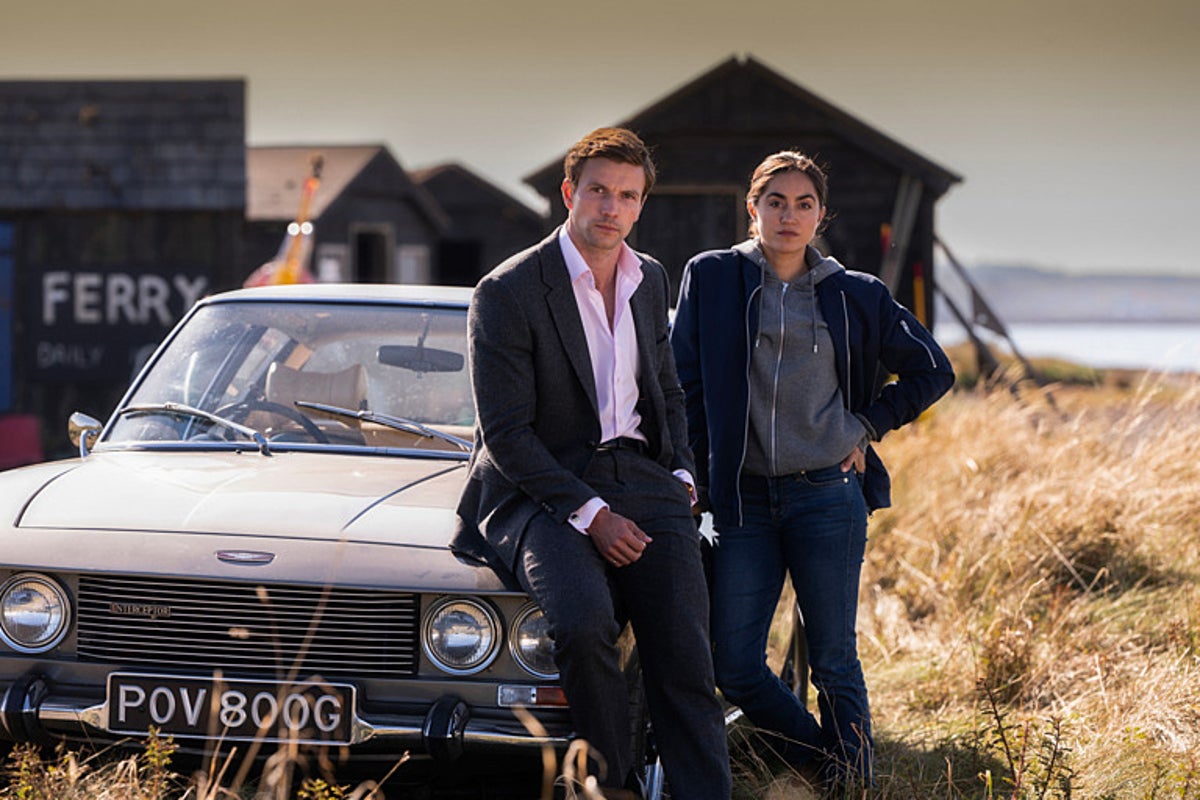
For anyone who imagines originality is the most sought-after quality in TV drama, the recent BBC police series Lynley stands as a sombre reminder that the reputed Sam Goldwyn-ism “Give me the same thing … only different” is less a joke than a guiding principle.
The series, a retread of one they did 25 or so years ago, stars Leo Suter as an aristocratic detective inspector who drives a classic 1960s British sports car, a Jensen Interceptor. In the earlier series, he drove another classic, a Bristol. In the original books, by author Elizabeth George (a US-based anglophile American, which may explain a cliché or two), Lynley drove a Bentley.
Now, fair enough; the trope of the unusual, loner detective who does things his own way is OK, if a bit threadbare. But you can see the point of it – nobody would want to watch a series about a jobsworth detective with no personality who does everything by the book. It would be original, yes, but extremely boring.
The classic car thing, however, is not only ridiculous for a variety of reasons, but it is so worn out, so hackneyed, that you would imagine, when they planned the new series, someone would have said, “We can’t do this again. Our Lynley has got to have a new gimmick.”
They had an opportunity to be original; Ms George is on record that she’s fine about the TV series being only “loosely based” on her novels. But they went for the same old same old anyway.
It may be worse than that. I’d like to think everyone involved giggled when it was decided to put DI Lynley in a 1969 Jensen – which incidentally was the archetypal hairdresser’s car in its day, not an Earl’s, But I have a horrible feeling, knowing TV drama types a little, that they all, especially the Gen Z ones, thought that the classic car was brilliantly creative.
Unfortunately, though, the exact same stroke of genius has been had by British TV production teams the best part of a dozen times. Even when, in the mid-1980s, Elizabeth George had the idea of a Bentley-driving lord joining the police, it had already been done. A lot.
To be precise, in 1988 when her first Thomas Lynley story came out, we’d had Inspector Morse in his 1960 Mk 2 Jaguar, Detective Sergeant Jim Bergerac in his 1947 Triumph Roadster, John Steed of The Avengers (a sort of a cop) in his pre-war Bentley 4.5-litre, and DI Jack Regan of The Sweeney in his 1972 Mark 1 Ford Granada.
The trope was mostly, although not solely, British. But in the States, there was Lt Columbo, a scruffy Los Angeles detective with no first name but a beaten-up, rare 1959 Peugeot 403 Cabriolet, which kept breaking down. In France, Commissaire Maigret was driving his 1952 Citroën Traction Avant as late as 1990, while Arsène Lupin in the early 1970s (a gentleman thief rather than a detective, but still a kind of clever detective figure) drove Alfa Romeos and Hispano-Suizas from the 1920s and 1930s.
In later years, the once eccentric trope has become a full-on formula to an almost comical extent. Enter DI Jack Frost in his 1953 Mk1 Ford Consul (1953), DCI George Gently in his 1962 Mk 1 Ford Cortina, Dalziel and Pascoe in their 1960s Rover P6, John Rebus in his 1978 Saab 900 and DCI Vera Stanhope’s beaten-up 1996 Land Rover in Vera. In the Scandi noir genre, we also have the 1977 Porsche 911S Coupé driven by Saga Norén in The Bridge.

open image in gallery
Sofia Helin as Saga Norén in ‘The Bridge’ was inseparable from with her bright yellow Porsche (BBC/ZDF)
The reasons a classic car would not in any way be a suitable police vehicle are legion. As someone who has had several classics, from a 1959 Mini to a 1962 Mk 2 Jaguar to a 1974 Saab, and tried to use them all for work (albeit journalism rather than crimebusting) I can attest that they are slow, unreliable, far too distinctive when being inconspicuous is called for, and mostly sound rubbish; Bergerac’s 1949 Triumph clattered like a lawnmower and its engine noise had to be painstakingly dubbed over with recordings of a Jaguar.
If you can park all the practical reasons in real life for not using a classic car as a serving police detective, the restrictions of classic car insurance finally put paid to it. Policies usually rule out work use and severely restrict the number of miles you can drive.
It’s also highly unlikely, a) that any classic car-nut detective would want to use their precious old vehicle for work, or b) that any police force would permit it, even if some freak insurance policy allowed both police use and pursuit or emergency response driving.
There is emerging a glimmer of an anti-cop-in-classic-car trend. In Sweden, Detective Sarah Lund in The Killing in 2015 used a variety of ordinary Copenhagen police pool cars, usually nondescript Peugeots or Fords. And in last year’s Edinburgh-based Netflix show, Department Q, DCI Carl Mørck drives a beaten-up 1980s Ford Sierra GL.
There is, in all this nonsense, some sense to be found, and no better authority to point it out than Jonathan Bignell, professor of film, theatre and television at Reading University, who wrote a chapter on cars in British and American police drama in his 2016 book, Contemporary British Television Crime Drama: Cops on the Box.
Prof Bignell explains the importance of cars in general in the structure of police dramas. They are, he says, a connective tissue or articulating joint between sequences set in different times and places – a shortcut, in other words, to signal that the protagonist is on the scene.
Cars have also, going right back to the days of Z-Cars, the 1960s Liverpool police series, provided a major conversational space for the plotline and the personalities to be developed.
As for distinctive cars driven by the protagonist, explains Prof Bignell, they are also a shorthand to explain graphically the personality and status of the cop in question. “Inspector Morse’s Jaguar Mark II matched the character’s upper-middle class tastes for opera, real ale and cryptic crosswords, and contrasted with the Ford Sierra driven by his working class subordinate, Lewis,” he says.
The problem then is that scruffy cars, too, have their semiotic role in police dramas. Lund and Mørck’s vehicles in their respective shows signify that they are too serious, highbrow, spiritual, and non-materialist to give a monkey’s about what car they drive. So to some extent, even if they want to be original, producers can’t quite win,
What, I asked Prof Bignell, would he suggest as a truly original idea for a car to be driven by a detective protagonist in a drama he was pitching?
He didn’t hesitate. “I would try to reverse the trope. Wouldn’t it be interesting if the detective, for whatever reason, couldn’t or wouldn’t drive? Because he’d been banned from driving, or just wasn’t able to drive, or was disabled, or just very green, and had to be driven around by someone else.”
“So he might say in the first episode that he’ll accept his new job as detective inspector on condition that he can bike to work and have a driver. Then you would be able to have those revealing talky scenes between the bag man sergeant who has to drive him and the hero himself.
“I’m pretty sure that hasn’t been done.”
Anyone working on a new police drama for 2028 or 2029, please note. You heard the idea here first.