
Iran campaign may take four to six weeks, says White House
The US military campaign against Iran may take as long as four to six weeks, White House press secretary Karoline Leavitt said a few moments ago, adding that the US is well on its way toward controlling Iranian airspace.
Leavitt added that the US would consider Iran in a state of “unconditional surrender” once Donald Trump determines the country no longer “poses a threat” to the United States.
She told reporters at the White House:
double quotation markWhat the president means is that when he, as Commander in Chief of the US Armed Forces, determines that Iran no longer poses a threat to the United States of America, and the goals of Operation Epic Fury has been fully realized, then Iran will essentially be in a place of unconditional surrender, whether they say it themselves or not.
Trump said today that only Tehran’s “unconditional surrender” will bring an end to the joint US-Israeli offensive launched seven days ago.
On timing, the US president has previously suggested the war would take approximately four to five weeks but could go “far longer” and today. Pete Hegseth, his defence secretary, said the US operation would continue for “as long as it takes” to achieve its objectives in Iran, saying yesterday: “Our timeline is ours and ours alone to control.”
Back to Leavitt, speaking ahead of a meeting between Trump and major defence contractors today, she told reporters at the White House that the US has sufficient weapons stockpiles to meet all its operational needs in Iran.
She added that the US was looking at a number of potential candidates to lead Iran but didn’t give any details.
double quotation markI know there’s a number of people that our intelligence agencies and the United States government are looking at, but I won’t get any further on that.
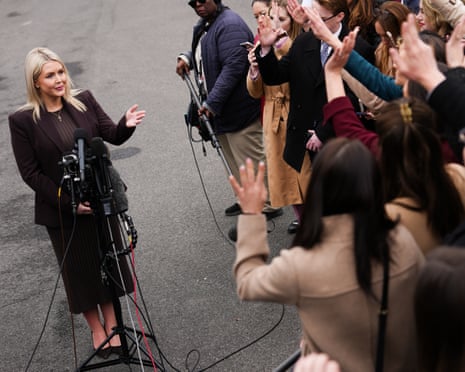 Press secretary Karoline Leavitt speaks with reporters at the White House. Photograph: Julia Demaree Nikhinson/APShare
Updated at 14.27 EST
Key events
1h ago
Iran campaign may take four to six weeks, says White House
1h ago
Macron expresses ‘full solidarity’ with Iraqi PM
2h ago
Russia providing Iran intelligence to target US forces – reports
2h ago
‘The stakes could not be higher’: UN chief urges end to ‘all unlawful attacks in Middle East’
2h ago
Today so far
3h ago
US Central Command: Iran targeted civilian neighbourhoods in Bahrain
4h ago
Iraqi prime minister discusses ‘unified positions’ with president of Kurdistan region
4h ago
UN: Forced displacement in Lebanon could be violating international law
5h ago
Trump: US is moving ‘thousands’ of people out of Middle East countries
5h ago
US investigators believe strike on Iranian girls’ school probably carried out by US forces
5h ago
Lebanon health officials say 217 killed in Israeli attacks
6h ago
US-Israeli strikes against Iran ‘extraordinary mistake’, says Spanish PM
6h ago
Explosions near Erbil airport in Kurdish-controlled northern Iraq- report
6h ago
Britain’s deputy prime minister suggests that the UK could take part in strikes
6h ago
Iran’s president says ‘some countries’ have begun mediation efforts to end war
6h ago
Trump: No deal with Iran except ‘unconditional surrender’
7h ago
Video: IDF footage claims to show air strikes on Khamenei’s underground bunker
7h ago
Lebanon drawn into war ‘it did not seek or choose’, says PM
8h ago
Summary of developments so far
8h ago
Video: Pastors pray for Trump and US success in Iran war
8h ago
Mediation talks should be aimed at US and Israel, says Iranian president
9h ago
IDF claims 50 jets bombed Khamenei’s underground bunker ‘still being used by Iranian officials’
9h ago
‘Plenty of oil’ in markets despite Middle East turmoil, says IEA chief
9h ago
Israel official says bombing campaign in Iran going ‘much better than expected’ – report
10h ago
‘We were humiliated’: Israel’s attacks on Beirut cause mass displacement crisis
10h ago
Azerbaijan withdraws diplomats from Iran
10h ago
US probe of Iran school strike must ‘happen very quickly’, says UN rights chief
11h ago
Sri Lankan president calls for peace as Iranian sailors seek refuge on island
12h ago
Four people in UK arrested on suspicion of spying on Jewish community for Iran
12h ago
Majority of Spaniards against US-Israeli attacks on Iran – poll
12h ago
Israel announces new phase in Iran conflict as US warns strikes will ‘surge dramatically’
13h ago
Summary
13h ago
Sri Lanka takes control of an Iranian vessel off its coast after US sunk an Iranian warship
13h ago
Iranian leadership council meets ahead of selecting new supreme leader, state media says
14h ago
Israel carried out 26 airstrikes on Beirut, IDF says
15h ago
Philippines mulls shorter weeks, less air-con as fuel costs bite
15h ago
Two Japanaese nationals detained in Iran, Japan calls for release
16h ago
Evacuated British nationals return to UK, as crisis continues to disrupt flights
17h ago
Trump responds to Iranian claims that ground invasion would be ‘big disaster’
17h ago
Gulf states intercept missiles amid reports of regional discontent
18h ago
Explosions in Tehran, as Israel launches more strikes
18h ago
Hezbollah warns Israeli residents to evacuate near border
18h ago
Ukraine to help US and allies counter Iranian drones
18h ago
Opening summary
Show key events only
Please turn on JavaScript to use this feature
A huge American bomber capable of carrying 24 cruise missiles has landed in the UK after the US defence secretary warned of a “surge” in strikes on Iran.
The 146ft B-1 Lancer has a wingspan of 137ft, weighs 86 tonnes and is the fastest bomber in the US Air Force, according to Boeing, hitting speeds of more than 900mph.
Piloted by a crew of four, “the Bone” – as the aircraft is nicknamed – has advanced radar and GPS systems to help hit targets, and electronic jammers, radar warnings and a decoy system to protect it from enemies.
The B‑1, which has been used in Syria, Libya, Afghanistan and Iraq, can carry up to 34 tonnes of weapons and equipment.
A bomber was pictured arriving at RAF Fairford in Gloucestershire on Friday after Keir Starmer granted the US permission to strike defensively against Iran’s missile facilities from British bases.
Saudi Arabia has intensified direct engagement with Iran to help contain the conflict in the Middle East, Bloomberg News reported, citing several European officials.
Saudi officials in recent days have used their diplomatic backchannel to Iran with increased urgency to ease tensions and keep the conflict from worsening, the report said.
Share Deepa Parent
Sleeplessness, fear and exhaustion gripped residents of Tehran as successive waves of strikes struck the Iranian capital, judging from messages sent by people in the city after the latest overnight onslaught, which several described as the worst bombardment in six days of war.
With Iran imposing a near-total internet blackout, information emerging from inside the country is fragmentary and difficult to verify. But in a series of accounts sent through proxy connections, and calls with friends abroad, Tehranis described a night of intense explosions.
Zahra, a teacher and mother of one living in central Tehran, said the strikes, in what she said was the heaviest attack to date, had left her deeply worried for civilians who found themselves in danger not just from Iran’s attackers but from their own government.
“This is the first time since the war began that I am genuinely scared for my fellow Iranians,” said Zahra*. “We are trapped between the regime that is killing us with machine guns, and a foreign power has likely decided that we are collateral damage.”
Although she had protested against the government in January and had celebrated the killing of the supreme leader, Ali Khamenei, in the first few seconds of the war a week ago, she has become increasingly fearful of the civilian toll.
“The initial joy of the regime’s leaders paying the price is soon turning into fear. Who will be left in free Iran if we all get killed?” Zahra said.
She described Thursday night as being unlike anything she had experienced before. “I don’t think I have ever experienced a night like this before or even seen [anything like it] in the movies. I am really scared, especially because I am in total information blackout.”
“If they don’t stop now, Tehran will turn into Gaza,” said Farzad*, a 36-year-old who has fled the city. “We can now tell the difference between the sounds of fighter jets, air defence, and missiles. Sometimes we stand together and watch the trails of hypersonic missiles in the sky.”
ShareIran campaign may take four to six weeks, says White House
The US military campaign against Iran may take as long as four to six weeks, White House press secretary Karoline Leavitt said a few moments ago, adding that the US is well on its way toward controlling Iranian airspace.
Leavitt added that the US would consider Iran in a state of “unconditional surrender” once Donald Trump determines the country no longer “poses a threat” to the United States.
She told reporters at the White House:
double quotation markWhat the president means is that when he, as Commander in Chief of the US Armed Forces, determines that Iran no longer poses a threat to the United States of America, and the goals of Operation Epic Fury has been fully realized, then Iran will essentially be in a place of unconditional surrender, whether they say it themselves or not.
Trump said today that only Tehran’s “unconditional surrender” will bring an end to the joint US-Israeli offensive launched seven days ago.
On timing, the US president has previously suggested the war would take approximately four to five weeks but could go “far longer” and today. Pete Hegseth, his defence secretary, said the US operation would continue for “as long as it takes” to achieve its objectives in Iran, saying yesterday: “Our timeline is ours and ours alone to control.”
Back to Leavitt, speaking ahead of a meeting between Trump and major defence contractors today, she told reporters at the White House that the US has sufficient weapons stockpiles to meet all its operational needs in Iran.
She added that the US was looking at a number of potential candidates to lead Iran but didn’t give any details.
double quotation markI know there’s a number of people that our intelligence agencies and the United States government are looking at, but I won’t get any further on that.
Press secretary Karoline Leavitt speaks with reporters at the White House. Photograph: Julia Demaree Nikhinson/APShare
Updated at 14.27 EST
Two British Wildcat helicopters have arrived in Cyprus today after Keir Starmer pledged to bolster UK defences on the Mediterranean island.
Starmer said on Thursday that the UK was sending the helicopters, which have anti-drone-capabilities, along with Type 45 naval destroyer HMS Dragon, which is due to arrive in Cyprus in the next few weeks.
It comes as Britain scrambles to bolster the defence of its RAF airbase in Cyprus after it was targeted by Iran, prompting fury from local ministers.
In updated travel advice issued today for Cyprus, the UK Foreign Office said terrorist attacks on the island “cannot be ruled out”.
The attacks could be indiscriminate, including in places visited by foreign nationals, the advice warned.
ShareMacron expresses ‘full solidarity’ with Iraqi PM
French president Emmanuel Macron said today that he spoke to Iraqi prime minister Mohammed Shia al-Sudani and praised his efforts to keep his country out of the conflict in the Middle East.
“I expressed to him France’s full solidarity with Iraq in the face of the ongoing escalation in the Middle East,” Macron said in a post on X. “I reiterated my support for his resolute action to prevent Iraq from being drawn into the conflict.”
He added:
double quotation markThe stability of the country is essential for the entire region. France supports the full respect for Iraq’s sovereignty, security, and territorial unity.
ShareRussia providing Iran intelligence to target US forces – reports
Russia is providing Iran with targeting information to attack US forces in the Middle East, the first indication that another major US adversary is participating in the war, the Washington Post (paywall) reported today, citing three officials familiar with the intelligence.
Since the start of the war on Saturday, Russia has passed Tehran the locations of US military assets, including warships and aircraft, the three officials told the Post.
“It does seem like it’s a pretty comprehensive effort,” one of the Post’s sources said.
The extent of Russia’s support to Iran was not entirely clear but the Iranian military’s own ability to locate US forces has been degraded since the US and Israel launched strikes against Tehran last week, the Post reported.
The Russian embassy in Washington DC, the Pentagon and the CIA didn’t comment when approached for the Post’s article, but the White House provided this statement from spokesperson Anna Kelly:
double quotation markThe Iranian regime is being absolutely crushed. Their ballistic missile retaliation is decreasing every day, their navy is being wiped out, their production capacity is being demolished, and proxies are hardly putting up a fight.
CBS News is also reporting that Russia is providing intelligence on US positions to Iran, citing three unnamed sources familiar with the matter, including a senior US official it says has direct knowledge.
Russia was in dialogue with representatives of Iran’s leadership, the Kremlin said today. Reuters reports that it declined to provide details when asked by reporters whether Moscow was helping Tehran.
Moscow has called for an end to the war, which it has described as “unprovoked act of armed aggression”.
Share‘The stakes could not be higher’: UN chief urges end to ‘all unlawful attacks in Middle East’
The UN secretary-general has called on nations to “stop the fighting and get to serious diplomatic negotiations”. “The stakes could not be higher,” António Guterres wrote in a post on X.
double quotation markAll the unlawful attacks in the Middle East and beyond are causing tremendous suffering and harm to civilians throughout the region – and pose a grave a risk to the global economy, particularly to the most vulnerable people.
The situation could spiral beyond anyone’s control.
It is time to stop the fighting and get to serious diplomatic negotiations.
The stakes could not be higher.
Updated at 13.13 EST
Today so far
Lebanon’s prime minister, Nawaf Salam, said his country was drawn into a war “it did not seek or choose”. In a speech during a meeting with Arab and foreign ambassadors, he warned that “a humanitarian disaster is looming”.
Donald Trump posted on social media that there would be no deal with Iran except “unconditional surrender”. The US president said following “unconditional surrender”, there would be “the selection of a GREAT & ACCEPTABLE Leader(s)” – earlier, Trump had said he must “be involved in the appointment” of Iran’s next leader as he was in Venezuela, and dismissed the idea of the assassinated ayatollah’s son, Mojtaba Khamenei, succeeding his father as supreme leader as “unacceptable”.
US investigators believe it is likely that US forces were responsible for an apparent strike on an Iranian girls’ school that killed scores of children on Saturday but have not yet reached a final conclusion, according to a Reuters report citing two unnamed US officials.
Iranian forces fired seven attack drones at residential neighbourhoods in Bahrain overnight, said US Central Command (Centcom), which accused the Iranian government of attacking 12 different countries and “deliberately” targeting civilians.
The Israeli military announced a “new stage” in its campaign against Iran, with US and Israeli officials hinting at escalating strikes. The IDF said it has “additional surprising moves” as part of this new phase, without elaborating, while US defence secretary Pete Hegseth announced that strikes on Iran will “surge dramatically”.
The IDF claimed to have destroyed the underground bunker of the slain Iranian supreme leader, Ayatollah Ali Khamenei, which it claims is still used by senior Iranian officials. The Israeli military said approximately 50 fighter jets dropped about 100 bombs at the site in Tehran, which it claimed spread across multiple streets and included “many entry points”. There was no immediate comment from Iran.
The UN said nearly 100,000 people have been displaced within Lebanon and tens of thousands of Syrian refugees in the country have fled back over the border. It follows a mass evacuation order by the IDF for people to flee a vast swathe of Beirut’s southern suburbs as it bombs what it says are Hezbollah targets in the area.
Volker Türk, the UN high commissioner for human rights, raised concerns that the Israeli military causing the mass displacement of people in Lebanon may be violating international law, the AFP reports. “Lebanon is becoming a key flashpoint,” Turk said.
Officials in Azerbaijan said they are withdrawing diplomatic staff from Iran for their own safety. It comes a day after Azerbaijan said four Iranian drones had crossed its border and injured four people in the Nakhchivan exclave.
Four people in the UK have been arrested by counter terror police on suspicion of spying on the Jewish community for Iran, the Metropolitan police said. The men, one Iranian and three dual British-Iranian nationals, were arrested this morning shortly after 1am in Barnet and Watford.
ShareUS Central Command: Iran targeted civilian neighbourhoods in Bahrain
Iranian forces fired seven attack drones at residential neighbourhoods in Bahrain overnight, Brad Cooper, the head of the US Central Command (Centcom), said in a statement posted on X.
Iran “has attacked 12 different countries and continues to deliberately target civilians throughout the Middle East”, Cooper said.
“This is unacceptable and will not go unanswered.”
Air defences in Bahrain have destroyed 78 missiles and 143 drones since the start of the conflict, the Bahrain Defence Force said.
Here are some images coming in from the Middle East today:
Smoke rises from an Israeli airstrike in Dahiyeh, Beirut’s southern suburbs, in Beirut, Lebanon on 06 March 2026. Photograph: Hussein Malla/APSmoke rises from a fire caused by an Israeli strike
on Beirut’s southern suburbs on 06 March 2026. Photograph: Khalil Ashawi/ReutersIsraeli tanks gather on the Israeli side of the border with Lebanon on 06 March 2026. Photograph: Atef Safadi/EPAA man hangs Israeli flags near a buildng that was damaged in a missile attack in Givatayim near Tel Aviv, Israel on 06 March 2026. Photograph: Nir Elias/ReutersSmoke rises after an airstrike in central Tehran, Iran on 06 March 2026 Photograph: Abedin Taherkenareh/EPAIranian women holds pictures of the late Ayatollah Ali Khamenei during the Friday prayer ceremony at Mosallah mosque in Tehran, Iran on 06 March 2026. Photograph: Abedin Taherkenareh/EPAShare
Updated at 12.40 EST
Footage shows the aftermath of an Israeli strike in the south of Lebanon’s capital, a day after Israel issued a mass evacuation order for this part of the country.
The Israeli military carried out further strikes on Beirut’s southern Dahiyeh suburb, as well as towns in southern Lebanon. The Lebanese health ministry said 217 people had been killed in Israeli attacks since Monday.
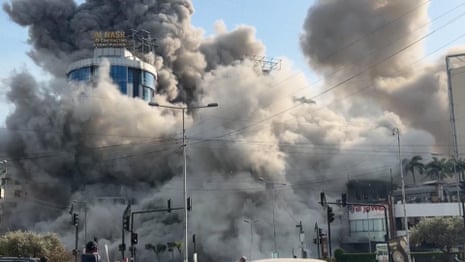 Smoke engulfs buildings after Israeli forces strike Beirut suburbs – videoShare