
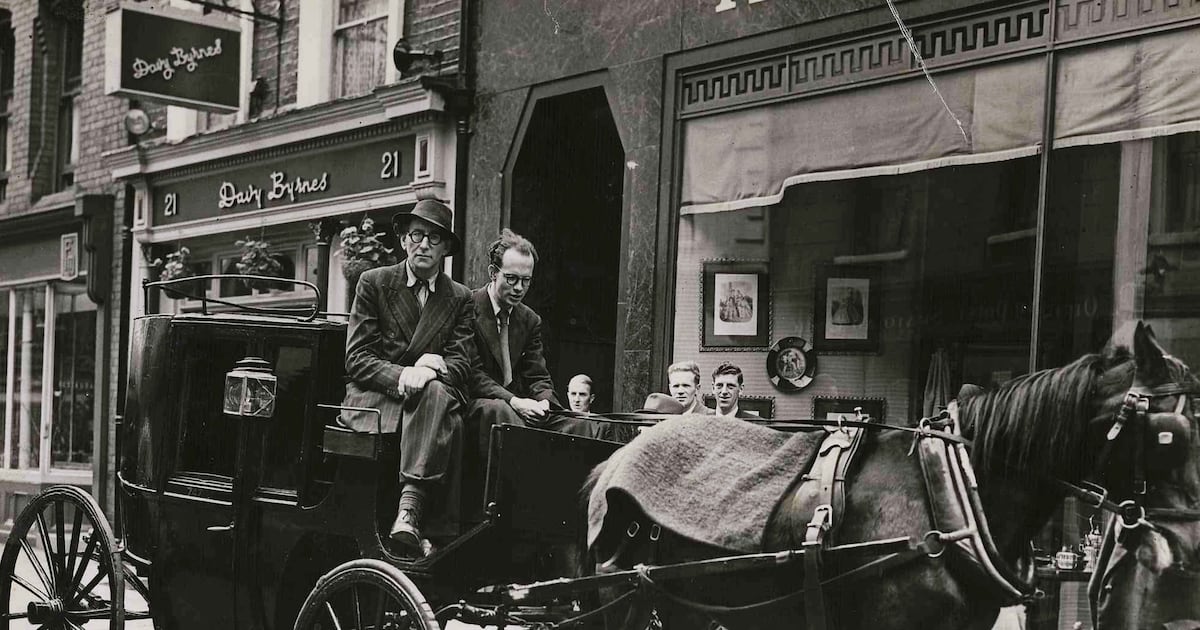
Tony Cronin was always suspicious of what he called “the Kerry schoolmaster” genre of Irish literary writing, which prized rootedness, authenticity and tweed.
His fine novel The Life of Reilly (1964), a kind of cousin to Dead as Doornails, has a lot of fun mocking the subspecies of word-smithing Celt that haunted 1950s BBC Radio in London, hanging out in the pubs near Broadcasting House, talking wistfully of turf and the mammy to attractive young people while assembling scripts full of marketable Synge-Song.
This isn’t the only sort of author to whom Tony’s prose was, and is, an implied rebuke. Auden and Cyril Connolly were among his touchstones; he liked clarity, exactitude. The mid-century era of Dead as Doornails was one in which many an Irish writer, flailing in the slipstream of the great ocean liner that was Joyce, piled up the adjectives as though trying to assemble them into a raft, but Tony’s sentences have an almost Augustan classical elegance even when they describe sitting in McDaid’s in wet socks and wondering where the next crust is going to come from.
This tension between content and style is where the wonderful energy of his writing arises, and his control of it is unerringly deft. He knocks worlds together in a way that makes the sparks fly, but he does it with the laidback skill of a jazz drummer using brushes. I find Dead as Doornails a book that is difficult to stop reading once you start, even though I know it so well. I’m always wondering how Tony works the trick with such brilliance.
The book is immensely funny, but not as continuously funny as is often said. There is hunger, loneliness, worry, a lot of drinking, which you feel is self-medication more than ordinary social boozing. When a man in a pub in London says to Tony, “You have a nice face. I’d like to know you,” you want to put your arms around them both.
[ Anthony Cronin: last link to Dublin’s bohemian literary worldOpens in new window ]
Literature might be defined as the art of writing about things that matter for longer, or about things that matter at all. Tony’s book is hugely important as a picture of its times, of the desolate condition of Irish writers and artists and the society around them, but it is at heart a series of portraits of his friends. His own great and lasting gift for friendship is obvious on every page: no saint, but he is forgiving, companionable, accepting of eccentricity, seeing it as a price he is content to pay for knowing such remarkable people.
In Farewell, My Lovely, Raymond Chandler writes of one character, “She’d make a bishop kick a hole through a stained glass window.” There are times in the book when Kavanagh, Behan and Brian O’Nolan are outrageously annoying. Tony doesn’t judge. Well, not much. It has often seemed to me that in its picture of the compassion sometimes required when you love someone impossible, Dead as Doornails anticipates Withnail and I.
The book has been seen, rightly, as a powerful evocation of Dublin in the 1950s, a backwater of crusty proprieties and pitiless squalor, where the rain lashed horizontally and happiness was prohibited by constitutional amendment. Self-esteem was not thought to be useful or wise. Tony understood suffering; his biography of Beckett was acclaimed by the late Eileen Battersby as “one of the greatest Irish books ever written”.
[ Eileen Battersby: When Anthony Cronin dismissed me as an idiotOpens in new window ]
Yet, there was fun to be found in what Tony calls “the possibilities of the day” and in the nights heading out in someone’s hire-purchase car to the drinking dens on the city’s outskirts, where you could gargle away after hours if you claimed to be a bona fide traveller. Often there would be a woozy trek back into town, to a network of cellars under a Georgian house on Fitzwilliam Place, where there was “a smell of money gone”. Close to dawn, this underworld heard many a rebel ballad and last-minute chat-up line, and some subterranean homesick blues.
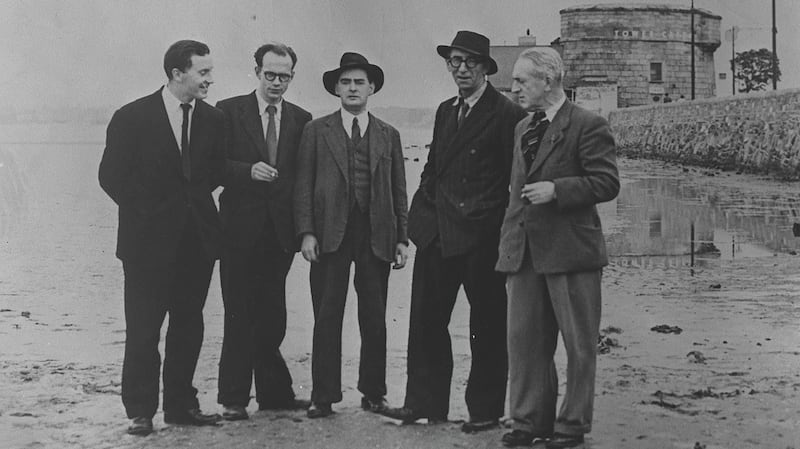 The first Bloomsday trip to the Joyce Tower in 1954, from left: John Ryan, Anthony Cronin, Brian O’Nolan, Patrick Kavanagh and Tom Joyce.
Tony always resisted the word “Bohemian” when applied to the Dublin of his past – he was a poet, first and last, resisting lazy words was a part of the job – but you can see that there was a shabby glamour, a monochrome, hardboiled, collar-raised-against-the-rain sense of doomed life, and there was even a bit of sex in the suburbs.
It shouldn’t be forgotten that this is also a tremendous book about an already vanishing corner of England: the postwar Soho of sullen jazzmen and partying painters and red light reflected on broken glass. Tony’s vision of these streets and alleyways is surely a presence in Shane MacGowan’s love songs to them. I can never hear Shane’s line in Fairytale of New York, set in another great metropolis, “got on a lucky one, came in eighteen to one” without remembering Tony’s fondness for the ponies.
Some people get a lot from reading the lives of the saints. We learn more from the lives of the sinners. It’s fabulous how at ease Tony is, whether in Dublin or in the then capital of literary Ireland, London W1. I love how he says to an English policeman called to the lodging house because two blokes who are lovers are having a drunken, half-naked fistfight in the garden, “The lads were just being a little ebullient.”
Authority, Tony points out, must be either obeyed or confused. Threadbare but cosmopolitan, he moves through his tale of two cities with admirable coolness and watchful wit, no better or worse than any of the memorable people he encounters. His curiosity is always so attractive.
[ Fintan O’Toole: Anthony Cronin, a true man of lettersOpens in new window ]
These days, Irish writers are feted, interviewed, promoted, pointed to by politicians as a sort of national fruit. Back then they were ignored, censored, rubbished or found baffling by a young, congenitally insecure state, which like all post-revolutionary societies was at war with itself about images and didn’t know what to do with these misfits. Every Irish author and artist owes a debt to Tony Cronin for his work, not just the writing, which is so achingly vivid and enjoyable, but the many years of advocacy for those who work in the arts. He knew what it was like to be afraid that the knock on the door is the bailiff or the man come to cut off the gas. In Dead as Doornails, he has us laugh. But he knew.
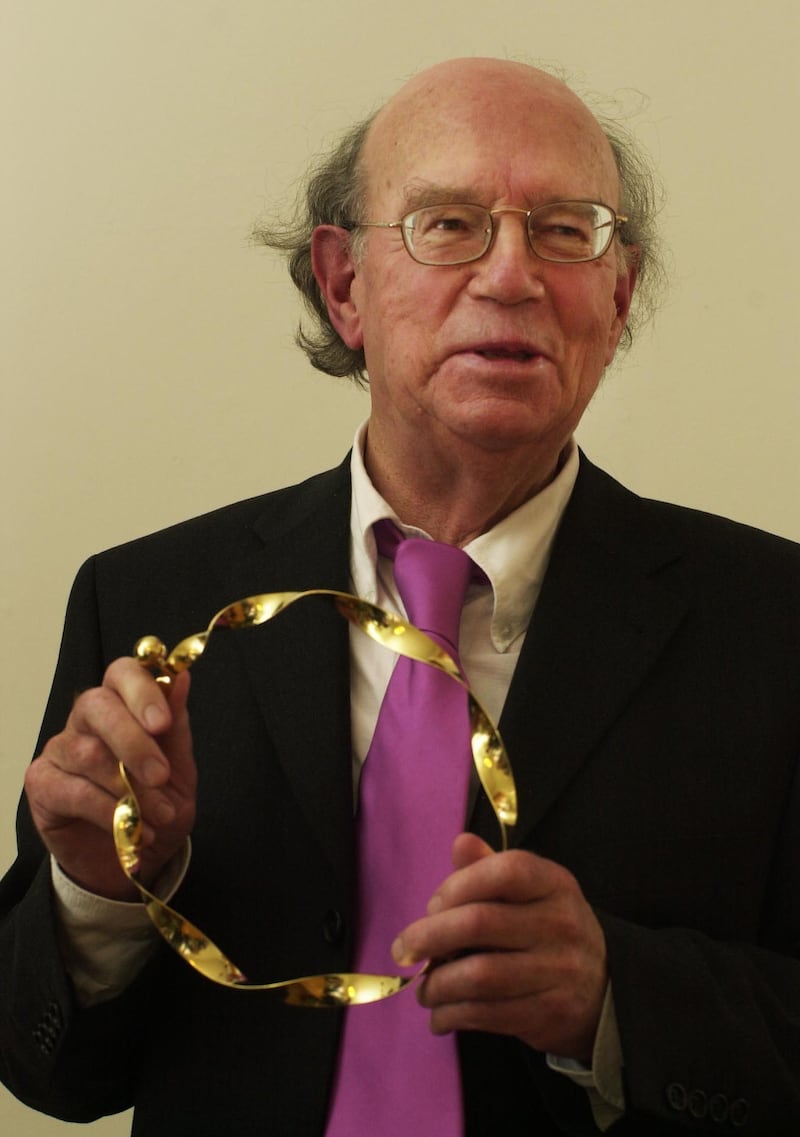 Writer Anthony Cronin with his Torc at a ceremony in Dublin to mark his election as Saoi in Aosdána in June 2003. Photograph: Frank Miller/The Irish Times
And like all the greatest Irish storyteller-comedians, from Wilde to Roddy Doyle to Dave Allen and Tommy Tiernan and Lisa McInerney and Deirdre O’Kane and Joanne McNally and beyond, he knew that when we laugh, we are thrown a little off balance. The truth goes in deeper when we’re laughing. The glee that is only grief on a good day is never far away in this wonderful, important, brilliantly irreverent memoir by a poet who walked on the wild side.
This is Joseph O’Connor’s introduction to Lilliput Press’s new edition of Dead as Doornails by Anthony Cronin. Joseph O’Connor’s novel The Ghosts of Rome won the An Post Book of the Year Award 2026. He leads the Creative Writing programme at the University of Limerick