
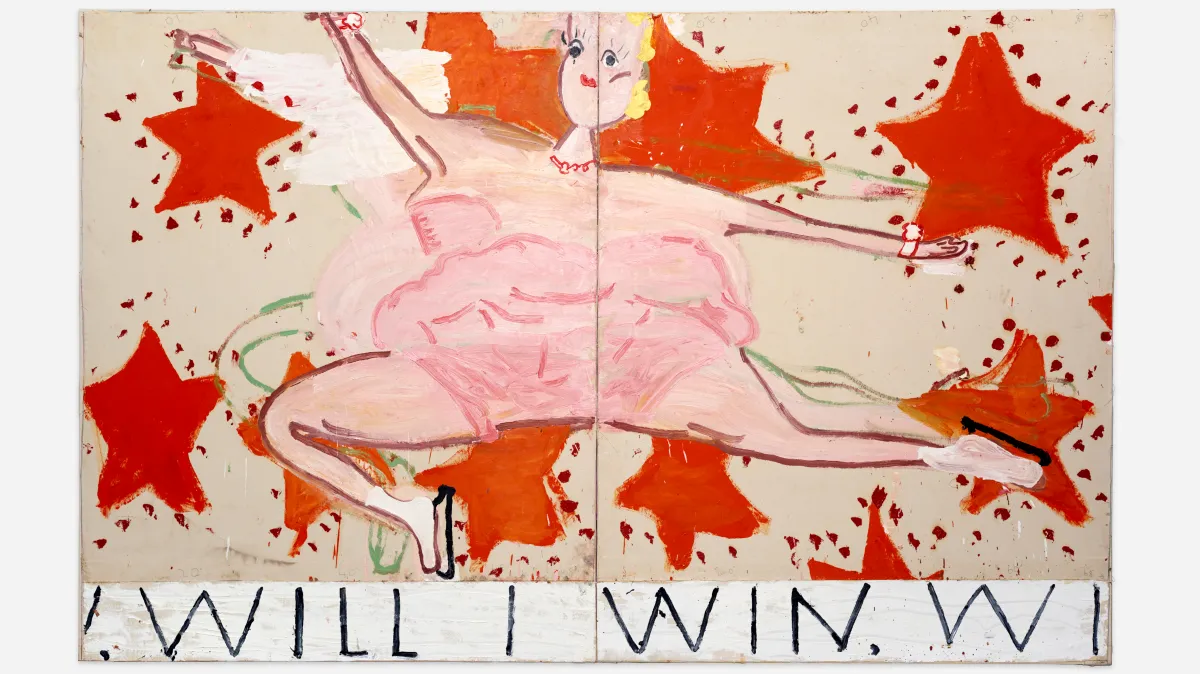
Childishness can be a pleasing quality in art. From Michelangelo’s giggly portrayal of Boaz on the Sistine ceiling to Matisse’s nursery-coloured paper cut-outs, the sense of fun and freedom unleashed by acting younger than you are has given art many memorable moments. But childishness works best as an ingredient. When it is the only mood, it runs into a buffer. And that gets us to Rose Wylie.
Her story is charming. Born in 1934, and now aged 91, she studied art in Folkestone but put her career on hold to raise a family when she married Roy Oxlade, painter and pedagogue. Only when their three children had grown up and she was pushing 50 did she return seriously to art-making. Most of what we see now in the outpouring of excitable immaturity celebrated at the Royal Academy was produced in her seventies and eighties.
There is, of course, something truly wonderful about being discovered as an artist when you are past the pension age. Wylie started to be noticed properly only after 2010 and her belated popularity has struck a fine blow for the forgotten older woman. The torrent of happy granny art unleashed on us in the Academy’s best galleries is the first occasion on which these prestigious spaces have been devoted to a female artist. Which is ridiculous.
The good thing about being 91 is that you have seen a lot and survived it. Thus the RA’s celebration of Wylie’s belated arrival commences with memories of the London Blitz and the bombs that rained down on her as a child. In a series of quickfire paintings devoted to Hitler’s “doodlebugs”, the flying bombs that kept her awake at night, she remembers the terrors of the war as if they were adventures in an Enid Blyton comic. “Gee whizz, here come the doodlebugs.” “Oh look, a swastika.”
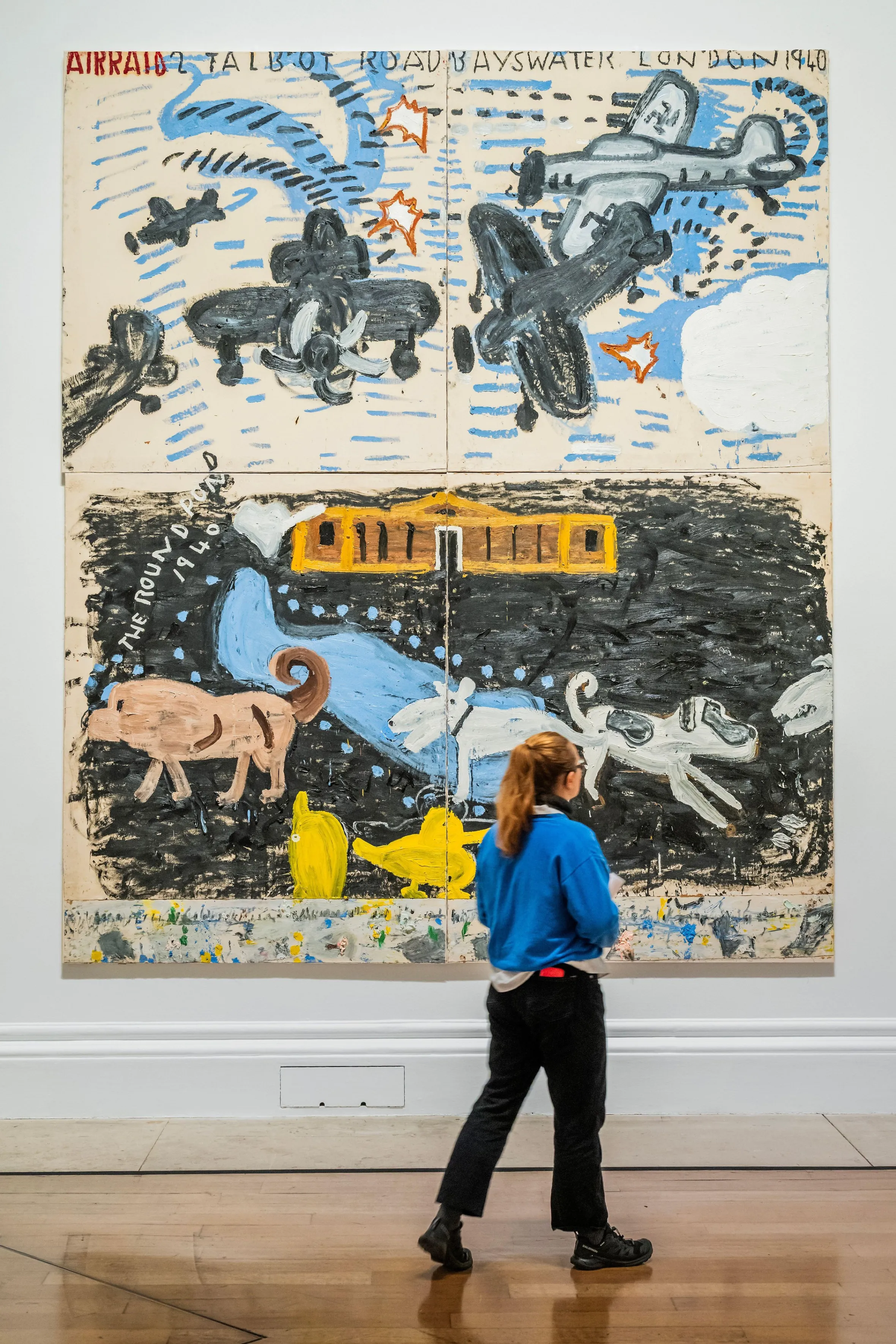 Park Dogs & Air Raid, 2017 by Rose WylieAlamy
It’s an unsettling start to the journey, but effective. We are entering a world view that has borrowed its tonality from the nursery, but which feels as if it is hiding decades of intense adult experience behind its deceptively jolly surfaces. Unfortunately, this opening sense of lurking profundity spends the rest of the show being dispelled.
As it crash, bang, wallops its way through the Academy’s poshest rooms, Wylie’s zesty parade of kiddie-coloured imagery delights in appearing super-fast and untutored. Her wonky figures make the matchstick men of LS Lowry look like anatomy studies by Leonardo da Vinci. Words, titles, headings are scrawled unmissably in “I hope I can write properly when I grow up” capital letters. There’s an elephant. Here’s a bird. There are some cut-out-and-keep fashions of the sort you used to find on the back page of Bunty.
Where the paintings in the doodlebug suite felt as if they shared a coherent concern, the rest of the exhibition fires off in different directions at Gatling gun speed. Here’s a Tarantino movie. There’s a football match. Here’s a puddy cat. We are in the presence of a mind that’s flicking from subject to subject like a kid on Saturday morning with the TV remote.
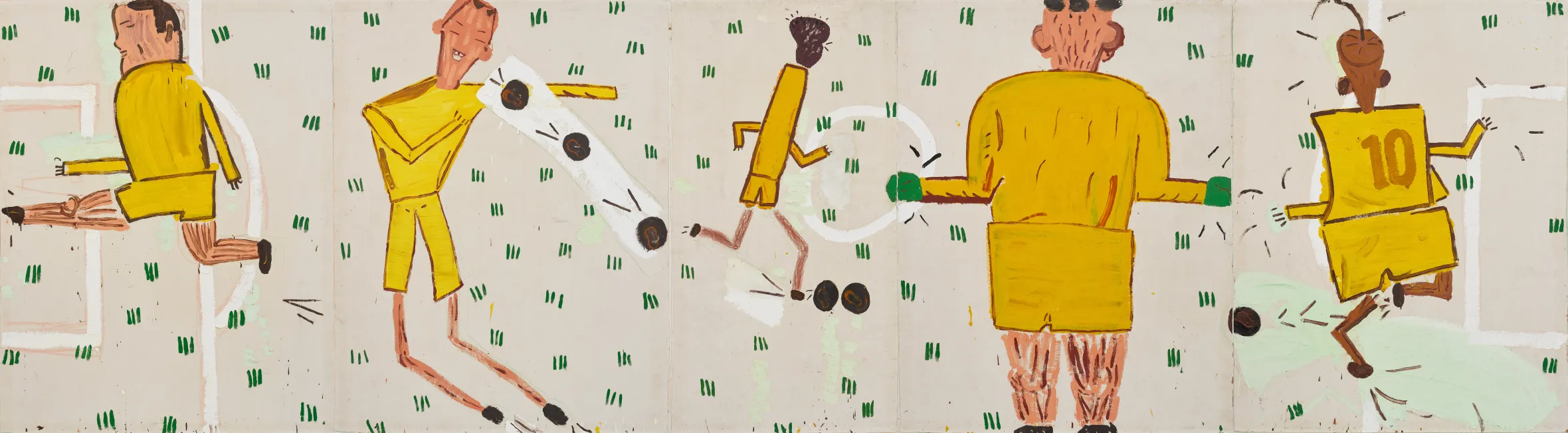 Yellow Strip, 2006© Rose Wylie. Courtesy the artist and David Zwirner. Photo: Jack Hems
Not that anything in the show has documentary ambitions. This is not an artistic vision that deals with facts. Rather, it’s a display of madcap artistic invention in which 91 years of piled-up experience is being re-imagined in the deliberately crude style of Tom and Jerry.
Her most obvious precursor in this mature return to immaturity was the great American painter Philip Guston, who, halfway through his career, changed from well-respected abstract expressionist to much reviled symbolic cartoonist. But where Guston seemed always to have profound satirical ambitions lurking beneath his simple surfaces, Wylie is altogether chirpier and shallower.
Her best works — memories of dances long gone; little-girl fashions that speak of frustrated desires — are enriched by hints of anxiety and yearning. Something deeper is being said than immediately meets the eye. But only rarely does it feel enough. In the end, the relentless nature of the childishness and the silliness leaves you hungry for some joined-up 91-year-old thinking.
At the National Portrait Gallery, the edgy American photographer Catherine Opie takes us on an investigation of humanity that appears to be dealing with a different human species from the matchstick men and women depicted by Wylie. Opie is a hardcore, grungy lesbian from Los Angeles. Wylie is a softcore, cottage garden heterosexual from Kent. The contrast in their atmospheres could hardly be more striking.
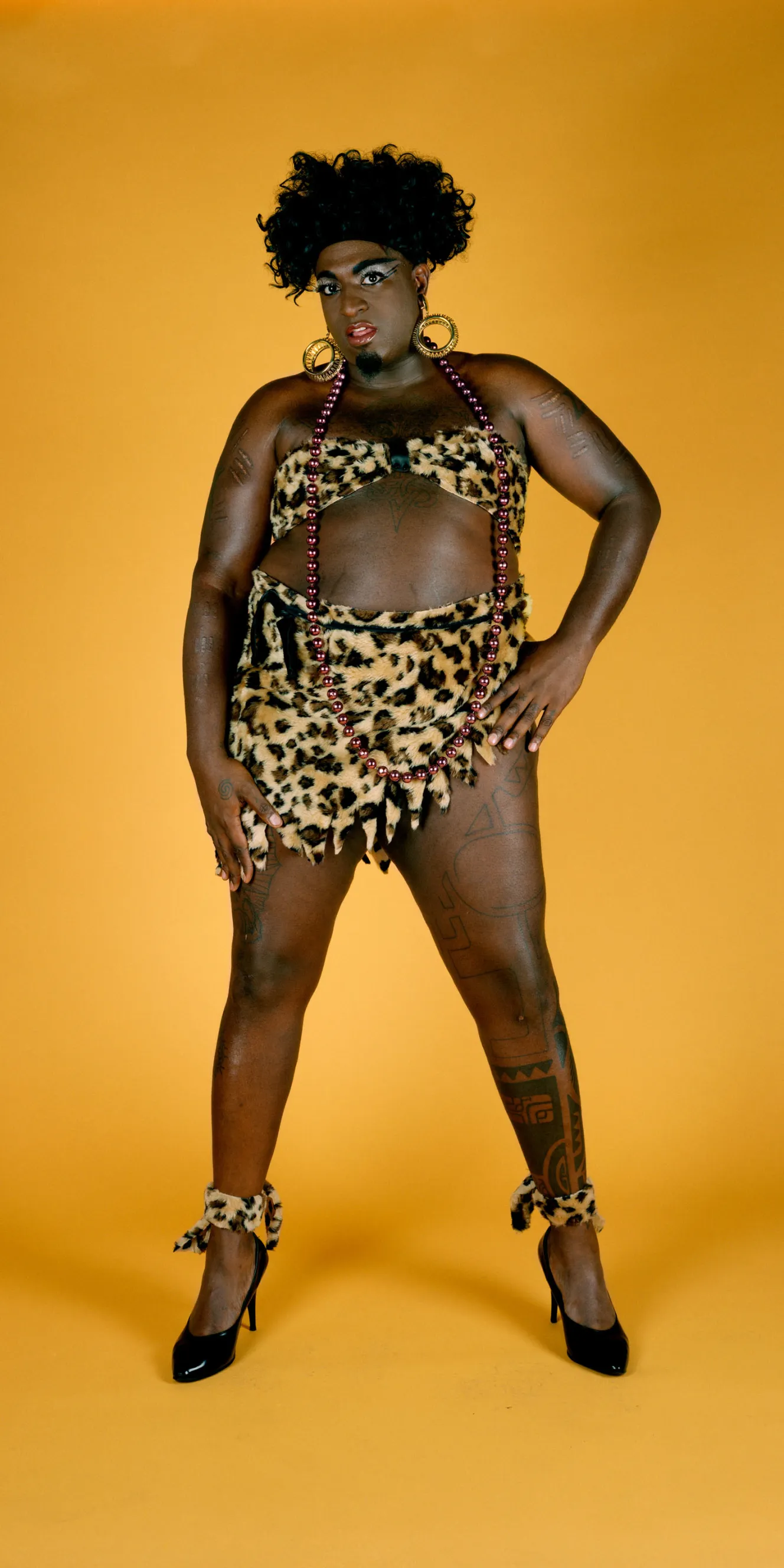 Divinity Fudge, 1997, by Catherine Opie© Catherine Opie. Courtesy the artist, Regen Projects, Los Angeles and Thomas Dane Gallery
Opie started out as a recorder of America’s queer wars and a witness of the Aids years. Her first memorable series of portraits featured a collection of “butches”, male role-players in lesbian relationships, who sported big, stuck-on, handlebar moustaches to signal their proclivity. For those of us who are not of that world, this is prickly art. If art made noises, this would sound like a nail scratching a blackboard.
A series of children’s portraits in which beautiful kids are adopting the kinds of poses preferred by adult models — sitting behind a Christine Keeler chair; slumped topless in a baseball cap — continue the nervy moods that distinguish this impactful retrospective.
One of the things Opie keeps noticing in her sitters, probably because she recognises it in herself, is that there’s a performative gene in humanity that makes everyone want to shout “Look at me!”, while, underneath, the vulnerable stuff is keeping its head down. I found her parade of conflicted show-offs gripping, spiky, affecting.
Rose Wylie is at the Royal Academy, London, to Apr 19; Catherine Opie: To Be Seen is at the National Portrait Gallery, London, to May 3