
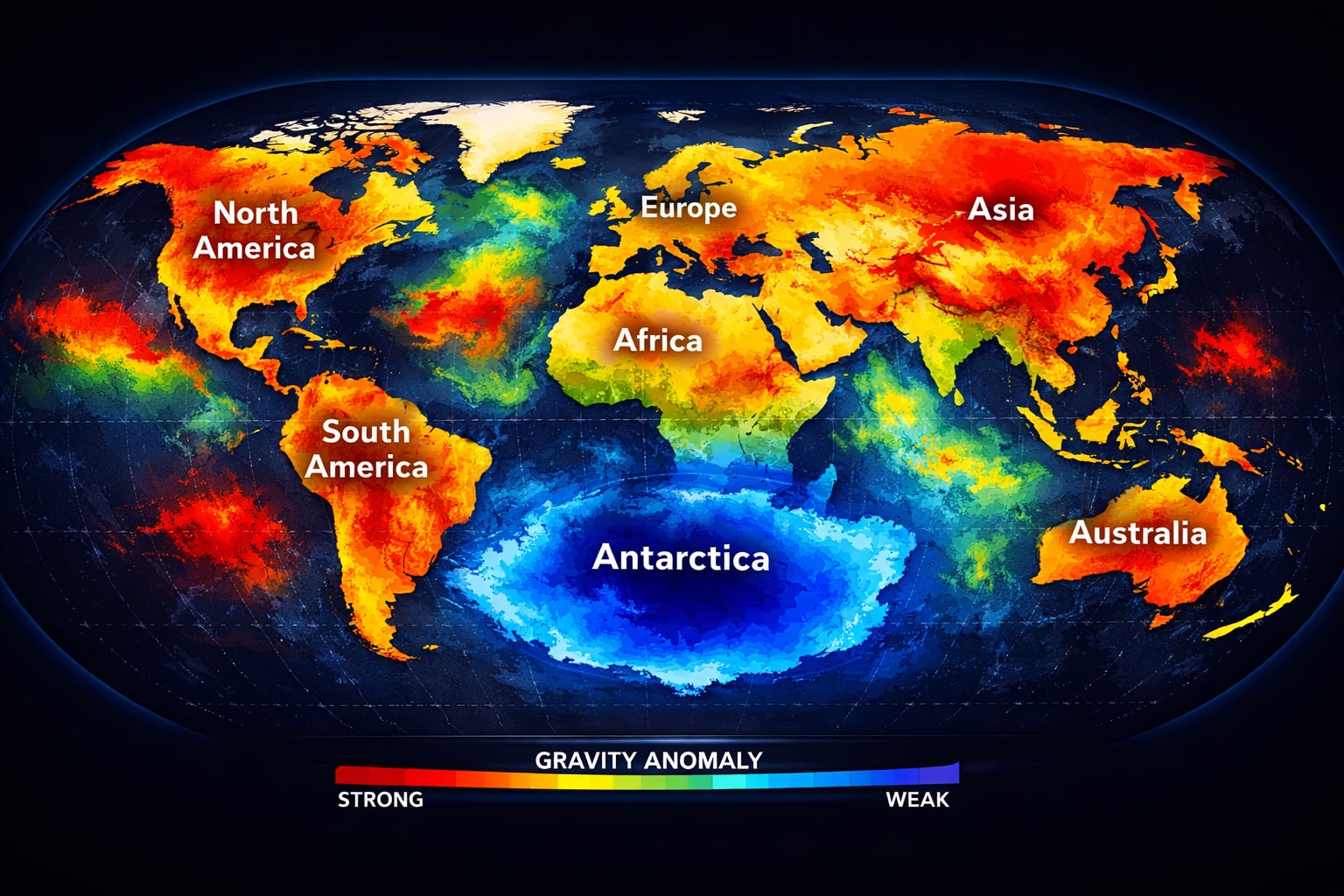
Gravity feels steady and reliable, always keeping us on the ground. But the surprising truth is that it isn’t exactly the same everywhere. Its pull changes slightly depending on where you are on Earth. And in one of the most remote corners of the planet, beneath Antarctica, gravity is at its weakest.
In a new study published in Scientific Reports, scientists found something unusual called the Antarctic gravity hole. It formed over tens of millions of years as rocks deep inside Earth slowly moved in ways too small to notice. These shifts changed the density beneath Antarctica, creating a spot where gravity’s pull is weaker than elsewhere.
What’s fascinating is that this geological quirk coincided with major climate changes in Antarctica, which eventually led to the formation of its vast ice sheets.
“If we can better understand how Earth’s interior shapes gravity and sea levels, we gain insight into factors that may matter for the growth and stability of large ice sheets,” said Alessandro Forte, Ph.D., a professor of geophysics at the University of Florida and co-author of the new study recreating the Antarctic gravity hole’s past.
Understanding how Earth’s gravity bumps and dips (called geoid anomalies) change over long periods of time is important. It helps scientists figure out what’s happening deep inside the planet.
Even tiny differences in gravity can have noticeable effects. Water naturally flows toward areas where gravity pulls more strongly. That means in places with weaker gravity, the ocean surface sits a little lower than it does at Earth’s center. Around Antarctica, this drop is measurable; the sea level there is lower because of the gravity hole.
Most studies focus on present-day geoid snapshots. Scientists in this study take a different approach. Instead of stopping at today’s picture, scientists reconstructed the time-dependent evolution of Earth’s strongest geoid depression: the Antarctic Geoid Low (AGL). Their focus spans the entire Cenozoic era, offering a dynamic view of how this anomaly has changed over tens of millions of years.
To map the gravity hole, scientists relied on earthquake recordings from around the globe. Think of it as a planetary CT scan, except instead of X-rays, they used seismic waves.
“Imagine doing a CT scan of the whole Earth, but we don’t have X-rays as we do in a medical office. We have earthquakes. Earthquake waves provide the ‘light’ that illuminates the interior of the planet,” Forte explained.
The researchers built a detailed gravitational map by analyzing how those waves traveled through Earth and combining the data with physics-based computer models. Their results matched satellite measurements of Earth’s gravity field, confirming that their models captured the planet’s hidden structure with remarkable accuracy.
The team then took their models a step further, backward in time. Using advanced simulations, they rewound the slow movements of rock inside Earth to about 70 million years ago, when dinosaurs still roamed.
Their reconstructions showed that the Antarctic gravity hole was weaker at first, but between 50 and 30 million years ago, it grew stronger. That period aligns with the onset of widespread glaciation in Antarctica.
This big change happened around 50 million years ago, when Earth’s rotation axis suddenly shifted sideways. Scientists confirmed this using paleomagnetic evidence, which shows how the planet’s orientation moved during True Polar Wander.
At first, the Antarctic Geoid Low (AGL) was mainly caused by stable density differences deep in the lower mantle. But over the last 40 million years, the upper mantle started playing a bigger role. Buoyant (lighter) material rising from above, about 1300 km deep, made the gravity lower.
This change happened because two big forces worked together. First, slabs of rock sank deep into the Earth under the northwest edge of Antarctica (a process called subduction). At the same time, hot, lighter material rose upward from the very bottom of the mantle in a wide flow. Together, these sinking and rising movements reshaped and strengthened the Antarctic Geoid Low (AGL).
The next goal is to explore whether this strengthening anomaly influenced the formation of Antarctica’s ice sheets. Future models will examine how gravity, sea level, and continental elevation interact.
As Forte put it, the ultimate question is: “How does our climate connect to what’s going on inside our planet?”
The Antarctic gravity hole is a reminder that Earth is far from static. Beneath our feet, rocks shift, densities change, and forces we think of as constant- like gravity- ebb and flow over millions of years.
These hidden processes may have shaped not just the land but the climate itself. And as scientists continue to peel back the layers of Earth’s interior, we may discover that the story of ice, oceans, and atmosphere is deeply tied to the planet’s unseen heartbeat.
Journal Reference:
Glišović, P., Forte, A.M. Cenozoic evolution of Earth’s strongest geoid low illuminates mantle dynamics beneath Antarctica. Sci Rep 15, 45749 (2025). DOI: 10.1038/s41598-025-28606-1