
39m agoMon 9 Mar 2026 at 11:15pmMarket snapshotASX 200: +1.4% to 8,721 points (live values below)Australian dollar: +0.1% to 70.71 US cents Dow Jones: +0.5% to 47,740 pointsS&P 500: +0.8% to 6,795 pointsNasdaq: +1.4% to 22,695 pointsFTSE: -0.3% to 10,249 points EuroStoxx: -0.7% to 594 points Spot gold: -0.5% to $US5,137/ounce Brent crude: flat at $US98.96/barrel Iron ore: +0.8% to $US103.70tonne Bitcoin: -0.5% to $US68,653
 ASX 200: +1.4% to 8,721 points (live values below)Australian dollar: +0.1% to 70.71 US cents Dow Jones: +0.5% to 47,740 pointsS&P 500: +0.8% to 6,795 pointsNasdaq: +1.4% to 22,695 pointsFTSE: -0.3% to 10,249 points EuroStoxx: -0.7% to 594 points Spot gold: -0.5% to $US5,137/ounce Brent crude: flat at $US98.96/barrel Iron ore: +0.8% to $US103.70tonne Bitcoin: -0.5% to $US68,653
Prices current around 10:15am AEDT.
Live updates on the major ASX indices:
2m agoMon 9 Mar 2026 at 11:53pm
And now for something completely different
From the people that brought you the ‘weekend’, unions are now calling for a 4 Day Working Week.
In a submission to an inquiry about the national employment standards (NES) the Australian Services Union (ASU) will soon lodge a call for a “fundamental reset” of Australian workplace laws.
The union argues the current standards need modernising to help protect Australian workers.
Here’s ASU National Secretary Emeline Gaske:
“With increasing work and care responsibilities, soaring cost of living and ever-expanding demands on workers’ time, we need to make sure that we have modern standards that give workers the flexibility to manage their increasingly busy lives.
“We are calling for a suite of reforms to modernise the NES, a four-day work week, roster justice and guards against work intensification.
“Work has become increasingly complex and Australian workers are working longer and longer hours. There are so many new pressures on workers and it’s time for the next evolution in workplace design.”
Call for ‘roster justice’
The ASU submission will also call for what might sound like a new concept: ‘roster justice’.
Essentially it means more standard and better-scoped out rostering patterns.
The union wants a new national standard requiring at least two weeks’ notice for shift rostering.
“Life doesn’t happen in 24-hour increments. You cannot arrange childcare, healthcare, or a life outside of work if you only find out your shifts the night before,” said Ms. Gaske.
“Roster justice is about dignity and giving workers the ability to plan their lives.”
More to come.
8m agoMon 9 Mar 2026 at 11:47pm
Luck needed
Totally confused ! All ‘experts’ say oil prices will continue to rise – they drop. Global turmoil will decimate risk assets (shares/bitcoin etc.) – they rise. Investors will chase safe havens (gold etc. ) – it drops. Wish the team good luck making sense of it all !!!
– Phillip
Thanks Phillip. Good luck to us all.
14m agoMon 9 Mar 2026 at 11:41pm
Fertiliser market grows uncertain
As noted in that last post, watch out for the rising cost of fertiliser.
Rabobank is a bit of an agriculture specialist and senior farm input analyst Samuel Taylor has a stark summary of where things are at:
“The current conflict in the Middle East, and its effects on shipping and access to the Strait of Hormuz, is disrupting global fertiliser markets, raising prices and tightening supply across global agriculture. Within 48 hours of the first strike on Iran, North African urea prices surged by nearly 20% and EU natural gas jumped by ~45%, underscoring the region’s critical role in global fertiliser flows.”
If you’re more graphically minded, here’s where the vital stock is made — that the world relies on to feed itself.
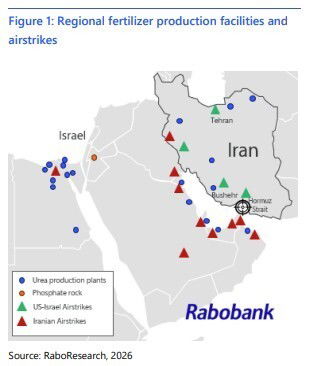 Middle East fertiliser production and areas affected by airstrikes (Rabobank)
21m agoMon 9 Mar 2026 at 11:34pm
Top movers: energy companies slide after yesterday’s lifts
Early trading in the ASX is underway.
The first losers share a theme: they are energy companies that were boosted in yesterday’s AAARRGH response to signs the Middle East conflict would be prolonged.
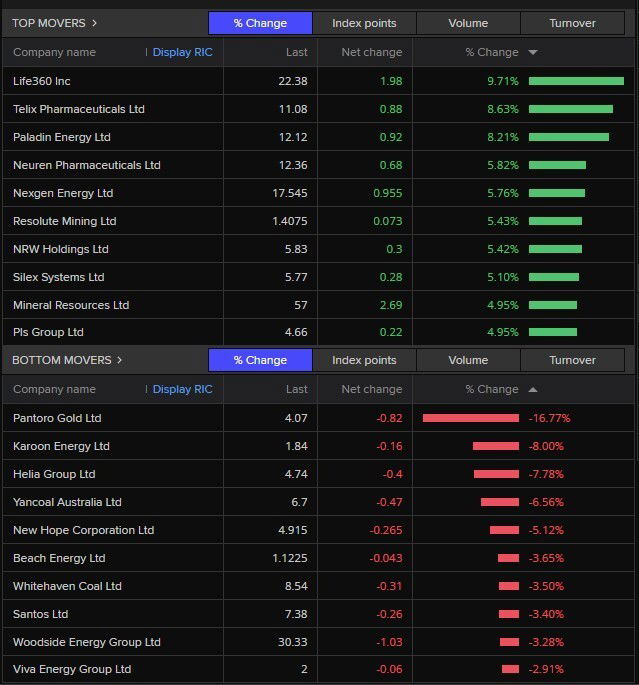 Top movers in early trade (LSEG)
26m agoMon 9 Mar 2026 at 11:29pm
Aluminium at four-year highs on Middle East shipping disruptions
Remember when the lasting economic impact of Russia’s invasion wasn’t rocketing fuel prices, but the knock-on effect on shipping, fertilizer and input costs for products?
(That led to a global inflation spike that took years to combat and we’re not there yet).
This from Reuters is another red flag about that scenario flowing from the conflict in Iran and across the Middle East.
Aluminium prices hit four-year highs on Monday as fears of prolonged shipping disruptions in the Middle East due to the US-Israeli war against Iran fuelled concerns about supplies of the metal.
Benchmark aluminium was down -1.5% at $3,394 a metric ton from an earlier $3,544 a ton, the highest since March 2022 when prices of the metal used in transport, construction and packaging hit a record $4,073.50.
Conflict in the Middle East has virtually shut the Strait of Hormuz through which aluminium produced in the region is shipped to the U.S. and Europe.
“The Europeans are particularly concerned, as the Gulf aluminum stoppage comes just as long-term supplier
Mozal is going offline this month,” said Marex analyst Ed Meir.
“Some producers are looking to draw down stocks from outside the region so as to fulfill their obligations, but we suspect this is going to be difficult given the preponderance of Russian metal on the exchange (currently sanctioned) and generally low inventories otherwise.”
In December, South32 said its 560,000-metric-ton-per-year capacity Mozal smelter would be placed on ‘care and maintainance’ from mid-March, after talks with utilities and Mozambique’s government failed to yield a new power deal.
Worries about supplies have flipped the discount or contango for the cash aluminium contract over the three-month forward into a premium or backwardation. It climbed to $47.4 a ton on Friday, the highest since February 2022 and was last around $22 a ton.
36m agoMon 9 Mar 2026 at 11:19pm
The latest on the Middle East war
For rolling updates of the conflict in Iran and the broader Middle East, there’s a whole other blog for you to consume.
Our colleagues here and in the region can update you with the latest information.
44m agoMon 9 Mar 2026 at 11:10pm
More super changes coming
Payday Super legislation comes into effect from July 1, 2026.
It is what it says on the tin: that instead of being able to make superannuation payments up to quarterly, workers will need to receive their super on the same timelines as their pay.
(Which for most people is fortnightly or weekly).
An interesting note from RSM Australia Restructure & Recovery Partner Adrian Hunter, who worries the changes could create working capital
issues for many businesses.
“Business owners only have four months until these changes come into effect, so businesses already
struggling with cash flow must act now to prevent becoming insolvent.
“March often brings with it an uptick in businesses insolvencies — we know businesses are already under
immense pressure at this time of year.
“We’ve just come out of the Christmas period, where many businesses will have had to pay employee
entitlements while revenue slowed down or stopped entirely. On top of this, fourth quarter BAS payments
were due at the end of February, putting additional strain on their working capital.
“For many small and medium-sized businesses, this new Payday Super legislation will only further increase
the pressure on their cash flow and extend it throughout the year.”
The issue was flagged in the unsuccessful attempts of several accounting lobby groups that tried to delay the introduction by two years to give business time to adjust to the regime. The government didn’t blink on that one; it starts in a few months.
(In the interests of disclosure, I’ve used Adrian Hunter as an expert in reports about insolvency and we even knew each other growing up in Gippsland.)
One of the issues is that superannuation is currently calculated as 12 per cent of ordinary time earnings (OTE).
But from July, super will be calculated as 12 per cent of qualified earnings (QE), which comprises of ordinary time earnings (OTE) and other payments.
This is because some payments like commissions and shift penalties are worked out after they do the work – this was part of the accounting lobby’s claim that it couldn’t be sorted in time.
When superannuation funds don’t receive contributions on time, employers can face penalties in excess of 60% of the superannuation shortfall. The level of pay will vary depending on the employer’s history of meeting obligations.
Mid last year, with Adelaide Miller, we wrote about some of the problems in super.
Payday super should reduce one of them – unpaid super— but it’s not without complications, as you can read.
53m agoMon 9 Mar 2026 at 11:01pmASX 200 leaps more than +1% at opening
The flagship ASX 200 is up +1.4% at opening.
It’s 100 points higher to 8,692.2 points.
It fell nearly -3% yesterday.
More to come.
1h agoMon 9 Mar 2026 at 10:54pm
The biggest market sell-off since ‘Liberation Day’
As we prep for today, breath in deep and examine yesterday.
The ASX was hit with a sharp sell-off, as the Brent crude oil price skyrocketed as much as 25 per cent to almost $US120 a barrel.
It’s the Australian market’s worst day since the “Liberation Day” sell-off in April 2025. The ASX 200 closed down 2.9 per cent.
Wall Street tumbled after the continuation of Middle East hostilities sent oil prices rocketing and new data showed a sharp deterioration in the US jobs market.
AMP’s deputy chief economist Diana Mousina says “markets are finally responding to news that this is probably not going to be resolved as quickly as they would have liked.”
Roger Montgomery from Montgomery Investment Management put it this way: “It’s not unusual for markets to act and behave like a deer in the headlights, waiting for the train to hit before everyone piles on.”
Hear from president of Chicago-based Northern Asset Trust Management, Michael Hunstad, MST Financial senior energy analyst Saul Kavonic and Oxford Economics’ Ben Udy in this comprehensive package.
Loading…
1h agoMon 9 Mar 2026 at 10:47pm
LISTO a GO as super laws grind through Parliament
Beyond the Middle East, the Treasurer Jim Chalmers is notching a win, putting out a release that talks about the introduction of the LISTO.
The What-O?
The Low Income Superannuation Tax Offset (LISTO) fixes a problem suffered by low income earners, where the 15 per cent tax on superannuation contributions meant they often paid more tax on their superannuation contributions than on their other income.
The ATO has a summary here.
“On 13 October 2025, the Australian Government announced from 1 July 2027 the Low Income Superannuation Tax Offset (LISTO) income threshold will increase from $37,000 to $45,000 to match the top of the second income tax bracket. The maximum payment will also increase to $810 to account for recent increases in the Superannuation Guarantee rate.”
As Dr J (I don’t think this will/should catch on) puts it in a media release about a bill going through Parliament…
“The workers who stand to benefit from the LISTO change include over 100,000 sales assistants, over 50,000 administrative workers, over 50,000 aged care workers and disability carers, and over 50,000 child care workers.
“Workers will receive a boost of up to $810 per year to their superannuation account depending on their income and contributions, with an average increase in the LISTO payment of $410 for affected workers.
“Workers could receive a potential benefit at retirement of around $15,000 depending on an individual’s income over their career.
“Our policy to better target super concessions for large balances will continue to affect less than 0.5 per cent of all Australians in 2026–27.”
That last bit is about taxing income on big balances.
1h agoMon 9 Mar 2026 at 10:14pm
Airline stocks lower to ground amid concerns
Unsurprisingly, the stock prices of key airlines are down, after the escalating conflict brought concerns about future travel plans.
Qantas was down 4.5% to 8.52 yesterday.
Virgin Airlines was down 5% to 2.74
In Asia, airline shares tumbled, with the worst-hit, including Korean Air Lines, which slid 8.6%, Air New Zealand down 7.8% and Hong Kong’s Cathay Pacific which dropped 5%.
In Europe, Air France KLM, British Airways-owner IAG, Wizz Air and Lufthansa fell between 2.5% and 6% in morning trade.
Major US airlines shares were down about 1% to 5% in afternoon trading with JetBlue Airways down 5.35% followed by American Airlines down 3.44%.
Underscoring that pain on the consumer side were jumps in ticket prices. Direct flights from Seoul to London on March 11 with Korean Air Lines, for example, leapt to $4,359, from $564 seven days earlier, according to Google Flights data. Flights from Los Angeles to Lima on LATAM Airlines rose to $2,125 compared to $499 in the same period.
“The issue for the airlines now is that travel demand may be curtailed as costs become prohibitive for leisure travellers and as some companies start to limit business travel due to the uncertain outlook,” said Lorraine Tan, director of equity research, Asia at Morningstar.
– With Reuters
1h agoMon 9 Mar 2026 at 10:05pm
As fuel prices rocket, what happens to transport?
“Without trucking, Australia stops” reads the bumper sticker on a lot of large trucks that move what we need around the nation.
There’s no suggestion of stopping, but an increase in fuel prices is putting pressure on Australia’s road transport industry.
A great read from colleague Adelaide Miller about a sector that saw one in 12 businesses shut last year, unable to keep up with rising costs, according to data from CreditorWatch.
2h agoMon 9 Mar 2026 at 9:50pm
War there, economic pain everywhere: the scenarios being calculated worldwide
War brings death, destruction and pain far beyond the land it touches.
Many Australians have links to and loved ones in the regions currently under fire.
Now, Australians are heading to the fight as well.
But there will be a broader impact: economic.
Yesterday, colleague Alison Branley and I tried to add up some of that cost, starting at the petrol pump and heading ever outwards.
2h agoMon 9 Mar 2026 at 9:25pm
Hold on, doesn’t the US have a massive pool of ‘strategic’ oil?
Yes it does, the Strategic Petroleum Reserve.
And even more surprisingly, Australia leases part of it.
In March 2020 then-emissions reduction minister Angus Taylor (now leader of the opposition) signed a deal to rent part of it.
At the time, US secretary of energy Dan Brouillette said this:
“The U.S. Strategic Petroleum Reserve is a critical asset for energy and national security that America has had at our disposal for decades. There is no more secure or resilient place to store emergency oil reserves than the SPR, and we are glad that Australia is choosing to entrust us with their reserves.
“This Arrangement with Australia will strengthen the energy reliability of one of our strongest allies, providing them options in case of an emergency, and bolstering their energy security.”
So, can we get it? Not so fast. The US has its own issues with the gooey pool of security.
Here’s Bob Savage, Head of Markets Macro Strategy at BNY, on the broader calculations of the reserve (abbreviated to SPR):
“The ability for markets to stabilise will take more than the talk of SPR releases.
“The math behind the release of 300-400 million barrels globally shows it will help offset the estimated 10-20 million barrels/day of supply constrained by the war, but will only buy more time.
“20-30 days of comfort won’t fix the other effects from the energy supply shock. Growth expectations are going down; job cuts will be a larger concern, and knock-on effects on inflation will complicate monetary policy.
“Politics will remain messy and add to the uncertainty. Overall, the impatient stage of the war is driving the more urgent risk reduction, but likely not the capitulation stage where value and buying the dip make sense. Watch equities for more extended corrections leading to tempering of U.S. bond moves and USD’s confusing role as a shock absorber.”
So, no easy answers there.
2h agoMon 9 Mar 2026 at 9:12pmAustralia’s starting point less favourable: NAB chief economist
Yesterday afternoon, economists at NAB made the call that Australia’s inflation rate is likely to peak around 5% as the oil price rise feeds through to petrol prices here.
NAB chief economist Sally Auld joined Radio National Breakfast host Sally Sara this morning, in the wash-up of yesterday’s 25%-plus spike in oil prices, and the subsequent moderation that has seen crude prices back below $US90 a barrel this morning.
“That is a little bit unique about Australia is that our starting point pre-the conflict wasn’t perhaps as favourable as it might be in some other countries,” Ms Auld told Radio National Breakfast.
“By that, what I mean is inflation, we already know, is elevated … we also have a labour market that’s pretty tight and an economy that’s looking like it’s pushing up against capacity constraints.
“So all of those things conspire, I think, to make the starting point a little less favourable for us.”
Ms Auld said the rally in oil prices would put further upward pressure on inflation and depending on where they settled, inflation could get somewhere around 5% by the middle of this year.
Not welcome news for households or the Reserve Bank, which meets next week.
Listen to more of the interview:
3h agoMon 9 Mar 2026 at 8:42pm
Countdown to 10AM on as oil prices pull back
When I woke up — early — to do radio crosses, the futures market was in the red.
That means the bets were that the ASX 200 would lose further value when it opens at 10AM on the East Coast of Australia.
But that’s shifted, likely off a positive finish to the US trading day, which has seen the key indicies in the green.
The NASDAQ is up 1.4%, even!
We’ll see what happens, and keep you informed through the day.
3h agoMon 9 Mar 2026 at 8:32pm
Market snapshot
ASX 200 futures: +2.1% to 8,751 points
Australian dollar: +0.6% to 70.7 US cents
Dow Jones: +0.5% to 45,740 points
S&P 500: +0.8% to 6,795 points
Nasdaq: +1.4% to 22,695 points
FTSE: -0.3% to 10,249 points
EuroStoxx: -0.7% to 594 points
Spot gold: -0.5% to $US5,137/ounce
Brent crude: -0.7% to $US91.96/barrel
Iron ore: +0.9% to $US101.91/tonne
Bitcoin: +4.5% to $US68,962
Prices current around 7:30am AEDT.
Live updates on the major ASX indices:
3h agoMon 9 Mar 2026 at 8:27pmBetter day for ASX ahead?
Hello, I’m Daniel Ziffer from the ABC business team and I’ll be taking you through the morning on our business, finance and economics blog.
After an almost -3% fall yesterday, the flagship ASX 200 index that tracks the value of our biggest 200 listed companies is set to lift.
Loading
The ASX 200 futures index tips a +2.1% rise of 184 points to 8,751 points on opening.
That’s largely due to positive results on Wall Street.
Its key indices all rose. (Have I used the rollercoaster GIF yet?)
The blue-chip Dow Jones of 30 mega-companies like Boeing and Visa was +0.5% to 45,740 points.
The broader S&P 500 that covers 500 of the largest listed companies in the US +0.8% to 6,795 points.
The tech-heavy Nasdaq was +1.4% to 22,695 points.
These numbers are live, and trading is continuing, we’ll update you when there’s a firm closing price.
There’s lots to get to, all of it news, analysis and information and none of it financial advice.
Let’s get started!