
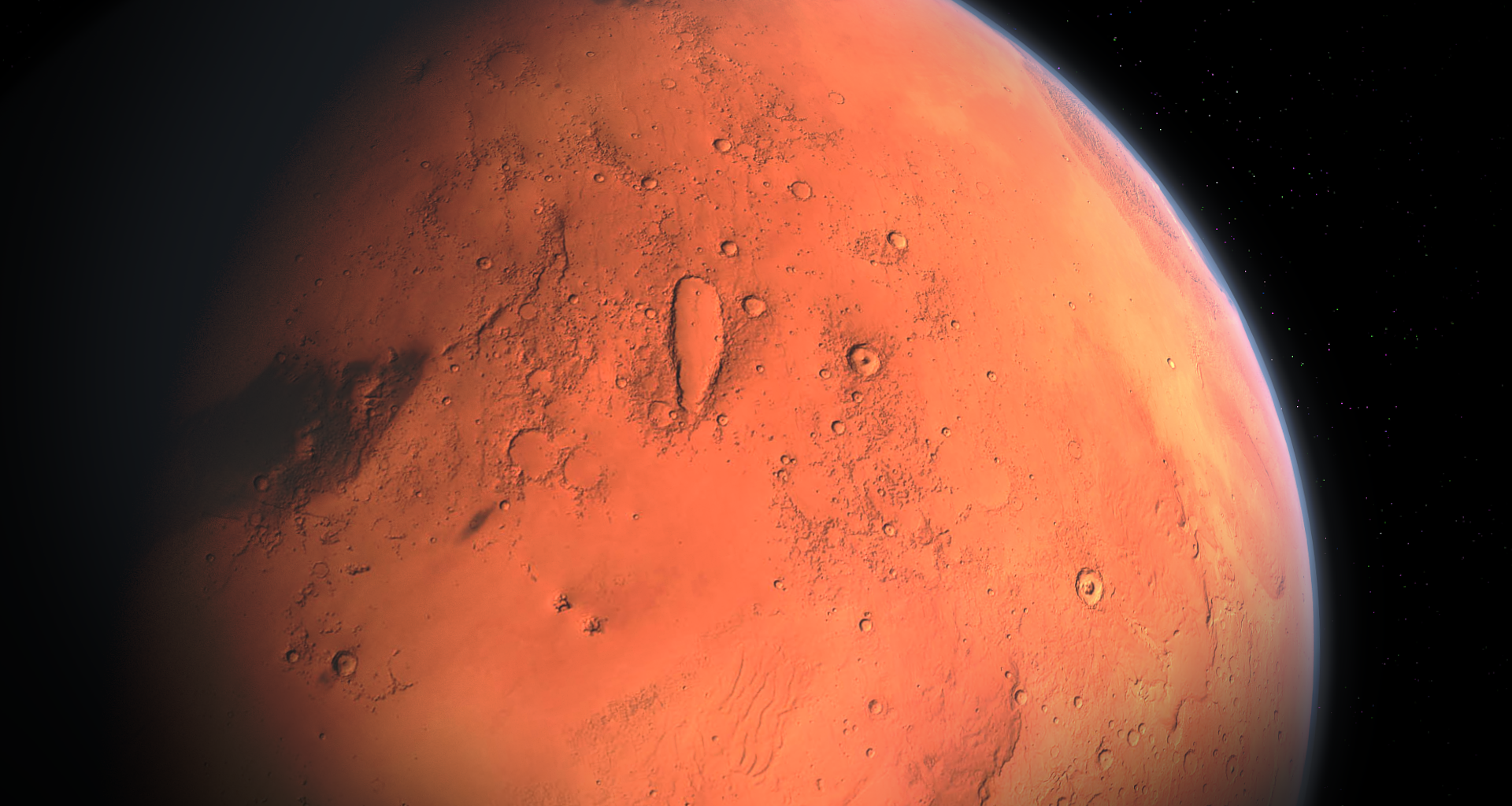
 Life forms tucked into asteroid debris could catapult to other planets – including Earth. Credit: Wikimedia Commons
The idea that life could hitch a ride between planets on chunks of rock blasted into space by asteroid impacts sounds a bit unreal. However, a new study from Johns Hopkins University has just given this far-out hypothesis a serious credibility boost — by literally shooting one of Earth’s toughest microorganisms out of a gas gun and watching it shrug off pressures that would crush just about anything else.
The bacterium in question is Deinococcus radiodurans, a desert-dwelling extremophile first isolated from the high deserts of Chile. It’s already famous among microbiologists for its near-supernatural resilience. Intense radiation, bone-dry desiccation, extreme cold — D. radiodurans weathers them all thanks to a remarkably thick cell wall and an extraordinary ability to stitch its own shattered DNA back together.
If any organism could survive getting catapulted off the surface of Mars and drifting through interplanetary space, this would be the one. The question was whether it could handle the initial violence of the launch itself.
 After shooting the microbes, the team determined whether they survived and examined the survivors’ genetic material for clues to how they handled the pressure. Credit: Johns Hopkins University
“Life might actually survive being ejected from one planet and moving to another,” said senior author K.T. Ramesh. “This is a really big deal that changes the way you think about the question of how life begins and how life began on Earth.”
Published in PNAS Nexus, the team set out to answer that question with unusual directness. They sandwiched living D. radiodurans cells between steel plates and then fired a projectile at the assembly from a gas gun at speeds up to 300 miles per hour. The setup was designed to replicate the transient, crushing pressures that rock fragments would experience during an asteroid impact on Mars — the kind of event that could loft material all the way to escape velocity.
The pressures generated in the experiments ranged from about 1.4 to nearly 3 gigapascals. To put that in perspective, the pressure at the bottom of the Mariana Trench — the deepest point in Earth’s oceans — is roughly a tenth of a gigapascal. Even the gentlest shot in this experiment hit the bacteria with more than ten times the crushing force of the deepest ocean on the planet.
“We expected it to be dead at that first pressure,” said lead author Lily Zhao. “We started shooting it faster and faster. We kept trying to kill it, but it was really hard to kill.”
The team’s equipment actually gave out before the bacteria did, as the steel target configuration broke apart under the most extreme tests.
×
Thank you! One more thing…
Please check your inbox and confirm your subscription.
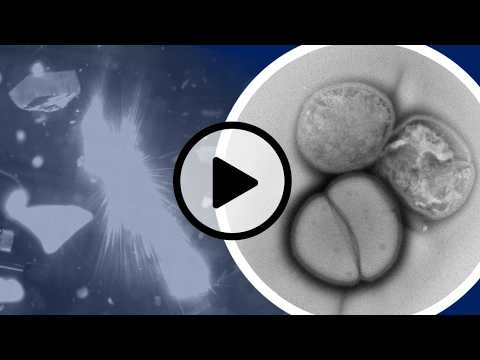
The researchers devised a way to replicate the pressure and a singular biological model in order to test pressure. Credit: Johns Hopkins University
What makes these findings particularly striking is how they compare with earlier work on other microbes. Previous experiments on organisms like E. coli and Shewanella oneidensis subjected to similar pressures showed survival rates plunging by several orders of magnitude — often dropping to around 0.01 to 1 percent at 1.4 gigapascals. D. radiodurans outperformed them all by a staggering margin.
This is important because the study is directly relevant to a concept called lithopanspermia. This is the hypothesis that life can spread between planets by riding inside rocks ejected by asteroid strikes. We know this kind of material transfer actually happens. Dozens of Martian meteorites have been recovered on Earth, flung here by ancient impacts on the Red Planet.
Simulations suggest that rock fragments ejected from Mars at escape velocity would experience transient pressures in the range of up to about 5 gigapascals. The Johns Hopkins results demonstrate that a hardy extremophile can survive pressures approaching that threshold with relative ease, and earlier research has already shown that D. radiodurans can endure the radiation, cold, and vacuum of space travel itself. The pieces of the puzzle are starting to fit together.
The researchers also performed transcriptomic analysis — essentially reading the bacteria’s gene activity after each shot — to understand how the cells responded at a molecular level. At 2.4 gigapascals, a clear stress response kicked in with distinct changes in gene activity related to DNA repair, membrane maintenance, and other survival pathways. In other words, the bacteria weren’t just passively enduring the pressure — they were actively fighting back.
The implications extend beyond the origins-of-life question. Current planetary protection protocols — the international guidelines that govern how carefully we sterilize spacecraft bound for potentially habitable worlds — may need to be reconsidered given these results. Mars’s moon Phobos, for instance, orbits so close that ejected material would reach it at far lower pressures than what is needed to get to Earth. If microbes can survive those pressures, Phobos may need stricter protections than it currently receives.
The team plans to investigate next whether repeated impacts could drive bacterial populations to evolve even greater resilience, and whether other organisms, including fungi, might also survive these conditions.
“We have shown that it is possible for life to survive large-scale impact and ejection,” Zhao said. “What that means is that life can potentially move between planets. Maybe we’re Martians!”