
ATLAS sets new limits on the masses of supersymmetric higgsinos, surpassing results set by the Large Electron–Positron (LEP) collider experiments over 20 years ago.
Supersymmetry (SUSY) is a compelling theory that predicts every Standard Model particle has a “super-partner.” Among these are higgsinos, the supersymmetric partners of the Higgs boson. If they exist, higgsinos could help explain why the Higgs boson has its observed mass. In many supersymmetric models, higgsino-like particles would also naturally account for the dark matter left over from the early Universe, making them attractive targets in searches for physics beyond the Standard Model.
Finding them, however, is easier said than done. Higgsinos would not appear as pure particles; instead, they would mix with other supersymmetric particles to produce physical states called neutralinos and charginos, whose masses can vary widely. Although extremely rare and difficult to detect, LHC experiments have been on the hunt for these particles for many years.
When the mass difference – or “mass splitting” – between charginos and neutralinos is small, the resulting experimental signatures become even harder to identify. Explorations of this “compressed mass spectrum” have long been limited by challenges in particle reconstruction and identification.
Equipped with new machine-learning techniques, the ATLAS Collaboration has met the challenge, setting new constraints on compressed higgsinos in regions last explored by the LEP experiments. The new result examines the full LHC Run-2 dataset, with targeted searches for the lightest higgsino-like states – namely, a chargino (χ̃±1) and two neutralinos (χ̃01 and χ̃02) – which are pair-produced. The mass splitting of these states strongly affects how they would appear in the ATLAS experiment. Researchers therefore conducted two distinct searches targeting different mass-splitting regimes.
The ATLAS Collaboration has now established constraints across the full range of higgsino mass splittings, closing gaps left by previous LHC results.
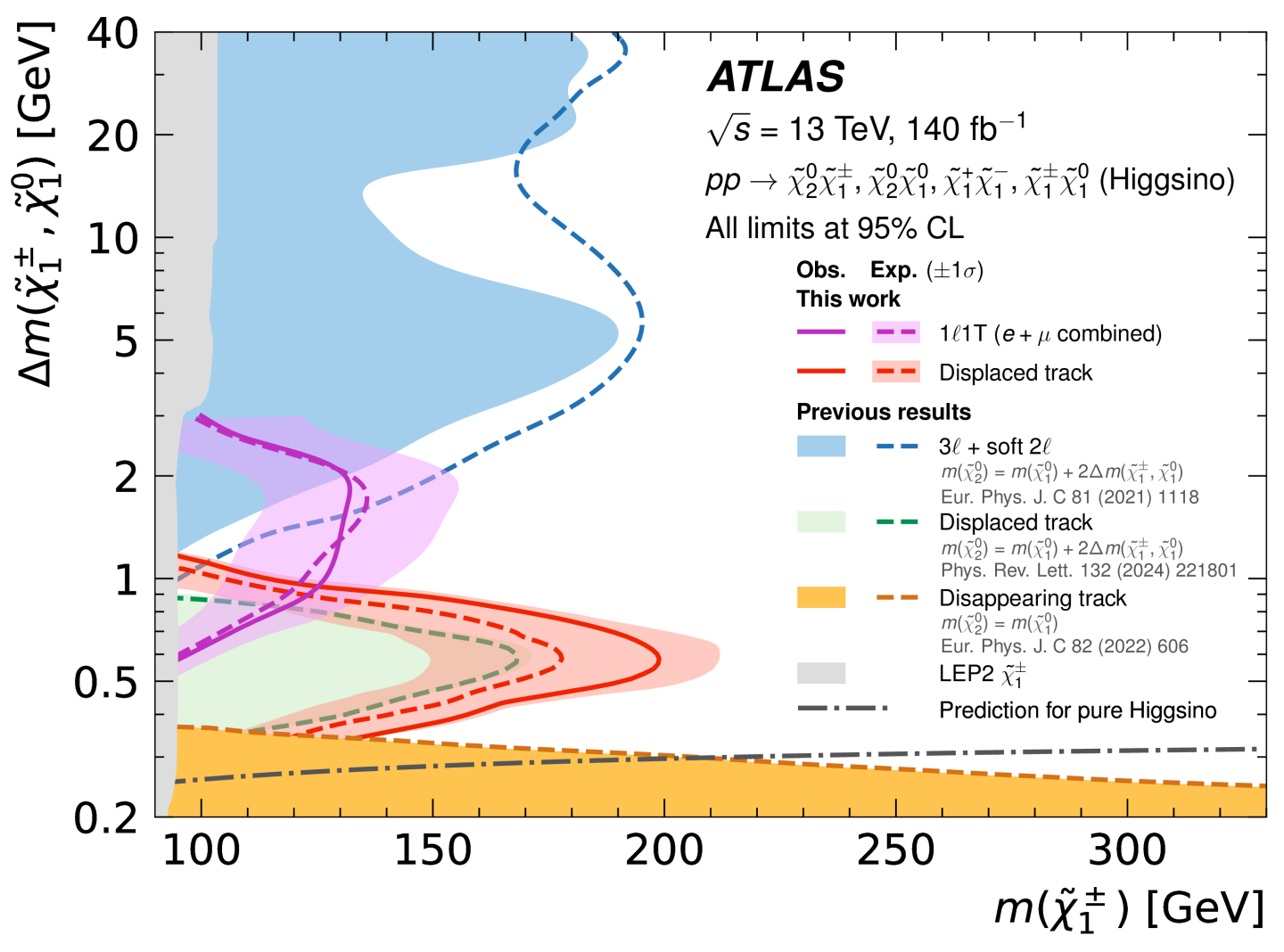 Figure 1: Observed and expected limits at 95% confidence CL for the higgsino model from 1L1T (purple) and displaced track (red) searches. The limits are shown in the Δm(χ̃±1, χ̃01) vs. m(χ̃±1) plane, along with previous limits from the LEP2 experiments (grey) and the ATLAS experiment (blue, light green, and yellow). (Image: ATLAS Collaboration/CERN)
The “displaced track” search focused on mass splittings of 0.3–1 GeV between the chargino and the neutralino χ̃01. In such scenarios, the chargino would travel a few millimetres before decaying into an invisible neutralino χ̃01 and a low-momentum charged pion. The resulting signature is a pion track that is “displaced” from the original collision point having a large transverse impact parameter and high missing transverse momentum from the presence of neutralinos. To enhance the signal sensitivity, physicists used two dedicated neural networks: one focusing on the overall event kinematics and another on the displaced track characteristics.
The “one-lepton-one-track” (1L1T) search targeted larger mass splittings between 1 GeV and 3 GeV. Here the heavier neutralino χ̃02 promptly decays into the lightest neutralino χ̃01 and two low-momentum leptons, one of which evades standard ATLAS identification algorithms. To spot these elusive tracks, researchers developed neural-network-based identification algorithms capable of spotting lepton-like tracks with momenta as low as 0.5 GeV for electrons and 1 GeV for muons. The resulting signature therefore consists of one lepton and one lepton-like-track. A parameterized neural network was then used for event selection, enhancing the signal sensitivity by focusing on the kinematic features that depend strongly on the mass splitting.
The observed data are consistent with Standard Model predictions. Physicists therefore set new limits on higgsino masses at the 95% confidence level (Figure 1). The 1L1T search excluded scenarios where the mass difference between the chargino and the lightest neutralino χ̃01 lies between about 0.8 and 2 GeV – extending previous LEP limits up to a chargino mass of 132 GeV for a mass splitting of 1.8 GeV. The displaced track search extends previous ATLAS exclusion limits by about 30 GeV, reaching chargino masses up to 199 GeV for a mass splitting of 0.6 GeV. Both searches excluded chargino masses below 126 GeV at the 95% confidence level in the targeted mass splitting range. These new limits supersede LEP experiment results in all mass splitting regimes.
The ATLAS Collaboration has now established constraints across the full range of higgsino mass splittings, closing gaps left by previous LHC results. This is an important step forward in the search for supersymmetry. The new Run-3 dataset and evolving analysis techniques will allow the ATLAS Collaboration to further advance these searches, potentially paving the way to the discovery of physics beyond the Standard Model.
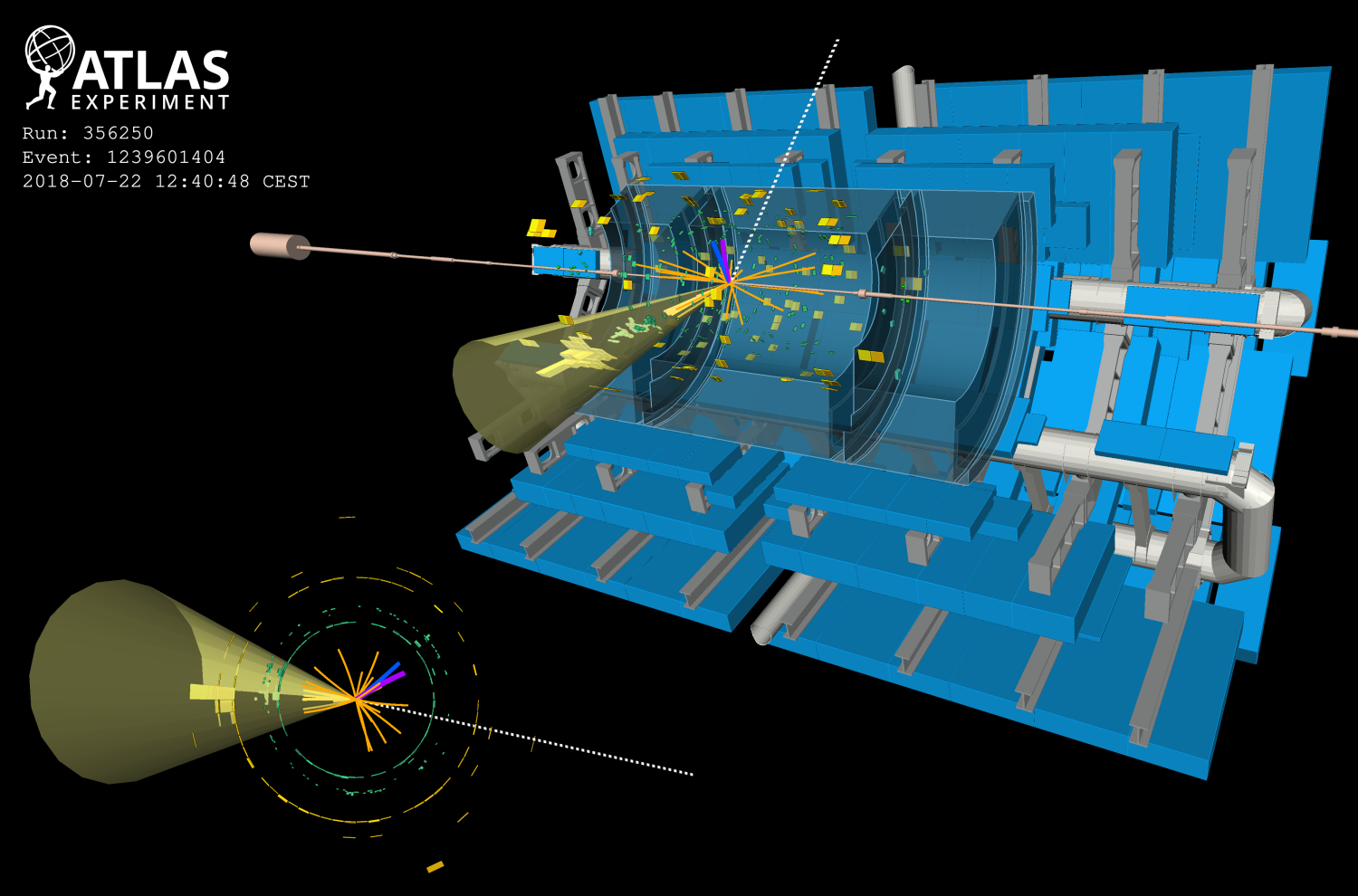
About the event display: Event display of a 1L1T event, consisting of an electron and an electron-track candidate. Energy deposits in the electromagnetic and hadronic calorimeters are presented as green and yellow blocks, respectively, while tracks reconstructed by the inner-detector are shown in orange. An identified jet is shown with the yellow cone, while the missing transverse momentum is indicated by the dashed white line. An electron with a transverse momentum of 8 GeV satisfying the standard ATLAS reconstruction and identification algorithms is shown in blue. The low-energy electron-track candidate with a transverse momentum of 2.5 GeV is shown in purple. (Image: ATLAS Collaboration/CERN)
Learn more