
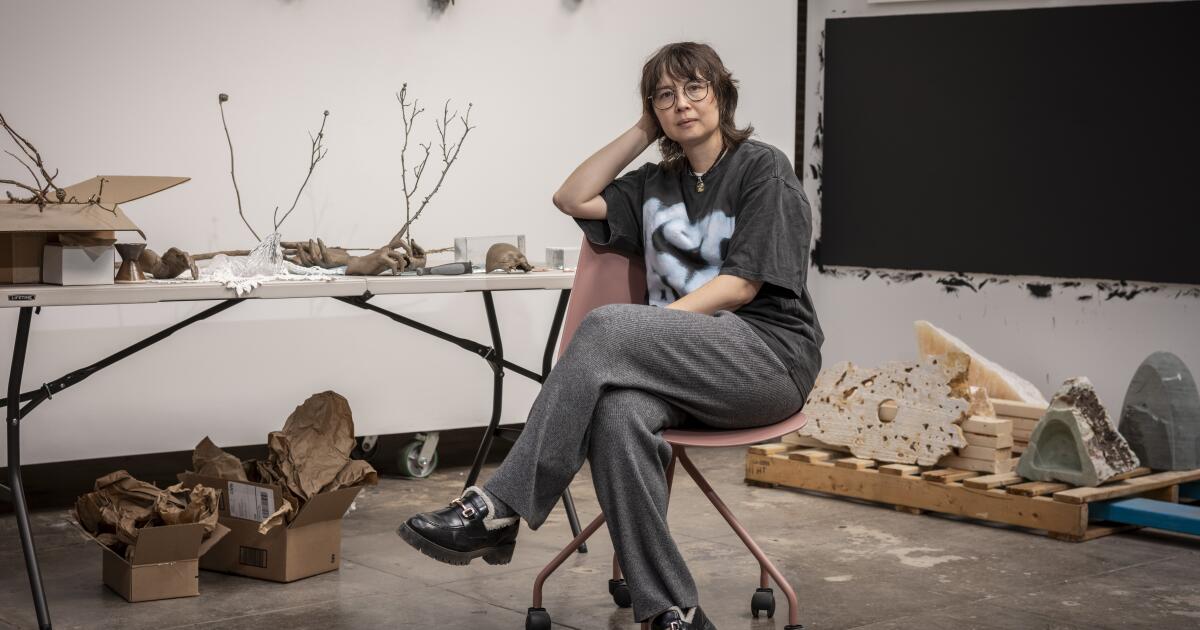
“We evacuated on January 7th, and never returned,” the artist Teresa Baker tells me when we connect to talk about the work she’s made for this year’s Whitney Biennial, which is among the country’s most influential exhibitions of contemporary American art.
Hosted every two years by the Whitney Museum of American Art in New York, this year’s biennial features 56 artists and collectives, roughly 1 in 6 of whom have lived and worked in Los Angeles in the time since the survey’s last iteration. The mass destruction wrought by last January’s L.A. fires made that interval far from routine, and like Baker, many participating artists have spent time recovering or rebuilding.
Baker, her husband and their three young children — all under the age of 5 — moved five times in the last year. First to San Diego, then to San Francisco and New York City, and finally twice within Montana, a state Baker has known since childhood.
Baker’s Indigenous and German heritage inform her three large abstract collage hangings, created using synthetic turf animated by acrylic paint, yarn and a variety of natural materials, including corn husk, willow, buffalo hide and buckskin. They are undeniably painterly. The pieces, says Baker, were made “in a tumultuous time, a time of transition.”
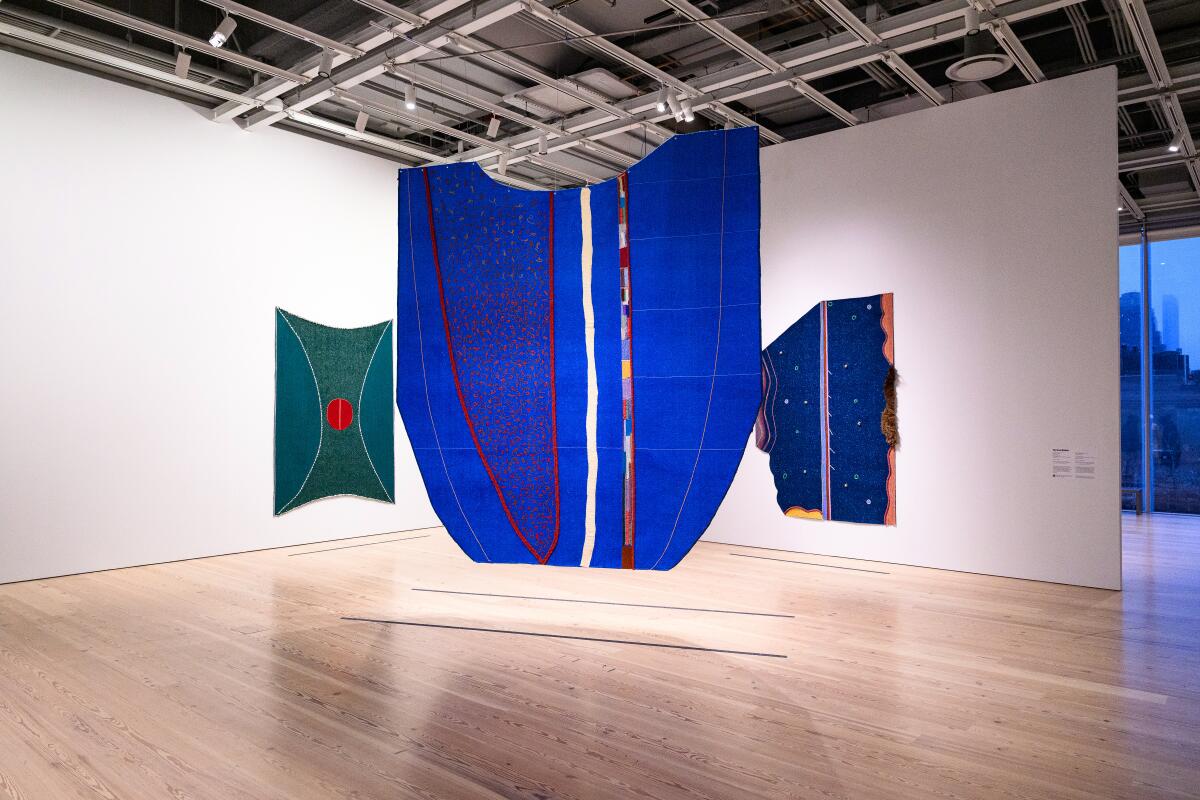
Installation view of Whitney Biennial 2026. From left to right: Teresa Baker, “To the Morning Light,” 2025; Teresa Baker, “The Harvest Melting on Our Tongue,” 2025; Teresa Baker, “Voluminous Day,” 2025.
(Darian DiCianno / BFA.com)
The glory of the natural world, “the very big, grandiose gestures” of the Montana landscape, has informed Baker’s art since her flight from L.A. After working in her new home studio, Baker says she marvels at the beauty of dusk — the depth of orange and blue — as she drives to pick up her kids from school.
“I think what I’m experiencing right now, and maybe, am especially aware of because of the intensity of the last year, is awe,” she says. “It’s so simple, but I think that’s what this landscape is giving me, constant awe in the midst of a really depressing world, and a tough year for the family.”
Leaving L.A. was hard, especially the supportive artistic community she cultivated, but “with all of the scientific unknowns post-fire,” Baker explains, “we made the decision to leave for the safety of our young children.”
By returning to Montana, Baker has drawn herself into alignment with another L.A. artist, Andrea Fraser. Fraser was born in Montana and says she considers herself a “Western person,” even though she lived in New York for 25 years.
“It is very different from the culture of the East Coast, which is much more European-influenced, much more intellectual,” Fraser says.
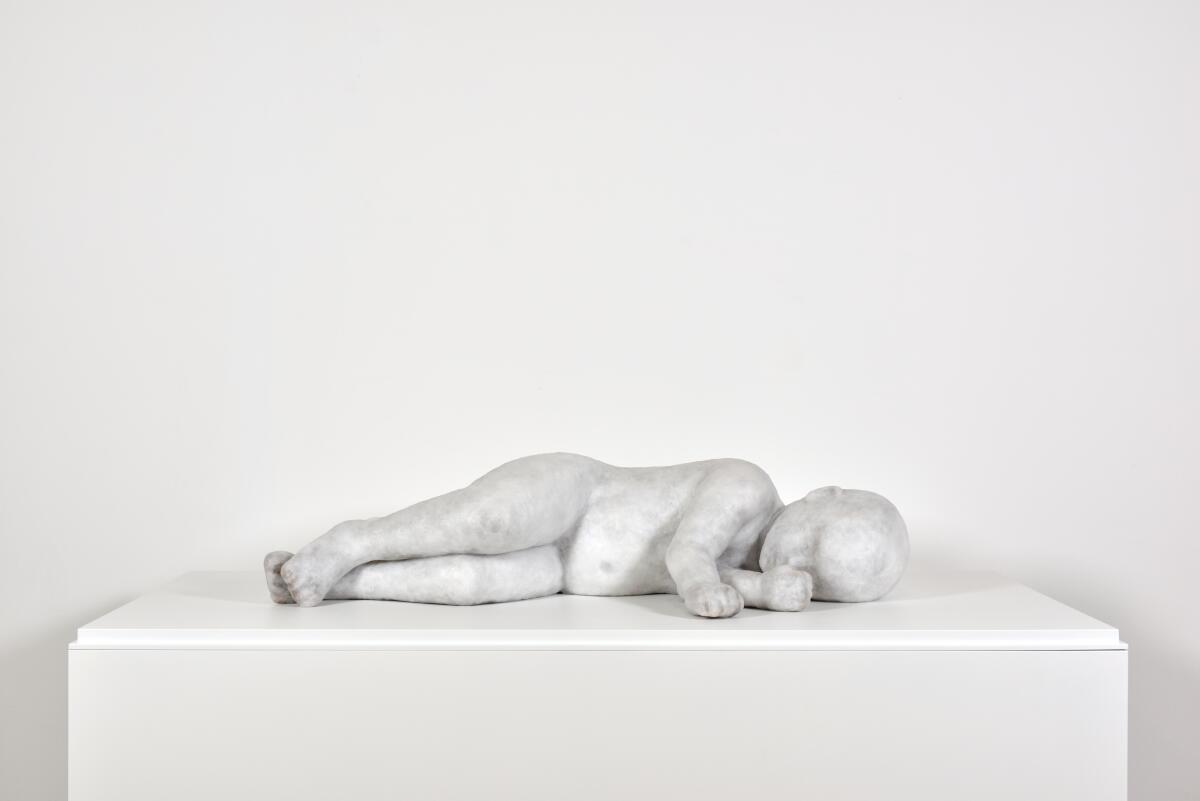
Andrea Fraser, Untitled “(Object) IV,” 2024 (detail). Microcrystalline wax, aluminum and steel armatures, 5 7/8 × 35 3/8 × 15 3/4 in. (14.9 × 89.9 × 40 cm). Collection of the artist. © Andrea Fraser. Courtesy the artist, Marian Goodman Gallery, and Nagel Draxler Gallery.
(Rebecca Fanuele)
Fraser is among this biennial’s most seasoned participants, having also participated in 1993 and 2012. Her contribution — five modeled microcrystalline wax sculptures of sleeping toddlers — appears beside three paintings from the 1960s by her mother, Carmen de Monteflores, who is now 92.
Pondering her return to sculpture after several decades as an acclaimed performance and conceptual artist, Fraser notes that the L.A. artists in this year’s biennial are united by the intersection of conceptual art and craft.
“At least once a year I go into the ceramics studios at UCLA and throw a dozen pots,” she says, noting that it’s a process she is quite good at.
“My garage was sort of my woodshop for a while. I made my desk, I made my partner’s desk, cabinet, shelves. I was doing quite a bit of that, but then I turned my garage into my home gym, a different kind of sculpting,” she says, with a laugh. “Very Los Angeles.”
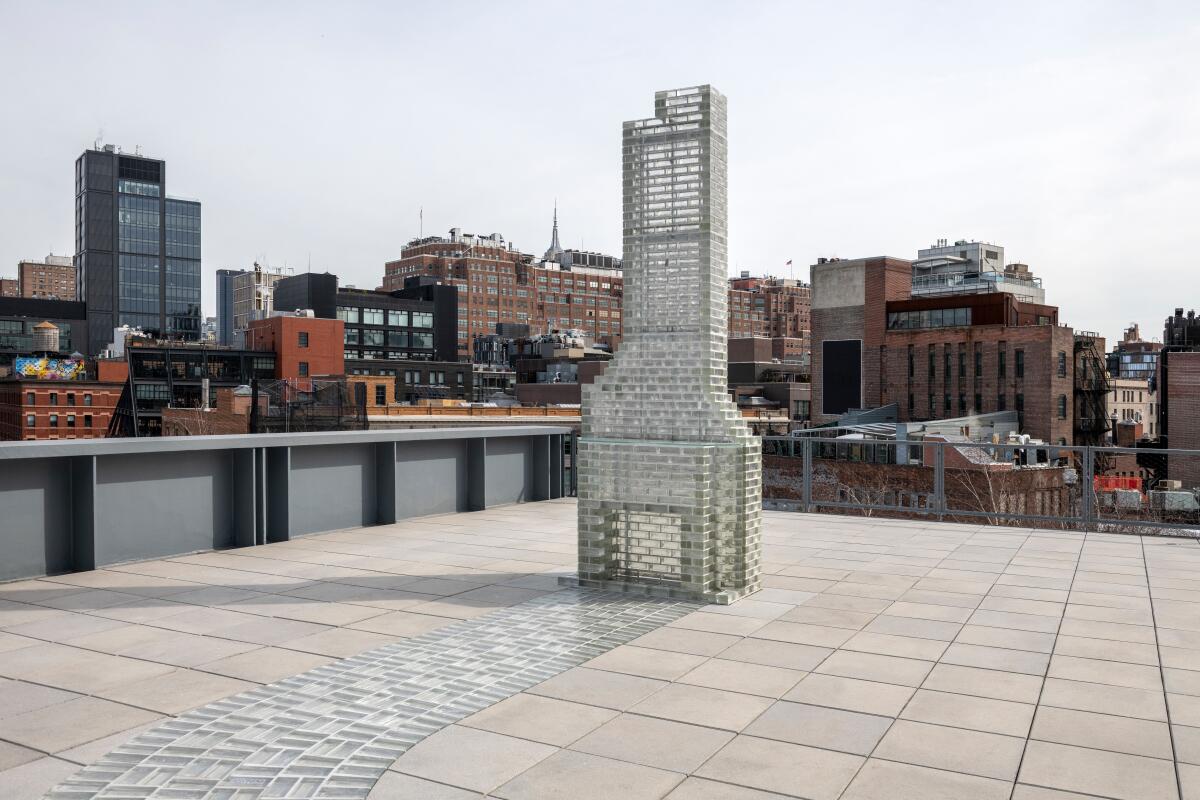
Installation view of Whitney Biennial 2026. Hyundai Terrace Commission Kelly Akashi 2026. “Monument (Altadena).”
(Timothy Schenck)
Another L.A.-based artist, Kelly Akashi, who lost her home and studio in Altadena, has erected “Monument (Altadena),” a glass chimney on the Whitney’s outdoor patio. Inspired by the brick-and-mortar version left behind on the site of her former home, it stands as a solemn icon, echoing hundreds of other slender survivors that still dot the L.A.-area burn scars, as well as Manhattan’s many skyscrapers that now frame it.
The chimney, says Akashi, is “a kind of restless object. It only functions with a home.” Once you create a chimney that stands alone, “it always signals that absence.”
Sculptor Sula Bermudez-Silverman — who, like Akashi, often works with glass — has also been thinking about home in relation to the loss brought about by the L.A. fires.
The biennial’s catalog features Bermudez-Silverman in conversation with her father, the psychoanalyst George Bermúdez, and in it Bermudez-Silverman says that the Eaton fire in Altadena “has been a big catalyst for me to rethink my own relationship to material things, and also about the broader impact of consumption, which has led me to live more minimally.”
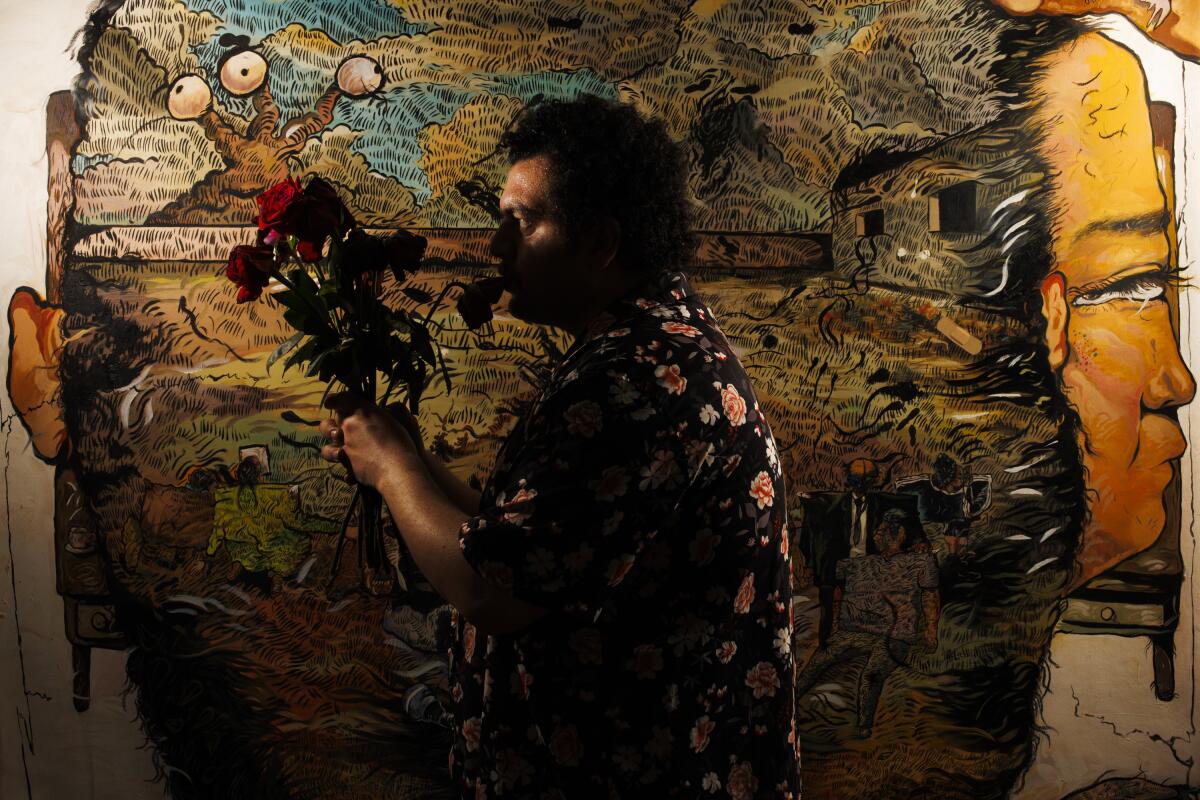
Iraq-born, L.A.-based artist Ali Eyal stands inside his home studio in front of his work. Eyal is part of this year’s Whitney Biennial in New York City — an exhibit that features many artists who have lived and worked in L.A.
(Carlin Stiehl / For The Times)
The L.A.-based Iraqi painter Ali Eyal, who left his home country in 2017, experienced the fires through the prism of his tumultuous youth. “When I saw that black smoke, it took me back to the war time, it seemed like a war zone,” he explained.
“L.A. reminds me of my childhood. I don’t know why,” Eyal mused, adding that the light of the sun is one of the most palpable throughlines, conjuring challenging memories, but also affirming the pleasure of the present.
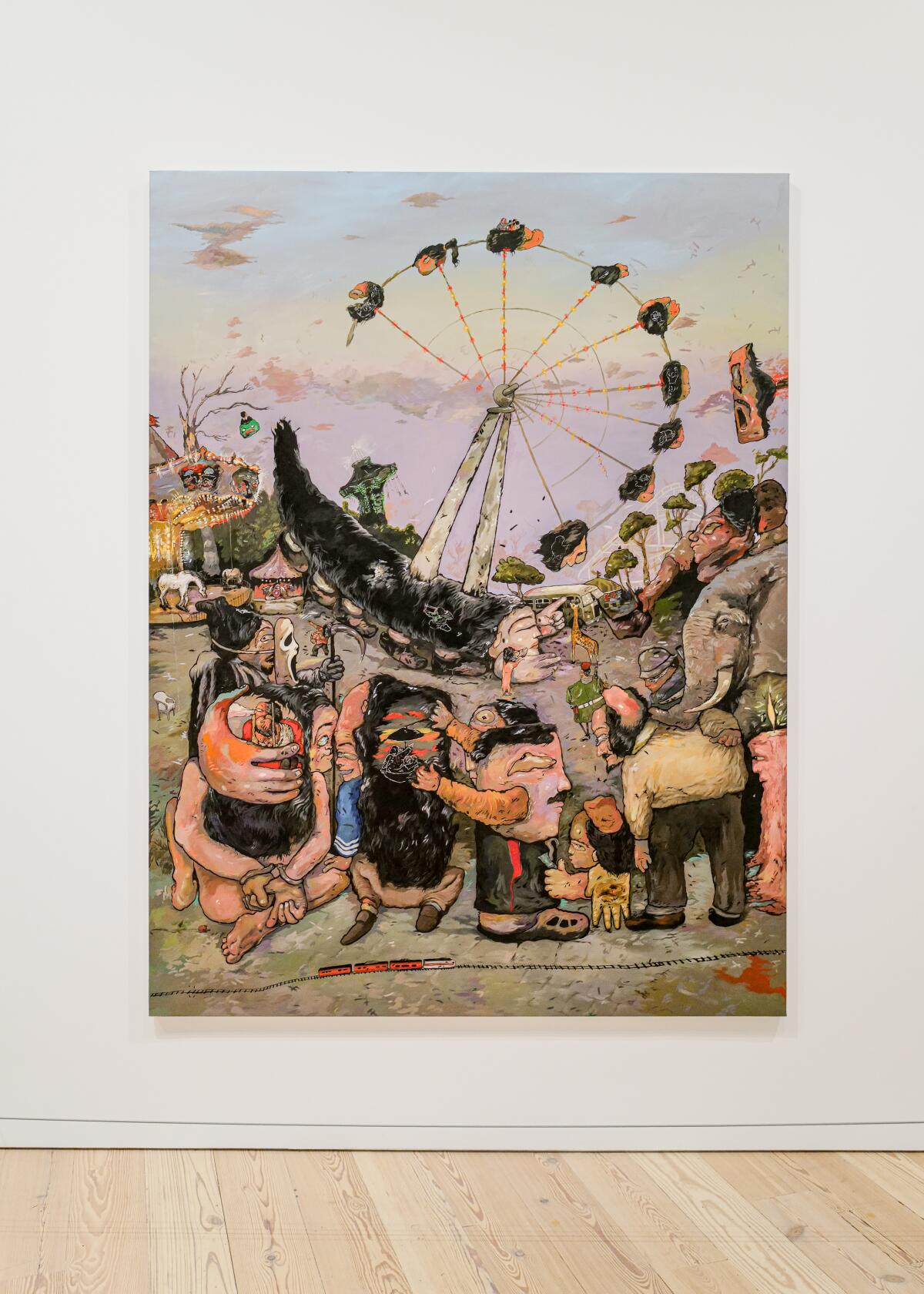
Installation view of Whitney Biennial 2026. Ali Eyal, “Look Where I Took You,” 2026.
(Jason Lowrie / BFA.com)
“The sunset is a difficult time for me, because of all of the violence that happened to me happened during sunset,” Eyal explained. “But in L.A., the sunset is different, the purple, the orange, all of these colors together.”
While that same sun will always rise in the East and set in the West, the work of these artists affirms that each new day is ours to make anew — no matter what sorrows may lay behind us.