
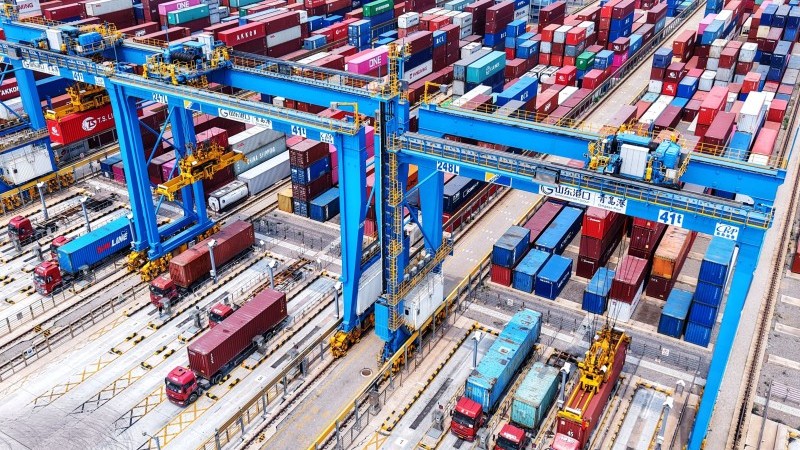
Export strength isn’t a new story for China, having been one of the primary drivers for growth in the last two years. What is new is China’s recent focus on ramping up imports in order to promote more balanced trade. This has been mentioned multiple times at high-level meetings, including the Two Sessions.
Encouragingly for China’s trade partners, imports are also off to a strong start in the first two months of the year, up 19.8% YoY, year-to-date, well above market forecasts for import growth of around 7%. One caveat: this strength partially reflects a supportive base effect, as imports were down -8.4% YoY ytd in the first two months of 2025.
Nonetheless, after import growth has been quite flat since 2022, the data represents a solid start to 2026.
By import origination, China’s imports from India (43.1%), Korea (35.8%), Australia (33.8%), and Latin America (28.9%) outperformed in the first two months of the year. Imports from the EU (11.7%) and ASEAN (12.9%) were below headline growth but still respectable. Imports from the US were the clear outlier, down -26.7% YoY ytd.
By product, the areas with the fastest import growth continue to be centred on tech products, with hi-tech products (27.7%), automatic data processing machines (68.7%), and semiconductors (39.8%) seeing robust growth over the first two months of the year. We also saw solid YoY growth in agricultural product imports of 9.7%. As the world’s largest crude oil importer, China saw the value of crude oil imports fall by -5.2% YoY. But the volume actually rose by 15.8% YoY. With the crude oil price spike in March, China’s oil imports are set to get more expensive. It remains to be seen how supply disruptions factor into overall imports.