
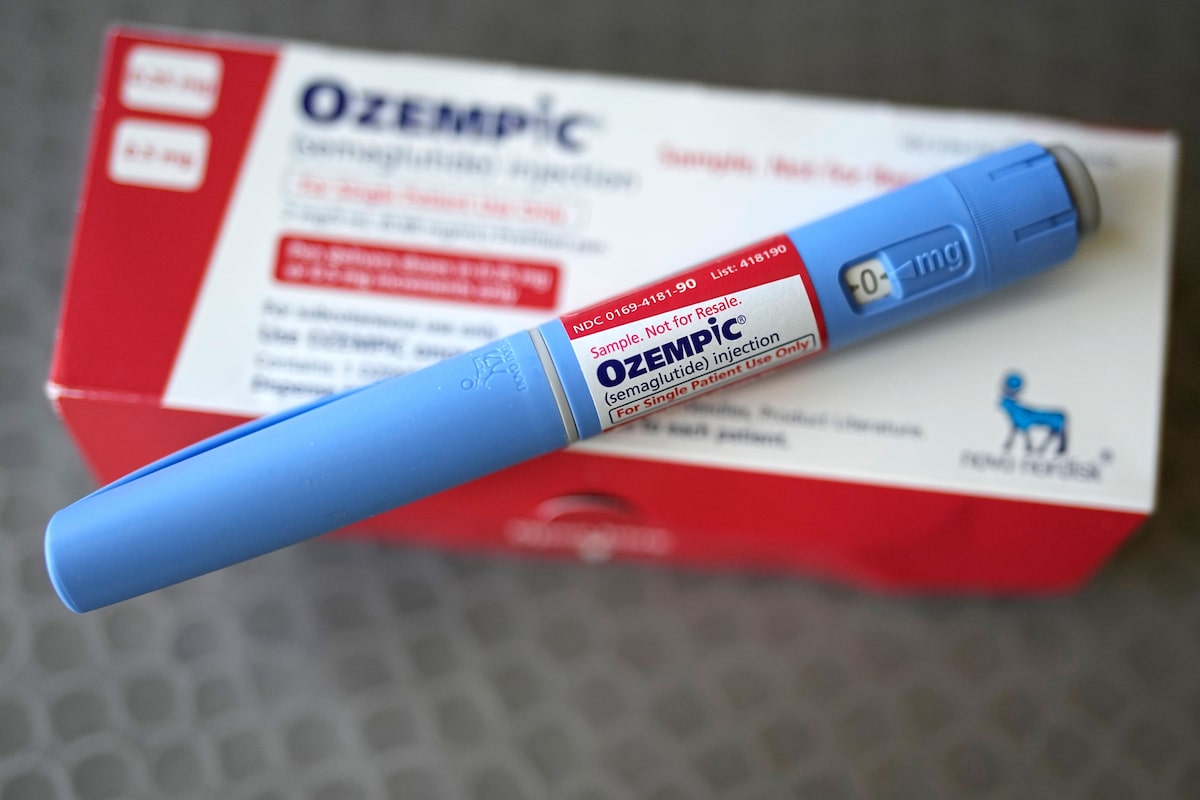
Public spending on prescription medications in Canada grew by more than 9 per cent in 2024, with one drug driving the increase more than any other: Ozempic.
The Canadian Institute for Health Information (CIHI) published a new analysis on Tuesday showing that taxpayer-funded drug plans shelled out $20.1-billion on prescription drugs in 2024, up 9.3 per cent from nearly $18.4-billion the year before.
That’s the highest annual growth rate in public drug spending in 20 years, according to CIHI, the country’s health data agency.
CIHI said Ozempic, a treatment for Type 2 diabetes, was responsible for 8.5 per cent of the total growth in 2024, the last year for which data are available.
However, that’s lower than the previous year, when Ozempic fueled nearly 20 per cent of a 6.7-per-cent increase in government spending on prescribed drugs.
What will change in Canada when generic Ozempic hits the market, according to our reporters
Individual drugs don’t often have such a dramatic impact on the bottom line of public drug plans, according to Tracy Johnson, CIHI’s director of health spending.
“It’s happened before, but it’s rare,” she said.
The CIHI analysis shows that governments in Canada spent $794.1-million on Ozempic, also known as semaglutide, in 2024. That’s up from $130.5-million in 2020, when far fewer Canadians took the medication.
The CIHI analysis was published just over two months after Canada became the first country where generic versions of semaglutide are legal, although Health Canada has yet to approve any of the cheaper duplicates. Six drugmakers have applications pending, one of which was submitted more than two years ago.
“Every month we spend waiting for a generic is a month that our public plans are paying more than they will in the future for these drugs,” said Michael Law, a professor in the Department of Community Health Sciences and the academic director of the Centre for Health Policy at the University of Calgary.
The Canadian researcher whose discovery led to Ozempic is still making breakthroughs
The Canadian Generic Pharmaceutical Association, a lobby group representing generic drug makers, has raised concerns about how long the federal regulator is taking to make decisions on copies of semaglutide and other generics.
In the case of semaglutide, Health Canada told The Globe and Mail in January that the review process is more “complex” than for typical generics because the original semaglutide is a biologic drug derived from cells. Generic companies are applying to make chemically synthesized copies.
Government drug plans across Canada are facing Ozempic-driven cost increases despite the limitations they’ve placed on covering glucagon-like peptide-1 receptor agonists (GLP-1s,) the wildly popular class to which Ozempic belongs.
Public plans don’t cover Wegovy, a version of semaglutide sold explicitly for weight loss, or tirzepatide, a newer GLP-1 marketed as Mounjaro for diabetes and Zepbound for weight management.
Provinces and territories only cover Ozempic for people with Type 2 diabetes, and most stipulate that patients first try older drugs such as metformin.
How will cheaper versions of Ozempic tip the scales?
Despite those restrictions, the number of public plan beneficiaries taking Ozempic rose to about 420,000 in 2024, up from around 100,000 in 2020.
Government drug plans in Canada generally cover senior citizens and poor people, although policies differ from jurisdiction to jurisdiction. Other Canadians who want to take GLP-1s have to pay out of pocket or rely on private insurers, who are also feeling financial pressure from covering GLP-1s.
When all payers are factored in, Ozempic is far and away the top-selling drug in the country. Canadian pharmacies sold just more than $2.9-billion worth of the medication last year, according to IQVIA Canada, which aggregates prescription sales. That includes some off-label use for weight loss.
Ms. Johnson of CIHI said an important question for provincial governments is whether broadening coverage of weight-loss drugs will save the health system money down the road by keeping Canadians healthy and out of hospital.
CIHI is working on a study of that question for Wegovy.
“There’s two big reasons you would pay for a drug as a public system. One of them is to improve health,” Dr. Law said. “You can also see these knock-on effects on other parts of the health system. Unfortunately, those are pretty hard to measure.”