
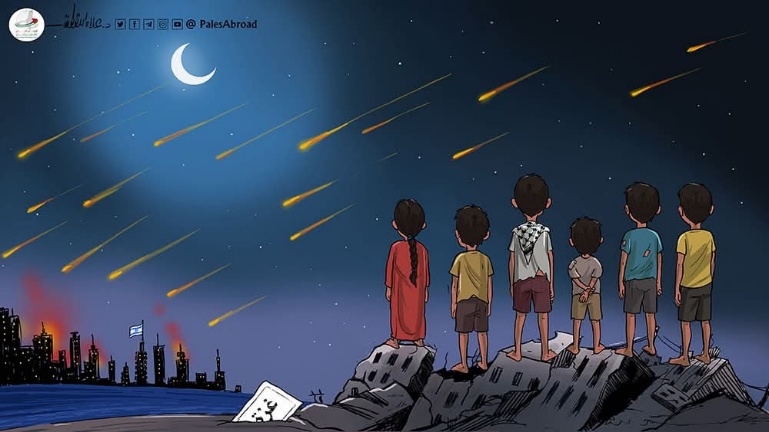
 Palestinian children watching the Iranian missile attack on Israel, by Hamas cartoonist Alaa al-Laqta (X account of Alaa al-Laqta, March 4, 2026)
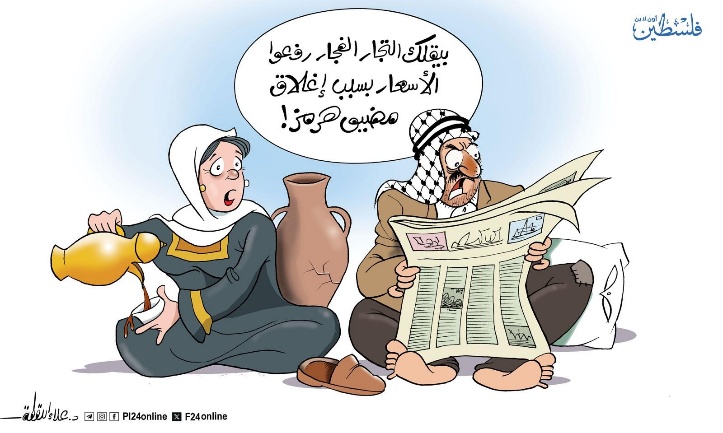 Merchants raise prices because of the closure of the Strait of Hormuz (Palestine Online, March 4, 2026)
 Armed Hamas police officers supervise the markets (Telegram channel of the Hamas police in the Gaza Strip, March 5, 2026)
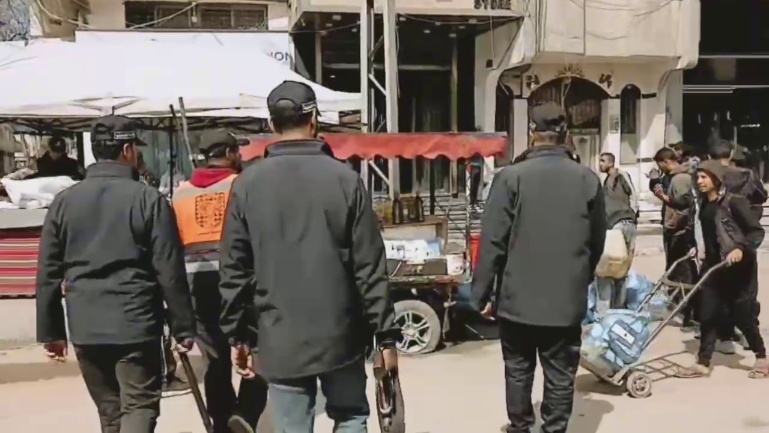 Armed Hamas police officers supervise the markets (Telegram channel of the Hamas police in the Gaza Strip, March 5, 2026)
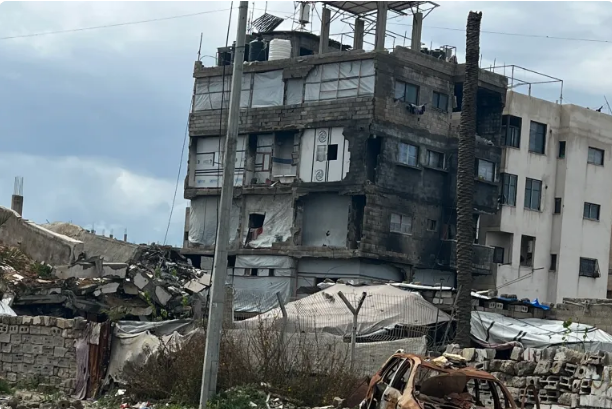 Apartments repaired and renovated with wood and plastic sheets (aljazeera.net, March 5, 2026)
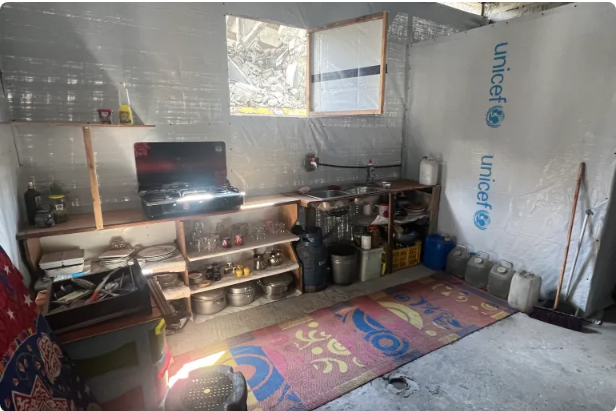 Apartments repaired and renovated with wood and plastic sheets (aljazeera.net, March 5, 2026)
According to reports, the talks on implementing the second phase of the ceasefire agreement in the Gaza Strip, including the issue of disarming Hamas, were frozen because of the war in Iran. A member of the technocrat committee for managing the Gaza Strip admitted they could not make progress under the existing circumstances.
IDF forces continued activity within the Yellow Line in the Gaza Strip and destroyed five underground tunnels and rocket launchers aimed at the State of Israel.
The Israeli Coordinator of Government Activities in the Territories accused Hamas of seizing goods and raising prices despite the renewed entry of aid trucks into the Gaza Strip.
Hamas exploited the delay in the activity of the technocrat committee and the new security forces to continue consolidating civilian governance and security in the Gaza Strip.
The Palestinian Authority condemned the deaths of local residents during settler riots, while Hamas called for confrontations with the “settler gangs.”
Sources familiar with the details of the negotiations said the talks on the second phase of the ceasefire agreement in the Gaza Strip, including the issue of disarming Hamas, had been frozen since the beginning of the war with Iran. A source, reportedly with direct knowledge of the activity of the Board of Peace, claimed it was a temporary pause because of “flight disruptions” in the Middle East which prevented the mediators from moving around the region. A Palestinian figure said Hamas representatives were supposed to hold talks with the mediators from Egypt, Qatar and Turkey on the day the war began, but a new date had not been set. Hamas confirmed the talks were “currently frozen.” The White House, however, claimed the discussions on disarming Hamas continued and were “positive” (Reuters, March 9, 2026).
A member of the national committee for managing the Gaza Strip said the committee’s activity had been restricted since the beginning of the Israeli-American war with Iran, and aid programs for the support of the Gazans had been suspended. He said that under the circumstances, the committee could not make progress, especially after the level of aid had declined significantly and the activity of the crossings through which goods entered the Gaza Strip had been reduced, including products that Israel defined as “dual-use.” He also said that before the war the committee had held discussions with the Board of Peace, headed by the commissioner, Nikolay Mladenov, regarding expanding the entry of goods into the Strip, but the result of the new war had been the opposite and had worsened the “siege.” Reportedly, the committee headed by Ali Shaath met after the outbreak of the war to discuss developments, but the situation was “difficult” and it was unclear how long it would last, and there were growing concerns that the Palestinian issue would be pushed even further to the margins by the international focus on the war Iran (al-Quds al-Arabi, March 8, 2026).
Palestinian children watching the Iranian missile attack on Israel, by Hamas cartoonist Alaa al-Laqta (X account of Alaa al-Laqta, March 4, 2026)
Abu Obeida, spokesman for the Hamas military wing, praised the attacks of the “Islamic Resistance” in Lebanon on IDF forces, claiming its operatives had inflicted “heavy losses” on the Israeli forces and attacked targets deep inside Israel. He praised the attackers for exercising “their right to defend their land and the sovereignty of their homeland” against what he claimed was “ongoing Israeli aggression.” He expressed condolences for those killed in Lebanon, wished recovery to the wounded and praised the late secretary general of Hezbollah, Hassan Nasrallah, who had “made a moral [sic], courageous decision” to stand with the Gaza Strip and its people and paid for it with his life. He called on the Arab-Muslim nation to unite against the [alleged] “plans of the Zionist enemy” to expand the war to other Arab-Muslim countries and warned of [alleged] Israeli aspirations to realize the idea of a “Greater Israel” (Telegram channel of Abu Obeida, March 8, 2026).
Sources in the Palestinian Islamic Jihad (PIJ) said the regional “security” changes and the war in Iran had imposed complications on the organization’s remaining places of refuge. According to the sources, PIJ secretary general Ziyad al-Nakhalah had reduced his visits to Iran and visited them only three times since the elimination of former Hamas leader Isma’il Haniyeh in July 2024. One of the visits, which lasted several days, was accompanied by PIJ and Hamas delegations, while the other two visits were short. In addition, a source close to al-Nakhalah said that in recent months he had moved between Doha and Cairo and stayed in both for periods of time, especially in Doha where his deputy, Muhammad al-Hindi, was almost always present. Al-Hindi himself also moved between Qatar, Egypt and Turkey. According to the source, while in Egypt the two met with officials in Egyptian general intelligence to discuss issues related to the Gaza Strip. According to the sources, al-Nakhalah and several leaders of his organization, especially Akram al-Ajouri, who is responsible for the PIJ’s military wing, had found a safe refuge in Iran, together with other capitals in the region, mainly Beirut, before they approached Qatar and expanded relations with Egypt. However, because of “security sensitivity,” the sources refused to comment on whether al-Ajouri had left the Dahiyeh al-Janoubia in Beirut, where he had found refuge in recent years (al-Sharq al-Awsat, March 8, 2026).
The IDF
IDF activity continued within the Yellow Line in the Gaza Strip. The forces destroyed five underground tunnels of more than two kilometers, including the route in which Hamas terrorists had hidden in eastern Rafah for several months, and destroyed launchers used for firing rockets at Israeli territory. The forces eliminated terrorists who crossed the Yellow Line or posed a threat to IDF soldiers, and terrorist operatives who helped strengthen Hamas (IDF spokesperson, March 7, 2026; al-Sharq al-Awsat, March 7, 2026).
The UN UNOPS agency reported that an empty fuel truck had been hit by gunfire from the sea while it was on its way to the Kerem Shalom Crossing after its movement had been coordinated in advance with the Israeli authorities. There were no casualties and the agency called for a full investigation. The IDF stated that during defensive naval activity in Gaza, naval fire accidentally struck the truck and caused it minor damage. According to the IDF spokesperson, the incident was being investigated and lessons had been learned (Reuters, March 6, 2026).
The Situation in the Gaza Strip
On March 3, 2026, after a two-day pause caused by concerns of Iranian missile attacks from Iran, the crossings reopened for the entry of humanitarian aid into the Gaza Strip. The Israeli Coordinator of Government Activities in the Territories (COGAT) said all requests submitted by the UN and aid organizations which been authorized to operate for the entry of food or aid had been approved and that hundreds of trucks had entered the Strip (al-Munasaq Facebook page, the COGAT in Arabic, March 3, 2026; X account of the COGAT, March 9, 2026).
Merchants said that despite the Israeli announcement about reopening the crossings and allowing the entry of aid and goods, there was a severe shortage of many goods in the markets, especially vegetables, fruits and eggs. They claimed that after a hiatus of three months, the situation had forced the Hamas ministry of national economy to intervene and set fixed prices for various goods, such as vegetables, eggs and meat, to prevent hoarding and price gouging. They also claimed that Israel still banned the entry of cooking gas and other fuels for the commercial sector, which led to price increases and shortages in large areas of the Strip, and Gazans had returned to using firewood for fuel. It was also claimed that the stock of tents and shelter equipment held by local and international organizations operating in the Gaza Strip had almost run out, since Israel refused to allow the entry of tents, except for a small number of trucks in recent weeks (al-Ayyam, March 6–7, 2026). In response, the COGAT stated that Hamas was seizing goods and raising their prices in order to survive, while the Gazans bore the cost. He also noted that the food supply in the Strip was continuously monitored in cooperation with the United States, the UN and international organizations, and called on Gazans to report which food products were being sold at particularly high prices so that their import could be coordinated according to need (al-Munasaq Facebook page, the COGAT in Arabic, March 8, 2026).
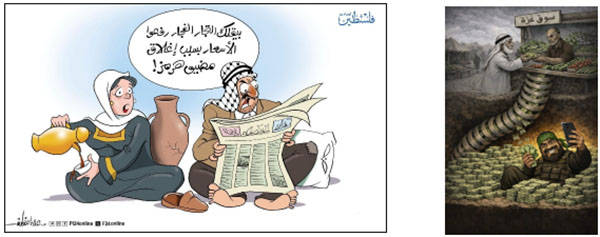
Right: Goods intended for Gazans are siphoned off by and enrich Hamas (al-Munasaq Facebook page, March 9, 2026). Left: Merchants raise prices because of the closure of the Strait of Hormuz (Palestine Online, March 4, 2026)
The World Health Organization warned that the medical stocks in the Gaza Strip were declining to a critical level despite the reopening of the Kerem Shalom Crossing for the limited entry of aid. According to the organization, basic items such as gauze and needles had already run out and the stock of essential medicines, trauma equipment and surgical materials was at a low level, while the shortage of fuel continued to disrupt hospital operation. Meanwhile, the Rafah Crossing into Egypt remained closed, the evacuation of patients was suspended and about 18,000 people, including wounded children and chronically ill patients, were waiting to leave. According to the organization, 18 of the 36 hospitals in the Strip remained closed and those which were operating found it difficult to provide essential services such as surgery, dialysis and intensive care (Reuters, March 6, 2026). Taysir Muhsin, an advisor to the Hamas government media information office, claimed that according to Israel the crossings were operating, but “allowed only the entry of luxury goods which did not meet the basic needs for food and medicines” (Telegram channel of Alam Radio, March 7, 2026).
The Qatari committee for the reconstruction of Gaza began distributing shelter packages, hygiene supplies and medical assistance in the refugee camp in the center of the Netzarim corridor south of Gaza City. Thousands of displaced persons who arrived in the area in recent days were staying in the camp because of a shortage of shelter and basic needs. The spokesperson for the committee, Abd al-Rahman al-Khaldi, said it was a continuation of Qatar’s ongoing support for the Gazans. He said that given the scale of the “humanitarian disaster,” a broad regional and international effort was required to assist all the residents of the Strip (Al Jazeera Mubasher, March 7, 2026).
Civilian Governance
The Hamas ministry of social welfare announced it would again distribute a payment of 500 shekels (about $160), part of the “We are your support 2” campaign. According to the ministry, the installments would go to cancer patients or those suffering from kidney failure or whose limbs had been amputated since October 7, 2023, families of prisoners in Israeli prisons who had not received the first installment, families of residents missing since the beginning of the war who had not received the first installment and widows who had not received the first installment (Shehab Agency, March 9, 2026).
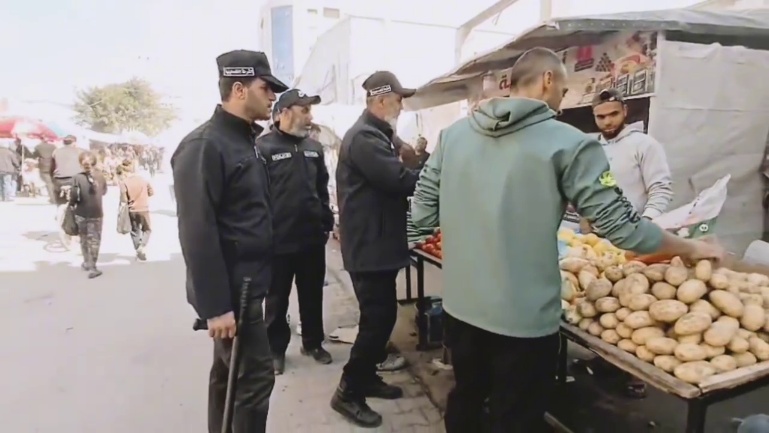
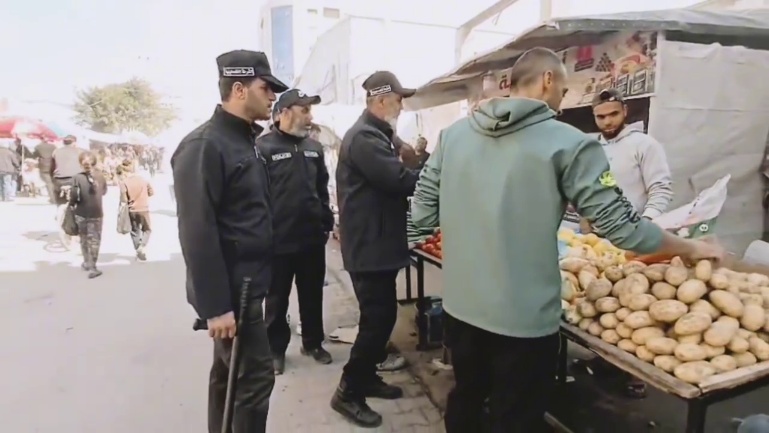
Because of the delay in beginning the activity of the technocrat committee’s Palestinian “security” forces, Hamas police continued routine activity. Reportedly, they focused on enforcement and maintaining order in the markets and on handling criminal incidents (Telegram channel of the Palestinian police, March 5–6, 2026).
Armed Hamas police officers supervise the markets (Telegram channel of the Hamas police in the Gaza Strip, March 5, 2026)
Activist Hamza al-Masri’s Telegram channel criticized Hamas, claiming that even after extensive destruction, displacement and severe distress, “protection” was still collected and extortion was rife in almost everything, from tents and shops to damaged vehicles and even donkey drivers, who barely managed to make a living. Hamas personnel reportedly stole diesel, gas and food packages and resources intended for the public, including donations collected abroad in the name of Gaza (Telegram channel of activist Hamza al-Masri, March 9, 2026).
Security Governance
“Security” sources in the Gaza Strip reported that an armed attack in the al-Nasr neighborhood in Gaza City had been prevented after members of a cell of the “popular army” militia, headed by Ashraf al-Mansi, opened fire on Hamas “security forces” in two separate incidents. Large forces were then deployed in the neighborhood, vehicles were searched and a pursuit began for members of the cell. During a raid on one of the houses an operative was arrested and two weapons and ammunition were seized, while the other members of the cell fled to areas in the northern Gaza Strip where the militia was active. According to reports, the detainee was being interrogated to determine whether the objective of the action had been to attack a Hamas “security officer” or whether it had been an attack on a security checkpoint (al-Sharq al-Awsat, March 6, 2026).
According to claims, gunmen from the Rami Halas militia, active in eastern Gaza City, kidnapped a Hamas government employee from the al-Zeitoun neighborhood and wounded several civilians. The gunmen confiscated weapons from an arms dealer, interrogated him and left the area. According to sources on the ground, the incident took place under the cover of Israeli UAVs which flew over the neighborhood and “shot indiscriminately.” In southern Khan Yunis, gunmen from the militia of Hussam al-Astal reportedly kidnapped five civilians from the Qizan Abu Rashwan area for the second time in recent weeks (al-Sharq al-Awsat, March 7, 2026).
Palestinian Authority (PA) Involvement in Gaza
Ruqayya Abu Alrub, head of the PA team for the reconstruction of the Gaza Strip in the ministry of public works and housing, said the PA government had “formulated principles” for providing temporary housing based on giving priority to repairing housing units which were partially damaged, along with work on other housing plans currently under preparation, such as supplying prefabricated housing units as a temporary solution. She said about 60,000 housing units had been partially or superficially damaged, out of 350,000 housing units damaged in total. She added that they had launched a project in cooperation with the UN Development Programme (UNDP) whose goal was to repair partially damaged houses using materials available on the local market, such as wooden boards and plastic sheets, and to provide a small kitchen, toilets and a water tank. The first phase of the project of 213 housing units had already been carried out and additional phases were being prepared (aljazeera.net, March 5, 2026).
Apartments repaired and renovated with wood and plastic sheets (aljazeera.net, March 5, 2026)
Counterterrorism
Israeli security forces continued extensive activity to prevent terrorism throughout Judea and Samaria, during which more than 200 wanted persons and suspects involved in terrorist activity were detained, including IED manufacturers, arms dealers, Hamas terrorist operatives, inciters and suspects who planned attacks. Dozens of weapons and two lathes used for manufacturing weapons were located and hundreds of thousands of shekels used to finance terrorist activity were seized. A laboratory which issued forged entry permits to Israel and served illegal residents was also uncovered (IDF spokesperson, March 3–10, 2026; Israel Police spokesperson, March 5, 2026). Palestinian media reported raids by Israeli forces on various localities south of Nablus, on Kafr Dan west of Jenin and Jaba south of Jenin, on Sa’ir north of Hebron and on the al-Amari refugee camp in al-Bireh (Telegram channel of Gaza al-An, March 7, 2026).
Friction between Settlers and Palestinians
This past week violence continued between Jewish settlers and Palestinians. According to reports, during clashes in Masafer Yatta in south Hebron a Palestinian was killed and his brother was wounded (Filastin al-‘An, March 7, 2026). Settlers attacked local residents in the village of Abu Falah northeast of Ramallah, where two Palestinians were reportedly killed by gunfire and another died from suffocation after inhaling tear gas following a raid by IDF forces on the village (Wafa, March 8, 2026). The IDF spokesperson stated that the forces had dispersed those involved and a criminal investigation had been opened by the authorities (IDF spokesperson, March 8, 2026).
The Palestinians condemned the violent incidents and the deaths of local residents. The office of the PA chairman, Mahmoud Abbas, called for immediate American intervention to prevent continued attacks on Palestinians (Wafa, March 8, 2026). The PA deputy chairman, Hussein al-Sheikh, also called for immediate international intervention to protect the Palestinians and to punish those who carried out the attacks (X account of Hussein al-Sheikh, March 8, 2026). Hamas urged Palestinians in all the cities, villages and refugee camps in Judea and Samaria and the “revolutionary youth” to “escalate confrontation and clashes with the enemy” and called on its operatives and “resistance fighters”[2] to “confront the settlers and make them pay for their crimes” (Telegram channel of Hamas in Judea and Samaria, March 8, 2026).
This past week, PA chairman Mahmoud Abbas held talks with the Saudi crown prince, the president of Egypt and the prime minister of Greece. He said it was necessary to curb regional escalation, implement the ceasefire in the Gaza Strip, open the Rafah Crossing and allow humanitarian aid to enter. He also warned of escalation in Judea and Samaria, east Jerusalem and Lebanon, condemned the Iranian attacks on Arab countries and Cyprus and claimed Israeli measures damaged the two-state solution. He noted support for the continued role of the PA as the legitimate authority. The people he spoke to called for advancing stability, peace and de-escalation in the region (Wafa, March 5–6, 2026).
[1] Click https://www.terrorism-info.org.il/en to subscribe and receive the ITIC’s daily updates as well as its other publications.
[2] Terrorist operatives.
Related Articles