
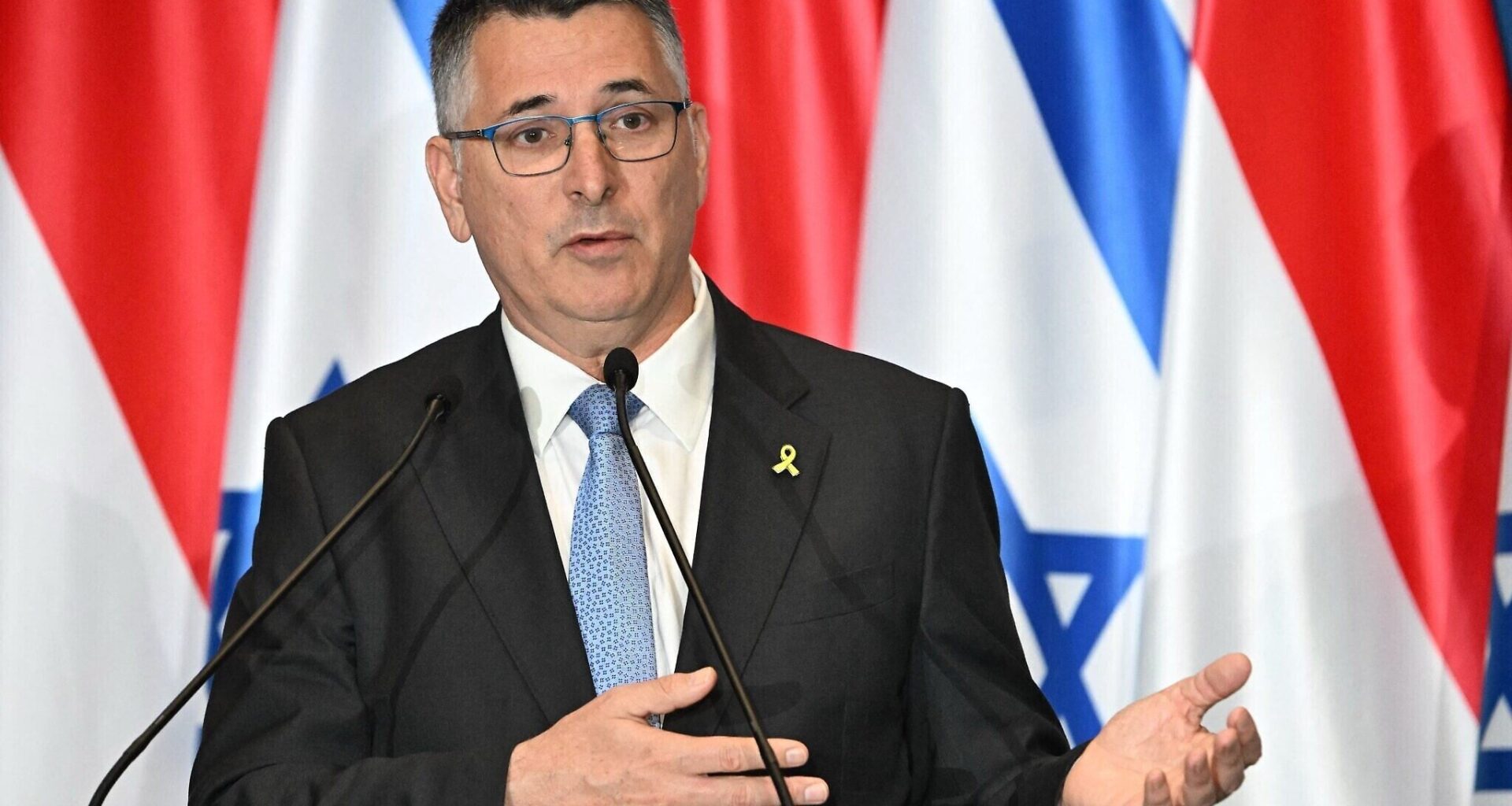
Israel itself cannot bring down the Iranian regime, Foreign Minister Gideon Sa’ar told The Times of Israel on Wednesday, adding that the Iranian people need outside help to bring down the Islamic Republic.
“Ultimately, we cannot topple the regime, only the Iranian people can,” said Sa’ar. “At the same time, we must say that without external assistance they have no chance to topple the regime.”
The US and Israel launched a bombing campaign on Iran on February 28 following a massive US military buildup in the region and repeated threats by Trump to strike Iran, first over its bloody crackdown on anti-regime protesters in January and more recently over its nuclear program.
Prime Minister Benjamin Netanyahu has repeatedly told the Iranian public in video messages that the time will soon come for them to rise against the regime. On Tuesday, he wrote on X that Israel would in the coming days “create the conditions for you to grasp your destiny.”
“When the time is right, and that time is fast approaching, we will pass the torch to you,” he wrote.
Get The Times of Israel’s Daily Edition
by email and never miss our top stories
By signing up, you agree to the terms
Sa’ar said that while regime change is not an explicit war aim, “we reached the conclusion that an effort must be made to create the conditions that allow for regime change — not by our hands but by the Iranian people.”
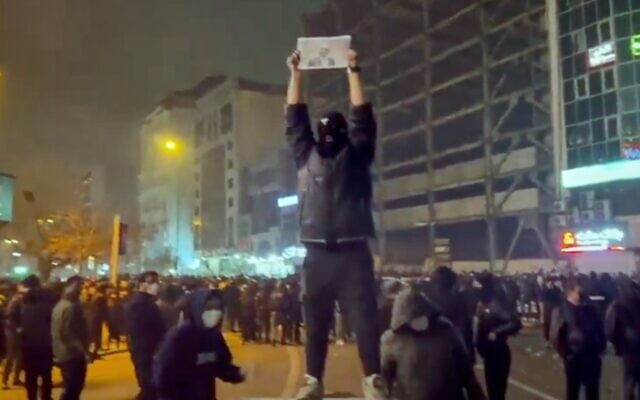
In this frame grab from video obtained by the AP outside Iran, a masked demonstrator holds a picture of Iranian opposition figure Reza Pahlavi during a protest in Tehran, Iran, January 9, 2026. (UGC via AP)
The most important of these conditions, Sa’ar explained, is “the dramatic weakening of the Iranian regime’s mechanisms of repression.” He said Israel is striking the Islamic Revolutionary Guard Corps’ bases, headquarters, and command-and-control sites, “operating in such a way that by the end of the campaign they will be sufficiently weakened and then perhaps it will be possible to carry out that change.”
For now, the Iranian regime continues to threaten any potential protesters with extreme violence. On Tuesday, the country’s top police officer warned that any demonstrators will be treated as enemies if they support Tehran’s foes.
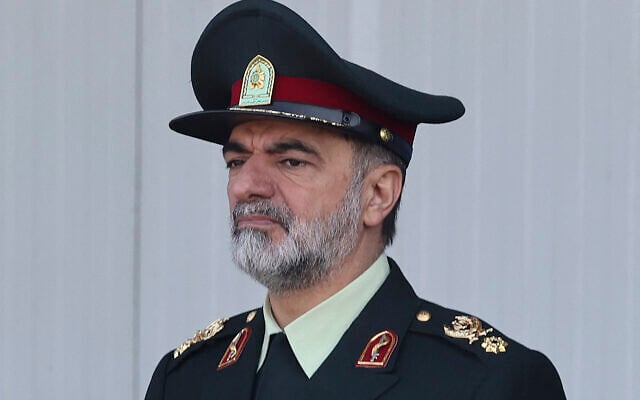
Iranian police chief General Ahmad-Reza Radan attends a military parade marking the Iran’s annual army day in the capital Tehran, on April 18, 2023. (ATTA KENARE / AFP)
The government in January brutally cracked down on anti-government protests over economic grievances in the sanctions-hit country. Iranian authorities acknowledge more than 3,000 deaths in the unrest, including members of the security forces and bystanders, but say the violence was caused by “terrorist acts” fueled by Iran’s enemies.
The US-based Human Rights Activists News Agency, however, has recorded more than 7,000 killings in the crackdown, the vast majority protesters, though the toll may be far higher.
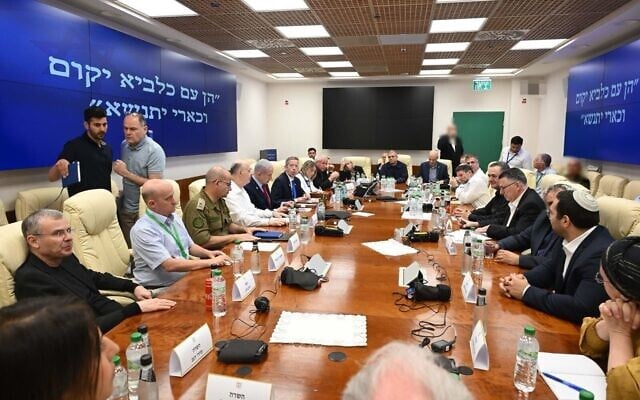
A security cabinet meeting, in Jerusalem, June 14, 2025. (Avi Ohayon/GPO)
Despite Israel’s rhetoric of revolution, the Kan public broadcaster reported Tuesday that Israeli government ministers, following a security briefing, believe the fall of Iran’s regime could take up to a year, while the ongoing US-Israeli campaign against Iran is expected to end far sooner, with US President Donald Trump speaking variously about weeks or days.
“Usually such things [as the fall of a regime] happen after the military campaign, less so when there’s a war,” Sa’ar explained.
There are “visible cracks” within Iran’s leadership, said Sa’ar, but the extremists still control the government. “At the same time, we have many indications that this regime is fraying and its capabilities are declining,
Nuclear and missile programs ‘badly damaged’
The objective of the Iran campaign, he said, “is the removal of long-term existential threats from Iran to Israel.”
Iran’s nuclear program, said Sa’ar, has been “badly damaged” in the US-Israeli attacks, especially its ability to weaponize and to enrich uranium.
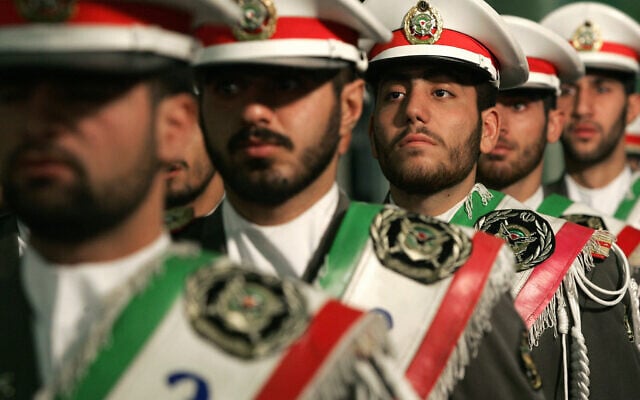
Iranian protocol soldiers stand guard during a ceremony to mark the 27th anniversary of the Islamic revolution at the mausoleum of Iran’s late founder of Islamic Republic, Ayatollah Ruhollah Khomeini in Tehran, 1 February 2006. (Photo by BEHROUZ MEHRI / AFP)
As for the ballistic missile threat, both the missile stores themselves and Iran’s ability to build more missiles “were hit very hard,” according to Sa’ar.
The achievements we’ve made so far definitely justify going into the campaign.
Had Israel waited only a few weeks more, he claimed, Iran would have moved much of its nuclear program and its ballistic missile production facilities deep underground and out of Israel’s reach.
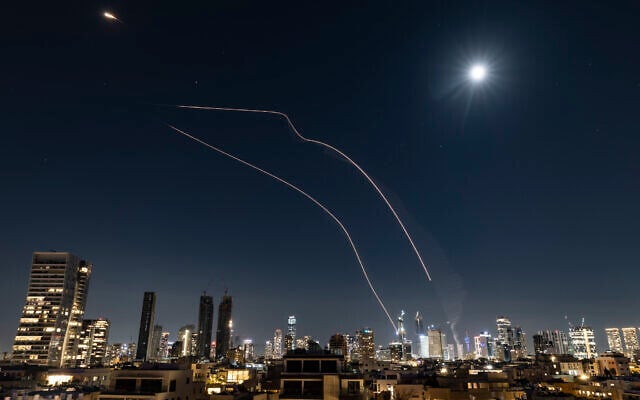
Anti-missile batteries fire interception missiles toward incoming ballistic missiles launched from Iran, as seen over Tel Aviv, during the war with Iran and ongoing missile fire toward Israel, March 5, 2026. (Chaim Goldberg/Flash90)
“The achievements we’ve made so far definitely justify going into the campaign,” he insisted, but it remains to be seen how long the achievements will last.
“We have no interest or desire to enter a new war every year or two,” said Sa’ar.
Nuanced differences
With the price of oil spiking, a warning sign in US politics, there are indications of possible cracks in the unified front Trump and Netanyahu have presented since the war began on February 28. Trump told CBS News on Monday that the war was “pretty much” over, despite his earlier vows with Netanyahu to pursue weeks, if not months, of attacks.
US officials also voiced unease after Tehran residents woke up Sunday to apocalyptic scenes of black smoke blocking out the sun and choking them, following an Israeli attack on fuel depots that the IDF said served the Iranian military.
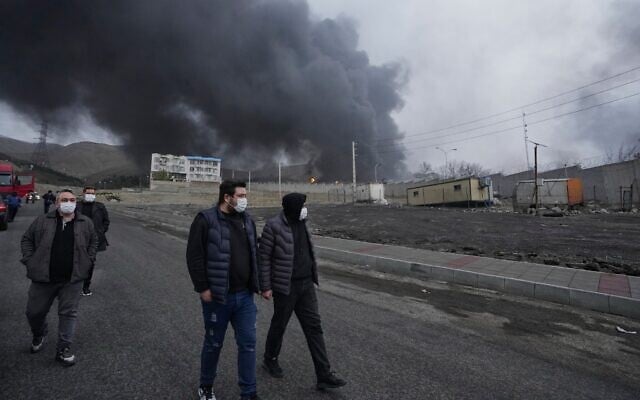
Four men walk as a thick plume of smoke from a US-Israeli strike on an oil storage facility late Saturday lingers in the cloudy sky behind them in Tehran, Iran, Sunday, March 8, 2026. (AP/Vahid Salemi)
Even Senator Lindsey Graham, a hawkish Republican ally of Trump who has urged war on Iran for years, called on Israel to “please be cautious about what targets you select.”
“I don’t think there are disagreements; there may be nuanced differences,” allowed Sa’ar.
“The United States entered the war together with Israel based on the same situational analysis,” he continued. “It sees in the Iranian regime the same dangers we see.”
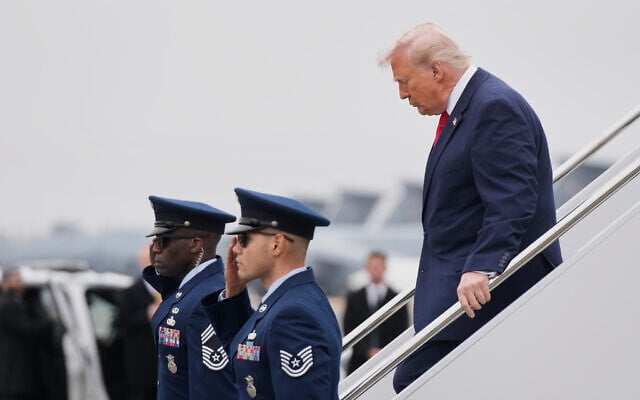
US President Donald Trump steps off Air Force One, March 7, 2026, at Dover Air Force Base, Delaware. (AP/Mark Schiefelbein)
The foreign minister asserted that Trump would not simply declare a sudden end to the campaign and force Israel to stop as well. “As for the timing of ending the military campaign — just as we consulted before we set out, we are consulting throughout the campaign and will consult as well before its end,” said Sa’ar.
“We are with America in this campaign, together. It’s not something they need to allow us to do. We are together with them at the highest level of coordination ever, both politically and militarily.”
In response to US and Israeli strikes, Iran has attacked commercial ships across the Persian Gulf, escalating a campaign of squeezing the oil-rich region as global energy concerns mount. On Wednesday alone, three commercial ships traversing the Gulf were hit by Iranian fire.
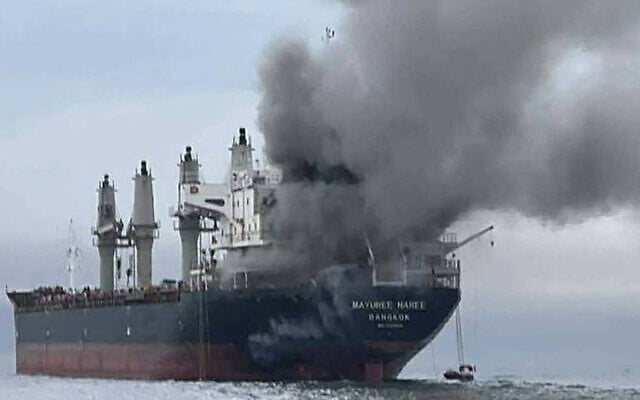
This handout photo taken on March 11, 2026 and released by the Royal Thai Navy shows smoke rising from the Thai bulk carrier ‘Mayuree Naree’ near the Strait of Hormuz after an attack. (ROYAL THAI NAVY / AFP)
Sa’ar said the strikes on oil infrastructure and ships were “not unexpected — neither from our perspective nor the American perspective.”
“You can’t say these things have zero effect,” he said. “They’re in the background. Ultimately, you proceed from the assumption that just as we want to win the war, the United States also wants to win the war. They don’t want it less than we do.”
A threat remains
Sa’ar spoke with The Times of Israel hours before Hezbollah dramatically escalated its attacks on Israel, launching over 150 rockets from Lebanon within a few hours. He entered an urgent security meeting with Netanyahu shortly after the conversation.
He said that Hezbollah’s decision to resume its attacks on Israel during the Iran war after over a year of quiet is not an indication that Israel’s 2024 campaign against the Shi’ite terrorist group — which ended in a humiliating ceasefire for Hezbollah — was a failure.
“We weren’t under any illusions that Hezbollah’s capabilities would disappear, but they have dramatically decreased,” he said.
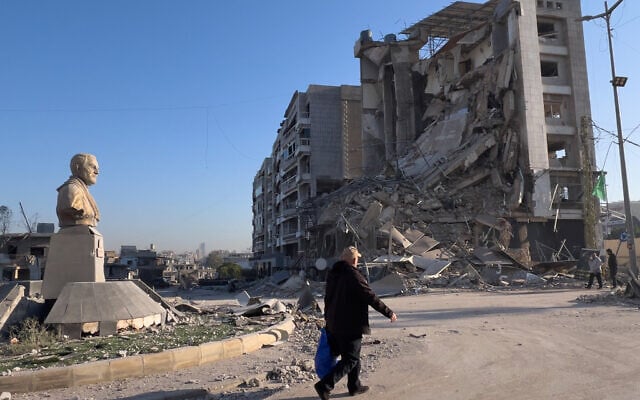
Residents pass in front of a destroyed building that housed a branch of Al-Qard Al-Hassan, a quasi-bank financial institution run by Hezbollah, which was hit by an Israeli airstrike in Dahiyeh, Beirut’s southern suburbs, Lebanon, March 10, 2026. (AP Photo/Hussein Malla)
“A threat remains, but it’s a lesser threat,” he continued. “And when we reached the ceasefire agreement [in 2024], we did not think we had ended the threat. We thought that bleeding Hezbollah served us and allowed us, in the end, to bring the northern residents back home, and to shortly thereafter reach a ceasefire with Hamas in Gaza.
The Lebanese government recently proposed, through the Trump administration, holding direct negotiations with Israel aimed at ending the war with Hezbollah and possibly reaching a peace agreement with Beirut, Axios reported. Both Jerusalem and Washington responded skeptically to the proposal.
Israel is ready for dialogue with the Lebanese government, Sa’ar said. “But the current problem is that dialogue with the Lebanese government cannot stop the fire from Lebanese territory.”
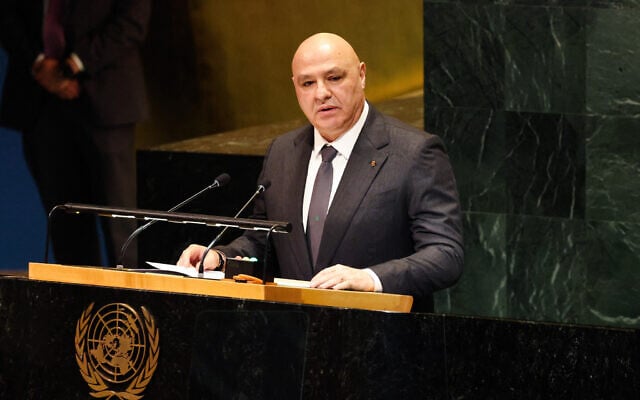
Lebanese President Joseph Aoun addresses the United Nations General Assembly at UN headquarters, in New York City, on September 23, 2025. (Ludovic Marin/AFP)
Hezbollah, he continued, is the biggest obstacle to achieving peaceful, normalized relations with Lebanon, “which we are interested in.”
“We don’t have dramatic disputes with Lebanon itself,” said Sa’ar. “We have some future border disputes around the fine print. The main problem was and remains Hezbollah.”
“The most important thing is cooperation regarding Hezbollah. And as for the Lebanese government, that they do what they need to do for an extended period.”