
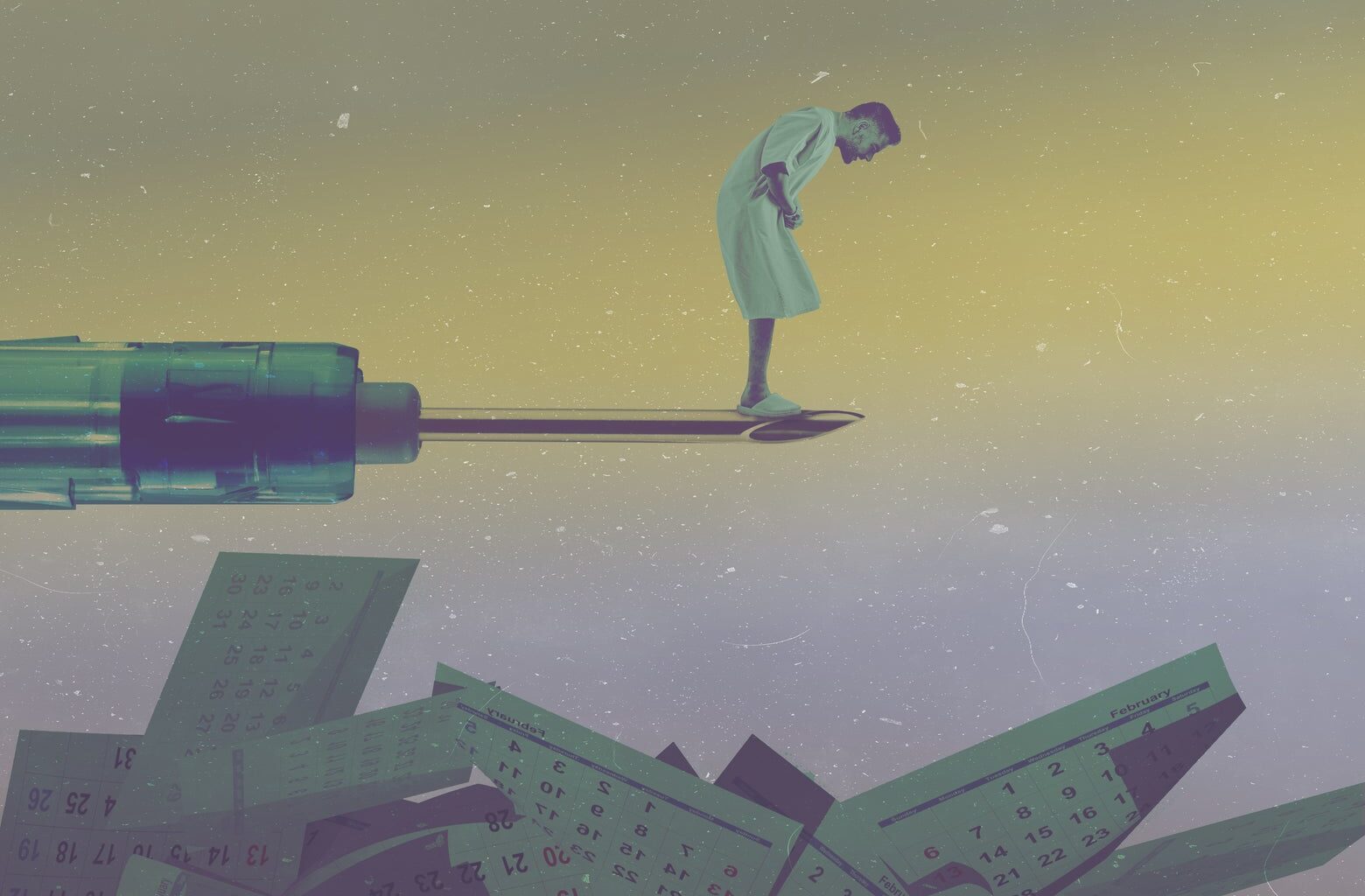
In the fall of 2022, when I was 42 and living with my wife and three young kids in a small town in northwest Minnesota, a specialist at an unfamiliar hospital approached us with some test results. He seemed genuinely shaken. “I don’t want to scare you guys,” he said, “but this is the kind of thing where you are going to want to have your affairs in order.”
I’d spent much of the summer trying to ignore a bizarre constellation of symptoms: dark pee, constant full-body itching, an odd yellowish cast to my skin that I convinced myself was just a trick of the cheap LED light bulbs we had gotten from Amazon. Then, on the last weekend before Labor Day, the whites of my eyes turned a bright, unsettling yellow, the type of thing it’s impossible to rationalize away. Some frantic Googling suggested that jaundice, brought on by a gallstone, was the most likely explanation.
I had gone to the local ER, expecting a run-of-the-mill gallbladder removal that would have me back at work by Monday. Instead, they shipped me down to the big regional hospital in Fargo, North Dakota, where an MRI showed a gallstone, yes, but also a 9.5-centimeter tumor wrapped tightly around the main bile duct and several major blood vessels in the liver.
The gastrointestinal specialist was in the room with my wife and me when the radiology report came back. I watched his face drop and his entire demeanor change as he read through it for the first time.
He was an affable guy roughly the same age as me. “We just don’t see this in guys our age,” he said.
I was diagnosed with cholangiocarcinoma, or cancer of the bile duct. As far as cancers go, it’s an especially brutal one: The five-year survival rate is around 10 percent, and most people diagnosed with it are dead within a year. That was going to be me.
Cholangiocarcinoma is deadly in large part because it is so rare: There are only about 8,000 new cases in the U.S. each year. Cancer treatment advances patient by patient, clinical trial by clinical trial. Each patient is a new data point. When there are few data points, the science advances very slowly.
“There are some chemo and radiation therapies that can slow it down a little bit, maybe buy you some extra time, but nothing that can kill it,” the GI doc explained. “The only way to cure it is to cut it out completely, either by surgically resecting the liver or doing a full-on transplant, but by the time most people are showing symptoms, it’s too late for either of those.”
“Is it too late for me?” I asked.
“I don’t know,” he said.
My wife, Briana, was by my side during that entire hospital stay, and later that night, she went out to the parking lot to sit in the darkened car and scream. As it happened, she had worked in the disability policy office of the Social Security Administration before we moved to Minnesota, and helped spearhead the agency’s compassionate allowances program, guaranteeing rapid approvals for patients with such hopeless diagnoses that they were usually dead before the regular paperwork went through. Cholangiocarcinoma was one of them.
By the end of the visit, the GI specialist had determined that my tumor was under the transplant limit by just half a centimeter. He sent a scope up my bile duct and biopsied some cells from the duct walls and a nearby bile duct to confirm the radiologist’s suspicion. Confusingly, they all came back negative.
The uncertainty was maddening: If there was actually a tumor in there, why weren’t the biopsies showing it? Other doctors told me that the mass was probably on the outside of the ducts, and that if that was the case, the cell scrapings from inside the duct were bound to come back negative. They wanted to directly biopsy the tumor from the outside, passing a needle into my abdomen and through the liver to reach it.
This made the GI specialist furious: “Those guys don’t know what they’re talking about,” he said. “If it’s really cholangiocarcinoma, and at this point I don’t think there’s anything else it can be, your only option is the liver transplant. And if you puncture the liver with a biopsy needle, they won’t do the transplant, because the tumor will grow back right along the needle path.”
He told me if I wanted to have a chance of beating this thing, I needed to go to the Mayo Clinic, so I did. I knew I was in for a harrowing ride. I had no idea quite what kind.
Mayo was in Rochester, six hours south of our home in Red Lake Falls. I had a lot of time to myself on the road to think about things. When I was 20, I had gone through a similar medical crisis after I got a chest X-ray to investigate a persistent cough, and it ended up showing a mass the size of a softball in my right lung. Everyone around me was convinced it was cancer, but I was certain, with the serene confidence of a 20-year-old, that it would actually be benign. I didn’t worry about dying at all: It was inconceivable that I could be on the brink of death in the spring of my sophomore year of college, when the flowers were blooming on campus and I had finals to think about.
I was right, in the end. A team of surgeons opened up my chest cavity and removed the mass, along with about half of my right lung. The pathology report showed that it was benign, likely just a bizarre, out-of-control inflammatory response to an unknown irritant that might have happened years earlier. It was a medical oddity, a statistical fluke. The surgeons presented my case at a conference later that year.
This time felt different, though. I was middle-aged and had a family, and I had seen enough of my peers pass away to know that I wasn’t invincible. Summer was crashing to an end, the flowers in our yard were dying, and there was a cold bite to the upper Midwestern air. Death seemed very much a real possibility.
I thought about it constantly, of wasting away in front of my kids and having to decide that enough was enough and it was time to pull the plug. Our youngest was 5, and the twins were 9, and I wondered how they’d remember me, and whether the horrible final days would crowd out memories of the good times. I wondered what my last lucid moments would be like—what I wanted to say to them, and what I would say to my wife. Which conversation would I have first? Would it be better to do it all at once, or would there be things I’d want to say privately to each of them?
With a transplant, my odds of surviving until the twins’ high school graduation were roughly 1 in 4. Without it, I would be dead before they got to middle school.
I worried about pain too. The GI specialist had placed stents in my liver to open up the bile ducts, and at the moment, I felt more or less normal. But how long would that last? When would the tumor get big enough that it would start to hurt? Would it metastasize elsewhere, shutting down organs or colonizing my bones? What would that feel like? Would there come a day I’d recognize after the fact as the last good day before pain simply took over my life?
I joined private Facebook groups for bile-duct cancer patients and their caregivers. There was something therapeutic about swapping medical horror stories with strangers who knew exactly what I was going through. But after a while, I had to stop visiting. The anguish of the people nearing the end was too raw for me to handle.
Maybe when I was closer to the end myself, I would be more receptive to their words, less wrapped up in my own shit and ready to make peace with whatever was coming. But I still had a sliver of hope of beating this thing, and I needed to hold on to it as tightly as I could.
The liver-transplant protocol for bile-duct cancer was developed at the Mayo Clinic in the 1990s. It involves a month of inpatient chemotherapy and radiation, followed by the transplant itself and months of recovery.
“The general idea is that the chemo and radiation keep the tumor from metastasizing long enough for us to find you a liver match,” the Mayo liver specialist explained. About half of the cancer patients entering the program dropped out prior to transplant due to disease progression or to their bodies being unable to withstand the intense chemoradiation bombardment. And among those who got the transplant, only about half would still be alive five years later.
Hellacious, debilitating complications were more or less routine, and sometimes fatal. My age and good health were factors in my favor, the doctor said. PET scans showed no metastases anywhere in my body. But the size of the tumor was a major concern: just a hair under 10 centimeters along its longest axis, the upper limit of what was considered a transplantable tumor.
“It’s kind of an arbitrary cutoff,” she said. “But at 10 centimeters, it just becomes much more likely that the cancer is already growing undetected in other places. Now, we’ve measured your tumor every which way, and you’re not there yet, which is great. But if we pull this off, it’s going to be just under the wire.”
I asked her if what the Fargo doctor had said was true, about direct biopsies causing the cancer to spread.
“That doctor saved your life,” she said bluntly. “If you had gotten a needle biopsy, we would be having a very different conversation right now, and unfortunately, we see that happen quite a bit.”
Doctors at Mayo had done a trial back in the early days of the protocol, she said, to see if they could safely get a direct biopsy before putting patients under the knife. But the tumor came back along the needle path in every single one of the first group of patients entering the trial, and they had had to end it early on ethical grounds.
Because of that, many patients who get surgery for suspected bile-duct cancer do so without a confirming biopsy, she told me. I asked if they ever transplanted someone’s liver only to find out that the tumor wasn’t what they had thought it was.
“I’ve been doing this for about 20 years,” she said. “There was one case. One case. We transplanted a lady’s liver, and it ended up being a lymphoma or something weird like that.” But that was a freak occurrence, she said. One in a million. An outlier so extreme it was statistically indistinguishable from zero.
Given that I had already played my 1-in-a-million card on the mass in my lung, it didn’t seem wise to pin my hopes on this.
What would happen if I just didn’t get the transplant? I asked.
“Well,” she said, “we would do palliative chemotherapy, try to buy you some extra time.”
“How much time?” I asked.
“Months, maybe a year if you’re lucky,” she said. “If I had 10 patients just like you, I’d expect to still be seeing four of them a year from now, and then maybe one or two the year after that, and then—that’s it, really. You’re young. You’re healthy. Your body could probably withstand more-aggressive treatment, keep the cancer at bay for a little longer. But the problem is that short of cutting the thing out completely, none of these treatments work very well.”
And that was the crux of it: With a transplant, my odds of surviving until the twins’ high school graduation were roughly 1 in 4. Without it, I would be dead before they got to middle school.
“Then let’s do a liver transplant,” I said.
Looking back at that period of our lives, I’m not sure how Briana and I did it, how we kept getting out of bed and sending the kids off to school and going to work as if the whole life we had built together wasn’t crashing down on top of us.
We explained to the kids what was going on but didn’t get into the odds of success and what failure might mean down the line. Dad’s liver was full of cancer, so the Mayo doctors were going to take it out and put in a new one, and that was that. They were familiar with cancer as a concept because one of the twins’ classmates had just gone through a harrowing diagnosis and treatment of a different kind of cancer the prior year. The classmate had been treated at Mayo and he was fine now, so Dad would be too.
The kids wanted to know if our cancers were connected, if there was something in the air or water that was giving people cancer in our town, and if they were going to get it now too. There were, certainly, a lot of cancer cases in the community. On the corkboard outside the local mom-and-pop grocer, it seemed as if there was always a flyer or two advertising a potluck fundraiser for so-and-so who had just been diagnosed with brain cancer or breast cancer or bone cancer.
I couldn’t help but look up our local cancer-incidence data on the state department of health website. We didn’t seem particularly unusual. Pinning down environmental determinants of cancer is notoriously difficult. Outside of slam-dunk cases like smoking and lung cancer, teasing out causality is virtually impossible.
Still, a number of studies in recent years have explored possible links between the use of farm chemicals and various malignancies. One study posited that living in a community exposed to pesticides “could increase the incidence of cancer as much as smoking,” and others have suggested that water-borne nitrates from farm runoff could also be driving some cancer cases.
Our town of 1,400 was surrounded on all sides by miles of cropland, and on days when nearby farms were spraying, you could often smell it in the air.
“It’s those fucking farmers,” I would say, looking for a place to channel my frustration and anger. I didn’t know if I actually believed it, but I tried not to think too hard about whether I would still have gotten sick if we had never moved to Minnesota.
I kept my mind occupied by reading academic studies on cancer and liver transplants. They showed, over and over again, that people who were in better physical shape had better outcomes on both the cancer and the transplant side of things. So I installed a stationary bike in the garage and started exercising like a maniac, putting in mile after mile, day after day.
One paper I found suggested that physical activity caused blood vessels to infiltrate tumors, forging a pathway for chemotherapy drugs to enter and start killing off the tumor from the inside. I imagined capillaries pushing into my tumor and becoming engorged with each heartbeat, each pedal stroke—a counterassault, finally, after weeks of it festering inside me, unopposed.
Your time is up, you little shit, I thought. I was going to kill this thing.
The final hurdle before official placement on the transplant list was a weeklong evaluation at Mayo. Teams of specialists from all over the hospital poked, prodded, and imaged my body and brain to make sure I was strong enough physically, mentally, and socially to handle what was coming.
For somebody in my position, this was mostly a formality, the liver team explained. The main indicators were tumor size and location, and we already had a lock on those via all the imagery I’d had done over the preceding weeks.
Briana joined me in Rochester. We got a hotel room close to the hospital and tried to pretend that it was the romantic weeklong getaway we had wanted to take since becoming parents. We ate at nice restaurants, went shopping, visited museums, and took in what sightseeing we could. (November isn’t exactly peak tourist season in Minnesota.) The days were punctuated by side trips to the hospital to take various tests and get procedures done.
Near the end of that week, we had a day off, so Briana and I visited a park on the edge of town where there were hiking trails and exposed fossils and a visitors center with a mini-zoo of local wildlife. When I woke up that morning, there had been a dull, gnawing ache in the upper right corner of my abdomen, where the tumor was. I popped some Advil and tried to ignore it, but it only got more intense as the day went on. That evening, I managed to fall into a fitful sleep but awoke in agony in the middle of the night, the dull ache having become a throbbing, stabbing sensation.
Up until this moment, I hadn’t had to deal with a lot of pain, and I wasn’t prepared for it to come on so swiftly and intensely. Maybe this was the last good day, I thought. Maybe the tumor was now asserting itself in some new way that my body wouldn’t be able to compensate for, and maybe it was going to hurt like this every single day until the transplant or the end, whichever got here first.
Briana talked me down in that dark hotel room and got me back to sleep again, somehow. The next morning, the pain had subsided just enough that I could get up and move around. I called the transplant team, and they rushed me to the hospital for a quick CT scan, a painkiller prescription, and some antibiotics, then we sat and waited for the final appointment of the whole trip, with the surgeon who would be performing the transplant.
It was supposed to be a pro forma visit, mostly educational, to discuss how he’d open me up and what he’d do once he got in there. But when we got to his office, he had the same ashen expression on his face that the first GI doc had had when he read my original radiology report. He took a minute to compose himself before speaking.
I had lived so much, but I was 42 and dying. I should have had a midlife crisis in my 20s. I would never experience being old.
The good news, he said, was that the CT from that morning showed that the pain I was experiencing was from the gallstone, that it had just shifted a bit and caused a small infection. The pain would probably go away soon.
“But with the CT, we also got another look at your tumor,” he said. “And we got a clearer look at it at an angle that we didn’t have before, and along that angle, it’s very obviously longer than 10 centimeters.”
Briana inhaled sharply.
“And what does that mean?” I asked.
“We’ve tried pushing it before,” he said, “back in the early days of the protocol, to see what the cutoff should really be. And every time we went past 10 centimeters, every single time, the cancer came back. It just came back. You have to understand how bad that is for the patient and their family, to go through chemo and radiation and the trauma of a transplant, only to have the cancer come back. It’s absolutely devastating.”
“I want to be sure what you’re saying,” Briana said. “There’s not going to be a transplant?”
“I’m so sorry,” he said, “I truly am, but we just can’t move forward with this.”
I asked if there was there was any plan B, any wild hail-mary scheme that could possibility get me out of this mess. But the transplant was the wild hail-mary scheme, he said. A cure was now out of the question.
I’ve always hated November. It’s a month of cold, dead, sodden things, gray skies and freezing drizzle, a time to hunker down and wait for the snow to come.
We drove back to Red Lake Falls in a state of numb shock, too tired even for tears. This was it, then—all the hoping and striving, the frantic tests and procedures, all the miles on the bike trying to out-pedal the tumor. It was all for nothing. I was going to die anyway.
It had been only a 1-in-4 shot. What the hell had we been thinking? I had written a check to fate when I beat all the odds on the lung tumor when I was 20, and now the universe was coming to collect. I had bought myself 22 extra years, not a bad deal really, long enough to find love and start a family and write a book and do all the things I had ever wanted to do. Wasn’t it enough?
I started asking myself that question all the time. Of course it wasn’t enough. It would never be enough. I had lived so much, but I was 42 and dying. I should have had a midlife crisis in my 20s. I would never experience being old.
I was tormented by the thought of Briana and the kids going on without me. Of course she wouldn’t want to raise three young sons by herself on the frigid prairie thousands of miles from family. She would have to move on, to find someone else. Some weird asshole would take my place, sleep on my side of the bed, and crack jokes with my sons and say and do things it would never occur to me to say or do. Once a year, on the date of my birthday or my death or our anniversary, Briana would post a remembrance to Facebook with photos of the good times and a note about how even though I was gone, part of me would be with her forever.
“My dad died when I was 5,” my son would say later in life, in college or young adulthood or when his kids asked about their grandfather. “I remember the end, the cancer, how sick he was. I just wish I remembered more of what he was like before that.”
This wasn’t a particularly productive train of thought, but I couldn’t help it. There had been a viral New York Times essay some years earlier, by a woman who was dying of cancer and wanted other women to know what a wonderful husband she had, and that he’d be in need of companionship after she was gone. It was beautiful and funny and full of grace, and for some reason, there was none of that in me. I wanted to hold on to all of it. I didn’t want anyone else to know how amazing Briana and the kids were, what they had meant to me, how much it killed me to have to let them go. They were mine; this life was mine, and it wasn’t for anyone else.
Briana and I started looking up end-of-life care. I was horrified to learn that there was no legal medical aid in dying in Minnesota. Most states and countries allowing the practice had residency requirements, so it wasn’t as if I could just parachute into Oregon on the eve of my death. I’d have to soldier through to the end myself, I realized, hopefully so blitzed out of my mind on painkillers that I wouldn’t feel a thing.
I couldn’t believe I would be dying in fucking Minnesota, of all places. I wasn’t even from here. I had only ended up here because of a stupid article I had written on a lark a decade ago.
“Reporter moves to town he called America’s worst place to live” was a good viral story, a great hook for a book. “Reporter gets cancer and dies there” was, in some ways, even better, a darkly funny prank played by an indifferent universe.
Existential anguish aside, there was something liberating to knowing that I wouldn’t have to worry about annoying bullshit like work and bills and my 401(k) balance anymore. In the video game Hades, the character Eurydice, trapped in the underworld for all eternity, sings a quiet, peaceful song, “Good Riddance,” about being free from all the headaches of earthly life: “No hunger,” part of it goes. “No sleep except to dream, mild and warm, safe from all harm, calm.” I hoped this was what dying would feel like, and debated asking Briana to have them play the song in the hospice room as I got closer to the end. She’d certainly hate the idea.
She was having a worse time than I was, in truth. I wouldn’t be around after I died, wouldn’t have to deal with the messy aftermath, wouldn’t have to figure out how to steer the kids through the whole process and keep on living afterward. That was her burden, and theirs—not mine.
When we were younger, I used to joke that if I died, I wanted her to send my ashes to one of those services that turns cremains into gems, and that I wanted her to wear the gem on a chain that dangled down into her bosom, so that I could spend the afterlife in the closest thing to heaven on earth I could imagine.
“Look on the bright side,” I said one day during that awful November. “Now you can finally turn me into a cleavage gem like I always wanted.”
By then, I was finally starting to feel like a cancer patient. I was losing a lot of weight and getting exhausted easily. I took a couple of half-hearted spins on the stationary bike, but I couldn’t even keep up with the paces I had set just a month before.
A couple of weeks after the failed transplant evaluation, I went back to Mayo so they could finally do a needle biopsy of the tumor. They weren’t expecting any surprises, my liver doctor explained, but very rarely, tumors would have mutations that would make them more susceptible to certain types of treatment. Nothing curative, but maybe something that would allow me to count out my remaining time in years rather than months.
“And we’re not worried about the cancer spreading anymore?” I asked.
“It already is,” he said gently. “We just can’t see it yet.”
The meeting with the palliative oncologist, to find out exactly how much time they thought they could buy me, and at what cost, was scheduled for the following week. I wasn’t even sure I wanted chemo—what’s the point of having a few extra months if you feel awful the whole time? Better, perhaps, to just enjoy life while I still felt good and not draw things out. Make hay while the sun shines, liquidate the 401(k), and go out in a blaze of glory. I had always wanted to go to Hawaii. Wouldn’t the kids love a trip to Hawaii?
On the Monday of Thanksgiving week, Briana and I logged on to the Mayo Zoom portal. While we sat in the waiting room, my phone pinged with the notification that the biopsy report had come in. I idly opened it up and scrolled through it, but it didn’t make any sense. It was a lot longer than all the previous ones, and it looked as if multiple people had contributed to it. Briana wanted to know what it said.
“I can’t tell,” I said. “Something about the hematology department and lymphoma?”
“Lymphoma? What the hell does that mean?”
“I don’t know,” I said, closing the app. “Maybe I have two cancers now, who knows.” By this point, I had become so accustomed to bad news that the possibility of a positive development didn’t even register.
At that moment, my phone rang. It was one of the liver docs, and he sounded a little out of breath. “Are you sitting down?” he asked.
“Sure,” I said. “I’m exhausted all the time now. I’m always sitting down.”
“OK. The biopsy results are in, and you’re not going to believe this,” he said. “We didn’t believe it either, and we had to send it to hematology to double-check, because we didn’t want to tell you unless we were absolutely, 100 percent sure, and now we are. You do not have bile-duct cancer. The tumor is a lymphoma.”
“Could you repeat that?” I said. He did. “Are you fucking serious?” I said.
“Dead serious. And now, listen, I’m about to throw 1,000 different numbers at you, but there’s really only one thing you need to know: We can cure this one. We can cure you. We will cure you. You’re going to be OK.”
Briana was sobbing. “Lymphoma isn’t on the list of compassionate allowances,” she said. I still couldn’t believe what I was hearing. “And there’s no cholangiocarcinoma in there at all? You’re sure of this?”
“We are sure of it,” the doctor said. “We couldn’t believe it either, because, seriously, this never happens. But it’s happening. Again: You are going to be OK.”
The technical term is primary biliary non-Hodgkin lymphoma, a lymphoma that establishes itself in the bile duct and nowhere else in the body. It’s outlandishly rare: just 43 cases documented globally between 1980 and 2022. As far as I know, I am No. 44.
If you have to get cancer, non-Hodgkin lymphoma is not a bad one to get. Mine was technically a Stage 4 because it was outside the lymphatic system. But, as the hematologist explained it to me later, the stage doesn’t matter as much with lymphomas because the treatments are systemic, wiping out the tumors wherever they are in the body. They had multiple options to eradicate it completely, and ultimately 80 percent of their patients walk away from the ordeal cancer-free, going on to live more or less regular lives.
So far, that has been my experience. I underwent six rounds of chemotherapy spread across four months. Early imaging showed that the tumor had been obliterated after the second round, but they hit it four more times to make sure it was good and dead. I like to think that my frantic burst of cycling in the weeks before the transplant evaluation played a role.
At 42, With Three Young Kids, I Got a Diagnosis That Would Have Me Dead in a Year. That Was Somehow Just the Beginning.
Everyone Told Me It Would Lower My Stress and Improve My Health. It Did Absolutely Anything But.
As a Teen, I Had an Eating Disorder. One Controversial Show Is to Blame.
A 20-Year-Old Looksmaxxer Is the Future of the Internet. We Should Be Worried About This.
Early in 2025, I passed a major milestone: two years posttreatment, with no sign of recurrence, at which point the relapse risk drops dramatically. I didn’t need regular scans anymore, or even regular checkups.
For a while, it was fun to drive myself a little bit crazy by thinking through the counterfactuals. What if the tumor had been just half a centimeter smaller and I had been approved for the transplant? What if my gallbladder hadn’t acted up on that last night of the transplant evaluation, triggering the extra CT? What if we had let the doctors in Fargo just go ahead and stick a needle in my liver like some of them wanted to?
But none of those things had happened, and here I was.
“What are you going to do now?” the Mayo Clinic hematologist asked at my last appointment.
“In two days, we are loading up a moving truck and heading back to upstate New York, where Briana and I grew up, to be a little closer to family and civilization,” I said.
Her eyebrows shot up. “Really? Forgive me for asking, but what would you have done if these scans hadn’t come back as good as they did?”
“I don’t know,” I said. “I literally hadn’t even thought about it.”