
The live-action adaptation’s second season playfully remixes its source material and is better for it.
Photo: Netflix
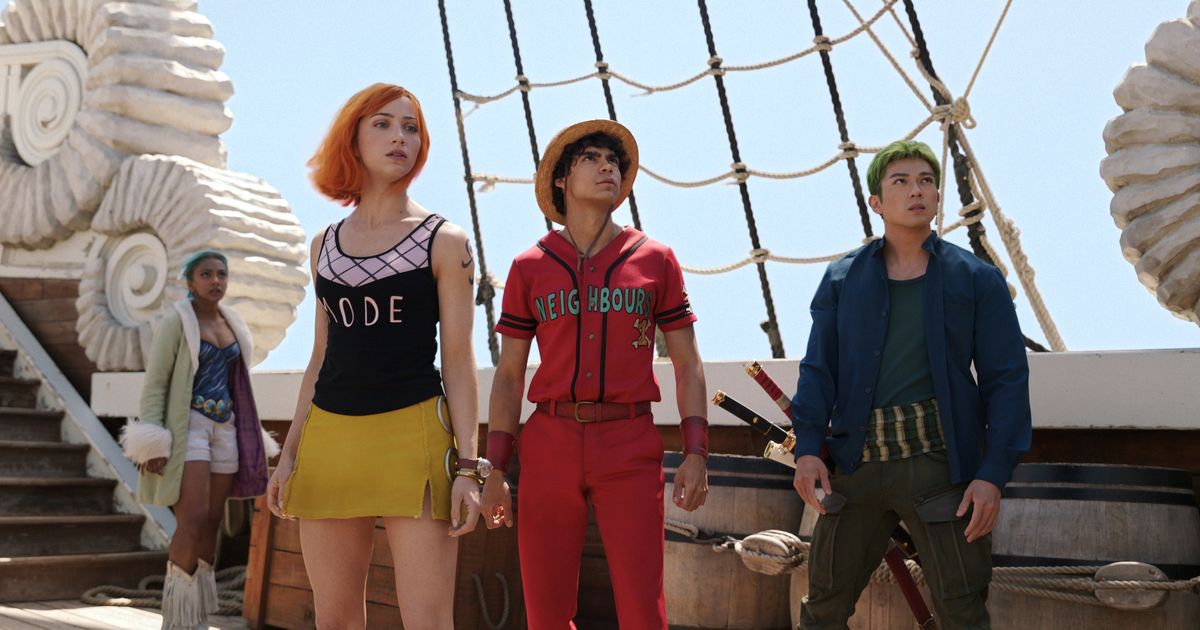
Though not as influential as, say, Dragon Ball or Sailor Moon, Eiichiro Oda’s One Piece is among the most successful manga of all time. But it is also almost unthinkable as a live-action production telling the story of the rubber man Monkey D. Luffy and his crew of pirates — which eventually includes a skeleton, a talking reindeer, a blue-skinned fish man, and a cyborg — as they travel the seas in search of a legendary treasure. That makes Netflix’s adaptation quite the miraculous achievement; it brings Oda’s world to life in a way that feels real while keeping the incredibly cartoonish tone and look of the source material very much in the foreground. The new second season greatly expands on the scope and scale of the first, introducing giants and dinosaurs, visiting several new and visually distinct islands, and even introducing Tony Tony Chopper, the aforementioned talking-reindeer doctor, and still it manages to balance emotion and action with exquisite production design and impressive visual effects.
One big reason it all works so well is that Netflix’s One Piece is unafraid to make changes to the source material. This is particularly true of season two, which not only ups the violence and adds original plot lines but also pulls from across the manga’s nearly 30 years of publication to bring characters and events into the story much earlier. Though some purists may scoff at these choices, they’re very much in keeping with the adaptation principles of Netflix’s One Piece — former showrunner Matt Owens explained in a 2023 interview that one of the most fun aspects of doing the show was playing with the chronology of events — as well as Oda’s renowned ability to revisit moments in the story and reveal information about things or people who were just off-screen at the time. Put another way: The live-action adaptation uses the source material to tell the story the way Oda might have done had he known all the reveals from the start.
Oda “enjoys seeing the depth of knowledge and love for his source material and allowing us to tell the story in a way that looks slightly different but is still on the whole in line with his vision,” Owens said in that interview. Indeed, by rearranging events, Netflix’s One Piece becomes more than just another remake of the manga, offering a unique viewing experience no matter your level of familiarity. Here are the most effective ways season two remixes the source material to make the live-action adaptation sing.
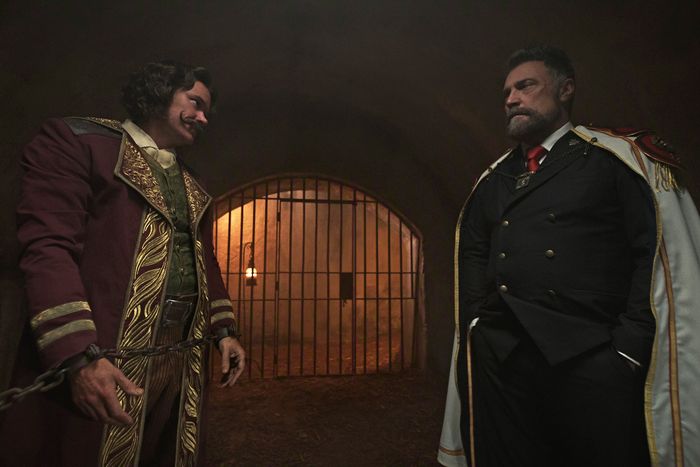
Photo: Netflix
One of the biggest changes comes early in the first episode of the season, when we get a flashback to King of the Pirates, Gol D. Roger (Michael Dorman), before his execution, talking to Luffy’s grandfather Garp (Vincent Regan). Roger, in chains, talks to his captor like an old peer as the two laugh about battles of old, and Roger asks Garp for a favor before dying. He reveals that he has a son and asks Garp to take care of him and keep him hidden and safe because he trusts the marine as if he were one of Roger’s crew.
In the anime, this scene doesn’t unfold until Episode 460, or chapter 551 in the manga. It is a pretty shocking reveal not only to the audience but to the characters of One Piece at large as no one knew Roger had a kid. Purists may consider the scene’s inclusion in the live-action show a giant spoiler, but moving it here serves to deepen the character of Garp, illustrating his conflicting natures: This is a man being hailed as a hero of the marines, yet he talks to the king of the pirates like an old friend. It not only shows why Garp has a soft spot for his grandson being a pirate but also suggests he may have a slightly different idea of justice from the rest of his institution. Plus it gives us a chance to see Roger as a man with a personality, rather than just a legendary figure whose dying words kick-start the show.
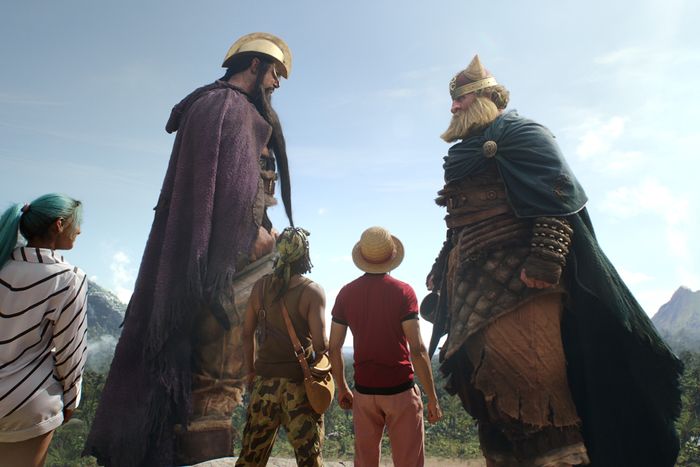
Photo: Netflix
In the same flashback, Roger refers to Garp as the Hero of God Valley, and later on we see Loguetown decorated with banners advertising Garp’s triumph in God Valley — there even seems to be an opera about the incident. God Valley is a pivotal part of history in the One Piece universe, but we hear about it for the first time only in episode 958 of the anime and the full scope of the event hasn’t even been adapted yet. If you’ve never seen the anime or read the manga, this is an empty reference, about as significant as when Ben Kenobi tells Luke he fought in the Clone Wars alongside Luke’s father. But just like that reference, it serves to bolster the history and lore of One Piece, giving hints of a much larger world than even our main characters are aware of.
The same thing happens later in the season when we meet the giants Dorry (Werner Coetser) and Brogy (Brendan Murray), who speak of the sun god, Nika. Without diving into spoilers, Nika has become an integral part of the manga’s lore and endgame, the importance of which hasn’t been fully explored. To have the giants name-drop their god when talking about traditions or saying a prayer plants seeds for future developments in a way that feels natural and in the moment; the giants wouldn’t care about whether it’s too early for the audience to learn about their god. These are small references in the larger scheme of things, but they make the world of One Piece feel alive and lived-in.
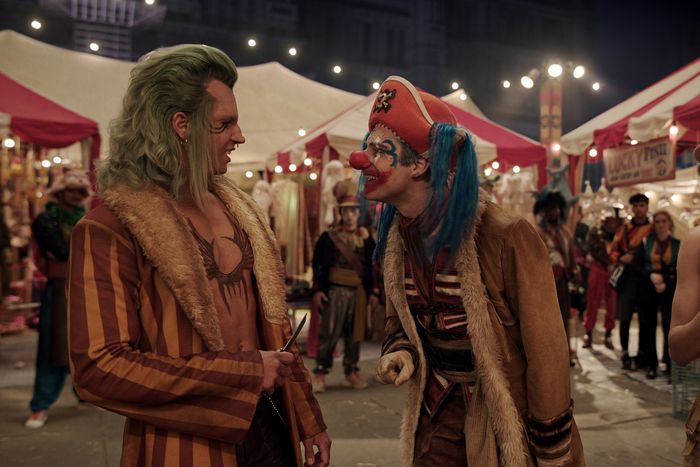
Photo: Netflix
Season two of One Piece brings in three rather surprising character appearances that deviate from their introductions in the anime and manga. Bartolomeo (Nahum Hughes) shows up in the first episode and interacts with both Luffy (whom he tries to scam) and Nami (who teaches him how to scam others); Sabo and his iconic top hat and goggles show up briefly to accompany the revolutionary Dragon; and episode two even brings in future Straw Hat Pirate Brook (Martial T. Batchamen) via flashback to sing a song. Once again, we don’t meet these characters until much, much later in the source material, but the first two are known to have been at Loguetown at the same time as the Straw Hats. In the case of Brook, the anime and manga don’t exactly show him, but they include a flashback of the then-unnamed pirate crew saying good-bye to the friendly whale, Laboon. If the show was already going to include this flashback, as it takes place when Luffy and the crew meet him, then it is but a small change to actually show the pirates Laboon befriended.
These are great examples of the type of fan service Netflix’s One Piece excels at. Sabo’s blink-and-you-miss-it appearance is vague enough to go unnoticed by many (though there is no mistaking his outfit if you’re a longtime fan). Bartolomeo’s role is small enough in the grand scheme of things that he could be mistaken for just another weird-looking side character. Brook, meanwhile, is just a stylish and musically gifted member of a similarly musically inclined pirate crew who loves singing a sea shanty to an adorable little whale. Yet for those who recognize them, these are perfect little tributes to fan-favorite characters that also serve to further populate the show’s colorful world. It’s unlikely Netflix will keep making One Piece long enough for the series to catch up to the 1,100-plus manga chapters, so small cameos like these may be the best chance fans have to see some of the many, many, many characters of Oda’s epic adventure.
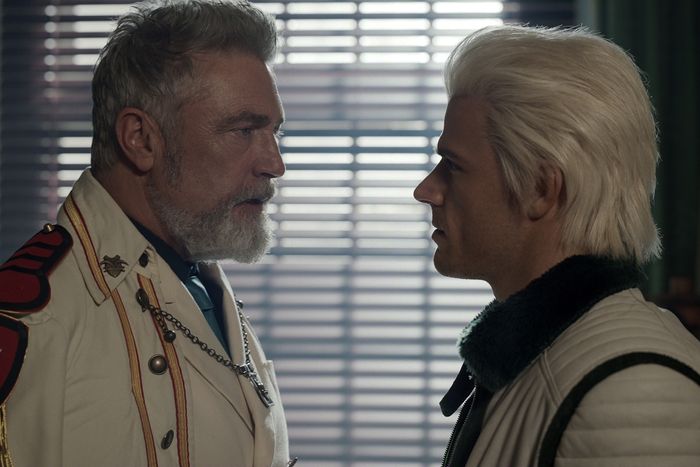
Photo: Netflix
Many of the changes the live-action One Piece makes to the source material just rearrange the series of events from the manga, but there are scenes, even entire plot lines, in season two that are original to the show. One involves marine captain Smoker (Callum Kerr) being tasked by Garp to uncover the mystery of the criminal syndicate Baroque Works. Though the manga alludes to the organization’s being vast, we really see them only when their agents face off with, and are defeated by, the Straw Hats. We don’t see their impact on the larger world or what makes them so dangerous outside of one particular island. To see Smoker actually investigate the organization and even fight some of their officers — all scenes original to the live-action series — make it clear that Baroque Works is an important threat to the marines and the World Government. It also serves as a great tease for the final reveal of the season, that the criminal organization’s leader, Mr. 0, is actually a Warlord of the Sea, a pirate sanctioned by the World Government whose crimes and bounty are canceled by the authorities. This could shake the foundation of the major government powers in the world of One Piece, and Smoker’s storyline is a good way to tease its larger impacts.
Then we have Miss All Sunday (Lera Abova), a character who appears only briefly in the chapters covered by this season. Though she becomes a prominent villain only once the crew makes it to Alabasta, One Piece makes Miss All Sunday a sort of overarching villain for the second season, beginning with her raiding a marine outpost and killing everyone inside in a gruesome matter (which sets the stage for a more violent season than what is allowed in the original anime). We also see her keeping tabs on the Straw Hats, making threats against them, and forming alliances throughout the season. She tries to recruit Smoker’s second-in-command, Tashigi (Julia Rehwald), in the first episode, and later she gives Wapol (Rob Colletti) a devil fruit to secure a partnership with him. This helps build the character as someone dangerous and powerful before she becomes more important to the plot in season three. It also fleshes out Baroque Works as a larger organization and not just a series of villains for our main characters to beat.
All these tweaks make it clear that Netflix’s One Piece understands that a 1:1 adaptation of its source material wouldn’t work as well in a different medium. Instead, the live-action series charts its own course by rearranging the source material and actively building on it, expanding on elements only teased in the manga and anime. These changes make the series a must-watch regardless of whether it’s your first introduction to Oda’s world or you’ve read every chapter and watched every episode, while boding well for the series’ ability to adapt the bigger, more complex story arcs to come.