
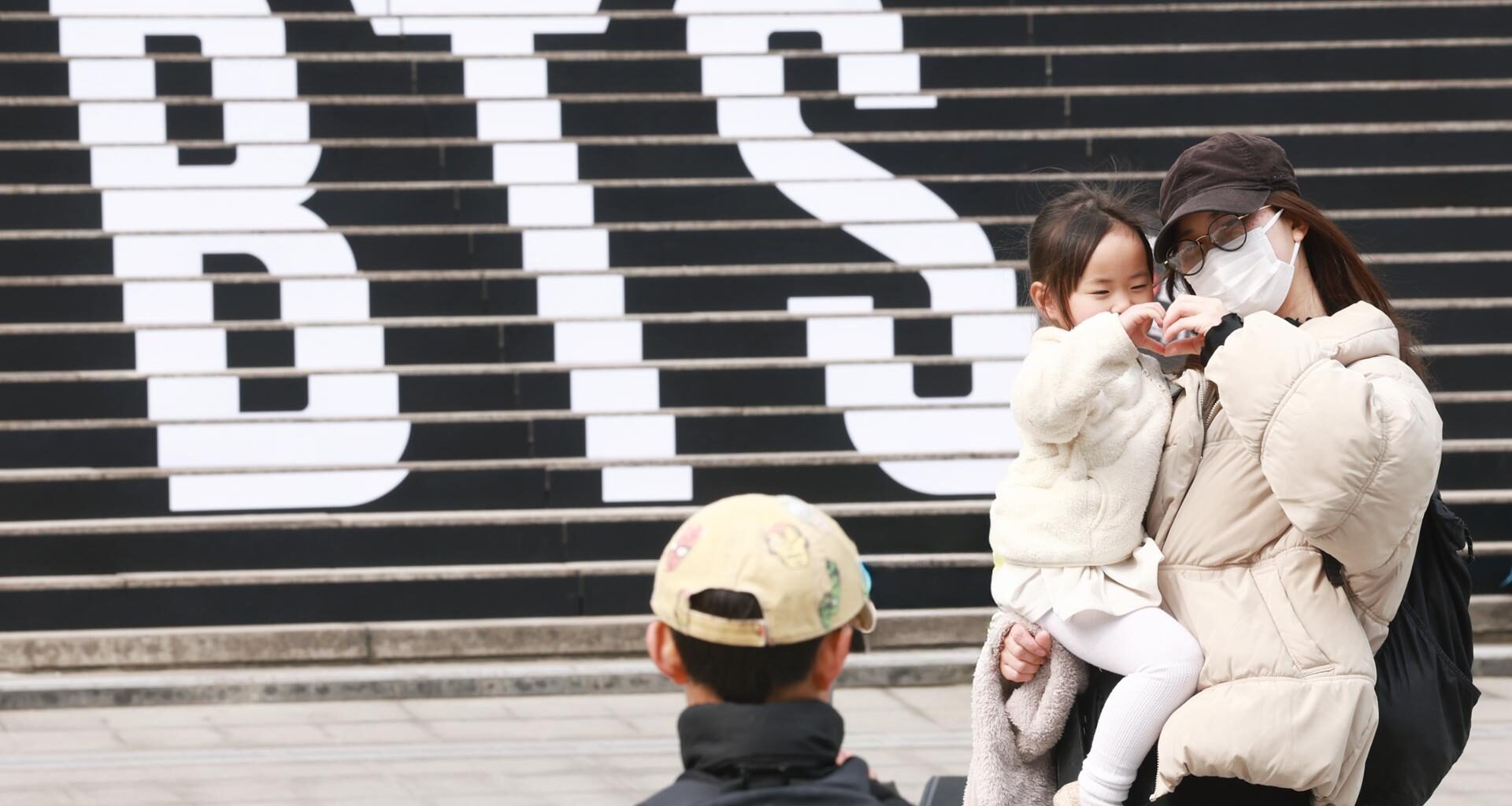
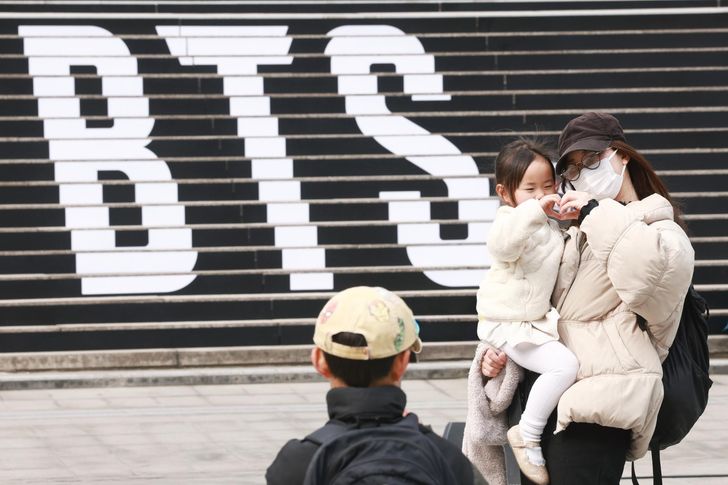
A family of foreign tourists poses in front of a promotional ad for a concert by K-pop boy band BTS, on the steps of the Sejong Center for the Performing Arts in Jongno District, Seoul, March 11. Yonhap
As K-pop juggernaut BTS prepares to return to the stage at Seoul’s historic Gwanghwamun Square, fans from around the world are once again planning journeys that extend far beyond a single night of music.
For many members of ARMY, BTS’ official fandom, traveling to Korea is not simply about attending a concert. It is about stepping into the physical landscapes that shaped the group’s story, tracing the arc from uncertain trainee years to global influence.
Across Seoul and beyond, buildings, cafes, coastal landmarks and performance sites have quietly evolved into a living map of BTS’ rise. Some are grand symbols of the group’s transformation. Others are modest, almost hidden spaces that carry emotional resonance precisely because they reflect the ordinariness of the members’ early lives.
Together, they form an unofficial pilgrimage route that continues to grow in significance each time BTS embarks on a new chapter.
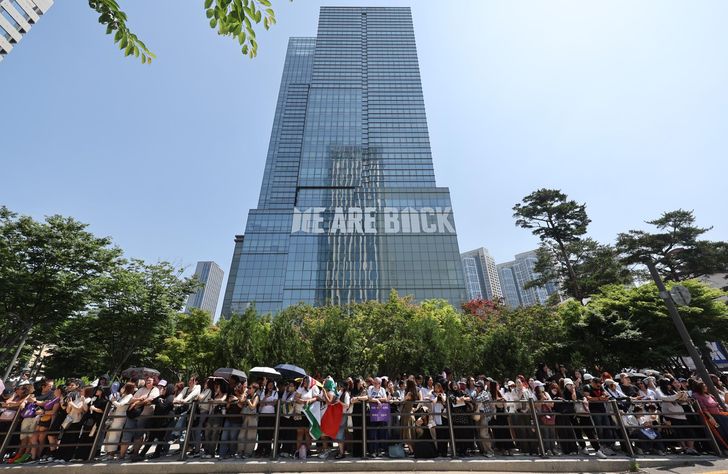
Fans of K-pop boy band BTS, known collectively as ARMY, gather outside HYBE Labels headquarters in Yongsan District, Seoul, June 11, 2025, to celebrate the military discharge of members Jimin and Jung Kook. Yonhap
HYBE Labels headquarters, Yongsan District, Seoul
Few places illustrate the scale of BTS’ sheer impact more clearly than HYBE’s glass-and-steel headquarters in Yongsan District. The sleek structure stands as a visible marker of how dramatically the group reshaped not only its agency’s fortunes, but also the global perception of the K-pop genre.
Fans often gather outside and around the building for photos or fan events, even though the interior is not open to casual visitors. The experience of standing before HYBE’s imposing facade is less about nostalgia than about witnessing the tangible results of BTS’ journey.
In many ways, the building symbolizes the moment when BTS’ success became institutionalized, transforming from a narrative of struggle into a blueprint for global pop ambition.
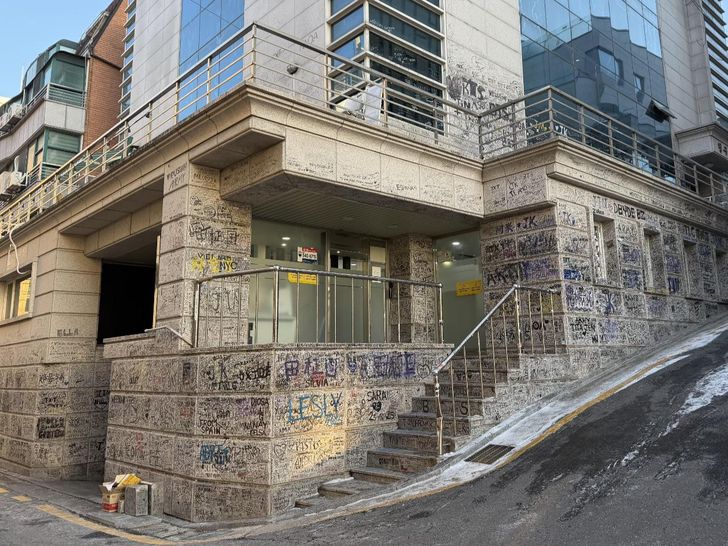
The former BigHit Music headquarters in Nonhyeon-dong, Gangnam District, Seoul / Korea Times photo by Pyo Kyung-min
The former BigHit building, Gangnam District, Seoul
In striking contrast to HYBE’s headquarters stands the group’s former agency office in Nonhyeon-dong, southern Seoul. Modest in scale and easy to overlook, the old BigHit building has become one of the most emotionally charged destinations for longtime fans.
This was the neighborhood where BTS spent its trainee years, rehearsing in relatively cramped practice rooms and navigating the uncertainty of debut in an industry dominated by larger agencies. Visiting the site offers a rare opportunity to encounter the group’s story at its most vulnerable stage.
Over time, the building’s exterior walls have become densely covered with graffiti left by visiting fans, transforming the space from a former company office into something closer to a cultural landmark. While BTS remains the central focus, the names of other HYBE artists can also be spotted among the layers of marker. For many visitors, part of the fun lies in scanning the walls to find the name of their own favorite artist, turning the act of pilgrimage into a personal treasure hunt.

The interior of Yoojung Sikdang, a Korean ssambap (rice lettuce wrap) restaurant in Gangnam District, Seoul, is decorated with posters and fan memorabilia related to K-pop boy band BTS. Captured from X (formerly Twitter) user @ssuny_rachel
Yoojung Sikdang, Gangnam District, Seoul
Just a short walk from the former agency site is Yoojung Sikdang, a Korean ssambap (rice lettuce wrap) restaurant in southern Seoul, that serves rice and grilled meats accompanied by a variety of fresh leafy wraps and side dishes. The eatery has become one of the most recognizable BTS pilgrimage stops in Seoul after gaining a reputation among fans as a place the members visited frequently during their trainee and early debut years.
Today, the restaurant is virtually impossible for ARMY to miss.
From the exterior walls to the interior decor, the space is densely lined with BTS posters, handwritten notes and fan-donated merchandise, transforming what was once a neighborhood dining spot into an important fan landmark. For many visitors, sharing a simple ssambap meal here feels less like dining out and more like stepping into a living archive of the group’s early memories.
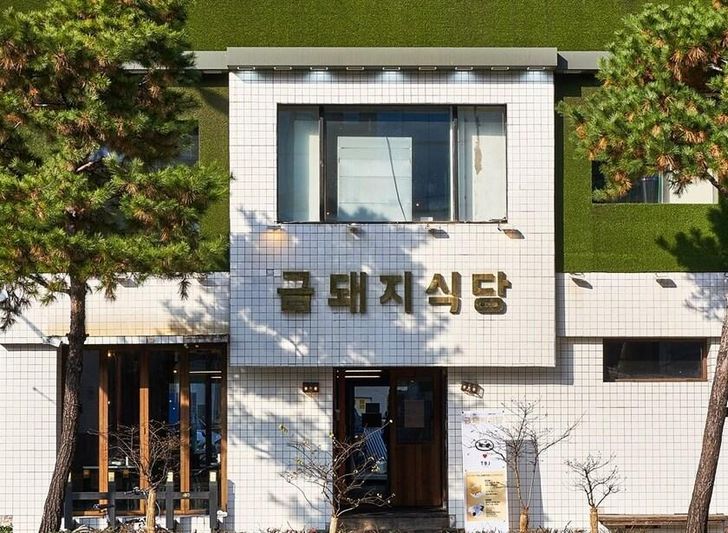
The exterior of Geumdwaeji Sikdang, a Michelin-recognized pork barbecue restaurant in Jung District, Seoul / Courtesy of Geumdwaeji Sikdang
Geumdwaeji Sikdang, Jung District, Seoul
In Jung District, Geumdwaeji Sikdang offers a different kind of BTS-related experience. The Michelin Bib Gourmand-selected pork barbecue restaurant gained further international attention after being associated with visits by the members of the group. Its inclusion in fan itineraries reflects how BTS’ everyday choices can elevate already-popular spaces into global attractions.
Otsu Seiromushi, Yeouido, Seoul
In Yeouido, Otsu Seiromushi is a Japanese-style restaurant known for its dishes served in traditional wooden steamers. The venue has drawn steady interest from BTS fans over time due to its widely circulated association within fandom communities with Jin’s older brother, making it a meaningful stop on the group’s informal pilgrimage trail.
Recently, the restaurant has seen a renewed wave of visitors after announcing that it will cease operations on March 30. The news has added a sense of urgency for fans hoping to experience the space before it closes, turning what might otherwise be a routine restaurant stop into a final chance to dine at a location popularized largely through word-of-mouth within ARMY networks.
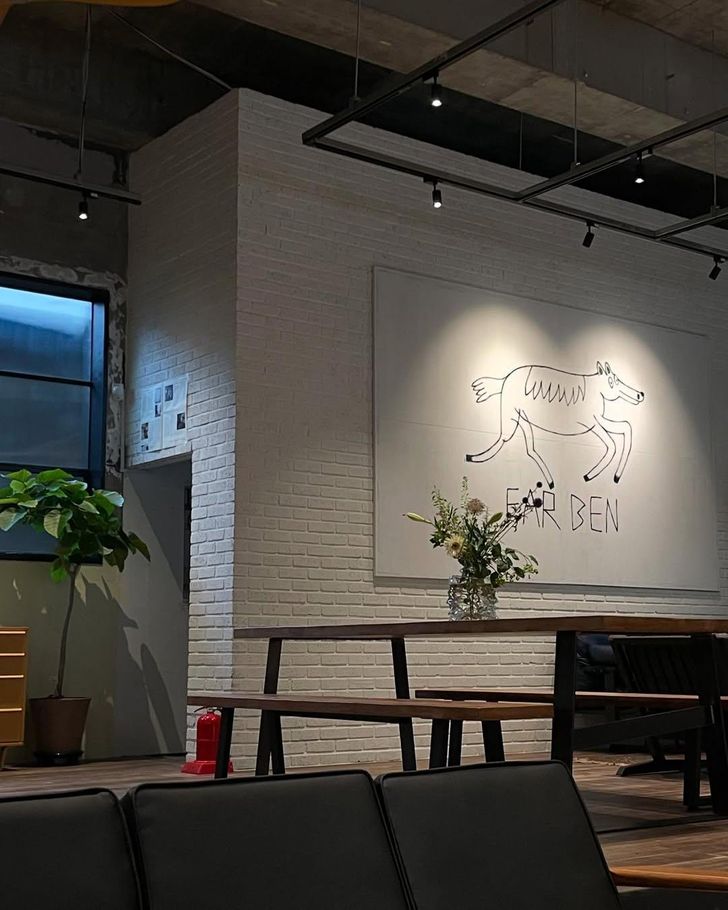
The interior of Café Far Ben in Seongdong District, Seoul / Captured from Instagram
Cafe Far Ben, Seongdong District, Seoul
Across the Han River in Seongsu-dong, Cafe Far Ben has developed a reputation among fans as a space associated with RM’s sister. Located in one of Seoul’s most trend-conscious neighborhoods, the venue embodies a quieter, more relaxing side of the pilgrimage route.
Visitors frequently describe the cafe as a contemplative stop amid a high-energy itinerary, aligning with RM’s public image as a thoughtful and intellectually inclined artist. Its understated atmosphere demonstrates how BTS-related destinations need not always be spectacle-driven to hold meaning.
Nodeul Island, Yongsan District, Seoul
Nodeul Island, located along the Han River in Yongsan, bridges the worlds of K-pop and urban regeneration. The site gained prominence among fans after appearing in scenes from the “Run” music video and later being revisited in BTS’ contents.
Today, Nodeul Island has evolved into a vibrant cultural complex hosting concerts, exhibitions and community events. Its transformation parallels BTS’ own trajectory, making it a fitting stop for visitors seeking to experience both the group’s visual legacy and Seoul’s evolving creative landscape.
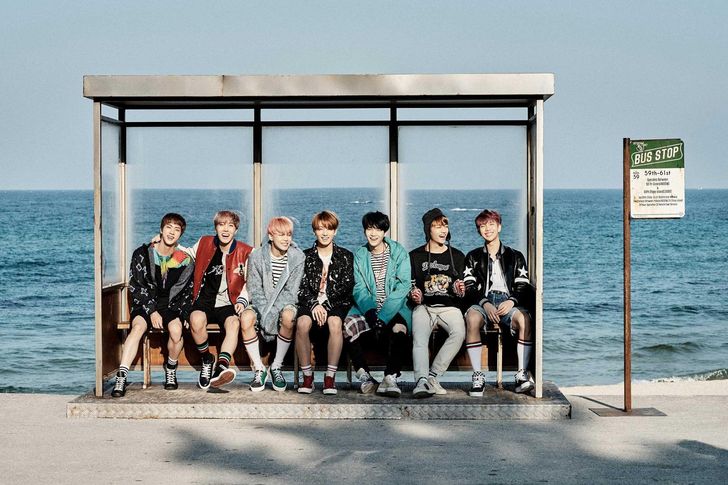
Members of K-pop boy band BTS pose at a bus stop in a promotional image released during the group’s “You Never Walk Alone” era in 2017. The structure, installed at Hyangho Beach in Gangneung, Gangwon Province, later became a well-known travel destination for fans visiting Korea. Courtesy of BigHit Music
Hyangho Beach bus stop, Gangneung, Gangwon Province
Beyond Seoul, the bus stop installed at Hyangho Beach in Gangneung, Gangwon Province, stands as one of the most iconic BTS landmarks. Originally built as a prop for album jacket photography tied to the 2017 album “You Never Walk Alone,” the structure was later reinstated after fans began traveling in large numbers to see it.
Set against the expansive East Sea, the stop has come to symbolize themes of companionship and endurance central to BTS’ artistic identity. For many ARMY visitors, the quiet coastal setting offers an emotional counterpoint to the intensity of urban pilgrimage sites.
Maengbang Beach, Samcheok, Gangwon Province
Further along the coast, Maengbang Beach gained global recognition after appearing in promotional imagery for the chart-topping single “Butter.” Its bright sands and open horizons evoke a celebratory mood, capturing BTS at the height of its global pop dominance.
Together with Hyangho Beach, Maengbang forms part of a coastal pilgrimage route that mirrors the emotional range of BTS’ music, from introspective longing to exuberant confidence.
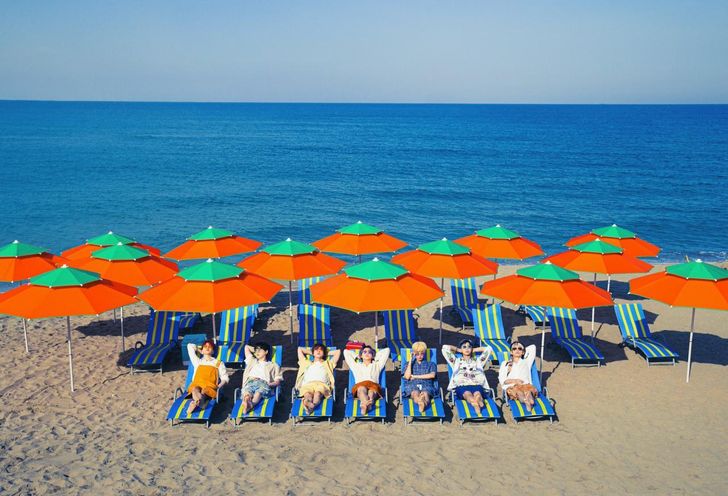
Members of K-pop boy band BTS pose in a promotional photo shot at Maengbang Beach in Samcheok, Gangwon Province. The coastal backdrop was used in imagery tied to the group’s global hit single “Butter.” Courtesy of BigHit Music
Mosan Airfield, Jecheon, North Chungcheong Province
Inland in Jecheon, Mosan Airfield provides one of the most visually symbolic stops on the BTS trail. Featured in the “Young Forever” music video, the abandoned runway setting underscored themes of youth, uncertainty and aspiration.
While the airfield was built in 1950 as a training ground for war prevention and peace regime establishment, the venue has since been repurposed as a public park. The site allows visitors to step into one of the group’s most enduring visual metaphors: the idea of life as an open runway, filled with both risk and possibility.