
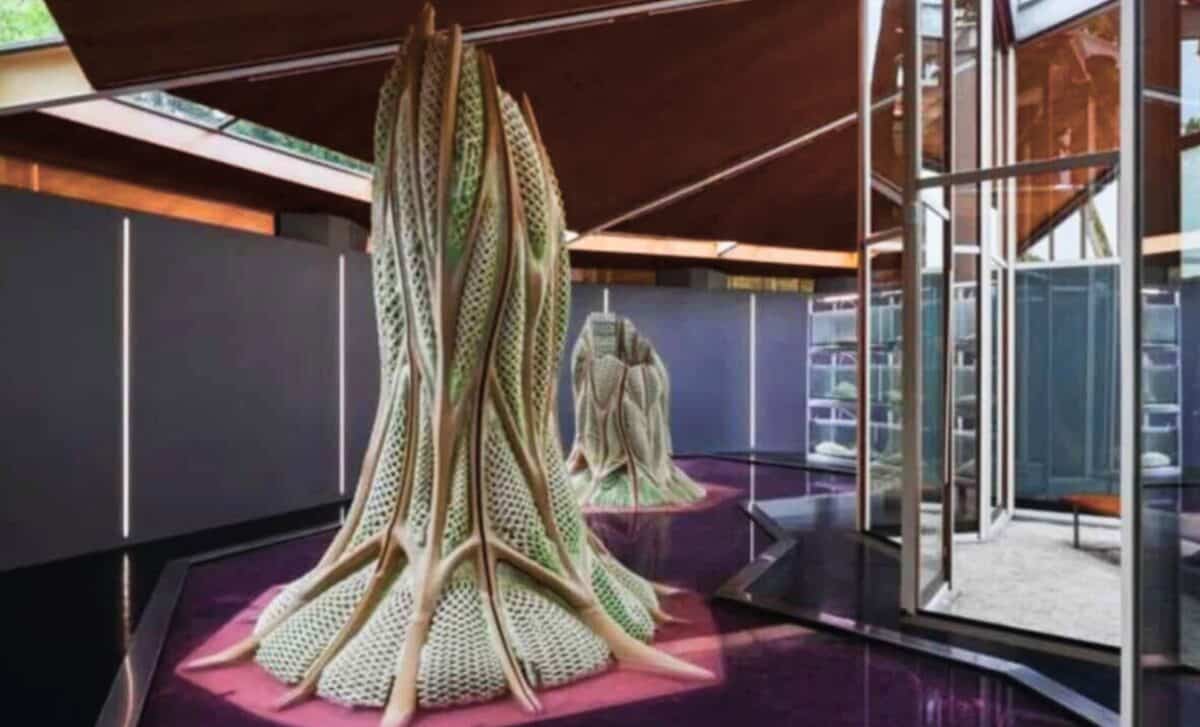
At the Canada Pavilion in Venice, the walls were not built to stay still. Opened as part of the 2025 Venice Architecture Biennale, Picoplanktonics filled the space with 3D-printed forms that had to be kept alive through carefully managed light, humidity, and temperature. The installation, presented by the Canada Council for the Arts, was scheduled to run until November 23, 2025.
That detail made Picoplanktonics different from a normal architectural display. The structures were embedded with living cyanobacteria, so the project depended on daily care rather than a finished object alone. If the microbes failed, the architecture failed with them.
The pavilion also arrived with a longer backstory. Picoplanktonics was developed over four years by the Living Room Collective, an interdisciplinary team led by Canadian architect and biodesigner Andrea Shin Ling. The group described the work as an experiment in building with living systems rather than extracting and assembling inert materials.
What the Pavilion Walls Were Actually Doing
At first glance, Picoplanktonics looked like a speculative design installation scaled up for public view. ArchDaily described it as the largest architectural structure made from living materials, with printed components designed to host microorganisms capable of carbon sequestration. That made the pavilion a test site as much as an exhibition.
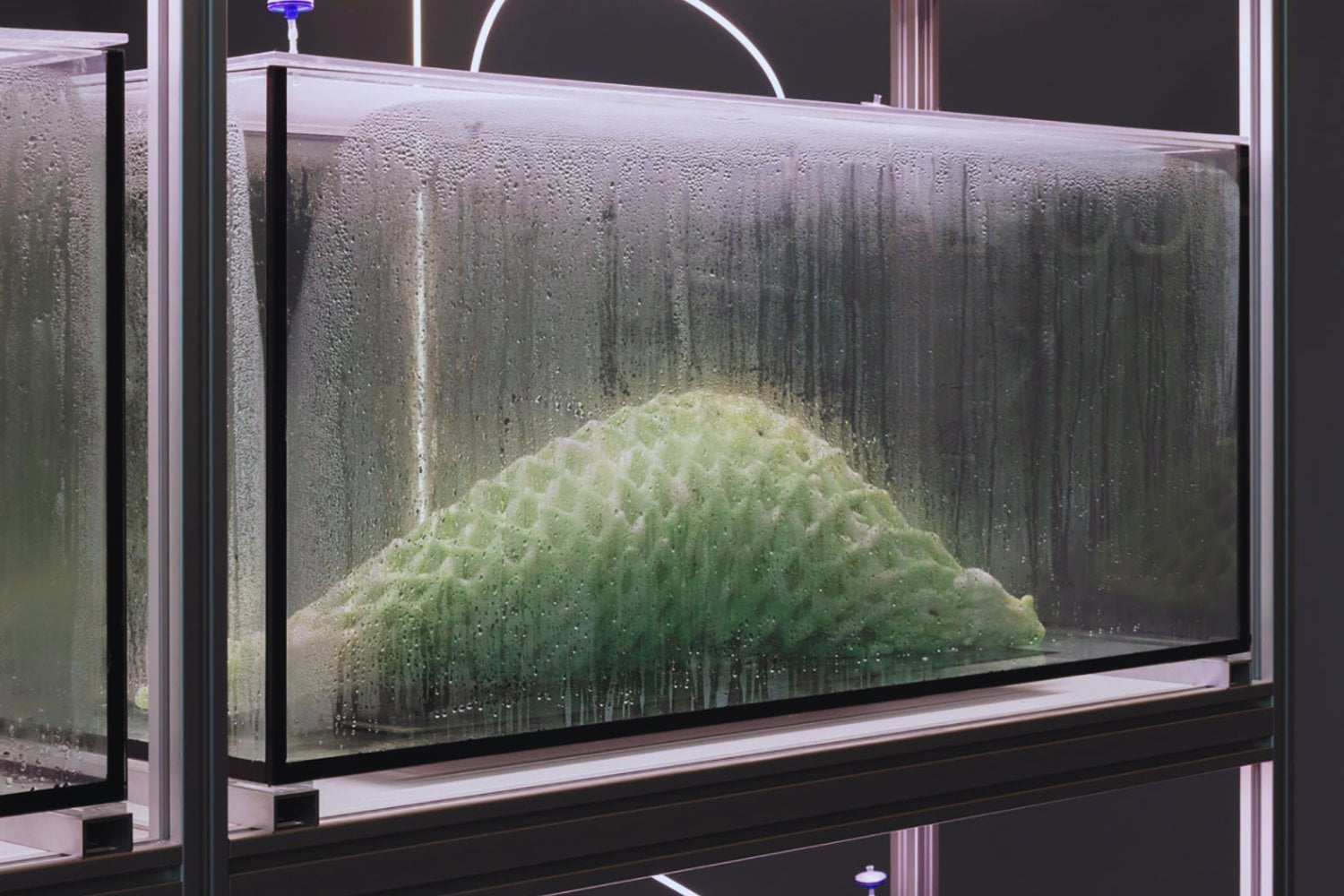 A new living material grows in sunlight and could change the way buildings are constructed.© La Biennale di Venezia
The timing of the public installation also matched a separate laboratory effort. In a paper published in Nature Communications on April 23, 2025, researchers reported that their photosynthetic living materials kept capturing carbon for more than a year. The overlap mattered because the exhibition showed what these materials might look like in architecture, while the paper measured what they could actually do.
The research team was led by Dalia Dranseike, Yifan Cui, and corresponding author Mark W. Tibbitt of ETH Zurich, with Andrea S. Ling and Benjamin Dillenburger also contributing through ETH Zurich’s digital building technologies group. Their system used the cyanobacterium Synechococcus sp. PCC 7002 inside a printable hydrogel. The goal was not only to keep the organism alive, but to make the material perform useful work over time.
The Result Stayed Hidden in the Gel for 400 Days
The first clue was visual. During a 30-day incubation, the printed samples became greener as the encapsulated cells multiplied, and they began forming mineral deposits throughout the hydrogel. By the end of that period, the living samples had accumulated 36% more dry mass than abiotic controls.
That extra mass came from two different pathways operating at once. One was straightforward biological growth, with the cyanobacteria fixing CO₂ into biomass through photosynthesis. The second was microbially induced carbonate precipitation, or MICP, in which the microbes created alkaline conditions that caused dissolved ions to form solid carbonates.
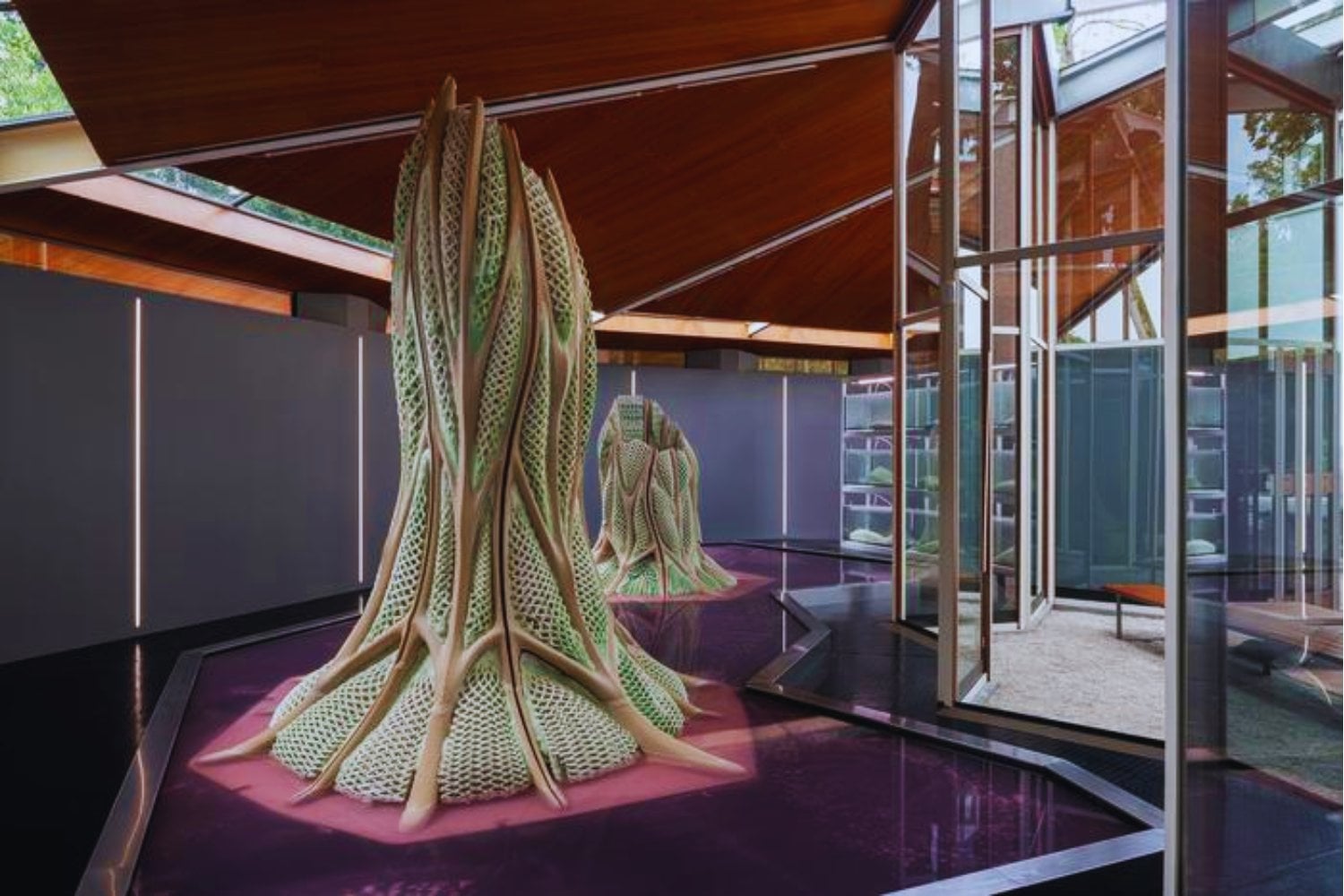 The living materials sequestered 2.2 milligrams of CO₂ per gram of hydrogel during the first 30 days.© Valentina Mori/ Biennale di Venezia
That second pathway carried the more durable result. Over the first 30 days, the living material sequestered 2.2 ± 0.9 milligrams of CO₂ per gram of hydrogel. After 400 days, the amount stored through mineral formation reached 26 ± 7 milligrams per gram, with the paper noting that most of the captured carbon ended up in a stable mineral form.
The structures did not simply hold their shape while this happened. In one set of experiments, the team printed lattice geometries designed to improve light access and passive movement of culture medium. A self-standing printed lattice remained vividly green up to 365 days, a sign of continued chlorophyll production, while larger porous forms retained mineralized versions of their geometry after the biomass and polymer matrix were removed.
Why Shape Mattered as Much as Biology
The material itself had to solve a basic conflict. A dense scaffold can support a structure, but it can also block the light and nutrient flow that living cells need. To get around that, the researchers built their bioink from F127-BUM, a photo-cross-linkable hydrogel system that could be extruded or shaped through additive manufacturing while still transmitting usable light.
The paper reported that the base F127 hydrogel transmitted 76 ± 3% of visible light across the 400 to 750 nanometer range. That transparency gave the cyanobacteria room to photosynthesize inside the printed network rather than only on the surface. The researchers also found that geometry changed performance, which pushed the project closer to architecture than standard materials science.
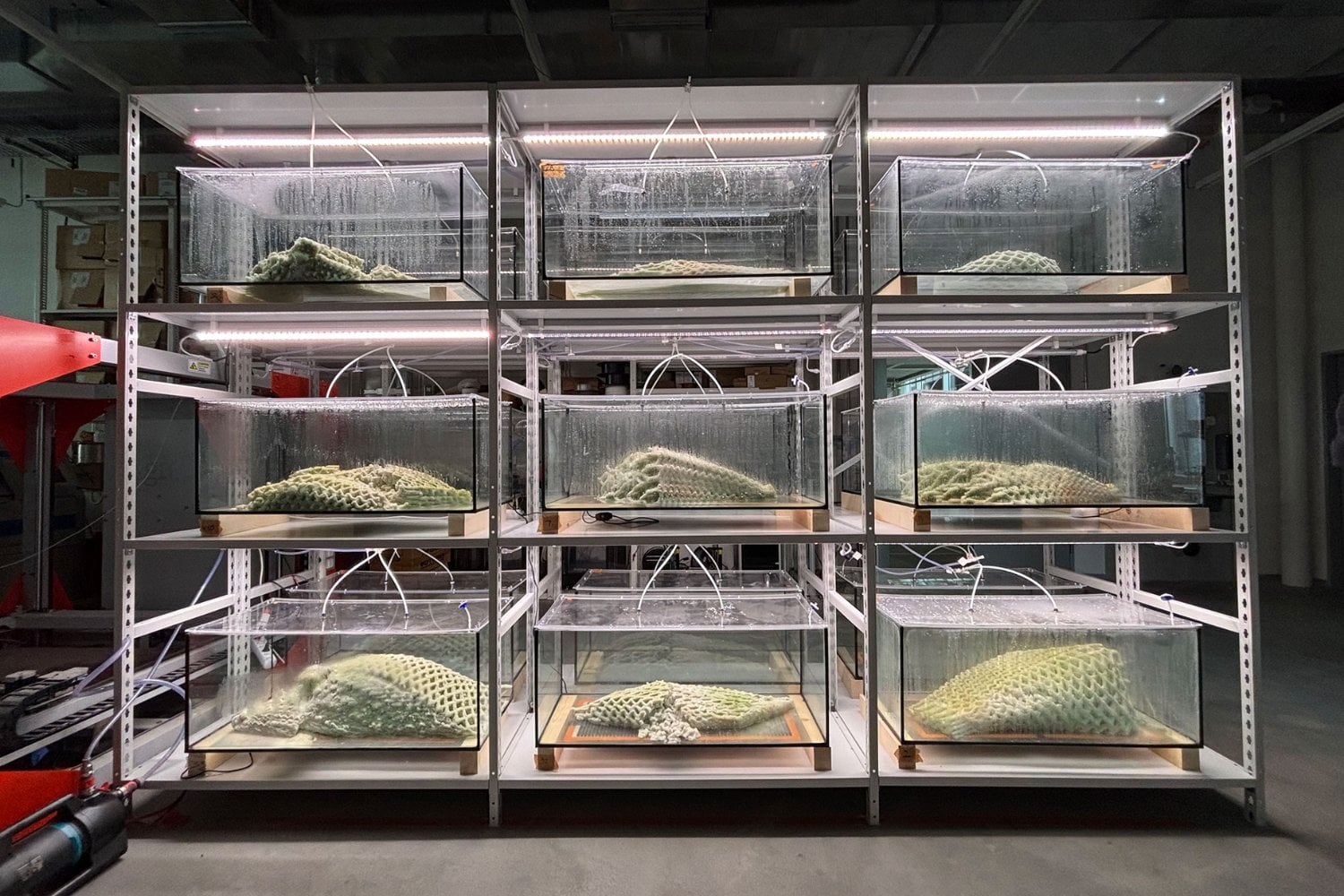 Researchers engineered a Pluronic F-127 based hydrogel that transmits sufficient light for photosynthesis while remaining printable via extrusion based 3D printing and photo crosslinkable for long term structural stability.© Clayton Lee
A flat block was not the most efficient option. The team reported that 5 millimeters was an optimal thickness for maintaining viability in bulk material, then tested textured and lattice-like designs to improve light exposure. One coral-inspired surface increased printed gel volume by 150% while keeping the same footprint and preserving bacterial viability.
That design logic helps explain why Picoplanktonics looked the way it did in Venice. The pavilion structures were not decorative shells wrapped around a concept. They reflected the same constraint seen in the lab: living matter needs space, light, and exchange if it is going to keep functioning inside a built form.
What This Living Material Can Do, and What It Still Cannot
The attraction of these photosynthetic living materials is not speed. The authors wrote that biological sequestration is slower than many industrial carbon-capture systems, but it works under ambient conditions with sunlight and atmospheric carbon dioxide, and it does not require toxic feedstocks. They also contrasted it with ureolytic mineralization methods that can generate large amounts of ammonia and depend on a constant urea supply.
What the ETH Zurich team showed instead was a low-maintenance material that keeps changing after fabrication. As carbonate minerals accumulated, the paper said they mechanically reinforced the living material over time. That raises the possibility of structures that not only store carbon, but also become harder as they age.
Picoplanktonics did not prove that a city can be built this way tomorrow. It showed that architecture can be used to host a living experiment at room scale, while the Nature Communications paper showed that the same class of material can keep sequestering carbon for 400 days under controlled conditions. Together, they placed a laboratory result directly inside a building-sized test.