
The pro-Israel lobby arouses a unique degree of controversy. Hostile accounts of it claim that through its activities the small segment of the American population that is Jewish has wrenched the country’s foreign policy out of its proper course and enlisted it in support of a tiny state in the Middle East, contrary to American interests. Such accounts sometimes go beyond normal political discourse and enter the realm of conspiracy theories, and this pattern has intensified since the Israeli war in Gaza, which was provoked by Hamas’s murderous assault on Israeli civilians on October 7, 2023.
In fact, there is nothing special or singularly powerful about the pro-Israel lobby in the United States. Properly understood, its successes and failures conform to the predominant patterns of America’s democratic political system. Seen accurately—that is, in historical and comparative perspective—it is as American as apple pie.
The contentiousness—and indeed the confusion—that surrounds this subject makes an examination of the history and functioning of other ethnic pressure groups, as well as a comparison with them of the pro-Israel lobby, a useful way of arriving at a clear understanding of this particular lobby’s successes, failures, and roles in American life.
_____________
From colonial days, Americans have had different ideas about politics and government, different ways of earning a living, different political and cultural affinities, and therefore different political and economic interests. The American Constitution, through the First Amendment, invites the country’s citizens to organize to press for public policies that reflect and support their interests, and the people have enthusiastically taken up this invitation. Indeed, the American political system is sometimes described as a forum for the interplay of many such groups, with public policy as the outcome of that interplay.
Most interest groups seek to affect domestic policy, usually in order to gain economic benefits for its members. A smaller number work to exert influence on American foreign policy. The term commonly used for groups with both domestic and international concerns is “lobby,” and the word does double duty as a verb to describe such a group’s efforts to induce public officials to adopt their preferred policies.
In foreign policy, interest groups, while not of negligible importance, have generally had less influence than they have had on domestic matters. This is so because foreign policies often have much higher salience than domestic issues do. Foreign policies are carried out in the name, and on behalf, of the entire country. They involve matters of national security—not only the waging of wars (the most salient foreign-policy issue of all) but also diplomacy linked to the American position in the world. This has meant that groups focused on foreign policy have succeeded in persuading the government to act as they wish when their preferences have aligned with the national interest as defined by the American majority, and when the interest groups have advocated a direction that the nation was likely to take, or was already taking, for other reasons.
So it has been with the pro-Israel lobby, which arises, like others of its kind, from immigrants who have populated the nation from the beginning. Immigration has given the United States diasporas—groups of people from the same country who retain connections to, or at least sympathies for, their own and their forbears’ countries of origin. Such people have often acquired a social identity known as ethnicity, combining fidelity to the United States with continuing affinity for the old country. Ethnic groups have organized themselves to promote their original countries’ interests in the foreign policy of the increasingly powerful country to which they have moved. Immigration on a large scale took place in the 19th century, particularly during its second half, but because a generation or two usually passes before the immigrants and their children feel sufficiently integrated to participate in American public life, ethnic lobbies did not become a significant part of American foreign policy until the 20th century.
Two ethnic groups that arrived in the 19th century, the Germans and the Irish, were active in advance of American entry into the two world wars, seeking to prevent it on both occasions. Both groups regarded American participation in a British-led coalition, which is the course that the United States eventually followed in both conflicts, to be detrimental to the interests of their forbears’ homelands. This was certainly true for Germany, against which the United States fought in both wars. Irish Americans opposed what ultimately became American policy in the two conflicts because they saw Britain as Ireland’s imperial oppressor. Before World War I, Ireland was in fact a British possession, but opposition to American intervention in Europe persisted afterward, in advance of World War II, when an independent Irish republic had come into existence (while the six northeastern counties of the island remained part of the United Kingdom). On both occasions, the march of events—German submarine warfare in 1917 and the Japanese attack on Pearl Harbor in 1941—overrode the wishes of German and Irish Americans and propelled the United States into the two world wars.
Poles arrived in the United States later than the Germans and Irish did. By the end of World War II, though, they had become politically important enough that, at his February 1945 summit meeting at Yalta on the Black Sea with the Soviet leader Josef Stalin (as well as with British prime minister Winston Churchill), President Franklin D. Roosevelt appealed to Stalin for fair treatment of Poland, which the Red Army had occupied in its campaign against Nazi Germany. While the importance of Polish-American votes in American elections persuaded the American president to espouse Poland’s cause, it did not move Stalin. For him, Polish votes in the United States, or indeed anywhere else, had no significance. To free Poland from Stalin’s clutches would have required a war against the Soviet Union, which no one in the United States wanted to fight. Thus, neither Roosevelt nor his successor, Harry Truman, managed to prevent Moscow from imposing a Communist government on Poland. In fact, neither president seriously attempted to do so.
In the decades after the war, the United States did support, although largely rhetorically, the Polish people’s efforts to resist their Communist overlords, but that stance was very much in keeping with the broader American foreign policy of anti-Communism and opposition to the geopolitical designs of the Soviet Union. The Polish-American lobby scored its greatest success after the Cold War had ended, when it helped win the American government’s support for including Poland in the American-led transatlantic military alliance, the North American Treaty Organization (NATO). With the end of the Cold War, however, while Poland’s future mattered greatly to ethnic Poles, issues of European security had become much less important in the eyes of the American public. Polish NATO membership is therefore an instance of an interest group getting its way because the issue in question combined high intensity for a relatively small number of people with low salience for the rest of the country.
Unlike the Germans, the Irish, and the Poles, Cuban immigrants to the United States organized themselves soon after they arrived, in the early 1960s. An important reason for this difference is that they were not economic migrants but rather political refugees, fleeing Fidel Castro’s Communist dictatorship. They pressed for a policy of robust opposition to the Castro regime, and the American government carried out such a policy throughout the Cold War as well as thereafter. It did so, however, principally for reasons of global anti-Communism, which was the guiding principle of American Cold War foreign policy: Successive administrations did not need the urgings of Cuban Americans to find the Castro regime both morally repugnant and strategically threatening, particularly when it aligned itself with the Soviet Union. Indeed, the most vigorous American initiative against the Communist government of the Caribbean island, the failed invasion by American-sponsored anti-Castro Cuban exiles at the Bay of Pigs, took place in April 1961, before the Cuban-American lobby had fully formed.
In one notable instance, ethnic lobbies conspicuously failed to bend American foreign policy to their wishes. Two of them sought to make the nation’s policy less friendly to Turkey. Armenian Americans were motivated by the mass slaughter of Armenians in which the Turkish-dominated Ottoman Empire had engaged during World War I, an event that the successor to that empire, the Turkish republic, refused even to acknowledge. Greek Americans remembered the eviction of ethnic Greeks from Asia Minor after World War I, when the Turkish republic was established, and objected to Turkey’s invasion of Cyprus, its mistreatment of Cypriot Greeks, and its forcible partition of that Mediterranean island in 1974.
The United States had no ties of sentiment with Turkey, which had fought on the opposing side in World War I and remained neutral in World War II. During the Cold War, however, the American government considered Turkey a valuable ally against the Soviet Union and included it in NATO. Washington’s geopolitical concerns gave Turkey protection against the efforts of two American ethnic groups to modify American policy toward it.
_____________
This brings us to the pro-Israel lobby, a latecomer to the roster of ethnic interest groups even though Jews have been present in America since colonial times. Many emigrated from Germany in the middle of the 19th century, and many more came from Eastern Europe in the last decades of that century and the beginning of the next one. In the latter decades of the 19th century, they persuaded the American government to protest (although not to take any concrete steps to stop) the murderous assaults against Jews in czarist Russia.
In the wake of the destruction of European Jewry in World War II, the State of Israel was established in the ancient Jewish homeland on the eastern shore of the Mediterranean, in what had been a province of the British Empire known as Palestine. For millennia, the land that became Israel had loomed large for Jews, playing, as it does, a central role in the Jewish religion; but in 1948, for the first time, like their Irish, Polish, Cuban, Armenian, and Greek countrymen, Jews had a state with which they could identify. Before World War II, American Jews had largely responded to Zionism, the movement to establish such a state, with indifference or even hostility; but afterward, the vast majority came to support it enthusiastically and continues to do so.
The United States became the second country to accord official recognition to Israel upon its establishment (the Soviet Union was the first), but in the new state’s early years, when it had the greatest need of outside support, America provided very little. In Israel’s War of Independence against the five Arab armies that invaded it in 1948, the American government did not supply it with weapons. (The Israeli army did obtain some American arms through nongovernmental channels.) In the Anglo–French–Israeli 1956 war with Egypt, Washington forced Israel to withdraw from positions it had gained in the fighting. In its sweeping victory over three Arab countries in June 1967, Israel relied on French, not American, arms.
Not only did Israel not receive American help when it was most needed, as the events after the 1956 war demonstrate, American Middle Eastern policy did not always favor Israel, the efforts of the pro-Israel lobby notwithstanding. In 1981, the lobby and the Israeli government strongly opposed the sale of a sophisticated Airborne Warning and Control System (AWACS) to the Kingdom of Saudi Arabia, fearing that it would be employed in ways that would undermine Israel’s security. The sale went ahead anyway. In 2014, the lobby and Israeli government (and a majority of the American public) opposed the Obama administration’s nuclear deal with the Islamic Republic of Iran known as the Joint Comprehensive Program of Action (JCPOA). That deal also went forward.
American foreign policy worked to Israel’s advantage when and because the two countries’ domestic political values, and more important, their strategic outlooks, were aligned. More often than not, they were. During the Cold War, Israel acted as a bulwark against pro-Soviet countries and movements in the Middle East; and in that region, Israel stood out as the lone democracy.
In the post–Cold War period, it has retained both distinctions, becoming the major regional opponent—and by far the most effective one—of the Islamic Republic of Iran, which has, since its inception in 1979, threatened America’s allies and interests in the Middle East. Indeed, Israel qualifies as the most valuable ally of the United States in the sense that, unlike America’s many other allies, it has actually fought and won wars against the adversaries of the United States and has done so while not asking or expecting American troops to fight alongside Israelis for this purpose. The joint attack on Iran launched on February 28 demonstrated anew Israel’s high strategic value to the United States.
The American public and, for the most part, the American government have understood and appreciated this, which accounts for the generally pro-Israel tilt of American foreign policy. Both what Israel is and what it has done, and not the supposed machinations of the groups lobbying on its behalf, have inclined Americans to be favorably disposed to the Jewish state. Because of this positive disposition, policies favorable to Israel followed. That is how democracy works.
Still, the critics of the pro-Israel lobby who assert that it differs from other interest groups are correct in one way—although not in the way that they believe. The other such groups have consisted mainly of people with ethnic ties to the country whose interests they were attempting to promote. Similarly, one of the principal pro-Israel organizations, the American–Israel Public Affairs Committee (AIPAC), is composed mainly of Jews. By far the largest pro-Israel group in the United States, however, Christians United for Israel (CUFI), has a largely non-Jewish, Christian membership. CUFI has supported the Jewish state for reasons related to their Christian faith. A reported 3 million people belonged to AIPAC. The comparable number for CUFI is 10 million. In this one respect, the pro-Israel lobby in the United States, which in every other way is similar to every other ethnic group seeking to influence American foreign policy, and like them a pure product of American democracy, is unique.
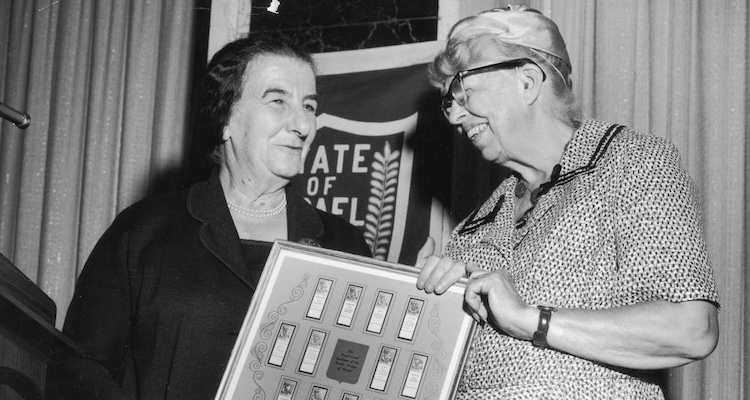
Photo: Hulton Archive/Getty Images
We want to hear your thoughts about this article. Click here to send a letter to the editor.