
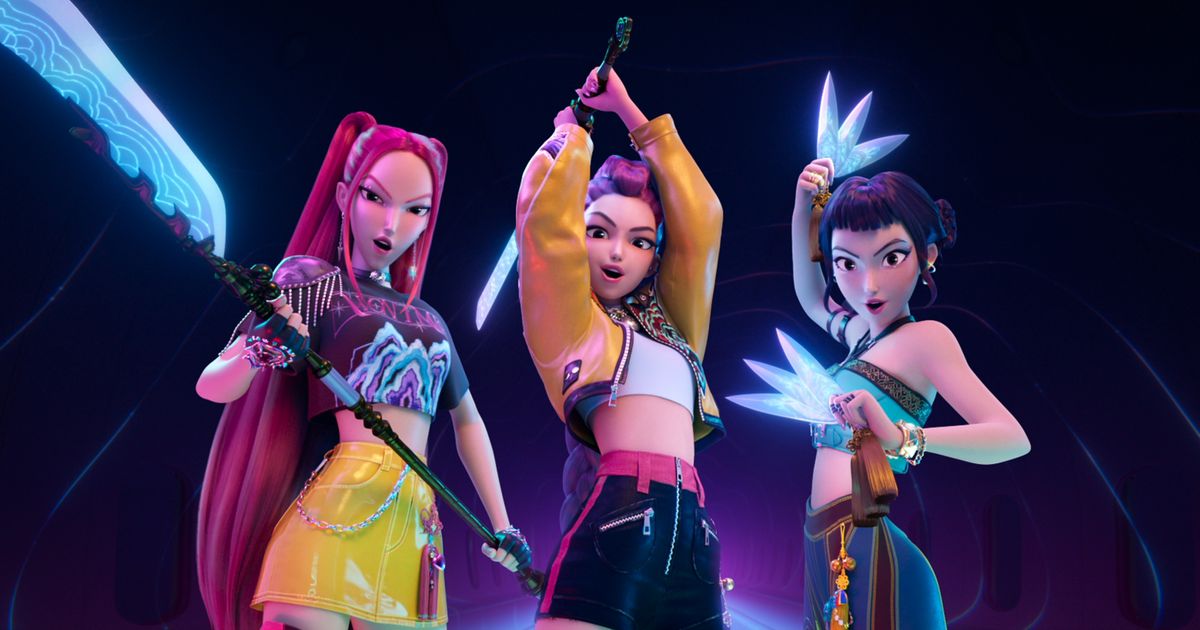
We’re no longer in the heights of KPop Demon Hunters mania — that stretch last summer and fall when the movie placed four songs in the Billboard Hot 100, Huntr/x became the first K-pop girl group to have a No. 1 song, Netflix made $24 million at the box office off a movie that had already been streaming for two months, and a third of every elementary-school classroom dressed as Rumi for Halloween.
But one stop remains on the movie’s coronation tour as it cements its status as one of the biggest cultural phenomena of 2025: this weekend’s Oscars, where it’s the front-runner to win both Best Animated Feature and Best Song, for “Golden,” which already earned the distinction of becoming the first K-pop song to win a Grammy in February. The recognition is deserved, as the movie’s songs have proved to have real staying power. In an episode of our podcast Switched on Pop from last year, hosts Charlie Harding and Nate Sloan broke down what makes five of KPop Demon Hunter’s songs so effective. Ahead of this weekend’s ceremony — and a performance of “Golden” by EJAE, Audrey Nuna, and Rei Ami — here’s a snapshot of that discussion.
Nate Sloan: We have to start with our introduction to these characters. They are three massive K-pop stars in the world of this animated film, but they are also …
Charlie Harding: … demon hunters.
N.S.: Yes, the title of this movie is very literal. The creators said they wanted to establish this as a group with some smashes. This song needs to stand on its own as a K-pop banger.
C.H.: It’s giving Blackpink. It’s got those big 808 electronic bass drums and very dexterous rapping and then you have that moment before the chorus with lush vocals in English and Korean.
N.S.: The song needs to do something else, too: give us a little bit of insight on our protagonists. There’s the kind of tough bad girl, Mira. There’s the cute one, Zoey. And there’s our fearless leader, Rumi. We’re introduced to Rumi as this powerhouse vocalist, and that’s a big part of her, but there’s more, and we’ll learn that she’s harboring a secret: She’s part demon.
The lyric “That sound ringing in your mind” hints at the deeper power of these hits. They’re not just fun songs to listen to; it’s really a battle between good and evil, life and death, and the stakes are high.
C.H.: They literally say music’s job is to ignite our soul, to bring people together and to vanquish the demons.
N.S.: You may not expect the other source of inspiration the creative team used for this introductory song: “Jet Song” from West Side Story. I don’t know how much musical overlap there is, but there’s that sense of solidarity you get from the Jets — “From your first cigarette to your last dying day” — that really permeates “How It’s Done.”
N.S.: This is the most successful Demon Hunters song in the pop realm, and you can hear why. It builds in this really powerful way. It starts kind of low in the singers’ registers, and you know it’s just gonna get higher and higher.
As we move into the pre-chorus, something cool is happening. Zoey sings, “I lived two lives, tried to play both sides,” and the music is kind of doing the same thing. The melody goes to this note, A, but underneath we have a C-major chord. It’s almost like this melody is living two lives because it doesn’t really belong with that C-major.
Then not only do the singers go up, up, up into the highest part of their ranges, but over the course of the chorus, it gets higher and higher. The arc of this song has just been this slow build up and up and up and up to the highest point you can imagine, and what is so brilliant is that after this climactic high point, it goes even higher.
C.H.: When I was watching the movie, I immediately went over to the upright piano in my living room. Oh, I gotta learn how to play this. And I struggled! Because while the chords were simple, the melody was really sophisticated. All right, I gotta look up the sheet music. Then I got really frustrated because the sheet music actually starts way down in the bottom of the treble clef in a way where it’s actually hard to read. I hate this! Why is it written down there? Because the melody needs to build and build to that very high note, it traverses so much range.
N.S.: EJAE, the writer and the voice of Rumi, said she challenged herself to create these huge ranges for the song and then immediately regretted it when she realized she was actually going to have to sing all of these notes.
C.H.: This song really earns its range because it is the hero song of the film. It is the big hit from the movie.
N.S.: It’s the “I want” song.
C.H.: It’s also the song that justifies what I thought was an absurd premise: Wait, there’s a K-pop band that is actually a bunch of demon hunters, and through singing songs, they’re going to unite the world and vanquish the demons? But they really thread this needle effectively. The idea of the demon is really all of the repressed shame and anguish we feel, and when we repress those feelings, they only jump out louder and come back as demons.
That’s what our protagonist is dealing with: Should I repress those feelings deep down to the lowest part of my range? Or is there some kind of way of unifying the fact that I both have good qualities and imperfect qualities that can have some kind of meeting place? That’s the ending of the film. She unites these two worlds, and the extended range of “Golden” takes us into the demon world, into the golden barrier that will protect us from the demon realm, and everything in between.
N.S.: It’s a tall order for a three-minute pop song, and yet “Golden” pulls it off.
N.S.: The Saja Boys embody many of the archetypes of the K-Pop quintet and make their debut in the film with an incredibly catchy and infectious single called “Soda Pop.” This is so well done. It’s meant to be like soda — kind of empty pop calories — to lull you into the seemingly anodyne sounds of the Saja Boys. But underneath, there’s a darker reality.
C.H.: These demons are trying to recruit all the fans of Huntr/x, and if they win over the hearts and minds of the fans, they will spread their evil into the universe and be able to take the souls of all the people. It’s a fight for idol fandom, which is so much a part of the larger K-pop lore.
N.S.: I love the naked commercialism of it. “Soda Pop” is such a great title. It’s something kind of effervescent and something you can sell and shill. They incorporate the sound of a fizzing can of soda in this really satisfying way. But then there’s also maybe a hint at the true intentions of this group. I mean, the message of the song is “We’re gonna drink you up.” It’s so innocent until you consider these cute boy-band members are literal demons.
C.H.: Ooh, we’re gonna suck up your soul. I love how self-aware this song is and how the whole movie is not afraid to use some of the cliches of K-Pop. This is a blatantly commercial song. There are plenty of blatantly commercial songs in the world of K-Pop that, like “Soda Pop” in the film, end up just being huge hits because, like soda, maybe it’s not that good for us but dang, it tastes sweet.
N.S.: If “Soda Pop” has a little bit of menace kind of bubbling up under the surface, in “Your Idol,” it comes to the fore. This is literally a song about stealing people’s souls. This track starts with a choir intoning the “Dies irae,” a Gregorian chant about death that goes back millennia. This is a heavy beginning. We are not in the world of pop anymore.
We get a song that has this kind of double meaning. It’s about the literal demon sucking out people’s souls. It might also be a commentary on the dark side of K-pop itself, the way fandom can be both something celebratory and also something negative and divisive. “Anytime it hurts, play another verse / I could be your sanctuary.” It’s the cultlike devotion to somebody who doesn’t really care about you at all except in extracting your capital — or your soul.
C.H.: It’s literally idol worship.
N.S.: It’s so perfectly done. The masks fall away from the Saja Boys, and the song just gets darker and darker. The last lines are very striking because, up until that point, there’s kind of a double entendre to each of the lyrics, but by the end, it’s just demonic: “No one’s coming to save you.” There’s no other way to interpret that.
As if all that weren’t menacing enough, check out what key we’re in: E-minor. That’s the relative minor of G-major, which is the key “Golden” is in. It’s the dark inverse of our big golden hit.
N.S.: This is the climax of the movie and the soundtrack. It’s an apotheosis: accepting your flaws and confronting your shame. Who are the real demons, Charlie? They’re all of us, and embracing that fact becomes true salvation. The way salvation is expressed through song in this final number has a different vocal style than the rest of the songs — a little less manicured and processed, a little more vulnerable and authentic.
C.H.: It’s reflecting on the performance of authenticity, something that is in constant tension in all of pop music and especially in any kind of idol group that has been formed by a corporation. These performers are expected to be performers, but they’re also expected to be presenting themselves.
I’m not a deep K-pop historian here, but my understanding is that a lot of what happens is that each successive generation of K-pop groups pushes the boundaries of what is socially acceptable to say in pop music. In early K-pop, you had to be a little more reserved about what you could say about yourself, your identity, your sexuality. Perhaps that is the sort of repressive quality the demons feed off. It turns out we make better music when we reach people who feel shame and negative emotions and help them realize it’s okay that those are a part of them. We can express it through song, and through generations, great K-pop groups have been able to push cultural boundaries, accept their inner demons, and push culture forward.
N.S.: In the song’s climactic ending, we actually get a musical reference back to the very beginning of the film. We hear a melody in the background that was originally sung by the demon hunters’ ancient ancestors in the opening montage. It’s a subtle but effective moment, a commentary on the power of music itself. KPop Demon Hunters is a story about stardom, fandom, and good vs. evil, but in many ways, the main character in this story is music. Can a song save the world? The movie would like to think so — and I hope it’s right.
C.H.: This film is produced like a pop song. It’s not going to challenge you in some profound, unique way. It’s not some crazy piece of art film. You’re not listening to Björk. What you are getting is unbelievable excellence, an attention to detail over every single microsecond, that is so perfectly framed and constantly entertaining. It’s not using any new story forms, but it is going to completely open your heart to some of the most mushy-gushy feelings and leave you feeling like, Ah dang! It really won me over.
Related