
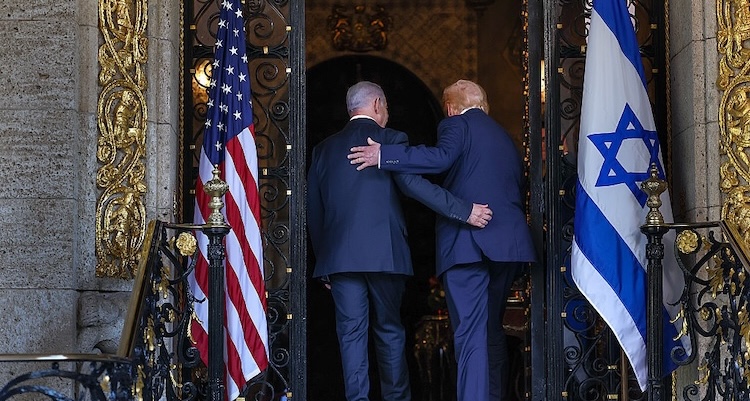
Only two days after Operation Epic Fury began over the skies of Iran, voices rising from the network of new-media podcasters and its tentacles throughout social media were singing from the same hymnal about the malign force that is really behind it all.
“This feels very much to me like it is clearly Israel’s war,” the NBC News and Fox News alum-turned-populist firebrand Megyn Kelly told her audience on March 3. The popular YouTube show Breaking Points featured an interview with Iran regime apologist Trita Parsi under the headline “Trump RISKS IT ALL for Israel.” Tucker Carlson, the leading light of right-wing anti-Semitism, hammered it home in a near two-hour monologue: “How did this tiny country with no resources and 9 million people convince the world’s great superpower with the greatest military in history to do its bidding in a way that was going to hurt it?”
This is twaddle. Trump is not known to have been bullied or pressured by anyone—ever. The president himself quickly made it clear that he had called his own shot.
“If anything, I might have forced Israel’s hand,” he told reporters at the White House. And for good reason.
The Islamic Republic of Iran has been an enemy of America since its founding in 1979, when the new regime took the U.S. Embassy hostage for 444 days. Since then, its ruling mullahs have racked up a butcher’s bill: funding and training terrorists responsible for the bombings of the Marine barracks in Lebanon in 1983 and the American civilian residence called Khobar Towers in Saudi Arabia in 1996, not to mention roadside bombs that maimed thousands and killed hundreds of U.S. forces in Iraq and Afghanistan. And we should not forget the attempted assassination of Trump himself as well as senior officials from his first term.
Nonetheless, there is the tiniest kernel of truth to the populist podcast slander. Israeli intelligence—in both a tactical and strategic sense—did help persuade Trump to launch the second Iran war when he did.
And also for good reason.
Six days before Trump gave the order to commence combat operations, Prime Minister Benjamin Netanyahu provided the president and his senior advisers with intelligence gold. He told them that Iran’s supreme leader, Ayatollah Ali Khamenei, would be meeting with his top military advisers on February 28. The CIA confirmed the intelligence with its own sources. Negotiations over disarming Iran were deadlocking in Geneva. So Trump seized the moment. The Iranian regime could be decapitated by hitting that February 28 meeting. And that is exactly what happened in the first strikes.
Netanyahu’s tip, which led to the righteous undoing of the man who had ruled Iran since 1989, was just one element in a mosaic of information Israel provided to Trump that demonstrated just how thoroughly it had succeeded in penetrating Iran’s closed society (and the inner workings of its proxies in Lebanon and elsewhere). Nothing in recent history can compare to Israel’s efforts to look inside Iran as though it had its enemy country in an MRI machine. The world first got some sense of this in 2024, when former President Mahmoud Ahmadinejad acknowledged in an interview with CNN that the man whom Iran’s counterintelligence bureau had placed in charge of a mole hunt for Israeli spies was himself Israel’s mole.
Even despite this amazing bit of detail, and despite Israel’s history of inventive operations against Iran and its proxy networks since the October 7 attacks in 2023, Trump himself was not fully aware of the extent of its capabilities until they were demonstrated in June 2025. The 12-day war Israel launched against Iran culminated in a series of devastating American strikes on Iran’s nuclear facilities in a 37-hour mission called Operation Midnight Hammer.
Netanyahu had shared remarkable intelligence with Trump before it launched the war then as well—intelligence that just seemed too good to be true. Israel’s generals claimed to have the ability not only to disable Iran’s entire air defense network, but also to take out the regime’s top military leadership. One senior Israeli war planner said Trump and his advisers were disbelieving. “This seemed like science fiction to them,” he said of those briefings. Trump gave Israel a green light, but he didn’t endorse the mission until he saw it could succeed. Indeed, the first public message from the administration after Israel’s combat operations began was designed to stress U.S. neutrality in the war. “We are not involved in strikes against Iran, and our top priority is protecting American forces in the region,” Secretary of State Marco Rubio said then. “Israel advised us that they believe this action was necessary for its self-defense.”
The tone changed after the results began to come in. In the opening salvo of the 12-day war, just as promised, Israel eliminated General Mohammad Bagheri, the chief of staff for Iran’s armed forces; General Amir Ali Hajizadeh, the general in charge of the Islamic Revolutionary Guard Corps’ (IRGC) missile program; and General Hossein Salami, the commander of the IRGC itself. All told, 30 top Iranian generals perished in the first wave of attacks.
This kind of decapitation would not have been possible unless Israel had Iran wired for sound. The Jewish state wasn’t just running a few well-placed moles, nor did it simply glean data from eavesdropping on military communications channels. The Mossad and the IDF had achieved intelligence dominance over its adversary. Israel knew where and when the entire Iranian air force command would meet—and then proceeded to drop warheads on their foreheads. After the first day of sorties, Israeli jets were in control of Iranian airspace. By the time Trump ordered stealth bombers to drop bunker busters on Iran’s underground enrichment facilities 11 days later, there was no real risk to the American pilots flying the mission. Why? Because Israel had obliterated Iran’s air defenses.
Netanyahu’s diplomacy with Trump was not a lobbying campaign that relied on cunning or salesmanship. Rather, the prime minister was inviting the president to place a large bet on a fight it had already fixed. As the Israeli senior war planner told me, “We won the war before it even started.” Trump likes winners, and the Israelis had offered him a can’t-lose proposition.
_____________
The history of the modern Jewish state cannot be understood without an appreciation for its brilliance in espionage and intelligence gathering. The first startling success came in 1960, when Mossad operatives tracked down Adolf Eichmann 15 years after World War II had ended. The Nazi leader was going about his daily life under an assumed name and residing in a nondescript home just outside Buenos Aires when he was taken—and then ferreted out of Argentina under the regime’s nose nine days later.
More important, in 1967, in the preemptive strikes that launched the Six-Day War, Israel’s penetration of Syria and Egypt enabled its air force to knock out most of the planes of the two enemy countries as they sat on their runways.
The roots of Israel’s intelligence war against Iran were planted three decades ago, during the Oslo process. Israel’s prime minister at the time, Yitzhak Rabin, is largely (and somewhat speciously) remembered as a peacemaker, standing nobly beside Bill Clinton in pursuit of concord between Israel and the Palestinians. But Rabin was no dove, and he was fully aware of the rising threat east of Israel and the need to counter it by any means necessary. In a speech before the American Israel Public Affairs Committee in 1995, Rabin listed those he considered the “enemies of peace,” naming Hamas, Palestinian Islamic Jihad, and Hezbollah. Then he asked, “By whom they are paid? Who assists them?” And he answered his own question: “A country who supports terrorism. Its name is Iran.”
At the time, Rabin did not have an intelligence service he could rely on without worry. In the 1980s and 1990s, the reputation of the Mossad and related agencies inside the Jewish state had plummeted. They had come to seem reckless and feckless, with an unfortunate history of embarrassing and controversial mistakes. The recruitment and subsequent exposure of the American spy Jonathan Pollard proved so destructive that the agency responsible for managing Pollard was literally disbanded. A decade later, the Mossad botched an assassination attempt on Khaled Meshaal, the chairman of the Hamas political bureau. Agents had tried to kidnap Meshaal in Jordan’s capital by spraying a toxin in his ear, but they were captured by his bodyguards and arrested. In a humiliating episode, Netanyahu (then in his first term as prime minister following Rabin’s assassination in 1995) had to provide the antidote to the poison and release several political prisoners, including the founder of Hamas, Sheik Yassin.
The Mossad may have been down, but it was not done. It did manage to determine that Iran had restarted a nuclear program first initiated under Shah Mohammad Reza Pahlavi before the 1979 revolution, and that it was building a massive enrichment facility in Natanz to bring uranium to weapons-grade levels. Eventually, the Mossad shared this intelligence with an Iranian opposition group, the Mujahedin e-Khalq, who first made it public in 2002.
The Oslo process finally failed at the beginning of the 2000s, when hopes for a two-state solution crashed into the second intifada. During that five-year campaign, Palestinian suicide bombers disrupted daily life in Israel, blowing up synagogues, hotels, markets, shopping streets, buses, and cafés. In 2002, then–Prime Minister Ariel Sharon appointed Meir Dagan to lead and transform the Mossad. While Israel’s main domestic intelligence agency, the Shin Bet, was tasked with ending the second intifada, Dagan was given a different brief. He was to target Iran’s nuclear program.
Dagan was a warrior intellectual, and to say he was tough as nails would be to understate matters. I met him before he became Mossad director, and he quoted Clausewitz from memory during our lunch. He recommended I bring Johnny Walker Black to a meeting I had scheduled in Gaza with Amin al-Hindi, who was serving as the spy chief for the Palestinian Authority. “He’s an alcoholic, you know that, right?” he asked. The most memorable Dagan story comes from the memoir of Leon Panetta, who got to know Dagan when he was the secretary of defense and the CIA director for President Barack Obama. In one meeting, Panetta said he asked Dagan what America should do with all the al-Qaeda operatives who were still alive. “I’d kill them,” Panetta recalls Dagan saying. “And then I’d kill their families.”
Dagan developed a program that blossomed in the 2010s—quietly killing off key scientists associated with Iran’s nuclear program to degrade the knowledge base and future innovations arising from the Islamic Republic’s efforts. As many as 20 were dispatched, including 10 slain during the 12-day war last June. The most significant mission was the 2020 assassination of Mohsen Fakhrizadeh, the head of Iran’s nuclear program. Israel had been trying to kill him since 2004. But in 2020 the Mossad caught a lucky break when he drove with his wife to the Caspian Sea. At an exit road off the main highway to their destination, a blue Nissan pickup truck with a remote-controlled sniper machine gun in the bed began firing when the scientist’s car approached.
Dagan also authorized the sabotage of Iran’s nuclear supply chain. This was a precursor to the dazzling operation using beepers with which Israel grievously injured thousands of Hezbollah fighters in Lebanon in 2024. To enact the beeper plan, the Mossad first created a front company years earlier, sold beepers to their adversaries at a discount price, then delivered the goods after having booby-trapped the devices with small bombs. The beepers went off in the first phase of a series of attacks culminating in a massive bomb strike that killed the terrorist group’s leader, Hassan Nasrallah, in a fortified bunker meeting with deputies in Beirut.
The Mossad taught itself how to pull off this spectacular attack through earlier operations it had implemented against and inside Iran—innovations in strategy involving business practices, shadow companies, and planted devices. Former Israeli Prime Minister Ehud Olmert told Jerusalem Post reporters Yonah Jeremy Bob and Ilan Evyatar that Israel “attacked [Iran’s] supply chain throughout the world.” Olmert went on: “Israeli agents were everywhere including in Iran to learn what the Iranians were doing. . . . If they were building a plant, [the Mossad] would learn how it was being built, how to identify its weak points, and where it could be hit. We did a lot of operations like that and we reached a very detailed level of knowledge.”
Over time, this kind of sabotage work builds an extraordinary institutional knowledge. At the outset, though, the Mossad’s work was designed to be invisible even to the enemy. Iranian scientists would be killed, but seemingly by accident. Batches of vacuum pumps or special chemicals would fall apart when assembled; in some cases, microscopic tracking devices were placed strategically inside equipment and then would beam the locations of secret laboratories and facilities back to Tel Aviv. None of it made headlines.
This began to change with one of the first joint U.S.-Israeli operations against Iran, known as “Olympic Games.” The plan, first developed at the end of the George W. Bush administration and continued during Obama’s first year in office, inserted the Stuxnet cyber virus into the programmable logic controllers that Iran’s engineers were using to run the Natanz enrichment facility. The virus overrode the controllers’ instructions, making the centrifuges used to enrich Iran’s uranium spin too quickly until eventually they self-destructed. The story came out in 2011; it was the first time cyberwarfare had been used against a country’s industrial base.
Dagan did not just seek to foil Iran’s nuclear program. He also played a key role in opening up secret security relationships between Israel and Gulf states such as Saudi Arabia and the United Arab Emirates. Those relationships over time also gave Israel’s spies more resources and opportunities to infiltrate Iran’s security services.
Dagan ended his tenure at the Mossad unhappily in 2011. He was bitter in the last year of his tenure because he disagreed with the plans of the new prime minister, Netanyahu. Bibi was determined if necessary to bomb Iranian nuclear facilities without getting approval from Barack Obama, which Dagan considered too reckless. Dagan had also become persuaded that it would be in the interests of both Israel and America to support the democratic Iranian opposition openly. He recommended to U.S. officials on a 2007 visit to Israel that more should be done to lift up regime opponents (a fact eventually made public through the release of documents by WikiLeaks). After his retirement, Dagan told 60 Minutes in 2012 that “it’s our duty to help anyone who likes to present an open opposition against their regime in Iran.” Netanyahu was focused on Iran’s nuclear program and developing a preemptive plan to take out its enrichment capabilities through air strikes. Domestic matters inside Iran were of limited interest to him. But his view has changed over time. During the 12-day war, he spoke directly to the Iranian people and encouraged them to rise up against their oppressors—and has continued to do so during this war.
After Dagan’s departure, Israel continued to foil Iran’s nuclear ambitions. Its most dramatic coup came in January 2018, when the Mossad stole the regime’s secret nuclear archives en masse from a warehouse in Tehran. The Mossad managed to infiltrate a team of agents who pilfered the materials and spirited them out of the country just as Eichmann had been spirited out of Argentina more than half a century earlier. Netanyahu then made them available to the world to see, proving without question that Iran had lied for years about the peaceful nature of its program. The timing of the operation was extraordinary. It helped make the case that Trump should follow through on his campaign pledge and pull out of the Iran nuclear deal negotiated by Obama in 2015. And Trump did.
The greatest irony of recent Israeli history is that, for all of its brilliance in penetrating and sabotaging Iran, Israeli intelligence failed to pick up the signs before October 7 that the worst pogrom against Jews since the Holocaust was in the offing. But that failure quickly led to profound changes in the scope of the mission against Iran. The senior Israeli war planner to whom I spoke put it like this: “We began rethinking the war plan in early 2023, but after October 7 we focused on a broader war against Iran, not just its nuclear program or missiles.” This represented at least a partial vindication of Dagan’s ideas a decade earlier.
And that is where things stand today. As Israel and America take out Iran’s missiles, nuclear facilities, defense industries, and its political and military leadership from the air, the hope is that after the dust settles, the remaining regime leadership will either surrender or agree to end the Islamic Republic’s war on the Great and Little Satan. As I write at the beginning of March, that may seem like a long shot, and one that invites intolerable risks. After all, without boots on the ground, neither the U.S. nor Israel will have the ability to shape the inevitable chaos that will result after the bombing stops. On the other hand, Israel has proven over the past eight months that it has eyes and ears everywhere in Iran. I wouldn’t be shocked if the Mossad has a plan for what comes next.
Here at home, what is going to come next for those who decided to blame this just American war on the little Jewish state they seem to hate so much? The populists seething about Trump’s war to Make Iran Great Again have shown that they misunderstand recent history and that their audiences are fools to listen to them. Over the past 30 years, Israel has built a capability that is on the precipice of removing a blood enemy of America. It has located and eliminated the clerics and generals responsible for 47 years of terror against our country and her allies.
Trump has not launched a war for Israel. Rather he has joined a war with Israel—a war Israel may have won even before the bombs started dropping.
Photo: Joe Raedle/Getty Images
We want to hear your thoughts about this article. Click here to send a letter to the editor.