
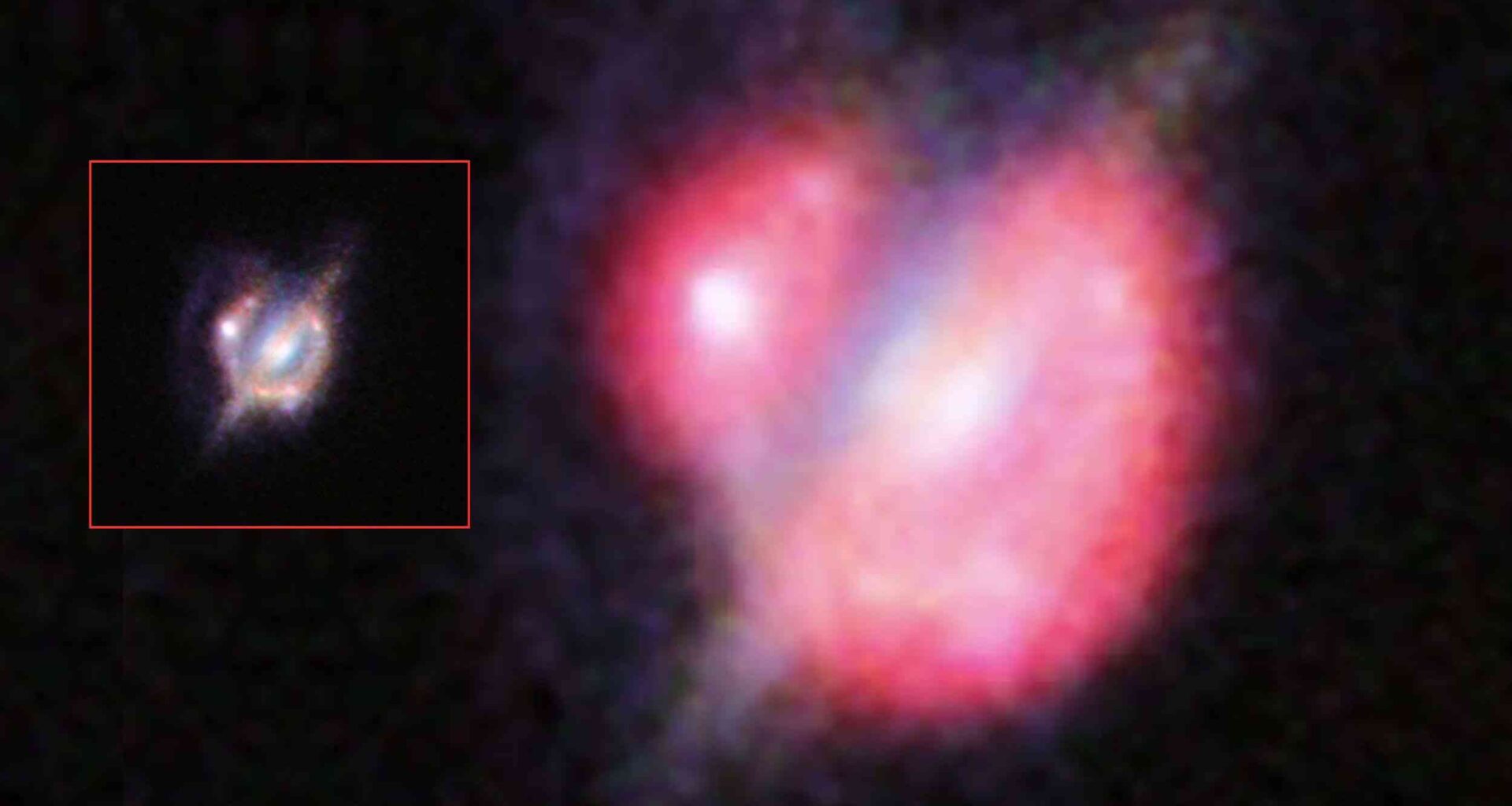
Researchers have detected a laser-like microwave signal from a pair of colliding galaxies nearly eight billion light-years away.
The discovery reveals that violent galaxy mergers in the distant universe can generate extraordinarily powerful beams of amplified radiation visible across cosmic time.
A distant galaxy merger

Inside a merging galaxy system known as HATLAS J142935.3-002836, radio telescopes captured an unusually bright microwave signal emerging from dense clouds of gas.
Analyzing that signal, astronomer Thato Manamela at the University of Pretoria (UP) identified it as the most distant known example of a hydroxyl megamaser.
The emission arrives not as a single smooth feature but as several tightly packed peaks, indicating that multiple regions within the merger are contributing to the same amplified beam.
That complex structure suggests the signal reflects turbulent conditions inside the colliding galaxies and points to a physical environment that requires deeper explanation.
Pressure from the galaxy collision
Galaxy collisions crush huge clouds of gas, and the pressure helps certain molecules start amplifying microwave light.
Astronomers call that source a hydroxyl megamaser, a giant microwave beacon powered by excited gas clouds.
Hot dust and background radio emission keep feeding the effect, so the beam can grow enormously bright inside crowded galactic cores.
Because this system looked even brighter than known megamasers usually do, the team argued it may belong to a rarer category.
Gravity boosted the signal
A second galaxy sat in the right place to magnify the beam before it ever reached Earth.
That gravitational lensing, gravity bending and enlarging a distant signal, likely boosted the system by about eight to ten times.
Earlier imaging had already revealed a nearly complete arc around the lens, showing that the foreground galaxy was bending light from behind it.
Without that boost, a source this far away would have been vastly harder to detect in a single short observation.
The merger was primed
Long before the radio discovery, astronomers already knew this target was no ordinary galaxy pair.
Earlier imaging showed two main components, heavy dust, and a star-making pace of about 394 times the Sun’s mass each year.
Those conditions fit what these microwave beacons need: thick gas, bright infrared light, and a merger stirring everything together.
Seen that way, the signal was not a random oddity but output from a system already built for extremes.
A spectrum with secrets
Instead of one broad hump, the new detection arrived as several peaks packed close together.
One standout feature was extremely narrow, under five miles per second wide, while another spread across nearly 186 miles per second.
That contrast suggested the beam was not coming from one calm zone, but from compact and more extended regions.
The pattern also hinted that lensing may brighten small pockets much more strongly than larger gas clouds.
A second signal was detected
The same observation also exposed a second signal that was made when cooler gas absorbed background radio light.
Astronomers call that material neutral hydrogen, ordinary hydrogen that still keeps its electron firmly attached.
Its position matched the merger’s overall motion better than the laser-like emission did, which made the mismatch hard to ignore.
Because the microwave beam arrived at slightly higher frequencies than that colder gas, the team saw signs of material moving toward us.
Some questions still remain
One explanation is a warm outflow, with gas pushed outward fast enough to offset the signal from calmer material.
Another is simpler: two galactic cores in the merger may each host their own microwave-emitting region.
Strong lensing complicates both ideas, because it can brighten tiny structures far more than broad ones.
Until sharper observations pin down where each peak begins, neither picture can fully close the case.
A bigger cosmic census
Before instruments like MeerKAT, the search for these sources had mostly stayed much closer to Earth.
The new result shows that distant galaxy mergers can still stand out when bright gas, lucky geometry, and sensitive radio dishes align.
“This system is truly extraordinary; we’re seeing the radio equivalent of a laser halfway across the universe,” Manamela said.
What sharper images may reveal
To sort those possibilities, astronomers need sharper radio images that can map each bright spot separately.
Future arrays, especially the Square Kilometre Array, should resolve smaller regions and show whether a feeding black hole is helping drive the signal.
That matters because compact spots near the lens can be magnified much more than the wider gas around them.
Better maps would also tell astronomers whether this beacon traces an outflow, two nuclei, or something stranger.
What emerged from this one signal was a far richer picture: colliding galaxies, amplified microwaves, and gas moving in complicated ways.
If similar beacons start turning up by the hundreds, they could become one of astronomy’s best tools for tracking ancient mergers.
The study is published in Monthly Notices of the Royal Astronomical Society: Letters.
—–
Like what you read? Subscribe to our newsletter for engaging articles, exclusive content, and the latest updates.
Check us out on EarthSnap, a free app brought to you by Eric Ralls and Earth.com.
—–