
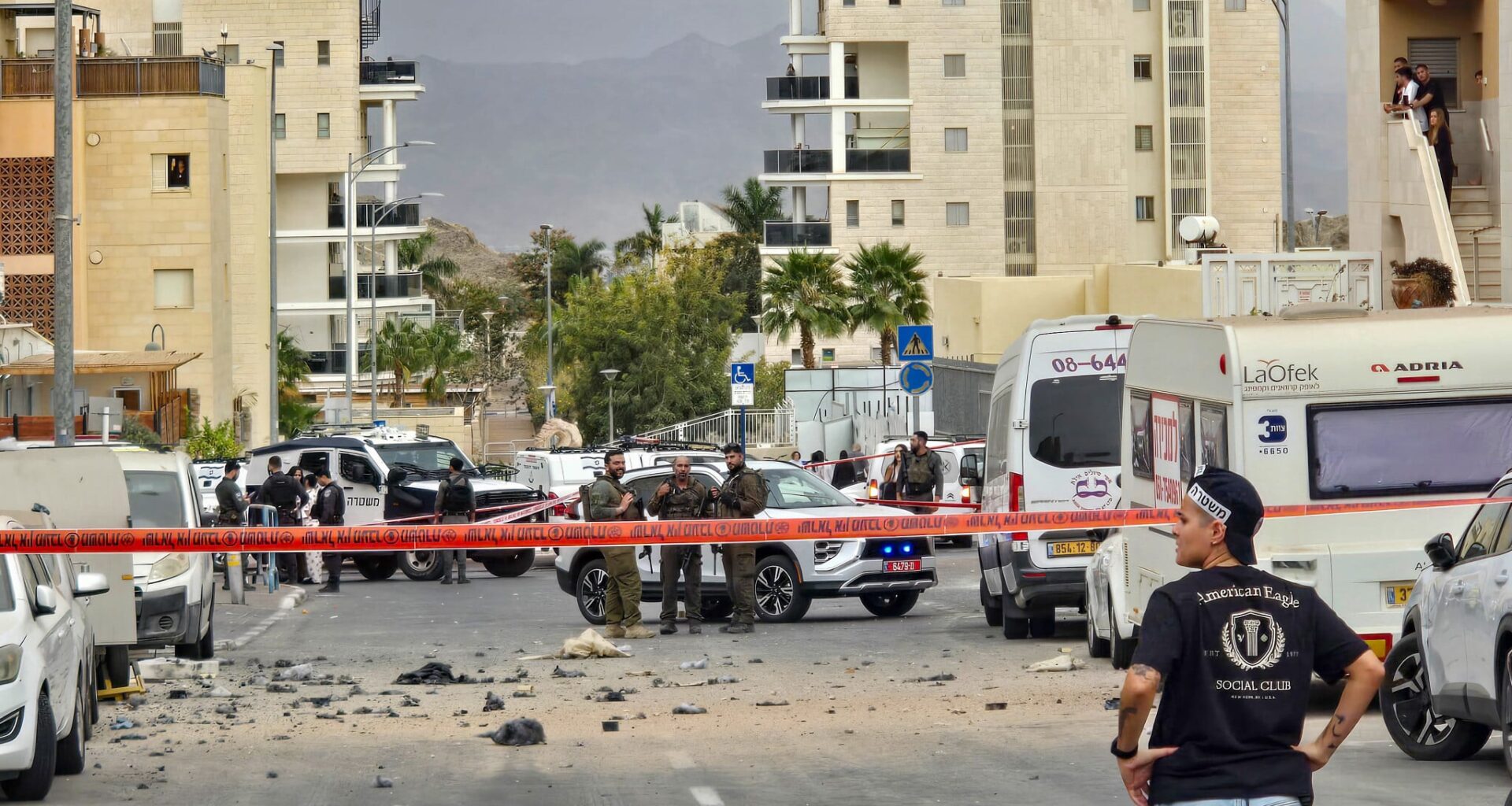
Iran fired several missile salvos at Israel on Saturday, with one impact injuring three people in Eilat, and a few other impacts in the country’s center causing damage but no injuries, as the Israel Defense Forces continued to pound the Islamic Republic.
Meanwhile, the Home Front Command eased guidelines to allow schools to resume in areas deemed to be under a lower threat level.
Six volleys, consisting of a small number of missiles each — some carrying cluster bomb warheads — targeted most parts of the Jewish state, including southern, central, and northern Israel, as well as the Jerusalem area and West Bank settlements. Most were intercepted or hit open areas.
But in the afternoon, an impact of a cluster bomb munition in the southernmost city of Eilat moderately hurt a 12-year-old boy and lightly hurt two other people, all of whom were injured by shrapnel and taken to the city’s Yoseftal Medical Center.
The hospital said six other people were treated for acute anxiety.
Get The Times of Israel’s Daily Edition
by email and never miss our top stories
By signing up, you agree to the terms
Submunitions from the cluster bomb missile struck at least three sites in Eilat amid that attack, causing the injuries as well as damage to roads, according to rescue services.
Another video shows one of the impacts, likely a cluster bomb munition from the Iranian missile, in Eilat a short while ago. pic.twitter.com/KbrnGrKlVk
— Emanuel (Mannie) Fabian (@manniefabian) March 14, 2026
Those injured were apparently outside, and a dog was said to have been seriously wounded.
Footage posted online showed one of the submunition impacts.
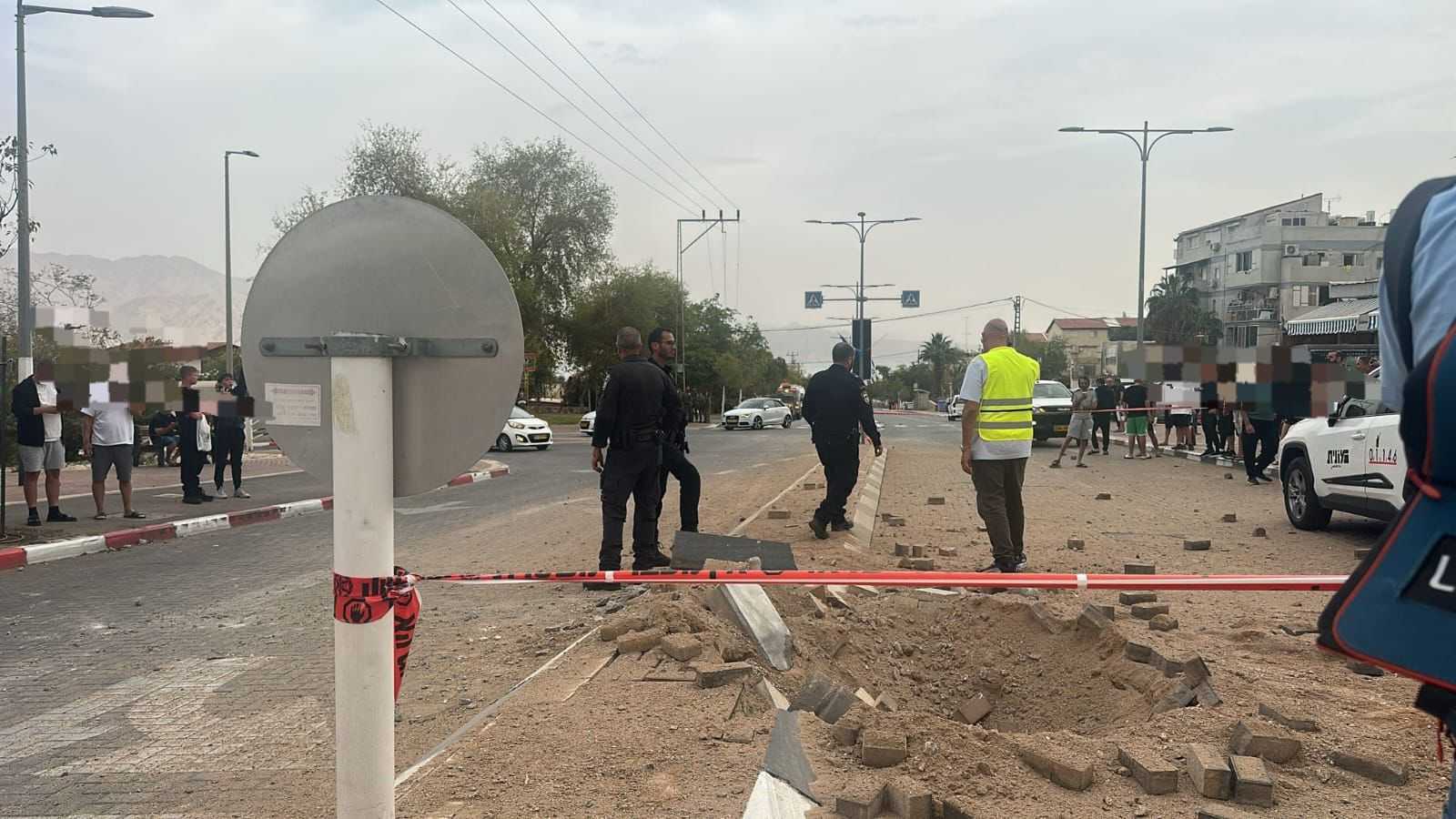
An impact site in Eilat after an Iranian missile targeted Eilat, March 14, 2026. (Israel Police)
Another cluster bomb warhead spread bombs across central Israel around the same time, causing damage but no injuries at a number of locations, including in the cities of Lod and Ness Ziona.
Footage shows an impact, possibly a cluster bomb munition from an Iranian missile, in central Israel a short while ago.
A number of impact sites in central Israel were reported, with no injuries. pic.twitter.com/GAkKd4C6nL
— Emanuel (Mannie) Fabian (@manniefabian) March 14, 2026
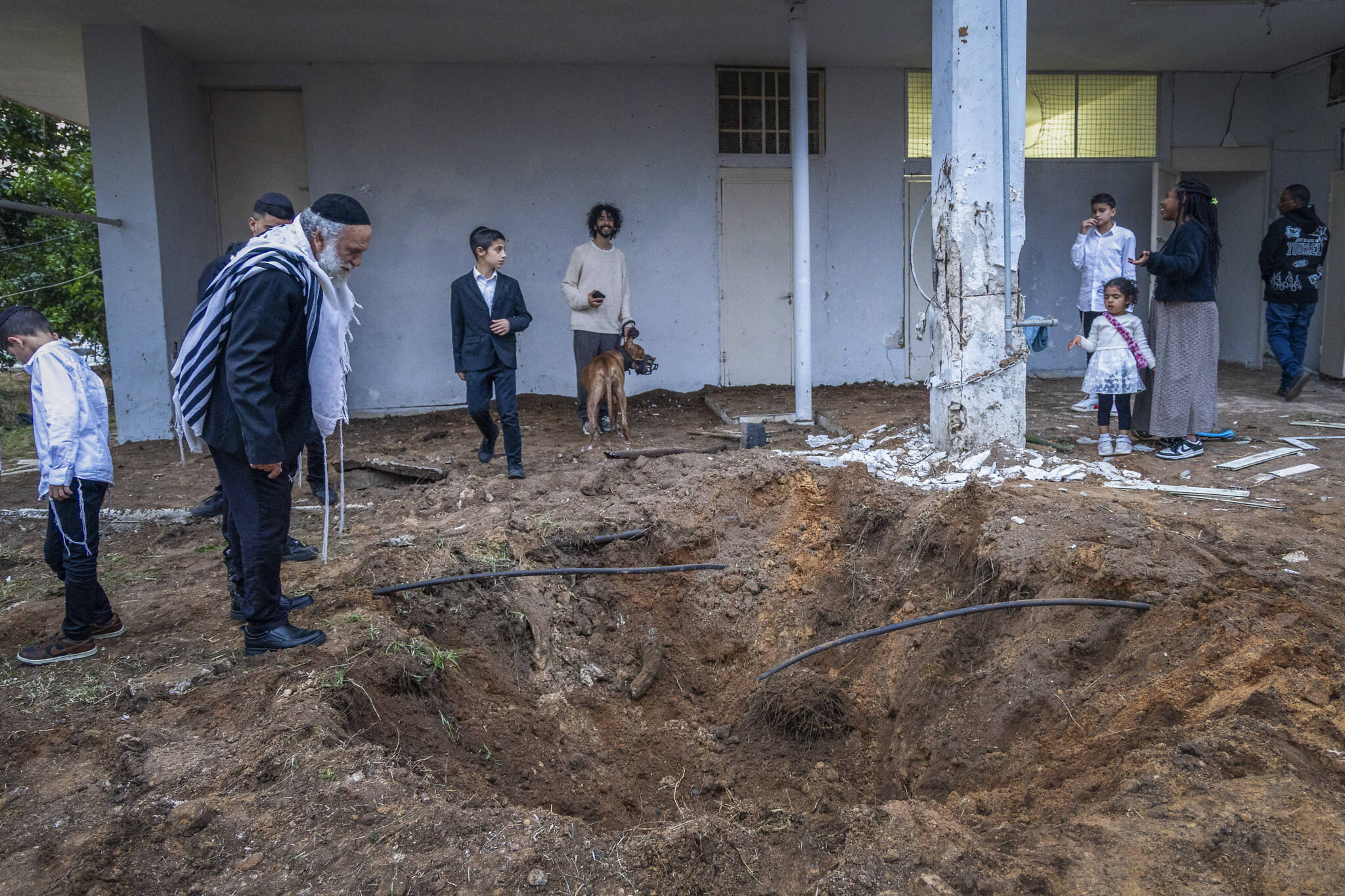
People inspect the damage at the site of an Iranian missile impact in Lod, March 14, 2026. (Yossi Aloni/Flash90)
Schools to resume in lower-risk areas
The IDF’s Home Front Command said Saturday evening that it was easing wartime restrictions in parts of the country deemed to be under less of a threat from Iran’s ballistic missiles and Hezbollah’s rocket attacks, allowing schools to reopen there.
Following a fresh assessment, it said that starting on Monday at 6 a.m., the activity scale in the Beit Shean Valley, Jordan Valley, West Bank, Dead Sea area, West Lachish, Gaza border communities, Western Negev, Southern Negev and Arava would be adjusted from “limited activity” to “partial activity.”
This means that educational institutions will be able to operate in those areas, provided there is an adequate shelter that can be reached in time. Gatherings of up to 100 people indoors and 50 people outdoors will also be permitted, under the same conditions.
The Home Front Command said the threat of Iran’s and Hezbollah’s attacks on those areas was significantly lower than in other areas of the country, which has also led to fewer sirens. However, military officials stressed that this did not mean there would not be any attacks or sirens in those areas.
In the rest of the country, the activity scale was to remain at “limited activity,” with restrictions remaining in place, prohibiting educational activities. Under those guidelines, gatherings of 50 people are permitted, provided a shelter can be reached in time, and workplaces can operate under the same conditions.
“In light of the security situation, the vast majority of the education system will operate through remote learning only,” Education Minister Yoav Kisch said in a statement. “This is a targeted and phased reopening — responsible and controlled — tailored to the differences between local authorities and the threat map.”
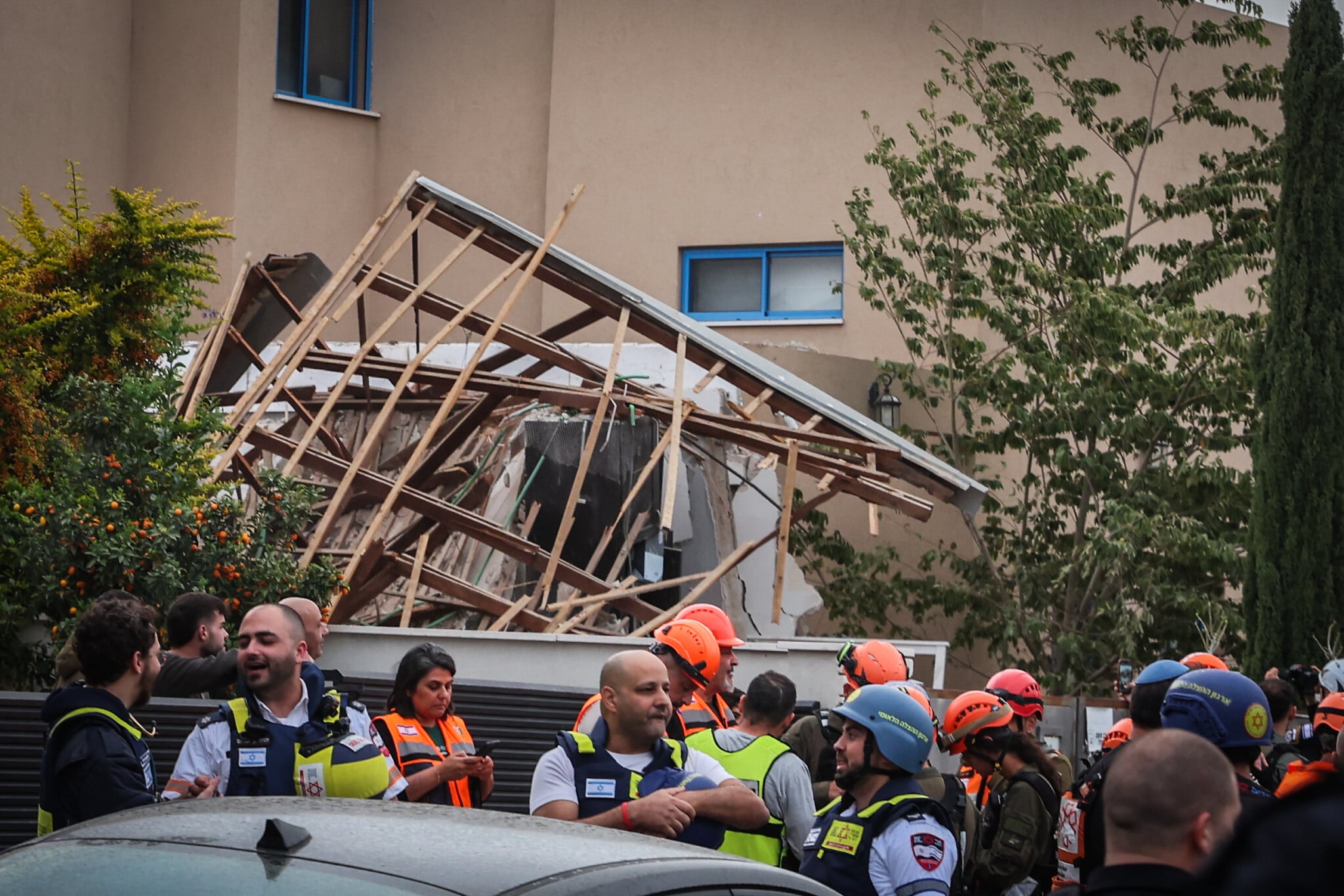
Security and rescue forces inspect the damage at the site of an Iranian missile impact in Ness Ziona, March 14, 2026. (Roy Alima/Flash90)
Meanwhile, the Home Front Command also said it was working on making its missile warning system more accurate.
The early warning to Israelis’ phones is issued shortly after the IDF detects a missile launch from Iran, though it is initially hard to predict exactly where it will land. Therefore, the preliminary phone alert usually applies to a wide area. Sirens then generally sound in a more limited area: By that point, the missile’s trajectory is clearer.
Following work over the past two weeks amid the war, the Home Front Command said it was now set to issue the early warnings in smaller areas, meaning that fewer civilians would receive an early warning but ultimately no sirens.
The Home Front Command was aiming to reduce the number of civilians who face this issue by 30%-50%.
Israel hits hundreds of Iran sites as war enters ‘decisive stretch’
The IDF kept up its heavy airstrikes throughout Iran, saying Saturday evening that it had hit over 200 targets in the country’s west and center over the past day.
The targets included dozens of ballistic missile launchers, including some that were armed and primed for attacks on Israel, according to the IDF.
Other targets included air defense systems, missile launch sites, and sites used to store weapons, the military said, explaining that it has focused many of its strikes on Iranian missile launchers, “to reduce as much as possible the scope of fire toward Israeli territory.”
Defense Minister Israel Katz said the war against Iran was “escalating” and entering a “decisive stretch that will continue as long as necessary.”
“Only the Iranian people can put an end to this through a determined struggle, until the fall of the terror regime and the deliverance of Iran,” he added during an assessment Saturday morning with IDF Chief of Staff Lt. Gen. Eyal Zamir and the military’s top brass.
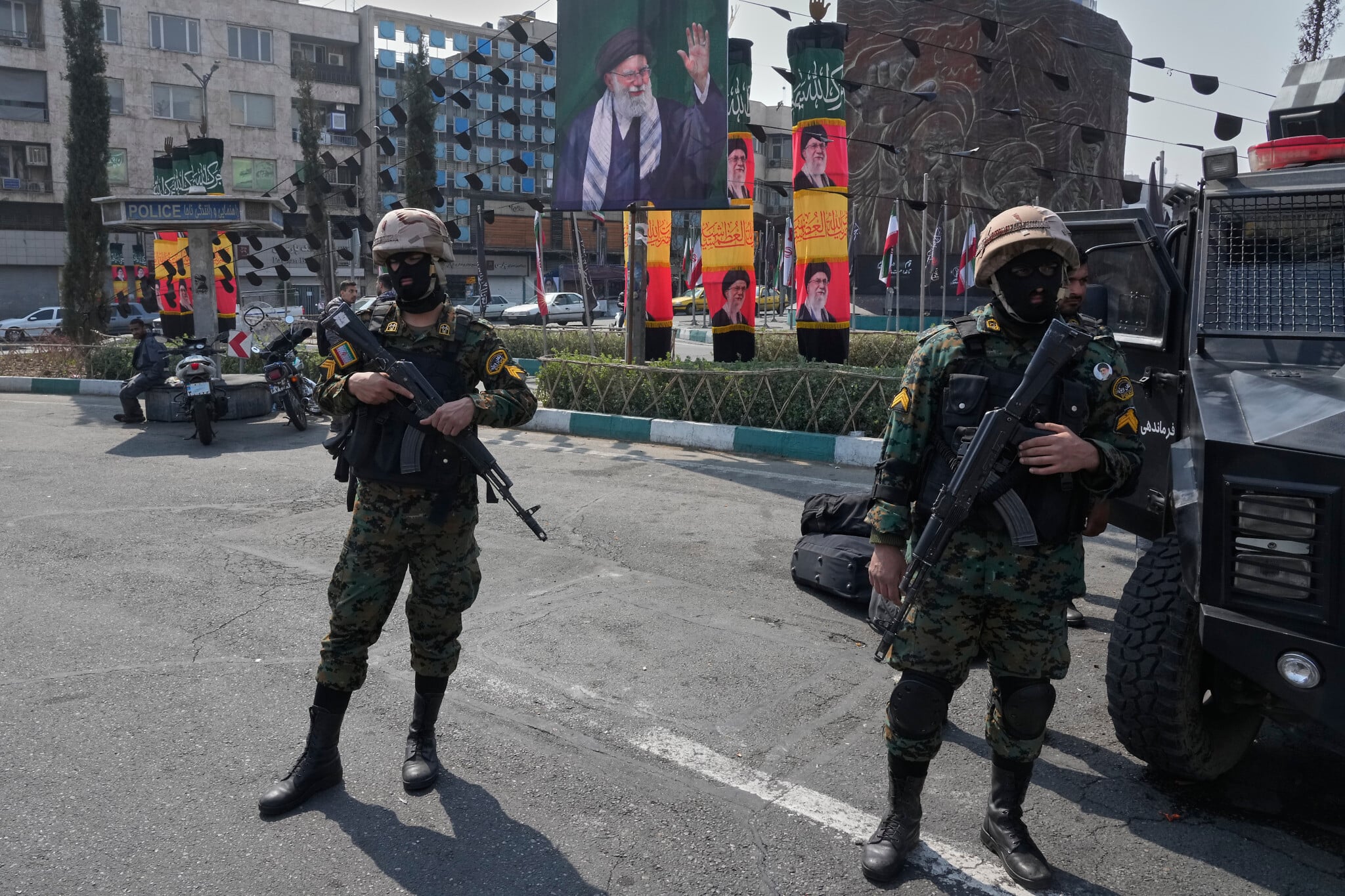
Iranian policemen stand guard next to banners showing portraits of slain supreme leader Ayatollah Ali Khamenei at the Enqelab-e-Eslami, or Islamic Revolution, square in downtown Tehran, Iran, March 14, 2026. (AP Photo/Vahid Salemi)
The military also elaborated Saturday on some of its strikes the previous day, saying that two senior Iranian intelligence officers had been killed in a Tehran facility belonging to the intelligence directorate of the Khatam-al Anbiya Central Headquarters, also known as Iran’s military emergency command.
According to the military, the strike killed Abdollah Jalali-Nasab and Amir Shariat, two top officers in Khatam-al Anbiya’s intelligence directorate. The IDF said that the pair had been appointed as acting heads of the unit after Salah Asadi, chief of intelligence in the emergency headquarters, was killed in the opening strikes of the war on February 28.
“The two were senior intelligence commanders and were key figures in the Iranian intelligence community. In addition, the two were close to the top leadership of the Iranian terror regime,” the IDF added.
The army also said it carried out a wave of strikes in the Tehran area on Friday night that hit “dozens of Iranian terror regime infrastructure sites.”
Among the targets was Iran’s primary space research center, which the military said “contained strategic laboratories used for research and development of military satellites for various purposes, including surveillance, targeting, and directing fire toward targets across the Middle East.”
Additionally, the IDF said it struck several sites used by Iran to produce air defense systems, including a “central factory.” It said the strike “significantly degrades the Iranian terror regime’s ability to rehabilitate its aerial defense array.”
Iranian Space Research Center (ISRC) was bombed tonight. The center is responsible for various space activities of Iran including development of satellites, space propulsion and tests of space components. pic.twitter.com/Sq7qjvSRiw
— Tal Inbar (@inbarspace) March 13, 2026
IAF warplane nearly shot down over Iran
The IDF also said Saturday evening that an Israeli Air Force fighter jet had almost been shot down over Iran amid the war, without saying when exactly.
According to the IDF, an attempt was made to shoot down the jet, and it was “close to being hit.”
The attempted interception of the plane “failed due to the alertness and professionalism of the pilot,” the military said, adding that the sortie “was completed successfully.”
The incident was investigated by the IAF, and lessons were learned, the military added.
Rossella Tercatin and Diana Bletter contributed to this report.