
Hamnet
A notorious Spanish film from 1976 asked the question Who Can Kill a Child? Fifty years later, filmmakers the world over responded, “We can!” and their movies got nominated for Oscars. Foremost among these is Chloé Zhao, whose Hamnet is a Shakespeare semi-adaptation based on a popular novel in which the Bard’s little son, Hamnet, dies of plague. His death, we are led to understand, partially inspired Hamlet. An opening title informs viewers that Hamnet and Hamlet were somehow the same name in Elizabethan times, which caused me to substitute other letters of the alphabet where the “l” in Hamlet should be. Hambet, Hamcet, Hamdet, Hameet. The movie does not allow viewers to forget the name Hamnet, though. An awkward shot of the dead tyke’s gravestone late in the film shows the title in all caps: HAMNET.
The film alternates settings like a stage play, descending on Jessie Buckley (Hamnet’s mother, “a child of a forest witch”) into woodland hollows to find her in the fetal position. Then it follows her across rows of Tudor houses, their white walls divided by black frames into empty comic-book panels. Paul Mescal is Shakespeare (“a pasty-faced scholar”), whose name the film leaves out, but we get the picture because he’s tortured, always trying to write, and has to live in London, away from his family. Three things in Hamnet define quality drama in 2025 movies: the majesty of trees, terrible fathers, and the use of screen-filling black to end scenes with a pause and begin new ones with a jolt.
A great thing about Jessie Buckley is the convincing look of disdain she has in most of her films. She looks like she doesn’t believe it, like she’s judging you, the viewer, and finding you, and all of this, wanting. For much of Hamnet, Zhao forces Buckley to maintain an uncharacteristic look of wonder, which segues briefly into her typical attitude of scorn at her husband’s absence, and then into howling grief when Hamnet dies. Finally, when she realizes her husband’s new play is a work of genius and a tribute to their son, the look of wonder returns. Now she gets it! It’s a realization somehow below Buckley’s usual knowing smirk, with its slight, almost imperceptible eyebrow lift.
Zhao is attempting to re-goblinize the Elizabethan with all of Buckley’s magick spells, or at least to un-Harry-Potterize it. This is at odds with the film’s ultimate message, which is that life beats the magic out of us by robbing us of what we love most. It’s sad, losing your son, but here, we are told, art transforms grief into immortality. Despite Buckley’s falconry early in the film—“I saw you with your bird,” says Will when he first meets his future wife—I’m not sure that when it comes to grief Zhao knows a hawk from a handsaw. But she does know how to extend a child’s death scene into new territory, turning Hamnet into a reverse birth-of-a-baby movie in which dying and being born trade places.
Sirât
If Hamnet works, it’s because we know what’s going to happen. The whole point is the death of a child. For Oliver Laxe’s Sirât to work, the audience has to have no idea what’s going to happen next. The film proceeds by surprise, so while the lead character’s missing daughter is kept off screen, the sudden plunge of his son into oblivion is the shocker of the year, one of the most insane moments in any recent movie. That Sirât gets loonier after that is either a sign of inspiration or a signal that Laxe has backed himself into a corner, despite the great expanse of Moroccan desert where the film ends up.
Sirât assembles a cast of raver misfit freaks who are forced to aid a father (Sergi López) and son (Bruno Núñez Arjona) in their quest to find the pair’s missing daughter/sister. The film is explicit in its message: these nonconformist bohemians, rejected by a world they in turn reject, can try to submerge themselves in a subculture in the middle of nowhere, but the world’s violence will catch up to them. One of the characters wears a Tod Browning’s Freaks T-shirt, another signal that things won’t end well. When that end comes, Laxe portrays the revenge of the world without including actual characters who appear to enact it. It is the residue of war that leads to exploded bodies, further limblessness, and death.
With its magic-bus trip through the cliffside roads of the Atlas Mountains, Sirât looks like it was grueling to make. Critics have compared it to The Road Warrior and The Wages of Fear (and Sorcerer), but it is also on a continuum with bleaker, colorless films from Kings of the Road to The Turin Horse. It is also on a continuum with Warner Bros. Road Runner cartoons, transforming its series of shocks into a form of elaboration that comes to seem funny by the end. Early in Sirât, the brain-beating EDM score clears the neural pathways for a kind of stoic apathy Laxe attempts to dislodge with dynamite. In many ways a thrilling, beautiful, and disturbing movie, Sirât’s callousness, intended as spirituality, mimics the world’s indifference.
Train Dreams
Clint Bentley’s Train Dreams, from Denis Johnson’s novella, opts for pleasantries and hard-won, cracker-barrel wisdom in telling its tale of a haunted man across time. Joel Edgerton plays Robert Grainier, a logger who’s absent when his wife (Felicity Jones) and daughter (Olive Steverding) perish in a fire at the cabin he built for them. Edgerton maintains a look in his eyes as intense as any in a silent movie. Even before tragedy strikes, he has begun to “feel a dread,” perhaps brought on by what another logger, an aging explosives expert played by William H. Macy, describes as the way mankind slowly destroys the natural world, which is “intricately stitched together, boys.” Cutting down 500-year-old trees is a version of “pulling bolts out of the Ferris wheel.” Or maybe Grainier’s sense of foreboding comes from his memory of the racist murder of a Chinese logger (Alfred Hsing) he witnessed at work but did little to stop.
Johnson’s astounding, often dismaying prose dominates the movie in the form of off-screen narration read by Will Patton. The audiobook quality of his performance is a pleasure to hear, but the movie, for all its patience and forest majesty, is bland, an example of the creeping Hallmarkization of American film, or of the domestication of Terrence Malick’s style in service of an illustrated novel. Or maybe it’s just that I saw it streaming, so that when I stopped the movie to take a break the hideous Netflix pause screen overtook the image, blotting out the film frame, an example of Train Dreams’ theme, which is that America is a country with no vision for its future, in which terrible things happen without reason. And yet, at the same time, America’s history is so mythic, its past so rich and varied, that it will give Australian and British actors jobs for decades to come.
Weapons
Contemporary America is a place more fraught than the haunted world of Train Dreams, in which Grainier’s lost daughter comes back to life, kind of, in the form of another girl (Zoe Rose Short). In Weapons, a panoply of well-played suburban types—the stalwart, close-minded contractor (Josh Brolin), the cute grade-school teacher slipping into alcoholism (Julia Garner), the dumb cop (Alden Ehrenreich), the homeless teen drug addict and incompetent thief (Austin Abrams), the gay elementary-school principal (Benedict Wong)—confronts the disappearance of an entire class of children who walk out of their bedrooms one night in strange formation, like a flock of neurodivergent ducks trying to fly, and disappear into the woods.
Zach Cregger’s film presents the missing children as a problem to be solved by the townspeople, one they don’t understand has a supernatural explanation. An ominously groovy old witch (Amy Madigan) has come to Maybrook to feed on the children’s collective life force. Madigan plays Gladys (the wife’s name in Train Dreams, coincidentally, about which Macy’s character says “those old names have power”) as a post–Rosemary’s Baby Ruth Gordon. She’s a 1960s–1970s relic who lives in her own mod world even as she takes over the children’s lives with thorny branches and blood potions.
Madigan’s outlandish, creepy performance, with its orange wig of baby bangs and large gradient eyewear, was criticized as crone-shaming, but Weapons is in fact the rare film to address the problem of American gerontocracy head-on. In Gladys, we see a direct illustration of one generation taking the lives of another so that it can go on forever. Gladys even claims a young couple’s house, in a horror-movie illustration of how landlord capitalism inhibits the success of young couples.
Hovering over the town at night is a constellation of stars in the shape of an automatic rifle, the primary weapon disappearing American schoolchildren today. That Cregger included this image in his film at first feels arbitrary, or a red herring that that’s too obvious. It could have been cut. This image resonates throughout the movie as an easy puzzle that demands to be solved.
The Voice of Hind Rajab
The audience I saw The Voice of Hind Rajab with in Cleveland was mostly Palestinian. They wept at the end, the same way I have heard that audiences cry leaving the theater after Hamnet. Like Hamnet, The Voice of Hind Rajab is a grief machine, the difference being that it is a true story about a 6-year-old girl named Hind, trapped in a car by the Israeli army in Gaza, surrounded by the corpses of her family. The IDF refuses to let emergency vehicles through to save her life, or has so many different kinds of rules and roadblocks in place that the Red Crescent can’t rescue her. The Israelis have made it impossible to save her and are therefore her murderers twice over. The other difference is that Hind’s voice, heard throughout the film only on call-center phones and computers, is the real voice of the real Hind Rajab taken from recordings made by the Red Crescent on January 29, 2024, the day she was killed.
Made with the best intentions, the film is therefore a kind of documentary that is also a kind of snuff film. The situation is similar to Billy Wilder’s Ace in the Hole (1951), in which a man trapped in the shaft of a collapsed cliff dwelling is kept from rescue by a cynical newspaper reporter. The actors playing the call-center workers at the Red Crescent are not like the character played by Kirk Douglas in Wilder’s film, nor is the filmmaker, Kaouther Ben Hania, from Tunisia, like him either. It is the IDF who are the authors of this cynicism, which the film nonetheless exploits for a good cause. The phone-call acting of the cast at the Red Crescent is heartfelt and urgent, though they spend most of the film looking at video screens. I want there to be more innovation in documentary filmmaking that takes the form away from the confines of entertainment, but in this case I’m not sure that this was the best way to go about telling the story.
In The Voice of Hind Rajab, reality butts up against form in a way that is more gruesome than productive. This movie will not bring Hind back, nor prevent the deaths of more children in Gaza, Lebanon, or Iran. During my book tour, I showed Jafar Panahi’s It Was Just an Accident and The Circle (2000) at the Cleveland Cinematheque the day before I saw Hind Rajab, and then I went to Durham, North Carolina to show Taste of Cherry (1997) just as the war in Iran started. Hind is like the children in Panahi and Kiarostami’s films, and so are the schoolgirls now bombed into nonexistence by the US, murdered. Panahi and Kiarostami often confine their actors to workarounds similar to Ben Hania having her cast act only on the phone, but the difference between their films and hers comes down to a respect for the cinematic recreation of a reality that might involve real people, as in Close-up (1990). Their work doesn’t distance itself from real people, as in Blow-Up (1966) or worse, Blow Out (1981), with its quest for the perfect scream. The sound of Hind’s voice becomes eerie and abstracted like the photographs of the murder in Antonioni’s film. We listen to her real cries of “help me, help me” over and over, sitting there, doing nothing.
If I Had Legs I’d Kick You
The mere existence of a second Mary Bronstein movie, much less one as amazing as this, proves that patience and a bad attitude are not just their own rewards. If I Had Legs I’d Kick You, her second film and her first since 2008’s Yeast (one of the best American films of the 21st century), is a masterpiece of alienated frenzy. It’s a comic version of The Exorcist in which the mother is the one possessed.
Bronstein’s film is one of doctors, therapists, and self-medicators trapped in a hostile world in which they have no control. Almost the first words Rose Byrne’s Linda, a therapist, says to her therapist (Conan O’Brien, remarkably disgruntled and forbearing, as if he is doing this against his will) are “Time is a series of things to get through. Each goal is a cliff. There’s nothing at the end of it. . . . And that’s why you need to keep moving.” It’s a perfect crystallization of the Bronstein-Safdie aesthetic.
Bronstein herself plays another doctor-therapist, presiding over a group of mothers grieving for the way their lives have been reduced to being caregivers for their sick children, victims of mysterious illnesses requiring round-the-clock attention. In her office she serves them a cake reading Its not your fault in cursive icing against a backdrop of posters on the wall with headers like Spiral of Shame.
“You trick your brain into thinking it’s dead,” says ASAP Rocky as a drug-buying resident of the motel where Linda lives while her apartment is repaired because a giant hole has appeared in her ceiling. Of course this hole will be penetrated by Bronstein’s camera, as at the beginning of Marty Supreme, because this hole is also a womb. The elusive, evocative title of the film has to refer to an abortion Linda tells Dr. Conan about, a lost child for whom she grieves and who has left an emptiness inside her made manifest by the growing hole at home. The child is trying to tell her something but can’t because it doesn’t exist, it can’t kick her from inside. One of her patients (Danielle Macdonald) brings a baby, unseen under a blanket in its bassinet, to her sessions with Linda, then splits, leaving the crying infant behind. As in The Voice of Hind Rajab, this child, and Linda’s real child at home, are out-of-frame, insistent voices calling for help in the world of Epstein and Gaza.
Bugonia
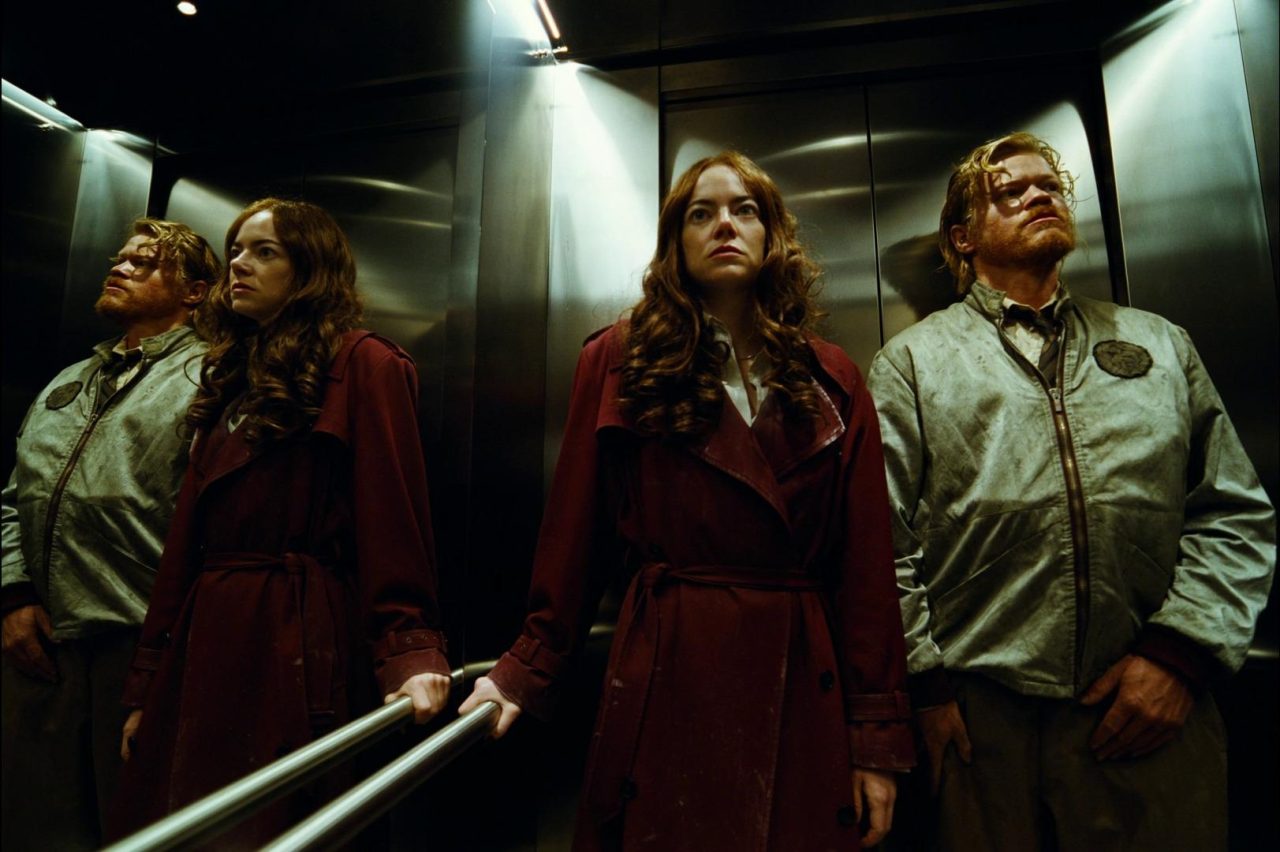
A feeding tube links Yorgos Lanthimos’s Bugonia to Bronstein’s film. This remake of Save the Green Planet! (2003) retools it for America today, reducing society to representative types: an overpaid corporate executive, Michelle (Emma Stone), and a conspiracy-minded lunatic, Teddy (Jesse Plemons), convinced he is the only person in possession of the truth about Michelle, which is that she’s an alien overlord who has arrived on Earth to subjugate mankind. Teddy’s mother (Alicia Silverstone), somehow the key to his understanding, lies in a hospital bed attached to a tube, like Linda’s unseen daughter in If I Had Legs I’d Lick You.
Teddy is an adult child of neglect who was abused by a benign-seeming fat cop (comedian-podcaster Stavros Halkias, the stunt-casting equivalent of O’Brien in Bronstein’s film). Bugonia shares with If I Had Legs I’d Kick You an excellent screenplay and a great cast, each superior in their concision to those in bigger films this year (One Battle After Another, Sinners, Marty Supreme), whose expansiveness, while admirable, made them a little muddy. As Byrne gives the standout performance by a female lead in a motion picture this year in Bronstein’s film, so does Plemons deliver the best performance by a male lead here.
As is usual with Lanthimos films, Bugonia’s commitment to its dour, insane message, the willful cheesiness of its first ending, and the bleakness of its finale turned off critics, who also carped that the film was insufficiently political, common complaints against this school of negative, anti-heroic filmmaking, which I think is much-needed in mainstream cinema. Audiences, at least the ones who make their voices known on social media and non-social media, refuse to be entertained.
Marty Supreme
The water explosion upstairs in If I Had Legs I’d Kick You preceded the bathtub falling through the floor in Marty Supreme, the difference being that Abel Ferrara was in that bathtub with a dog and in Bronstein’s film there was only the void. Josh Safdie’s everything-including-the-kitchen-sink approach proves his virtuosity in every aspect of filmmaking, not just production design and casting, but sometimes too much is too much. In Marty Supreme, Safdie shifts from the perfect balance of too much in Uncut Gems to the excessiveness of doing everything everywhere all at once, something I associate with both blockbuster cinema and awards-bait movies. The Safdies’ previous work is alive to the originality of the unexpected in screenwriting and features startling, weird, unpolished camera work and performances that have pushed their actors in new, deeper directions, all of which are also supremely entertaining because they are so novel and so, in a way, wrong for even existing.
The missing element here has to be brother Benny, whose 2025 movie The Smashing Machine also preceded Marty Supreme to theaters. In fact, it is the existence of The Smashing Machine—an inert, drab, strangely cast film also about the travails of a real American sports figure who competes in Japan—that gave away Marty Supreme’s game. After I first saw it late last summer I thought The Smashing Machine was a disappointment. Yet I thought about it for the rest of the year. I saw Marty Supreme twice in two weeks and then wanted to stop thinking about it for the rest of my life. Timothée Chalamet wore me out with his relentlessness, and the Mad Libs casting (writers, a rapper, a magician, a sitcom star, nepo babies, a reality-TV businessman, a grocery magnate, film directors, the guy from Son of Saul, a fashion designer) exhausted me. Who would appear next? Bhad Bhabie? Ross Perot? Nick Tosches? No, he’s dead.
Though Manny Farber’s descriptions of the differences between white elephant art and termite art have become overused concepts in arts criticism, they give us a clear illustration of what is going on in Marty Supreme and The Smashing Machine, two films from the same year made by separated brother-directors.
Marty Supreme: “a yawning production of over-ripe technique shrieking with preciosity, fame, ambition; far inside are tiny pillows holding up the artist’s signature, now turned into a mannerism by the padding, lechery, faking required to combine today’s esthetics with the components of traditional Great Art.”
The Smashing Machine: “Good work usually arises where the creators . . . seem to have no ambitions towards gilt culture, but are involved in a kind of squandering-beaverish endeavor that isn’t anywhere or for anything. A peculiar fact about termite-tapeworm-fungus-moss art is that it goes always forward eating its own boundaries, and, likely as not, leaves nothing in its path other than the signs of eager, industrious, unkempt activity.”
If Marty Supreme didn’t exist, then The Smashing Machine wouldn’t be understandable this way. It would just be a bad film, a minor Safdie or a misdirection. Coupled with its more successful brother movie, it emerges as a companion piece that is more interesting and rewarding that its obvious better. Or maybe one film (Marty) is about the hope and ambition of youth and the other about the failures and compromises of middle age (Smashing Machine), in the same way Richard Linklater’s two great 2025 films (Blue Moon and Nouvelle Vague) are, though those were made by the same person.
Sentimental Value
Joachim Trier is a filmmaker I have never appreciated and the great love his films engender escapes me. All I can say is that I found Sentimental Value ponderous and I knew that the last shot—or a shot close to the end that fools us into thinking it is from the “real” drama—would be from the movie-within-the-movie, in which father and daughter are reunited. The made-up problems of these successful Norwegian artistes and academics did not interest me. And whenever I think of a certain family of Swedish actors I hear the Peter Bjorn and John song “Young Folks” with different lyrics that go “And I don’t care about the Skarsgårds.”
Frankenstein
I saw Guillermo del Toro’s Frankenstein the way he meant it to be seen: on Netflix on a TV at a Hampton Inn. At least there was a blizzard outside to add to that stranded feeling, like Victor (Oscar Isaac) and the Monster (Jacob Elordi) trapped in the Arctic ice on the Horisont.
The drama here hews close to Mary Shelley’s original, with the trauma of having a bad father taking center stage in this two-part presentation. That’s the film’s innovation, that we get this very long story first from the point of view of the mad scientist, a romantic Prospero figure, and then from the POV of the Monster, an even more romantic Caliban because he is played by Elordi as a handsome Carel Struycken, with his face sown together like a glam-rock, mime-mask tetherball.
The film looks stagey and snow-globey and its green color palette unfortunately called to mind Wicked. It even has the same poppy fields. This Frankenstein is an illustrated classic for kids that asks the question “Who hurt you?” over and over. It simply isn’t metal enough, though it tries with its demonic “mother” imagery in bright red. The film lacks gravity because Del Toro’s camera always seems to be in the wrong place, rendering major parts of the film, especially the “spirit of the forest” (not the beehive) section, like a live-action Disney movie. “The achievement felt unnatural. Void of meaning”—a line from the film that describes itself.
Sinners
The best big action movie of the year, with a setup as languorous and deceptive as The Secret Agent’s, also to some extent in Tarantino’s debt, though Ryan Coogler chooses his worst material, From Dusk till Dawn, to thoroughly transform. Like many a Hollywood action movie, it has more endings than it needs, and before that it descends into mere violence, but the rest of Sinners is grand. The blues material Coogler adapts can too easily seem clichéd, but he again avoids that trap. Just the idea that Michael B. Jordan should play twins, Smoke and Stack, who have ripped off Al Capone and returned to Mississippi is enough.
From there, Coogler achieves a Leone-esque sweep, merging the history of Black music and dance into the set piece of the year, a long scene in the juke joint Smoke and Stack open, the culmination of the film until the vampires come. We learn these twins had a terrible father and this somehow made them criminals (sinners), but that they are also Black entrepreneurs managing a staff and artists they assemble Blues Brothers–style (a trope we also see in Song Sung Blue).
The villains are Lucky Charms vampires who have found a pot of gold at the end of a nighttime rainbow. Jack O’Connell, Lola Kirke, and Peter Dreimanis play them as entertainers, Americana musicians whose skill with a song is winning and ominous at the same time. “Pick Poor Robin Clean,” their song, is endearing and memorable, so much so that it threatens to take over the whole film in the way the vampires want to take over the bodies of the juke joint’s customers and staff.
Coogler presents these assimilationist vampires as a brand of communists who promise “heaven on Earth” if everyone becomes exactly like them. Sinners is essentially all-American in the conservatism of the twins’ business plan: it believes in stealing to get set up, then in innovating in business, delivering a good product that people want, being fair to staff, and being left the hell alone to do it. Clearly, both musical vampires and the Klan are a threat to that. “We was free” is one of the last things we hear in Sinners. But taking wooden nickels for corn liquor was the beginning of the end.
One Battle After Another
Perfidia (Teyana Taylor) could have killed Colonel Lockjaw (Sean Penn) in their first scene together—after all, she shoots a bank guard without thinking about it too much. If she had, there would’ve been no movie. Her goal is aligned with Paul Thomas Anderson’s in making One Battle After Another, which she and her screenwriter explain in an early speech to Pat/Bob (Leonardo DiCaprio): “I want you to create a show, Pat. This is going to announce the motherfucking revolution. Make it good. Make it bright. Impress me.” Pat, it almost goes without saying, is an anagram of PTA.
The film puts on that show. One Battle After Another is a rarity: a big Hollywood action movie self-consciously concerned with liberating the future from the clutches of a geriatric order. The Christmas Adventurers Club is a stand-in cabal that could be oligarchical, governmental, or movie-studio C-suite. Perfidia and Lockjaw’s biracial daughter, Willa (Chase Infiniti), an “American Girl,” is similarly a self-conscious creation of Perfidia’s and Anderson’s, an unwitting soldier in the revolution who is set in motion to advance the plot.
Relations between the sexes and races in the film expose a blatant truth about Hollywood action movies: Guns are for fun, sex is for power, not the other way around. It is Perfidia who explains this. The passwords of her revolutionary gang come from Gil-Scott Heron’s “The Revolution Will Not Be Televised,” by now a clichéd needle drop in Hollywood movies. Anderson deploys it as much for its anti-television lyrics as for its revolutionary advice. The revolution won’t be reruns, stupid sitcoms will be irrelevant, you won’t be able to skip out during beer commercials because in this 70mm, VistaVision, IMAX spectacular the beer commercials (“small beers”) will be on the screen, integrated into the comedy and car chases.
Tunnels provide escape routes and hiding places in One Battle After Another, but the main tunnel Anderson digs connects the California stoner rock of Licorice Pizza (2021) and Inherent Vice (2014) to the history of Black radicalism. The movie is like a Warren Zevon song, but one that somehow emerges from Tanya “Sweet Tee” Winley’s “Vicious Rap.” The director has added Junglepussy herself to the mix, one of the many characters in the film who come and go, disappearing too quickly. Always leave them wanting more is the strategy here, as One Battle After Another picks up, examines, and discards what Jim Downey, as one of the white-supremacist cabal, calls “dangerous lunatics, haters, and punk trash.” These include Benicio del Toro and Regina Hall in opposite-end calm mode, and Eric Schweig and John Hoogenakker as taciturn hired killers dispatched without fanfare.
DiCaprio, in the lead, is called “a stump” and has to prove himself otherwise, while Penn’s Lockjaw is a wind-up, rusted Popeye, not unexpected in a film where another character is named Bluto. Col. Lockjaw’s slow, two-part demise recapitulates Penn’s sour ending among the Southwestern skyscrapers and office spaces of The Tree of Life, putting a final period on the death sentence carried over from Malick’s film.
Accusations that the film’s ending is sentimental miss the point. Willa and Bob are reunited but back where they started, though Willa now owns a car. How will she afford the gas? Bob, who has spent his life on payphones, ends up the confused owner of a smartphone, which comes with a monthly bill whether he uses it or not.
The Secret Agent
The opening scene at the gas station in the middle of nowhere sets up a perfect film. Kleber Mendonça Filho’s Secret Agent then continues for 161 minutes, some of it in fact quite perfect, some of it digressive and warm considering it takes place in Brazil in 1977, “a time of great mischief” when the country was ruled as a police state that disappeared some of its citizens for being on the left. Mendonça has made room for so much in this inventive Once Upon a Time in Recife that is suffused with cinephilia and color, along with a severed leg and a snitch movie-theater projectionist, which I hated to see.
What one loves in The Secret Agent are Dona Sebastiana (Tânia Maria), an exceptionally endearing old lady helping the Resistance who owns a two-faced cat that no doubt like her has seen some things, and her cast of characters in the apartment complex she runs for leftists, a Renoir-esque idea that Mendonça brings to vivid life. Among them are a sexy dentist (Hermila Guedes), a disaffected Angolan couple (Isabél Zuaa and Italo Martins), and a gay kid who has escaped his family (Robson Andrade). Mendonça interrupts the story of Armando (code name Marcelo) with tape recordings made of his conversations, listened to in the present by two girls transcribing them (Laura Lufési and Isadora Ruppert), similar to the two girls in Nicole Flattery’s novel Nothing Special who transcribe tapes at the Warhol Factory in the late 1960s.
These interruptions culminate in one of the girls, Flavia (Lufési), coming to visit Armando’s son, Fernando, a phlebotomist at a blood bank that has replaced the movie theater where Fernando first saw Jaws, whose release plays an important role in The Secret Agent. Wagner Moura plays Armando and his own son, but effectively plays three roles, not two: Armando, his secret agent identity Marcelo, and Fernando. Two scenes highlight this movie as a classic spy film staking out real le Carré territory: the recollection of a conversation at dinner with Armando, his murdered wife (Alice Carvalho), and two capitalist officials, a disgusting father (Luciano Chirolli) and son (Gregorio Graziosi) duo. The other, the long open-air assassination scene, features a killer with an unforgettable face (Kaiony Venâncio), angry with the men who have hired him for being repugnant classists.
Mendonça is very generous to his actors, not least Robério Diógenes as the corrupt police chief Euclides, a dead ringer for the American character actor Vincent Gardenia, who played in a couple of the Death Wish movies. Whereas Gardenia played things harried and sweaty, Diógenes plays them entitled and sweaty. The difference marks the fascism of these cops, who cover up everything as a matter of course even as their plans go wrong.
It Was Just an Accident
We can see the severed leg in The Secret Agent as the missing leg of the torturer in It Was Just an Accident. Both are films that investigate the role of the secret police in their countries, Brazil and Iran. The latest and sixth of the films that Jafar Panahi has made illegally and that can’t be shown in his home country, It Was Just an Accident was released wide by Neon in the US, and Panahi was received as a hero despite not being allowed to travel here in the past. Panahi is an artist who has been arrested, spent time in prison for his work, and who makes films under constraints unknown to most filmmakers—a brand of oppression he describes as “psychological terrorism.” Now that the US has started a war with Iran, Panahi will probably reverse polarity again as far as US authorities are concerned, Oscar nomination or not.
The US is the same as Iran and Brazil in regard to torture: Abu Ghraib, Guantanamo, and the still-redacted torture report, even though we have all forgotten the dumb movie about it that Adam Driver starred in. With It Was Just an Accident, Panahi has decided to make a film that meets any audience more than halfway, a strategy he began to adopt in the 2022’s No Bears, but that he couldn’t fully realize because that was still a meta-movie with him in it, playing himself, as he had done in 3 Faces, Taxi, and This Is Not a Film.
It Was Just an Accident, made away from the eyes of the Iranian regime, is a basic narrative film, its one tricky device that at first we see the torturer, Eghbal (Ebrahim Azizi), as the film’s family-man lead, and its everyman hero, Vahid (Vahid Mobasseri), one of the past victims of the secret police, as its villain. Vahid, a mechanic enlisted to fix Eghbal’s car after he hits and kills a dog off-screen on a nighttime car trip with his family, is suspicious and furtive only because he has recognized Eghbal’s voice and the sound his prosthetic leg makes when he walks. He was blindfolded when he was tortured, like the rest of the cast of Eghbal’s previous victims we meet in the film, a cross-section of Iranian society brought together by their punishment for opposing the regime. Vahid’s van, which reminded me of the Criterion van, becomes a prison for Eghbal as Vahid and Eghbal’s former prisoners put him on trial in this confined space where they feel his stump to see if it matches their bland memory of it. By the end, through wedding photography sessions, hospital visits, the birth of a baby, and much bribery, the film ends on a desert at night, lit only horror-movie style with red brake lights, a version of “A country road. A tree. Evening.” where the subjects are mercy and the long wait for justice.
Song Sung Blue
I did not think the phrase “Kate Hudson’s stump” was one I was going to have to write this year, but I hadn’t counted on Song Sung Blue, a movie I knew nothing about before I saw it. Going into it cold turned it into one of the year’s great surprises.
Song Sung Blue is a musical melodrama, set in the late 1980s and early 1990s, about the existential crisis faced by a Neil Diamond impersonator (Hugh Jackman). Forced to give up his dreams of musical stardom, he decides to play someone he is not, and he isn’t happy about it. Love, in the form of Kate Hudson, changes him and makes it all right. His acceptance of this role rockets both of them to local stardom as a Diamond tribute act called Lightning and Thunder. (Jackman is lightning and Hudson thunder.) Then the two of them fall prey to a series of bizarre accidents and terrible addictions and health problems, including a car crash in their front yard unlike any I’ve seen in a movie. Later, a scene in which the heart attack–prone Lightning has to literally glue his scalp back together. Also, someone (John Beckwith) plays the real Eddie Vedder in this movie, because meeting Eddie Vedder becomes an important moment in Lighting and Thunder’s lives. The Vedder character wears a Cramps T-shirt, reminding Hollywood that a Lux and Ivy biopic could be made like this, too.
Song Sung Blue is like a 1950s King Vidor movie mixed with an episode of Star Search. It’s an instant classic. Jackman and Hudson, who one has to assume are pretty comfortable in their lives, both throw themselves into this movie like their careers—no, their lives—depended on making it. Hudson’s Wisconsin accent becomes so pronounced she sounds like Edie McClurg. Brought low by the accident that results in her losing half of one of her legs, she takes to addiction in a proactive way, turning getting hooked on painkillers into another showbiz challenge she’ll win. Jackman brings his status as the world’s showman to a new height of dazzle, especially when he falls face-first into a bathroom sink.
The whole thing is a goofy miracle brought about by director Craig Brewer, who both figured out that the musical biopic needed an entirely new approach without people playing stars, and who actually has some familiarity with members of the working class. He is so in favor of them that he teases the idea of Diamond showing up as himself, then yanks the possibility away at the crucial moment. It’s Brewer’s best film since Hustle & Flow, which was released twenty years ago. He’s made a movie with great star power that understands how life is both a terrible nightmare and a dream.
Blue Moon
From the ridiculous to the sublime, Richard Linklater’s Blue Moon has “blue” in the title and is about popular songwriting and musical theater of a higher order than Lightning and Thunder’s version of Neil Diamond, or even Diamond’s version of himself. Ethan Hawke plays Lorenz Hart, a very short, balding, bisexual alcoholic who looked nothing like Hawke, sounded nothing like Hawke, and had none of Hawke’s appeal as a physical human being existing in the world. Hart was, however, arguably the greatest American song lyricist of the first half of the 20th century. In addition to the song “Blue Moon,” he wrote dozens of others that became standards, including “Falling in Love with Love,” “I Could Write a Book,” “I Wish I Were in Love Again,” “The Lady Is a Tramp,” and “My Funny Valentine.”
Playing Hart means Hawke had to appear short, an effect the actor and Linklater achieve with no digital trickery. They do a better job than John Huston did when he had José Ferrer play Toulouse-Lautrec in Moulin Rouge in 1952. For Linklater’s film, this entailed a “height wizard” in the credits, actor Latham Gaines. It’s not clear what Gaines did, but it mostly works. Hawke is essentially playing a monster of sorts (an anti-Frankenstein), a part more suited to an unhandsome actor like Charles Laughton. His performance is aided by the make-up department. Besides getting Hawke to look and dress like Hart, they’ve made most of the rest of the cast look like Drew Friedman drawings. Except Margaret Qualley. No one would do that to her.
This is a long monologue of a movie, in which Hart sometimes interrupts himself to propose ideas for musicals to his estranged musical partner, Richard Rodgers (Andrew Scott), which puts it in line with Linklater’s Slacker, a film composed of a series of monologues and pitches that Linklater has now filtered through his interest in Sondheimian musical theater. A kid actor (Cillian Sullivan) even plays little Stevie Sondheim here, out late on the opening night of Oklahoma! on Broadway. The movie takes place at Sardi’s over one long evening, a stage set that never seems confining or stagey in Linklater’s mise-en-scene. One of the most enjoyable things about Blue Moon is the idea that Hart is the only one who understands that Oklahoma! sucks and is bad for American culture, representing a bland form of comforting showbiz.
Being right is part of Hart’s appeal, but it’s also what makes him difficult, intractable, a drunk and a monster—someone who knows a lot but not enough about himself, who is fooling himself that he won’t have another drink, that he has a chance with Qualley, and that everybody’s not sick of him at their celebration of Rodgers’s success without him. Liking the film, even getting it, depends on understanding that Hart is most artists in middle age, even most people in middle age who don’t want to go along with the crowd. Thus it will be an alienating movie for many people, probably most people, despite Hawke’s bravura incarnation. But most people didn’t write “Where or When.”
F1
I happened to see It Happened One Night again recently, and what impressed me most this time was not Frank Capra’s direction or Robert Riskin’s screenplay or Clark Gable and Claudette Colbert’s performances. It was Joseph Walker’s black-and-white cinematography. The sense of air in the outdoor scenes was so present, which is not something I feel that much in a lot of movies today. It Happened One Night came out in 1934 and swept the main Oscar awards at the 1935 ceremony. But it wasn’t even the best movie of 1934, which was Jean Vigo’s L’Atalante, a movie that no one cared about when it was released in France, that its distributors cut and retitled, and that was considered a failure until its rediscovery by French critics after World War II.
The reason I bring this up is that of the twelve movies nominated for Best Picture in 1934, none of them was L’Atalante. One of them, The White Parade, a Fox film about nurses starring Loretta Young, is a semi-lost film, existing only as a partial dupe print in an archive. It’s hard to believe a Hollywood film made by a major studio as late as 1934 only exists that way. I hope the same thing happens to F1.
Melania
This abysmal documentary about the First Lady, which exists as a bribe to Donald Trump from Jeff Bezos and Amazon Studios and as a way for its subject to stockpile millions in cash even as that other Bezos property, the Washington Post, lays off staff, was not nominated for anything because it didn’t come out last year. It came out this year. But I happened to see it so I’m including it as a reverse horror show that pretends everything is fine even as it plays “Gimme Shelter” in its opening scene of Melania in an airplane, with its lyrics about war and rape being just a shout away.
We can only hope that future documentarians do the obvious and intercut this monstrosity with footage of ICE raids, a flattened Gaza, and the bombing of Tehran. It’s funny that the White House insisted that this film be made even as they tore down the historic movie theater in the East Wing and therefore had no place to show it at home at its premiere. Melania is an anti-documentary that came out just as Frederick Wiseman died.
Most of the time Melania is seen from the back, moving through spaces and making entrances and exits into and out of Blair House, various ballrooms, black automobiles. She is like a vampire, not just because of the Slovenian accent, but because of her long black or “true navy” coats, because of the way she is attended to by fashion designers and priests, because in this movie she purports to be controlling everything around her. We see her dead, blue-eyed stare in close-up as she describes last year’s wildfires in Los Angeles and “all the structures that no longer exist,” making a connection between her gaze and this destruction, the generalized structural nonexistence of the present.
Much of the screen time consists of encomiums to her tall son, Barron. We learn how beautifully everything has gone for Barron as he’s grown up, how loved he is by his mother and father. We see him waving and not quite smiling. Maybe smirking just a little. Here is a child that is doing just fine. He has a great future ahead of him.
If you like this article, please subscribe or leave a tax-deductible tip below to support n+1.