
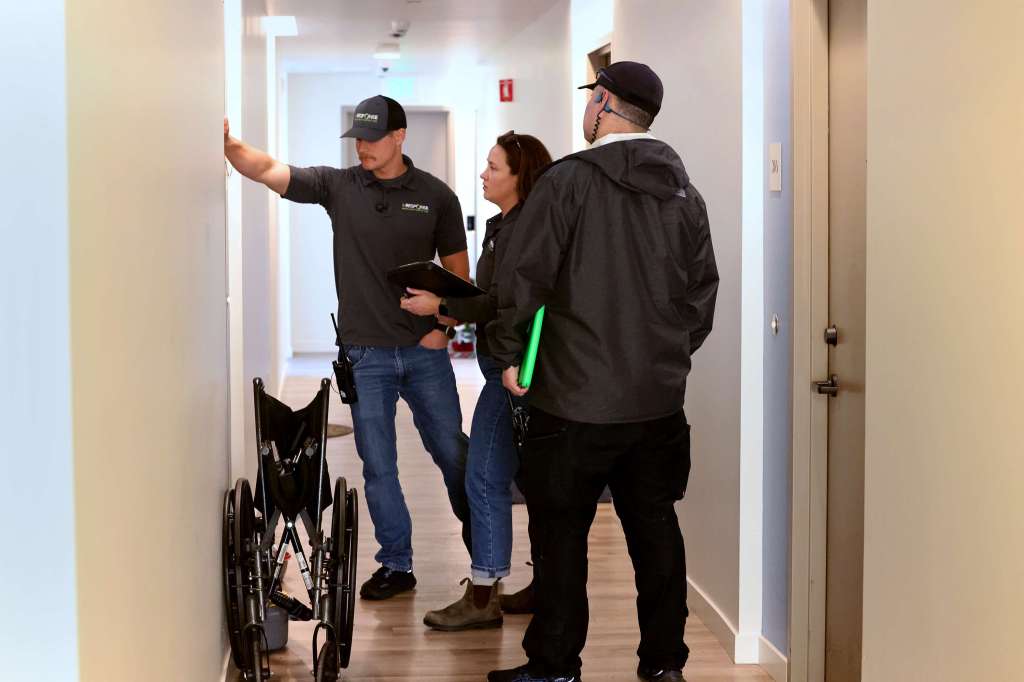
In the photograph, two Santa Rosa police officers stand over Barbara and Denny Bozman-Moss’ 37-year-old son, who is face down on a mattress that sits on the floor. A large pile of cigarette butts litters the charred carpet next to him. Dirty clothes, shoes, empty water bottles and energy drink containers are strewn about.
It was mid-September last year, and the couple had been desperately trying to get their son, who is schizoaffective — a disorder that combines symptoms of schizophrenia with mood swings — into a psychiatric facility where he could get the help he needed. A caregiver had become convinced he was a danger to himself and possibly his neighbors. He’d started to leave lit cigarettes on wooden furniture, upholstery and the carpet. During a last visit in late August, he answered the door with blood on his hand but wouldn’t let the caregiver in.
Over the span of two weeks, his parents called 911 more than half a dozen times. His mother said the scene played out the same in each instance: Police officers showed up with a team of mental health crisis workers, and though that team deemed him eligible for a psychiatric hold, police ended up walking away when he refused help.
The Bozman-Moss family’s experience reflects a growing dilemma, according to behavioral health advocates, as some local law enforcement agencies have shifted their approach to enforcing psychiatric holds — known by the state statute code, 5150 — where someone in acute mental health crisis can be detained and temporarily hospitalized if they are a danger to themselves or others.
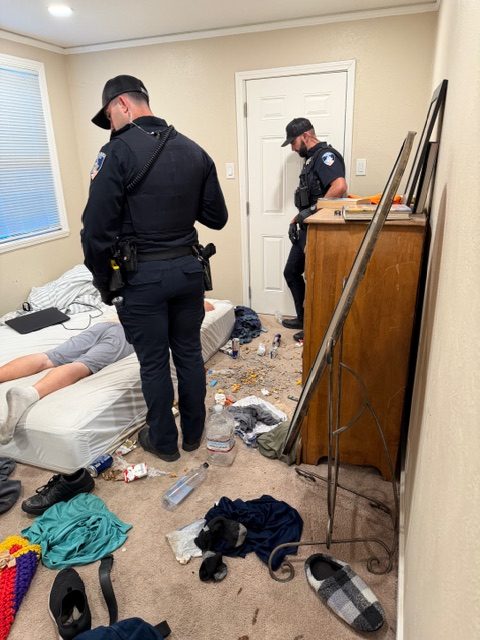
Santa Rosa police officers respond to crisis call from Barbara and Denny Bozman-Moss for their son, who lies face down on his mattress in his apartment on a day in September 2025. The couple’s son is schizoaffective. Fearing for his safety, and the safety of his neighbors, the Bozman-Mosses tried unsuccessfully for weeks to get first responders to transport him to a local psychiatric facility. It wasn’t until he became physical with Denny that police went “hands on” and arrested him. (Courtesy of Bozman-Moss family)
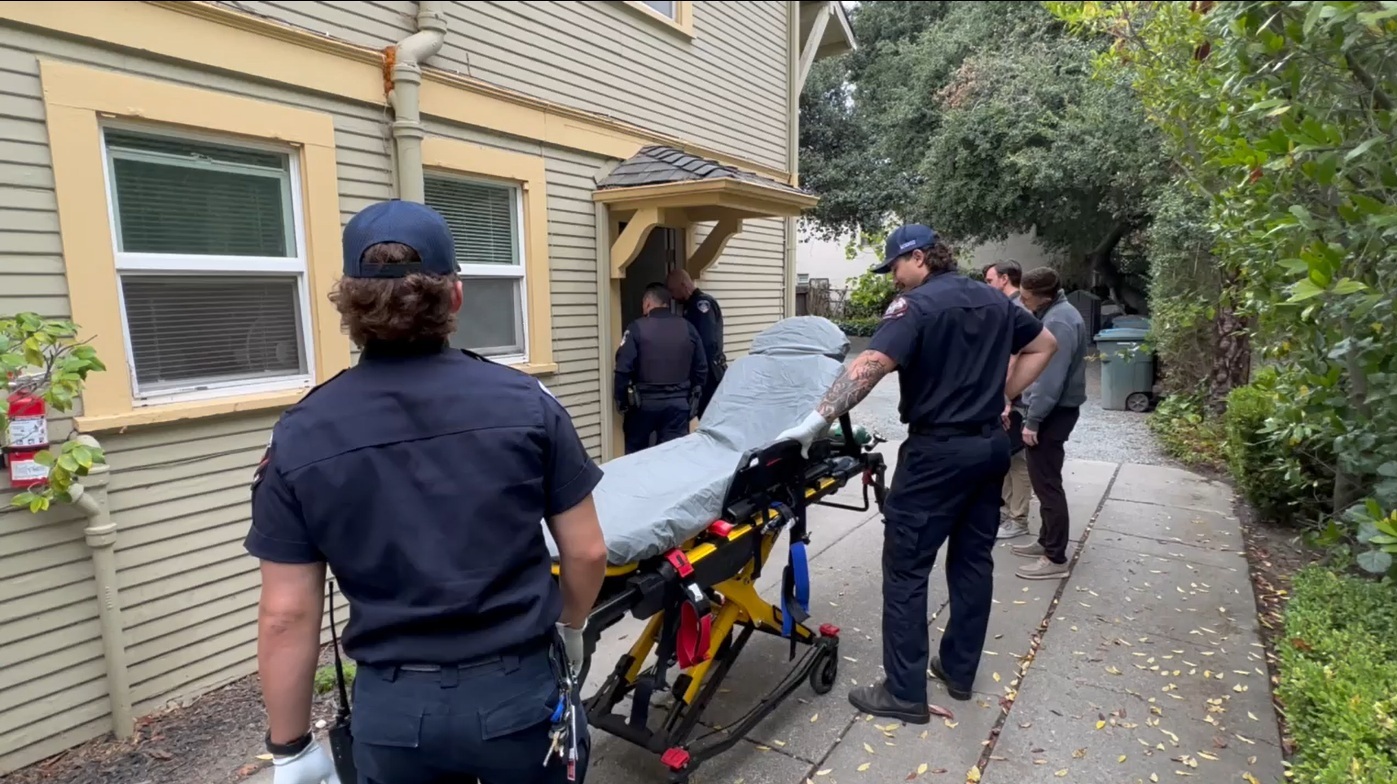
Santa Rosa police officers, Medic ambulance drivers and inRESPONSE mobile crisis workers respond to a crisis call at the apartment of the son of Barbara and Denny Bozman-Moss in September 2025. Their son is schizoaffective and the couple tried unsuccessfully for weeks last summer to get him transported him to a local psychiatric facility. They said first responders told them a recent court ruling prevented them from going “hands on.” (Courtesy of (Courtesy of Bozman-Moss family)
Show Caption
1 of 2
Santa Rosa police officers respond to crisis call from Barbara and Denny Bozman-Moss for their son, who lies face down on his mattress in his apartment on a day in September 2025. The couple’s son is schizoaffective. Fearing for his safety, and the safety of his neighbors, the Bozman-Mosses tried unsuccessfully for weeks to get first responders to transport him to a local psychiatric facility. It wasn’t until he became physical with Denny that police went “hands on” and arrested him. (Courtesy of Bozman-Moss family)
In California and elsewhere, such holds can be involuntary, meaning they don’t require the person’s consent to carry out. Nevertheless, the decision can be complicated in cases where the person refuses care.
In Sonoma County and across the state, law enforcement officials describe an evolving, if inconsistent, “case by case” approach based on a better understanding of mental health response. Also at play are court rulings some have interpreted as increasing officer liability during such calls, making authorities more hesitant to engage, and especially to use force.
Officers must weigh what’s best for a person in crisis against what a law enforcement agency deems within legal bounds, said Lt. Chris Mahurin of the Santa Rosa Police Department.
“It’s always a tricky balance,” he said, adding that amid the debate, the department has instituted special training to deal with these complicated scenarios.
But the upshot in the field, according to some local health officials and news reports, is that officers increasingly are refusing to carry out involuntary holds. In Sonoma County, health officials point to a growing number of what they call unenforced holds they tracked back to late 2024. It shows dozens of such cases since then, primarily in Santa Rosa and in the unincorporated county.
“This is a really big concern of our members,” said Michelle Doty Cabrera, executive director of the County Behavioral Health Directors Association of California. “Every day we hear of new cases of law enforcement agencies pulling back.”
In Sonoma County, county and nonprofits teams with specialized staff help respond in cases of police calls involving people in mental health crises. The county’s Mobile Support Team, for the most part, responds to crisis calls in the unincorporated area, where the Sonoma County Sheriff’s Office operates; inRESPONSE, operated by Novato-based Buckelew Programs, works in Santa Rosa; and the SAFE Team, run by Petaluma People Services, handles Cotati, Rohnert Park and Petaluma.
In Santa Rosa and the county’s unincorporated area, two jurisdictions that account for the majority of the county’s population, law enforcement in 62 cases between Dec. 1, 2024, and Jan. 23 refused to carry out a hold recommended by mental health crisis responders on scene with officers, according to records compiled by the Sonoma County Department of Health Services.
For context, over that same period, ending in mid-January 2026, Sonoma County’s Mobile Support Team, serving the unincorporated area, was dispatched to 1,937 calls, 365 of which resulted in successful holds.
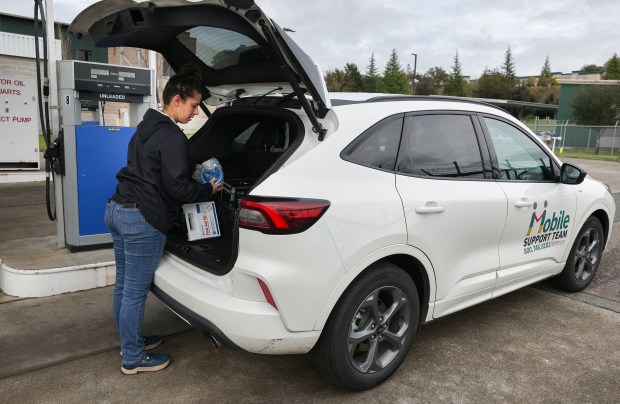 Behavioral health clinician Jessica Kastrup organizes a Sonoma County Mobile Health Support Team vehicle while refueling at a county facility in Santa Rosa on Wednesday, February 25, 2026. (Christopher Chung/The Press Democrat)
No comparison for any prior period is possible because data on unenforced holds wasn’t being collected. And a broader snapshot across the county isn’t possible because the SAFE Team does not collect such data.
While there is little wider data available, law enforcement agencies have taken a patchwork of approaches across the state. Sheriffs in Del Norte and Sacramento and Orange counties have said they may not respond to mental health calls alone. Several police departments in Southern California have said they’ll respond but may leave without a crime in progress or any imminent threat to others.
For families who’ve summoned first responders for assistance, seeing officers walk away after a loved one in crisis rejects aid can leave them feeling helpless.
Local officials warn it could be dangerous.
“The client basically is left to be in their residence or in the community in that state of mind, and that’s not good,” said David Evans, acute and forensic services section manager for Sonoma County’s Department of Health Services, which operates one of three mobile crisis response teams in the county.
“Our utmost concern is a person taking their lives, or, if they’re a danger to others, taking someone else’s life. … That is what we’re all trying to avoid happening,” Evans said.
Barbara and Denny Bozman-Moss’ son had been taken into care on a psychiatric hold before without issue. When officers walked away in September, “it floored us, because it was such a different shift,” Barbara said.
The couple said police and mental health crisis workers repeatedly told them “new case law” tied their hands, and there was nothing they could do if their son was unwilling to go to the hospital. He would have to commit a crime, they said, for them to go “hands on,” Barbara recalled.
On Sept. 22, that finally happened. The couple called police after their son knocked Denny down during an encounter. He went willingly after police told him he was under arrest, Barbara said.
While the arrest removed their son from what had become a dangerous environment, it set off a monthslong judicial process that delayed the vital medication he needed to stabilize his condition.
“If things had been different, and they had just done what they’ve always done in the past,” Barbara said, “everything would look different than it does right now.”
Ripples from appellate ruling
A July 2024 court ruling out of the 9th U.S. Circuit Court of Appeals has repeatedly come up as signs point to a broader police retreat from enforcing involuntary mental health holds. The decision wasn’t particularly unusual, but the response it prompted from some law enforcement agencies stood out.
The case, Scott v. Smith, revolved around a man, Roy Anthony Scott, who, distressed and hallucinating that people were after him, called Las Vegas police for help in March 2019. Two officers responded and coaxed him out of his apartment. When prompted, he dropped a metal pipe and handed over a knife.
Though he continued to obey commands, Scott, who said he had schizophrenia, protested that he was too paranoid when told to turn and face a wall. A struggle ensued as officers took him to the ground and leaned on his back and neck. Scott eventually became unresponsive and died.
Judges agreed with a lower court that, weighing the level of force used against the threat Scott posed, officers in this case were not protected by qualified immunity, which shields police from individual liability unless there’s a clear violation of constitutional rights.
It wasn’t the first such ruling. The judges, in fact, based much of their reasoning on a similar case and outcome.
“The whole purpose of this case is to reaffirm what has been already established legally,” said Benjamin Barsky, an associate law professor at UC Law San Francisco who works at the intersection of health and criminal law.
Nevertheless, some law enforcement officials put a stake in the ground after the ruling. In early 2025, Sacramento County Sheriff Jim Cooper announced his department would no longer respond to mental health calls unless a crime was involved or someone besides the person in crisis was in danger. The liability risk for his officers, he said, was now too high, according to a CalMatters investigation that documented the fallout.
A number of agencies have moved in Cooper’s direction.
“The impact of this lawsuit out of Nevada has been pretty significant and growing, not only in California, but nationally as well,” said Doty Cabrera of the County Behavioral Health Directors Association of California. “Almost immediately, we started to hear about a handful of law enforcement agencies that fell back on interpreting this case to mean that they could not or would not be able to assist us in crisis response.”
The legal analyses have varied. In the aftermath, a partner from a large law firm representing public safety officers called the ruling “a regrettable restraint on first responders’ ability to act” that left law enforcement with “bad choices.”
“They can attempt to restrain the subject and secure the scene and risk losing qualified immunity, or direct officers not to respond,” he wrote in a post.
But in a memo to a host of sheriff and police department clients, an attorney from another prominent public sector firm, while disagreeing with the court’s conclusion, said any broader takeaway that the decision revoked officers’ legal protections was a “misinterpretation.”
In interactions with first responders, the Bozman-Mosses said they kept hearing references to a court ruling that had shifted the landscape. Then, at a Sept. 8 community meeting with Santa Rosa police and county behavioral health officials, including Evans, officials pointed specifically to Scott v. Smith.
That Monday afternoon meeting, at the southwest Santa Rosa offices for Buckelew Programs, followed a failed attempt the day before by the couple to get their son into a psychiatric facility.
Barbara and Edie Sussman, a local attorney of the Bozman-Mosses helping the couple, said officials at the meeting reiterated what they’d heard from first responders on the street — law enforcement could not go “hands-on” if the person was unwilling to voluntarily agree to emergency intervention.
After reviewing Scott v. Smith herself, Sussman wrote to Evans on Sept. 17 with her own conclusion: “Nowhere in the stated decision is there any discussion that could lead one to reasonably conclude that qualified immunity no longer exists.” She asked Evans to share her letter with the county counsel, warning that “current policy is dangerous to the community, as well as to the individual in need of intervention.”
She hasn’t heard anything back from the county health department, she said.
The state of limbo — for families as much as authorities — reflects a persistent struggle in the U.S. to adequately address mental health given the massive gaps in services and barriers to treatment.
“To claim that there is a radical legal departure in this case is incorrect,” Barsky said. Stepping away from mental health calls altogether is “a leap that raises a lot of justified questions and concerns,” he said.
But, “that doesn’t undermine the concern around (police) responding to someone who is experiencing some kind of behavioral health crisis,” he added, “because many officers feel ill-equipped to deal with these kinds of issues.”
Civilian response evolved from breaking point
The nexus between law enforcement and mental health crises has been a longstanding issue in Sonoma County and across the country.
Nearly 20 years ago, during a 12-month period, four Sonoma County residents in severe mental distress were killed by members of three local law enforcement agencies. The slain residents included a mother, a teenager and two men. None of the deaths resulted in criminal charges. Lawsuits by family members of two of the people resulted in settlement payouts totaling more than $2 million.
At the time, mental health care advocates and law enforcement officials sounded the alarm over the fallout of cuts to mental health services, including the closure of two psychiatric hospitals in Santa Rosa in 2007 and 2008.
In 2007, the Sheriff’s Office launched a five-year program of crisis intervention training for local peace officers, immersing them into the world of mental health services. The training included suicide intervention, crisis and tactical communication and strategies for the use of less lethal force.
John Burgess / The Press Democrat file
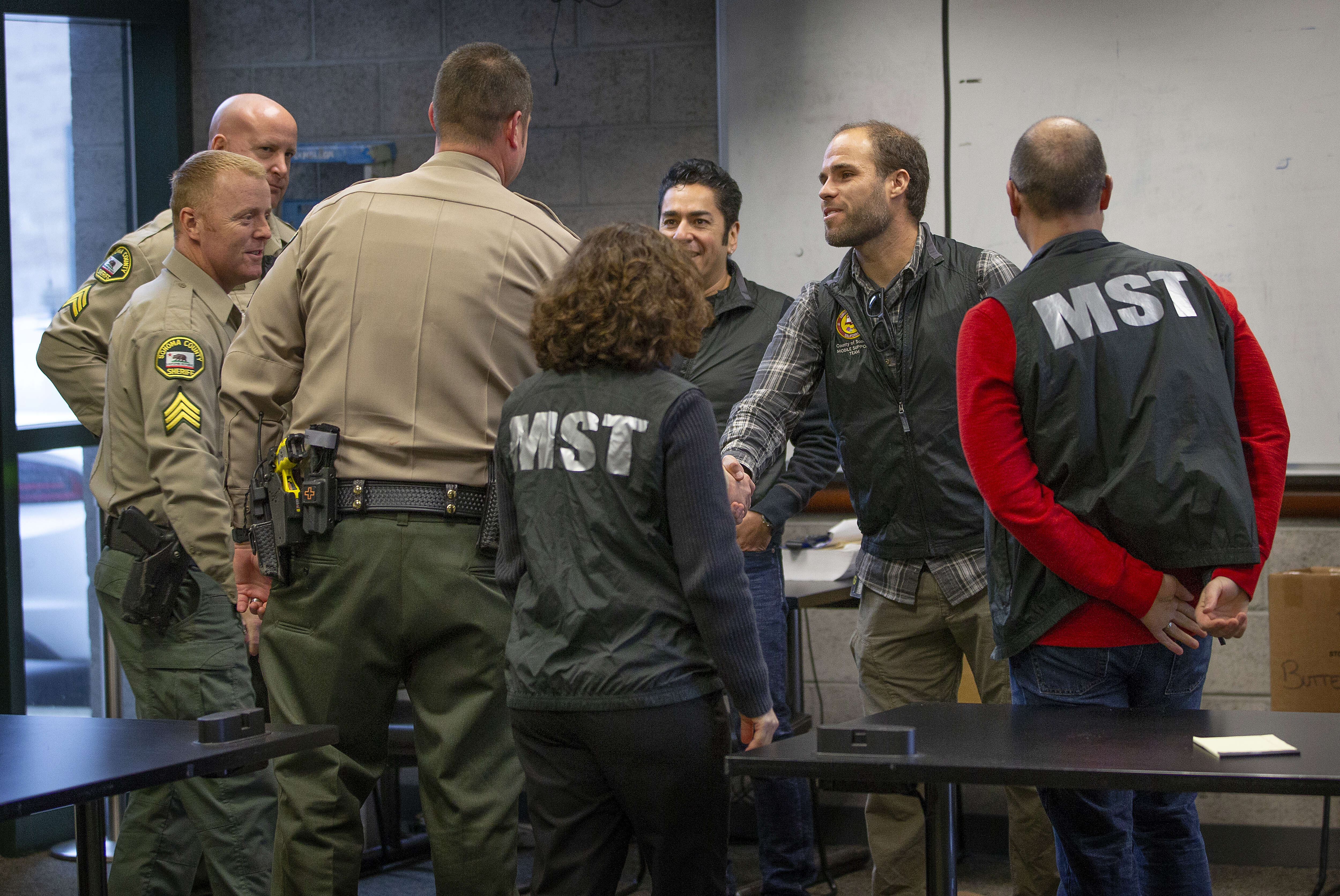
Members of the Sonoma County Mobile Support Team, a group of mental health specialists employed by the county, meet with sheriff’s deputies to talk about the day’s calls and how to decelerate situations involving acute mental health issues. (John Burgess / The Press Democrat file)

Behavioral health clinician Jessica Kastrup organizes a Sonoma County Mobile Health Support Team vehicle while refueling at a county facility in Santa Rosa on Wednesday, February 25, 2026. (Christopher Chung/The Press Democrat)
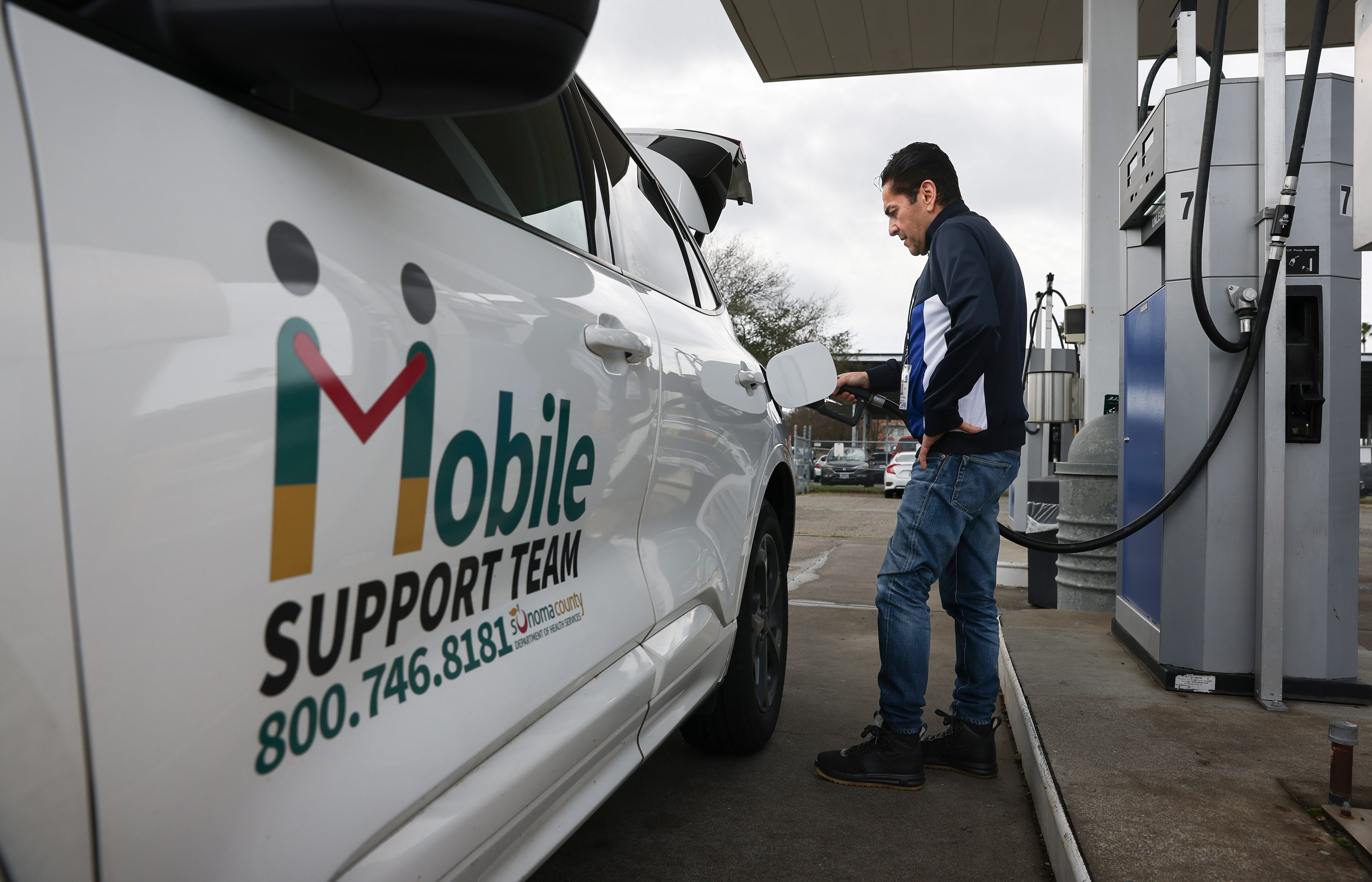
AODS counselor Steven MacDonald refuels a Sonoma County Mobile Health Support Team vehicle while at a county facility in Santa Rosa on Wednesday, February 25, 2026. (Christopher Chung/The Press Democrat)
Beth Schlanker / The Press Democrat
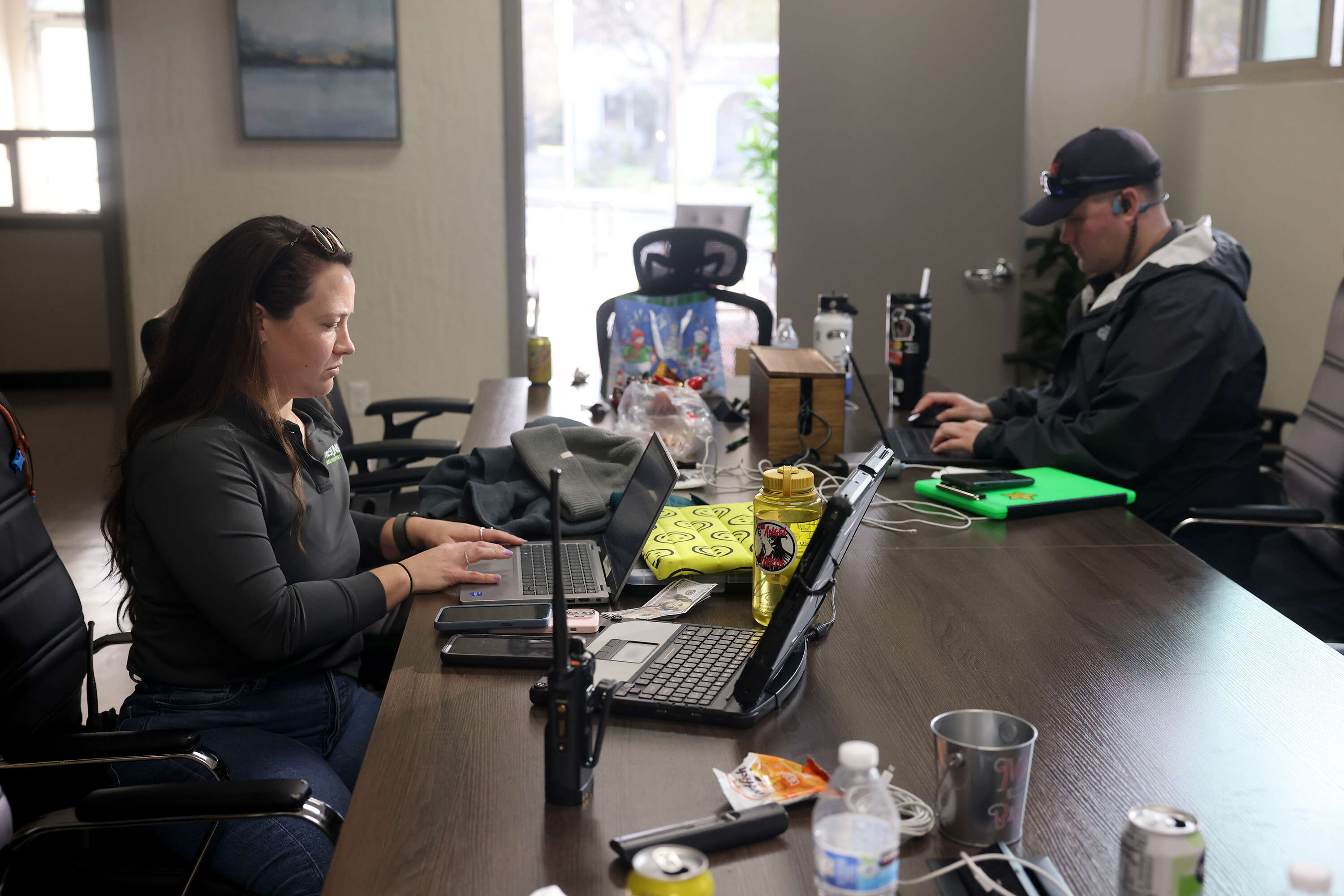
inRESPONSE Mental Health Support Team members Mariah King, a Sonoma County Behavioral Health Clinician, and Cavan Nelson, an engagement specialist from Catholic Charities, review and evaluate incoming calls at their office in Santa Rosa Wednesday, Dec. 18, 2024. (Beth Schlanker / The Press Democrat)
Beth Schlanker / The Press Democrat file
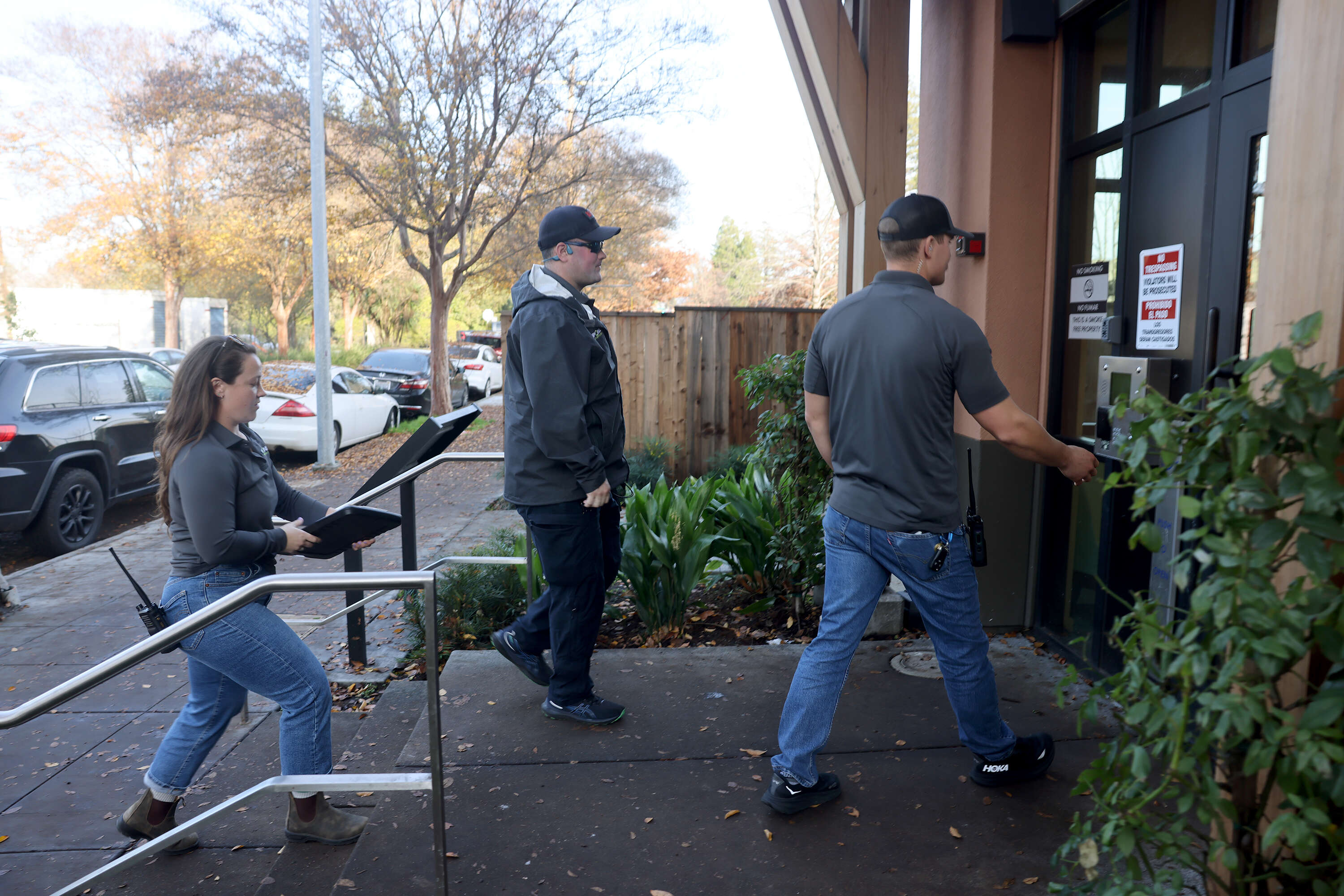
A inRESPONSE Mental Health Support Team responds to a call in Santa Rosa Wednesday, Dec. 18, 2024. (Beth Schlanker / The Press Democrat file)
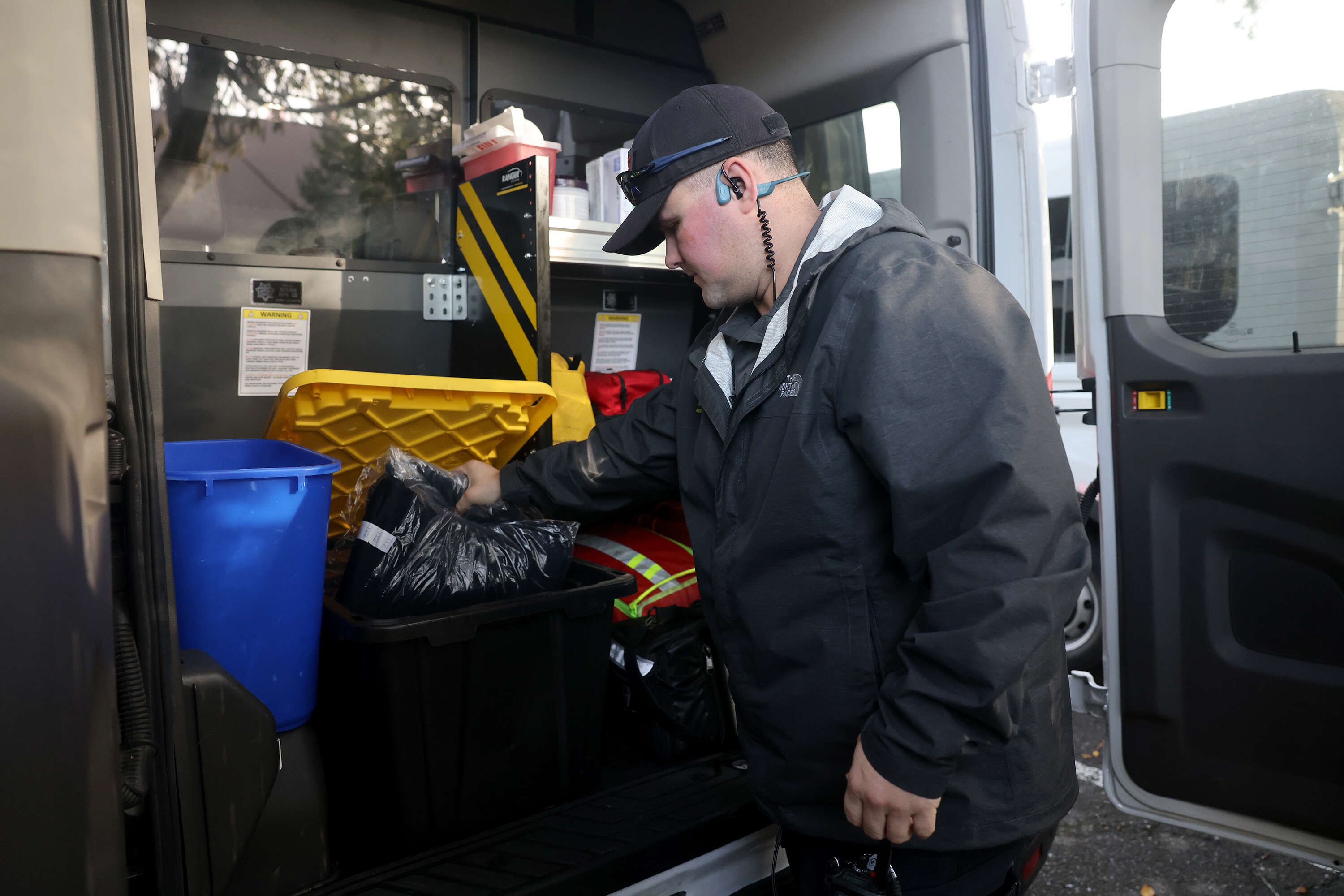
Beth Schlanker / The Press Democrat file
inRESPONSE Mental Health Support Team member Cavan Nelson, an engagement specialist from Catholic Charities, opens a bin containing new clothes for clients in Santa Rosa Wednesday, Dec. 18, 2024. (Beth Schlanker / The Press Democrat file)
Show Caption
John Burgess / The Press Democrat file
1 of 6
Members of the Sonoma County Mobile Support Team, a group of mental health specialists employed by the county, meet with sheriff’s deputies to talk about the day’s calls and how to decelerate situations involving acute mental health issues. (John Burgess / The Press Democrat file)
The county launched its mobile crisis support team in 2012, part of a concerted shift toward sending unarmed, trained professionals to mental health-related emergencies. These mobile crisis teams have become popular across the nation and yielded clear results — lower incarceration and emergency room visit rates, less police involvement and more service engagement.
For 70% of calls in 2024, Sonoma County’s Mobile Support Team didn’t need police backup, according to Wendy Tappon, the program’s manager.
“That’s the goal: to have non-law enforcement responses. But, for some of these cases, our law enforcement partners are really important to us and to the safety of the people we’re responding to,” Tappon said.
The noticeable shift in practice, she added, “it’s been a huge weight on the team.”
Fear of liability vs. best practices
Lt. Chris Mahurin of the Santa Rosa Police Department, which works with inRESPONSE, the city’s primary mobile crisis team, said the Scott v. Smith court ruling mainly “just reinforced a lot of the work that we’re already doing.”
That includes training officers on alternatives to traditional force where possible, such as having an ambulance on scene so someone can be put on a gurney using soft restraints rather than an officer holding them down to the ground and cuffing them.
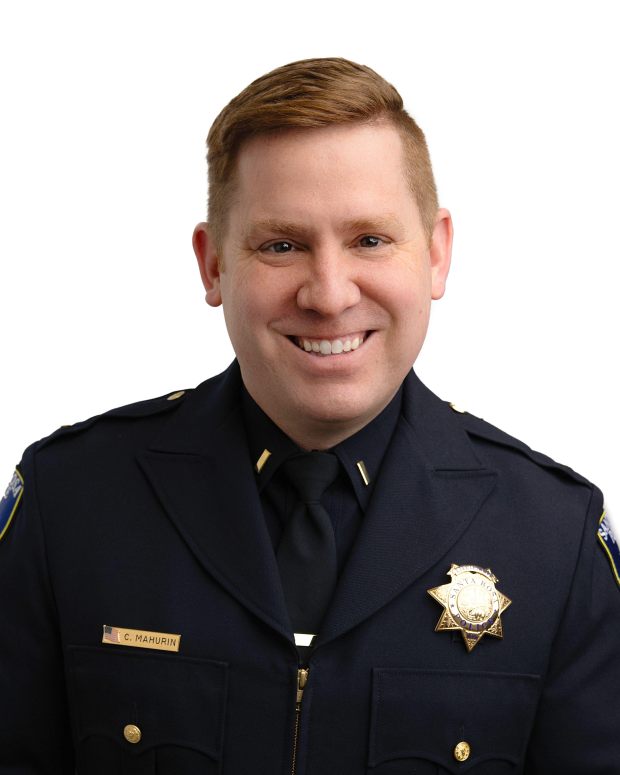 Santa Rosa Police Lt. Chris Mahurin (City of Santa Rosa)
“We’re trying to find other methods to be able to take people into protective custody without having to use force like we have in the past,” Mahurin said. When the case is specifically someone experiencing a mental health crisis, those are the ones even more so we’re trying to slow down, not use force if we don’t have to, or go hands-on if we don’t need to, because that’s not a crime and it’s not a criminal action.”
“I think that’s a laudable goal, obviously, to not escalate situations, but when somebody is a danger to themselves or others or they’re gravely disabled and they’re not eating right, and their house is full of moldy food and all that, they have to be able to go in with hands on and transport that person to a hospital. They just have to,” Barbara Bozman-Moss said. “The bottom line is, there’s nothing worse if that person stays just out in the community and is not being treated.”
Mahurin could not speak to specific cases, including the response involving the Bozman-Mosses’ son, citing health care privacy laws, but said that officers aren’t being directed to just walk away.
In the short-term after the court ruling, “there was a lot of confusion about what the law was actually indicating” that led to more unenforced holds, he said, but specialized training was implemented.
“Similar to a lot of new case law, there is a learning curve. Sometimes getting that information out takes time with 200 employees,” Mahurin said. Unenforced holds do still come up, but in those cases, officers are supposed to contact a supervisor to see if there’s anything that can be done to safely facilitate the hold instead, he added.
Buckelew Programs’ CEO Chris Kughn did not respond to a question about inRESPONSE’s experiences with unenforced holds or any shift in practices, but he emphasized the strong partnerships between local behavioral health providers and Santa Rosa police.
“Situations involving unenforced holds can be complex,” he said. He noted that when a mental health hold isn’t enforced, crisis response staff and police continue to follow up and try to connect the person with services.
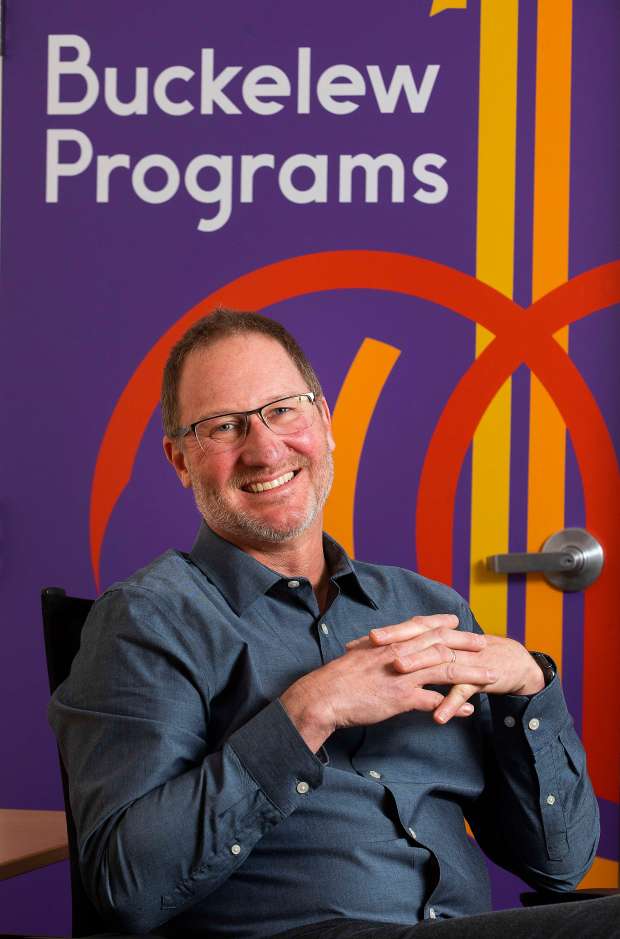
John Burgess / The Press Democrat file
Chris Kughn, CEO of Buckelew Programs, at the organization’s Novato headquarters in 2022. (John Burgess / The Press Democrat file)
Sgt. Juan Valencia of the Sonoma County Sheriff’s Office said the department approaches the dilemma on a “case-by-case basis.”
Generally, in potential 5150 cases “if the person has not committed a crime” — for instance, if they are alone at home threatening suicide — “we are not going to use force on them,” he said.
“The last thing we want to do is use force on a person who’s mentally ill or needs some sort of psychiatric assistance that has not broken the law.”
The Scott v. Smith ruling did affect the agency’s approach, Valencia said, but he described it as the culmination of case law that has created heightened liability concerns for law enforcement. “You’re putting yourself in a vulnerable situation … 5150 is a civil matter, it’s not a criminal matter. You’re putting yourself and the department in harm’s way.”
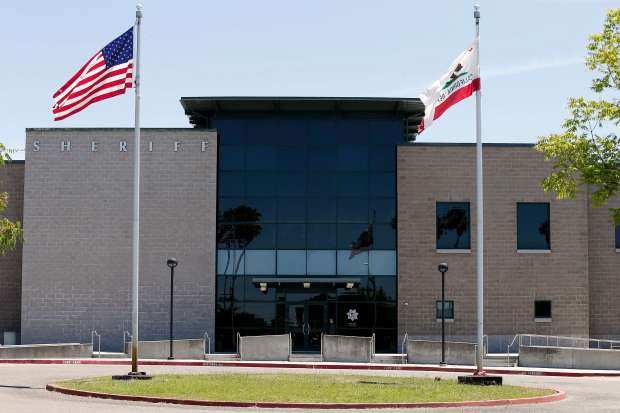
Alvin Jornada / The Press Democrat
Sonoma County Sheriff’s Office headquarters. (Alvin Jornada / The Press Democrat file)
In April 2025, the Sheriff’s Office added to their mental health response policy a section titled “considerations to disengage.”
“Any deputy may walk away from an individual who may qualify for a 5150 commitment if the individual is uncooperative” and the deputy has considered various factors, including if the subject “refuses medical services,” “is not an imminent danger to others,” “has not been involved in a crime” and “is not violent” among other things. “Nothing in this section is intended to dissuade deputies from taking reasonable action to ensure the safety of the deputies and others,” the section concludes.
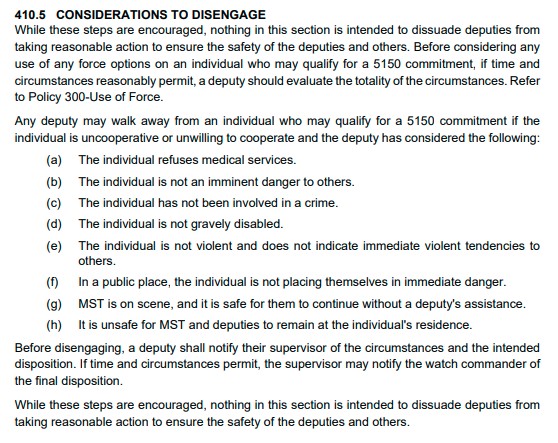 The Sonoma County Sheriff’s Office includes in its “Mental Illness Commitments” policy a section called “Considerations to Disengage.” (Screenshot from Sonoma County Sheriff’s Office , updated Feb. 25, 2026)
Still, as has been standard practice for some time, Valencia said, deputies continue to respond by trying to build rapport, offering services, returning later if someone initially refuses help, staging medical support and working with the county’s Mobile Support Team.
“All we can do is make contact with them, provide them resources,” he said. “If they choose not to take them, they’re adults, that’s up to them. We can’t force them.”
Liability for walking away
While much of the recent public debate has centered on the legal risk law enforcement officers could face if they go “hands on” with someone experiencing a mental health crisis, there is also potential liability when they walk away.
In June, Barbara Molland sued Sonoma County and the Sheriff’s Office for wrongful death after a stranger, Adrian Yanez, killed her husband at their Valley Ford home on Nov. 16, 2024.
Earlier that day, staff at Forestville’s Farmhouse Inn had called to report Yanez’s strange behavior at the luxury boutique hotel. The lawsuit claims deputies failed to bring in the mental health support team and should have placed him on an involuntary psychiatric hold given his erratic actions and warnings from Yanez’s family who’d asked he be detained until they arrived, but instead let Yanez walk.
Soon after, Yanez showed up at the Mollands’ house. He was yelling and eventually broke into the home with a baseball bat, which he used to kill Molland’s 77-year-old husband, Michael, while she hid.
The Sheriff’s Office has denied wrongdoing. In a statement at the time, the department said Yanez was not under the influence of any substances, did not meet criteria for an involuntary hold and had not committed a prosecutable offense. “Yanez was acting strangely but not violently,” the statement said.
The case is ongoing.
Dial again for a different response?
There’s been a noticeable shift for Tappon’s squad at the Sonoma County’s Mobile Support Team, which led the way in local civilian-assisted calls to police for mental health emergencies.
“They feel it, and I feel it, and all of us have been very worried about it,” she said of the rate of unenforced holds.
“It does feel like a pendulum has swung back the other way,” she said. “Really what we need is the appropriate intervention for our community. … We need that pendulum to swing back a little bit so that we can serve these individuals.”
Other mental health care experts and advocates echoed that call.
“Scott v. Smith was really about inappropriate and excessive use of force. We are asking for our historically good partnership and collaboration with law enforcement to continue and for law enforcement not to do our jobs for us, but rather to support us in doing our job,” said Michelle Doty Cabrera , the County Behavioral Health Directors Association leader. “We believe that there is a model for law enforcement to have an appropriate role in backing up mobile crisis teams, the same way they do for ambulance or for fire departments when there is an incident in the community.”
In the meantime, Mobile Support Team officials say they’ve tried to get creative.
They continue to fill out the paperwork for a 5150 hold even if it’s not enforced. If they have to walk away, they’ll look to make a scene as safe as possible. They encourage people to call back even if that means they return just two or three hours later.
“We just say, ‘keep calling us over and over again,’” Tappon said, partly in hopes that different officers — with different training or different interpretation of the law — arrive.
Any quick breakthrough on the legal logjam surrounding the issue appears unlikely. The Sonoma County Counsel’s Office offered little definitive clarity in the course of reporting this story. “Counsel is aware of the ruling in Scott v. Smith. However, Counsel is not able to provide abstract legal interpretations for hypothetical situations,” county spokesperson Matt Brown said. “Any legal analysis is performed with due consideration to known current relevant facts, and the existing case law, which may or may not be applicable to the current situation.”
If the whole point is to avoid criminalizing people in crisis and get them better care, Barbara and Denny Bozman-Moss feel the system failed their son.
He’s facing felony charges from his Sept. 22 arrest.
In jail, it took over two months and a series of court hearings to clear the hurdles necessary to get him on medication — administered for the first time by injection on Nov. 25.
In that time, their son’s mental condition kept deteriorating, Barbara said. She didn’t know the last time he’d taken medication on his own. She was confident that if he’d been taken to a psychiatric hospital — instead of the jail — he would not have gotten to the point “where he’s almost catatonic.”
“He’s just staring at the wall and refusing to come out of his cell,” she said in a December interview. “You’re just locked up in your own head, and his head isn’t stable right now.”
In the weeks after his first injection, correctional deputies, who Barbara called kind and caring, gave the couple a glimmer of hope.
Their son had been receiving sandwiches wrapped in paper — in his non-responsive state, he wouldn’t return food trays. One day, a deputy asked him to pass back a paper wrapper. Her son “looked at him and looked around and looked at trash and then very slowly picked up trash. The deputy said thank you and (he) said you’re welcome.”
Still, the couple worries, with so much time left untreated, “Will he come back? Will he be able to pull it together?” Barbara said. “The criminal charges are almost the least of our worries right now.”
On Jan. 6, their son finally got a transfer to Napa State Hospital, one of just a few public psychiatric facilities in Northern California. They don’t know what will happen next in the courts. Their focus right now is their son’s recovery.
He appears fragile, isn’t talking much and “cries out in agony” about voices in his head, his mother said.
But he asked for a comb. He’s come out of his room and will pace in front of the nurses’ station.
“I think that it feels like a safe space after being in jail for so long,” Barbara said.
He still doesn’t want visitors, but she has talked with him several times on the phone. The first two times he didn’t recognize her. The third time, she told him she loved hearing his voice and asked if she could call again.
After a long pause, he said she could.
You can reach senior reporter Marisa Endicott at 707-521-5470 or marisa.endicott@pressdemocrat.com. On X @marisaendicott and Facebook @InYourCornerTPD.
You can reach Staff Writer Martin Espinoza at 707-521-5213 or martin.espinoza@pressdemocrat.com.
Resources
Suicide Prevention:
Call 911: In case of a medical emergency or imminent danger.
Call 988: Connect with a trained crisis counselor.
Sonoma County Mobile Support Team (MST):
Provides crisis response services 24/7/356. MST can be reached at 800-746-8181; personnel at the MST Crisis Call Center will gather information to support those calling in and connect callers to the appropriate crisis response – including coordination with other crisis response teams in the county.
inRESPONSE Mental Health Support Team:
Designed to respond to calls for service within Santa Rosa city limits, inRESPONSE can be reached directly at 707-575-HELP (4357.)
Specialized Assistance for Everyone – SAFE Team:
Offers crisis response, prevention and intervention 24/7/365 within the city limits of Cotati, Rohnert Park and Petaluma, and also to Sonoma State University students on- or off-campus. SAFE can be reached directly in Cotati/SSU at 707-792-4611, in Rohnert Park at 707-584-2612, and in Petaluma at 707-781-1234.
National Alliance on Mental Illness (NAMI) Sonoma County:
Offers non-crisis mental health education, support, information and referrals (9-5, Mon-Fri). Call (866) 966-6264 or visit info@namisoco.org.