
The Iranian Arena
Over the weekend, March 13–14, the IDF carried out a large wave of strikes across Iran, during which more than 200 terrorist infrastructures and military targets were attacked. Among the targets struck were dozens of ballistic missile launchers, air defense systems, weapons launch and storage sites, as well as headquarters of the Iranian regime and internal security forces.
Since the beginning of the campaign, the IDF has completed approximately 400 strike sorties in western and central Iran, during which about 7,600 strikes were carried out in Iranian airspace. These operations focused primarily on damaging the Iranian regime’s firepower arrays and air defense systems, with the aim of reducing Iran’s launch and defense capabilities.
As part of the strikes carried out over the weekend, the main research center for space studies of the Iranian Space Organization was destroyed. The center included laboratories used for the research and development of military satellites.
In addition, during the weekend and on the morning of March 15, extensive strikes were carried out in the Isfahan area. Among the targets attacked in this area was an airbase of the Islamic Revolutionary Guard Corps. Additional strikes were reported in the cities of Tabriz, Lorestan, Shiraz, Karaj, Qom, Dezful, Sirjan, and Sanandaj, where industrial targets and military sites were attacked.
At the same time, over the weekend the United States carried out extensive strikes on Kharg Island, which serves as a central hub for Iran’s oil exports, with approximately 80–90 percent of Iranian oil exported from the island. During these strikes, more than 90 Iranian military targets were attacked.
According to reports in the American media, the United States plans to send warships and about 5,000 Marines and sailors to the Middle East in order to reinforce American forces in the region. In addition, the U.S. military confirmed that all six crew members of the American refueling aircraft that crashed in western Iraq last week were killed in the incident.
Targeted eliminations
On March 13, the Israeli Air Force eliminated Abdollah Jalali-Nasab and Amir Shariat, senior officials in the intelligence branch of the Khatam al-Anbiya Emergency Headquarters. The two had been appointed as acting replacements for Salah Asadi, the head of the intelligence branch, who was eliminated in the opening strike of the campaign.
In addition, the Islamic Revolutionary Guard Corps confirmed that Abu al-Qassem Babaian, who had been appointed head of the military office of Iran’s Supreme Leader, was also eliminated in strikes carried out last week.
Iran Attacks Targets Across the Middle East
Iran continues to carry out attacks against various targets across the Middle East. The attacks include the use of ballistic missiles and unmanned aerial vehicles against military targets and strategic infrastructure in several countries.
In Saudi Arabia, it was reported that air defense systems intercepted seven unmanned aerial vehicles over Riyadh and the eastern part of the country. In addition, it was reported that during an Iranian missile attack last week against Prince Sultan Air Base in western Saudi Arabia, five U.S. Air Force refueling aircraft were damaged.
In the United Arab Emirates, a UAV attack was reported against oil facilities at the port of Fujairah, located outside the Strait of Hormuz. At the same time, Iranian officials stated that American interests in the UAE, including ports, docks, and military facilities, constitute legitimate targets for attack. In addition, the spokesperson for the Iranian military announced that Iran intends to increase the use of upgraded weapons, including missiles with greater destructive power and improved accuracy.
In Kuwait, an Iranian suicide UAV crashed at Al-Salem military base. At the same time, reports were received of attacks in Bahrain, in which an airbase was targeted.
In Qatar, it was reported that air defense systems intercepted several ballistic missiles and unmanned aerial vehicles launched toward the country.
At the same time, according to reports, at least 18 commercial vessels and oil tankers in the Strait of Hormuz area have been attacked since the beginning of the war.
The Houthis in Yemen announced that they intend to join the campaign alongside Iran.
Iraq
During the latest strikes in Iraq, an attack was reported in Basra Province in the south of the country, alongside additional strikes against pro-Iranian militia targets in Salah al-Din Province in northern Iraq.
The militia Kata’ib Hezbollah Iraq announced that three of its members were eliminated in the strike, including senior figure Abu Ali al-Aamiri, who was responsible for the organization’s rocket domain.
In response to the strikes, Shiite militias in Iraq carried out a UAV attack against the U.S. Embassy compound in Baghdad. According to reports, the attack damaged the radar of the embassy’s air defense system as well as the helicopter landing pad in the compound. Following the incident, Iraqi security forces closed the Green Zone in Baghdad, where the U.S. Embassy is located.
In addition, it was reported that an Iranian UAV struck the Lanaz refinery facility in the city of Erbil in the Kurdistan Region of Iraq. At the same time, Shiite militias in Iraq also carried out an attack against the U.S. Victoria base near Baghdad International Airport.
The Israeli Arena
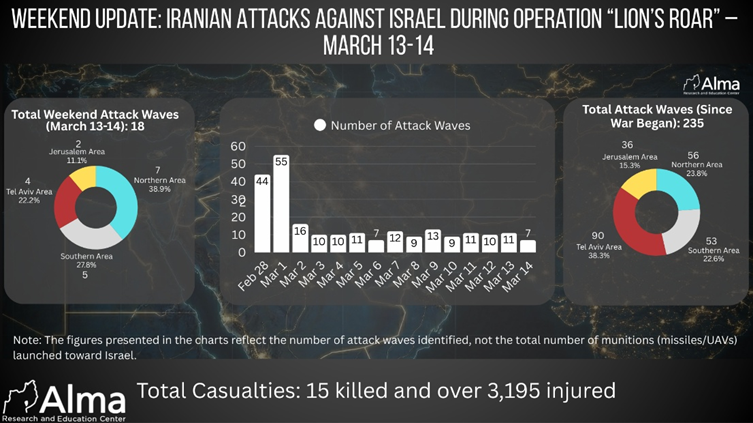
During the weekend, 18 Iranian attack waves against Israel were identified, carried out using ballistic missiles. Geographically, most of the attacks were directed toward the northern region, which absorbed 7 attack waves (38.9%). In addition, 5 attack waves were recorded in the south (27.8%), 4 attack waves in the Tel Aviv area (22.2%), and 2 attack waves in the Jerusalem area (11.1%).
Since the beginning of the campaign, a total of 235 Iranian attack waves against Israel have been identified. In the cumulative geographic distribution of all attacks, the central region—particularly the Tel Aviv metropolitan area—continues to be the primary target, with 90 attack waves (38.3%). This is followed by the northern region with 56 waves (23.8%), the southern region with 53 attack waves (22.6%), and the Jerusalem area with 36 attack waves (15.3%).
Iran has been carrying out its attacks against Israel using ballistic missiles, with only a few cases involving UAVs that managed to reach Israel and were intercepted.
An examination of the daily trend indicates that after the peak recorded at the beginning of the campaign (44 attack waves on February 28 and 55 waves on March 1), there has been a significant decline in the scope of attacks and a relative stabilization in the pace of strikes. Since the beginning of March, the number of daily attack waves has averaged about 10 per day.
Since the beginning of the war, 15 civilians have been killed in Israel, and more than 3,195 people have been injured to varying degrees as a result of direct hits, falling interception debris, and secondary damage. During the weekend, 210 civilians were injured in Israel.
Despite the decline in the intensity of attacks compared to the first phase of the campaign, Iran continues to exert sustained pressure on the Israeli home front, with significant focus on the Tel Aviv metropolitan area, alongside a complementary geographic spread of attacks in the north, south, and the Jerusalem area, with the aim of expanding the threat space and making it more difficult to restore routine life in different parts of Israel.
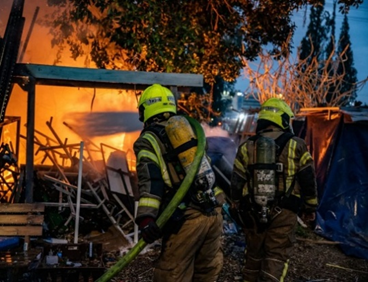
Missile impact in the city of Holon. Credit: Fire and Rescue Services.
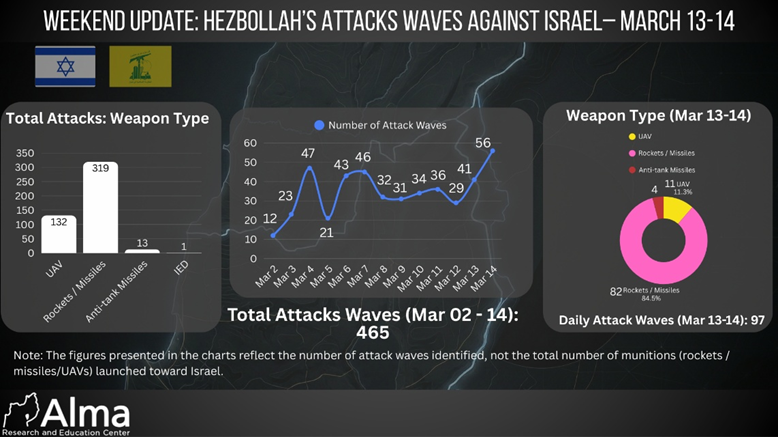
During the weekend (March 13–14), 97 Hezbollah attack waves against Israel were identified. Of these, 82 attack waves (84.5%) were carried out using rockets and missiles, 11 attack waves (11.3%) using UAVs, and 4 attacks using anti-tank missiles.
The data refer to the number of attack waves identified, not to the total number of rockets, missiles, or unmanned aerial vehicles that were actually launched.
A significant escalation in the scope of activity was observed over the weekend, with March 14 being the most intense day since the beginning of the fighting, with 56 attack waves in a single day—the highest figure recorded so far.
In addition, 27 of the attacks during the weekend were directed against IDF forces in southern Lebanon operating against Hezbollah. This information is based solely on Hezbollah’s claims of responsibility. Hezbollah also claimed responsibility for three additional attacks that were not included in the data: a UAV attack south of Haifa, firing toward one of the communities, and the downing of an aircraft in southern Lebanon—reports for which no additional confirmation was available.
Geographically, most of the attacks were directed toward communities along the border and in the Galilee, while attacks were also recorded toward the Golan Heights area, the Krayot, and Haifa.
It should be noted that the phenomenon of “launch failures” on Hezbollah’s side appears to be significant, and a considerable percentage of the rockets it launches do not reach Israeli territory, either falling within Lebanon or failing during launch. This is in addition to the high interception rates of the air defense systems.
Since Hezbollah joined the fighting on March 2, a total of 465 attack waves against Israel have been identified. An examination of the types of weapons used by the organization shows that rockets and missiles remain the primary means of attack, with 319 attack waves, alongside 132 attack waves using UAVs, 13 attacks using anti-tank missiles, and one explosive device attack.
Hezbollah continues to attempt to increase the scope of its operational activity, combining large-scale rocket fire attempts with continued use of UAVs and other weapons, in an effort to increase pressure on northern Israel and on IDF forces operating in southern Lebanon.
Lebanon and Hezbollah
Diplomatic efforts by Lebanon, the UN, France, and other Western actors to curb the escalation in the Lebanese arena and open channels for direct or indirect negotiations are continuing. These efforts seek to connect several key issues, including a ceasefire, the implementation of UN Security Council Resolution 1701, the question of Hezbollah’s disarmament, and future security arrangements between Israel and Lebanon.
On March 15, it was reported that the Lebanese presidency and government approached approximately 15 countries and international actors in Europe, the United States, and Asia in an attempt to examine the possibility of opening a track for direct negotiations with Israel through an official Lebanese delegation. According to the report, none of the countries approached by Lebanon had provided a final response, and the Israeli side is not currently willing to open talks. It was also claimed that Israel has received a U.S. green light to continue its military operations.
Over the weekend (March 13–14), it was reported that France had formulated a political proposal to end the war in Lebanon. According to the proposal, Israel and Lebanon would open negotiations with the support of the United States and France, at the end of which a joint political declaration is expected to be issued by the end of March. The declaration would include initial recognition of Israel by Lebanon, alongside an emphasis on the Lebanese government’s commitment to respect Israel’s sovereignty and territorial integrity. In addition, Lebanon would commit to preventing attacks against Israel from its territory and to implementing a plan to disarm Hezbollah and prohibit its military activity in the country.
According to the proposal, the Lebanese army would redeploy in southern Lebanon, while Israel would withdraw within one month from the areas it has seized since the beginning of the current war. UNIFIL forces would oversee Hezbollah’s disarmament south of the Litani River, while in the rest of Lebanon an international coalition operating under a UN Security Council mandate would supervise the disarmament process. The final stage of the plan includes the demarcation of a permanent border between Israel and Lebanon and between Lebanon and Syria by the end of 2026. According to reports, Israel and the United States are examining the proposal. At the same time, Prime Minister Benjamin Netanyahu tasked former minister Ron Dermer with managing the Lebanese portfolio during the war, and he is expected to lead any negotiations with the Lebanese government if direct talks begin in the coming months.
According to a report by the Lebanese MTV channel, the Speaker of the Lebanese Parliament, Nabih Berri, expressed a positive position toward the initiative of President Michel Aoun but conditioned the participation of a Shiite representative in the negotiation delegation on the achievement of a ceasefire. It was also reported that Hezbollah envoys had updated Berri since the beginning of the escalation and that he is authorized to handle the negotiation issue on Hezbollah’s behalf, as was the case in previous confrontations. It was further reported that Hezbollah opposes separate Shiite representation within a negotiation delegation.
French President Emmanuel Macron invited representatives from Israel and Lebanon to talks in Paris in order to advance mediation efforts. In addition, Macron published a message in Hebrew on his account on the X platform, calling on Hezbollah to immediately stop the dangerous deterioration it is leading the region into, and also calling on Israel to refrain from launching a large-scale attack.
Alongside the diplomatic efforts, Hezbollah Secretary-General Naim Qassem delivered a speech on March 13 marking the Iranian “Jerusalem Day.” In his speech, he described the campaign as a “legitimate defense” against what he called “Israeli aggression,” and claimed that Israel has been conducting a “barbaric operation” against Lebanon for the past 15 months. Qassem noted three main factors behind the organization’s decision to respond: the continuation of Israeli strikes, the elimination of the “leader” Ali Khamenei, and the desire to exploit the regional context of the confrontation with Iran in order to weaken Israel. According to him, the goal of the war is to defend Lebanon, its honor, and its land.
Qassem also accused the Lebanese government of failing to protect the country’s citizens and of failing to achieve full sovereignty, and claimed that Israel is responsible for the destruction of homes, damage to institutions, and the disruption of civilian life. According to him, “there is no solution except resistance, otherwise Lebanon will head toward ruin.” He further claimed that Hezbollah has drawn lessons from previous confrontations and emphasized that Israel is incapable of achieving its objectives in the campaign. Regarding the issue of displaced persons, Qassem stated that the civilians who were displaced from their homes are part of the campaign and that they contribute to the struggle through sacrifice and temporary suffering. According to him, the organization does not recognize the concepts of “defeat” or “surrender,” and Hezbollah will not withdraw from the campaign because it is, in his words, an “existential struggle.”
Regarding the conditions for ending the fighting, Qassem stated that a full cessation of attacks is required, along with a complete Israeli withdrawal from the territories under its control, the release of prisoners, the return of residents to their villages, and the beginning of a reconstruction process.
At the same time as these political and rhetorical developments, Israeli strikes continued over the weekend in southern Lebanon, the Bekaa Valley, the suburbs of Beirut, and other locations. Among the targets struck was the Al-Khardali Bridge over the Litani River, which connects Marjayoun and Nabatieh. The strikes on bridges and the roads leading to them were intended to hinder Hezbollah’s movement to and within the southern Lebanon area.
The IDF confirmed that last week two key commanders responsible for rocket launches toward Israel were eliminated: Rahif Ali Qassem, commander of the missile array in the Badr Unit, and Muhammad Baqer Ahmad Ali Malki, who commanded fire management in the unit. In addition, Hisham Abd al-Karim Yassin was also eliminated, a senior commander in Hezbollah’s communications unit and in the Palestine Corps of the Iranian Quds Force.
Earlier today (March 15), the IDF announced that it had eliminated Muhammad Majed Abd al-Salam Tawfiq Zidan, a senior Palestinian operative in Lebanon who operated within the intelligence network of the Iranian regime.
Since the beginning of the campaign, the IDF has carried out more than 1,100 strikes in Lebanon, during which approximately 110 Hezbollah headquarters were attacked. The IDF spokesperson stated that since the beginning of the fighting more than 350 militants have been eliminated in Lebanon, including about 15 senior commanders in the organization. Among the senior figures eliminated are Zaid Ali Jammah, commander of Hezbollah’s firepower management; Ali Reza Bi-Azar, head of the intelligence branch of the Lebanon Corps in the Quds Force; Ahmad Rasouli, responsible for intelligence in the Palestine Corps of the Quds Force; and Ali Maghlam Tabagha, commander of the Imam Hussein Division.
In addition, seven prominent Hezbollah commanders were eliminated, along with five commanders from the Palestine Corps and the Lebanon Corps of the Quds Force, three commanders from the Imam Hussein Division including the division commander, and a commander from the Palestinian Islamic Jihad organization. According to the IDF statement, the damage to the senior military leadership of Iranian regime representatives in Lebanon undermines the regime’s grip and influence in the region.
As a result of the fighting, the humanitarian crisis in Lebanon is worsening. The number of officially registered displaced persons has reached 831,882, although estimates indicate that the actual number exceeds one million. As of March 14, 619 reception centers for displaced persons had been opened, and the receiving cities have reached the limit of their absorption capacity. So far, 826 people have been reported killed and 2,009 injured.
On March 15, it was reported that Hezbollah had recently activated its social assistance network on a wide scale. As part of this activity, food packages and basic aid were distributed to displaced families staying in schools and neighborhoods in Beirut. According to the reports, the next stage of the program is expected to focus on directly reaching families who have moved to houses and apartments across the city, in order to expand the scope of assistance.
Syria
Over the weekend, it was reported that Syria had begun removing mines along the Lebanon–Syria border in the Wadi Khaled area and in the Bekaa, apparently in preparation for a possible entry of Syrian forces into Lebanon. In response, Hezbollah began reinforcing its forces in the Beqaa.
The International Arena
In an interview with CNN, Ukrainian President Volodymyr Zelenskyy claimed that Russia had supplied Iran with Shahed-type unmanned aerial vehicles, manufactured in Russia under an Iranian license and currently used in attacks across the Middle East.
At the same time, it was reported that Russian President Vladimir Putin spoke with U.S. President Donald Trump and proposed transferring Iran’s enriched uranium stockpile to Russia. According to the reports, Trump rejected the proposal.
Italian Prime Minister Giorgia Meloni referred to the war with Iran and argued that it reflects a growing trend of military interventions carried out outside the framework of international law.
Meanwhile, France and Italy initiated contacts with Iran in order to ensure safe passage for their commercial vessels in the Strait of Hormuz. The talks sparked disagreements among European countries, with some states expressing reservations about holding direct contacts with Iran. It was also reported that Italy is considering withdrawing its forces from Iraq. At the same time, EU foreign ministers are expected to discuss the possibility of expanding the European naval mission Aspides to the Strait of Hormuz.
It was also reported that South Korea is considering sending warships to the Strait of Hormuz area as part of efforts to protect international shipping routes.
The European Union’s foreign policy chief, Kaja Kallas, warned that the fighting in the Middle East is getting out of control and that there is uncertainty regarding how it will develop. According to her, the United States is trying to divide Europe, and she called on European countries to unite in light of the regional developments.
Turkey’s foreign minister referred to the fighting in Lebanon and stated that Ankara is concerned that Israeli Prime Minister Benjamin Netanyahu may use the fight against Hezbollah as a pretext to carry out a “new genocide.”
The UN Secretary-General called on the parties fighting in Lebanon to stop the attacks, halt the fighting, return to negotiations, and reach a diplomatic solution.
